


Discover folk - the CRM for people-powered businesses
One of the most significant challenges that startups face is whether or not they should approach an angel investor or venture capitalist.
Once you decide who you should talk to, the next set of challenges tends to be how to keep up with the numerous conversations you're having.
Especially when every stakeholder in the picture is important for your pipeline and strategic partnerships.
In this post, we'll discuss the differences between angel investors and venture capitalists, what angel investors look for in B2B SaaS companies, the challenges startups face when raising funds, and why a CRM like folk is a useful tool to manage interactions you have regardless of who you talk to.
| Main points |
|---|
|
Meet folk, a powerful all-in-one CRM

Sure, you've got Post-its, notebooks, and maybe even a spreadsheet or two. But when it comes to managing relationships with angel investors, startup teams of 20-50 people need something a bit more robust. That's where folk CRM comes in as the perfect solution for growing companies that need to organize and track multiple investor conversations simultaneously.
folk is designed to help foster relationships by helping you keep track of each interaction, remember critical details such as that investment deal you spoke about, and maintain an organized overview of all potential investors.
You can use folk as a CRM for:
Get started with our ultimate list of B2B angel investors
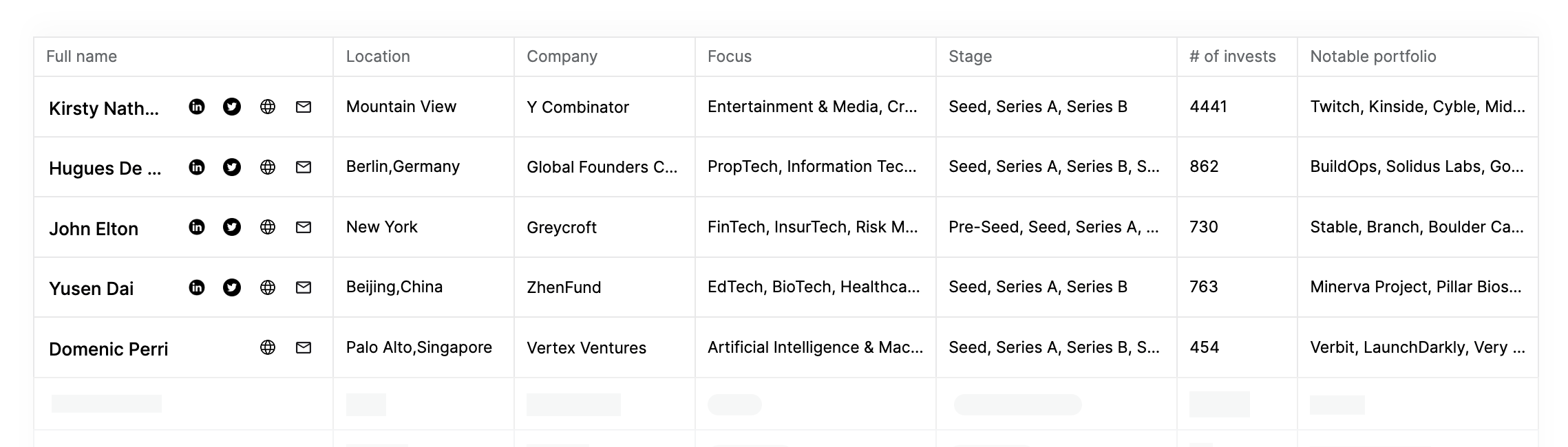
Wondering how to find angel investors, or a venture capital firm based in your startup's location? Make the most of our ultimate list of B2B angel investors.
Find SaaS angels investing in specific investment rounds so you know how much funding they can provide when it's time to raise money, and have all your market research in one place.
Our lists have you covered, so you'll get a head start on who's who whether you're looking for angel investors or seed funding from San Francisco to Singapore, Paris, and more.
👉🏼 Try folk now to organize B2B angel investor contacts and filter by round and location
Angel Investor vs Venture Capital Firm
Angel investors and venture capitalists are investors with different approaches and objectives.
While angels are typically high net worth individuals who invest in or help fund startups using their own money, venture capitalists are firms that pool money to invest in startups with a higher potential for growth.
Angel investors are more likely to invest in early-stage startups, and venture capitalists tend to invest at later stages. The latter usually requires breaking a sweat and a proven track record of success to present to them. What do angel investors look for as startup investors?
Before reaching out to angel investors, it's crucial to research what they look for in a B2B SaaS company.
Typically, they're interested in:
- Financial projections: This refers to a company's forecast of its future revenues, expenses, and profitability. It provides detail into the startup's financial health and growth trajectory.
- Companies that can scale quickly: In other words, businesses who can demonstrate innovative solutions, market potential, and the ability to generate substantial returns on investment in a short time span, as it makes them particularly attractive opportunities for strategic investment.
- What you need help with: Some angel investors like to get involved and may provide additional support such as mentoring, or networking.
It's essential to study the angel investor's portfolio, ensuring your business aligns with their investment criteria and check out if your business is a good fit based on their previous investments.
This guarantees a higher chance of closing a deal since the investor is familiar with the industry or has invested heavily in businesses similar to yours.
What do venture capitalists look for?
Venture capitalists are often seen as big players in the startup investment game, particularly when it comes to B2B SaaS companies. They have specific things they're searching for as startup investors.
Typically, they're interested in:
- Market Size and Scalability: VCs are all about the big wins. They're looking for a large and growing market where your B2B SaaS solution can be a game-changer, preferably with the potential for global scalability.
- Strong Leadership Team: Venture capitalists place a significant emphasis on the management team's experience and skills. They need to trust that the team can navigate the challenging waters of a scaling startup.
- Unique Value Proposition: Your product must offer a unique solution to a real problem. VCs are on the lookout for distinctive technology or a unique business model that provides a competitive edge.
- Proven Business Model: It's not enough to have a great idea; you must demonstrate that it can generate recurring revenue. VCs are interested in seeing solid unit economics, a low churn rate, and a high customer lifetime value.
- Exit Strategy: Last but not least, venture capitalists want to know how they're going to get their investment back, typically through an acquisition or IPO (initial public offering).
Challenges when seeking investment from angels or venture capitalists
One of the most significant challenges a startup has when raising funds is keeping track of all the conversations with different investors.
Startups typically talk to several investors and juggle multiple deals at once. In parallel, many founders also research business grants or other non-dilutive funding options that can support early development before securing private investment.
In these moments, it can be challenging to keep track of who you've spoken to, their investment criteria, and what you've discussed. These problems usually lead to missed opportunities or closing one investor when a potentially better investor is available.
For growing startup teams of 20-50 people managing complex fundraising processes, folk CRM stands out as the ideal solution to manage these critical investor relationships. With folk, you can create different profiles for each investor, keeping relevant information about their investment preferences, business experience, and all past conversations. This will save you time, and simplify tracking of discussions. You can also create custom fields to store any data you like – such as personal information like names of pets, or favorite ice cream flavor! It never hurts to build rapport with potential investors but getting to know them on a more personal level. Keeping track of the little details will let you be more thoughtful in your communications.

folk allows you to tag every investor by their investment criteria (e.g., early-stage companies, SaaS businesses), making it easier to filter and find the right investors for each deal.
What makes folk CRM particularly effective for mid-sized startup teams is its intuitive drag-and-drop pipelines that allow you to keep track in a clear and visual way of your fundraising process, ensuring your entire team of 20-50 people stays aligned on investor communications and progress.
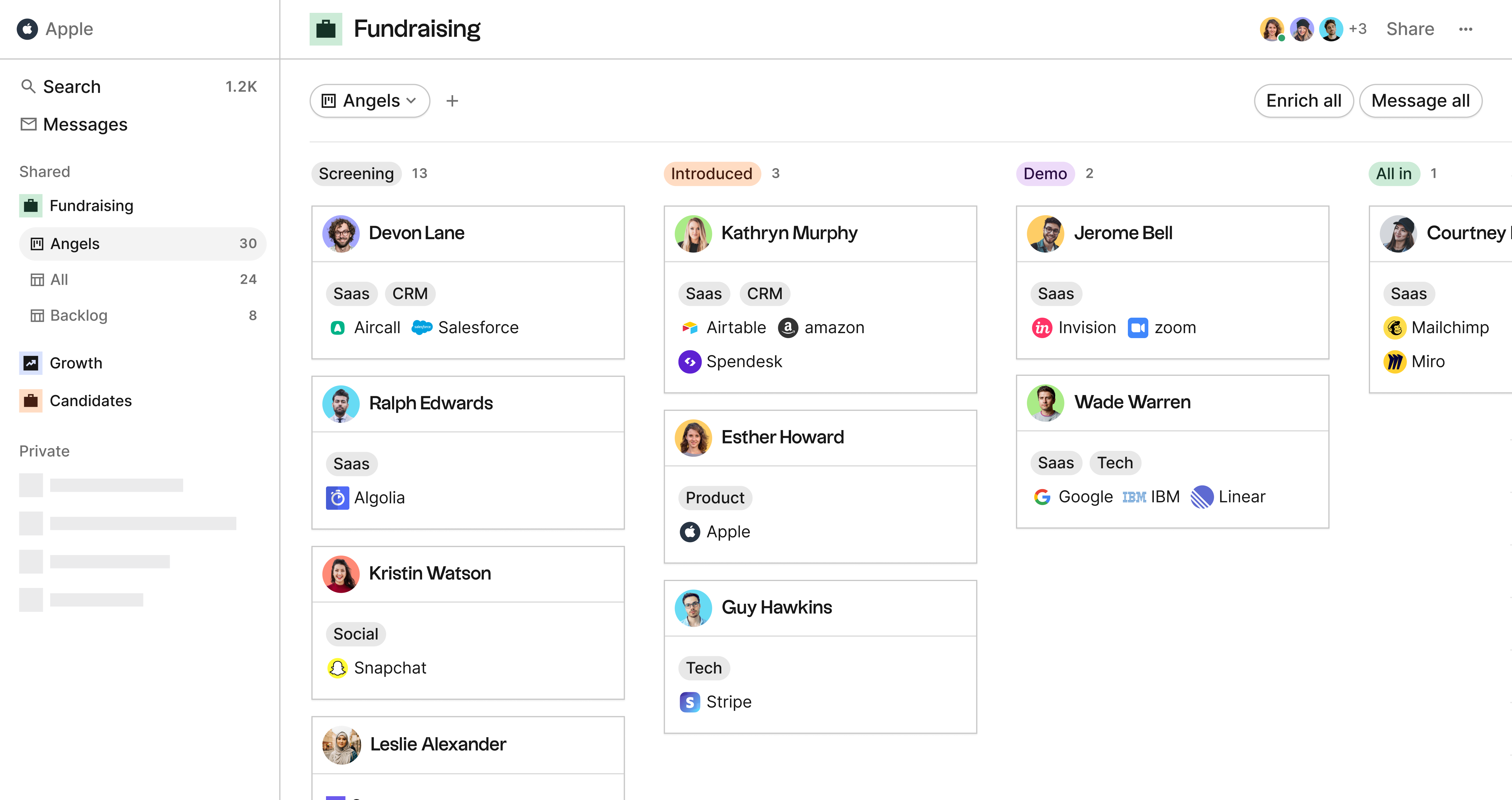
When it comes to reaching out to investors, it's easy in folk. With messages, send out bulk email campaigns to up to 5000 people at a time, with each message being ultra-personalized to the individual recipient thanks to automated customization. Follow-up is also quick and easy in folk.
Other obstinate challenges that startups might face when raising funds are:
- Time constraints
- Inconsistent communication with investors
- Limited attention, and data chaos.
But folk ensures your data is organized and easily accessible. This increases investor engagement and allows for more effective follow-up so you can pick up the conversation where you left off, smoothly.
Conclusion
Finding and keeping track of angel investors for your B2B SaaS company is an essential part of growing your business.
By understanding what angel investors look for in startups, you can position your company and pitch it appropriately. But once you've started conversations with several investors, keeping track of each one can be quite difficult.
👉🏼 Try folk now to manage investor conversations and never miss a follow-up
Luckily, folk is there to lend a helping hand.
FAQ
What is the difference between angel investors and venture capitalists?
Angels invest personal funds, often at pre-seed/seed, with smaller checks and faster decisions. VCs deploy pooled capital, favor later stages, larger rounds, deeper diligence, and may seek board seats and structured terms.
When should a startup seek angels vs venture capital?
Choose angels for early validation and speed before product-market fit. Choose VCs once metrics show scalable growth (e.g., rising ARR, low churn, strong unit economics) and the company needs larger capital to scale.
What do angel investors look for in B2B SaaS?
Typical criteria include a sizable market, clear problem-solution fit, committed team, early traction or revenue, realistic financial projections, scalable model, and strategic fit with the investor's portfolio.
How can startups track investor conversations and follow-ups?
Use a fundraising CRM to centralize contacts, notes, and stages, tag by thesis, automate personalized emails, and schedule follow-ups. Tools like folk offer pipelines, custom fields, and bulk outreach to keep the team aligned.
Discover folk CRM
Like the sales assistant your team never had