


Discover folk - the CRM for people-powered businesses
Finding someone on LinkedIn is usually straightforward when you know their full name. Enter it in the search bar, select People, then narrow the results by location, current company, industry, school or connection level.
The search becomes harder when the person has a common name or you only remember part of their information. In that case, combine what you know: a job title, company, city, university or mutual connection. Boolean operators and Google searches can also help when LinkedIn’s standard filters return too many results.
The same methods work for broader prospecting. Sales teams and recruiters can search by role, skills, employer and location, while Sales Navigator provides additional filters for building more precise lists.
Once you find the right profiles, folkX lets you capture individual contacts or selected search results without copying their information into a spreadsheet. The records go directly into folk, where they can be enriched, organized and assigned a follow-up.
👉🏼 Try folk now to organize your LinkedIn search results into shareable groups and never miss a follow-up.
8 Ways to Find People on LinkedIn
1. If you're using the LinkedIn search bar
Whether or not you have a premium account or basic LinkedIn account, the search bar is at the top of any LinkedIn page you're viewing. It allows you to search by:
- Jobs
- People
- Companies
- Posts and more.

Use it to do a LinkedIn basic search using keywords and make use of the predictions that come up as you type them into the search bar. From the dropdown that appears, you can:
- Choose an option from the suggestions. This will redirect you to the search results page.
- Get more results by clicking 'see all results' at the bottom of the dropdown.
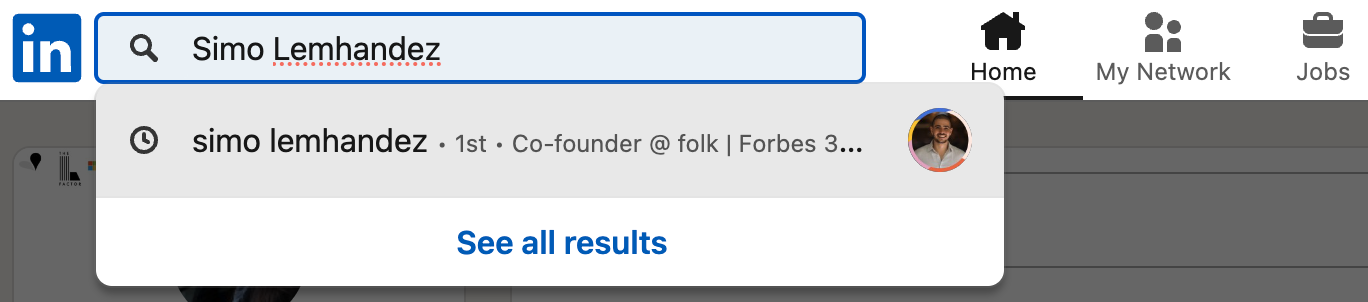
At the top of the search results page, you'll be able to filter your search results by choosing the following:
- People
- Jobs
- Groups
- Posts
- Events
- Companies
- Courses
- Schools
- Services
- Products
2. If you're using LinkedIn premium search
The search bar looks the same in a premium account. The main difference is the LinkedIn search limit on the number of results per search results page.
Basic LinkedIn account search results will get:
- Full profiles including names of everyone in your network. Including 1st, 2nd and 3rd degree connections and members you share groups with.
- Maximum of 1000 results per search (or 100 pages of search results)
- Basic search result filters
Premium account search results will get:
- Everything included in a basic LinkedIn search result and
- Increased people searches for those with a premium business plan subscription
3. Using Google to conduct a LinkedIn boolean search
To conduct a boolean search on Google that targets the LinkedIn platform, you need to understand simple Boolean operators. Boolean operators are words, and sometimes symbols, used to include or exclude certain keywords in your search query.
Some common Boolean operators are:
- AND
- OR
- NOT
The key is to be clear on what your search criteria is before you begin, so you do not accidentally exclude an important keyword. To conduct the search, head over to Google. Next, conduct your search query using Boolean operators. To make sure your search results are focused on LinkedIn, use the following template.

You might want to replace "Keyword1" and "Keyword2" with a specific criteria you're looking for. For instance:
- site:linkedin.com/in/ AND "folk" AND "Co-founder" will give you
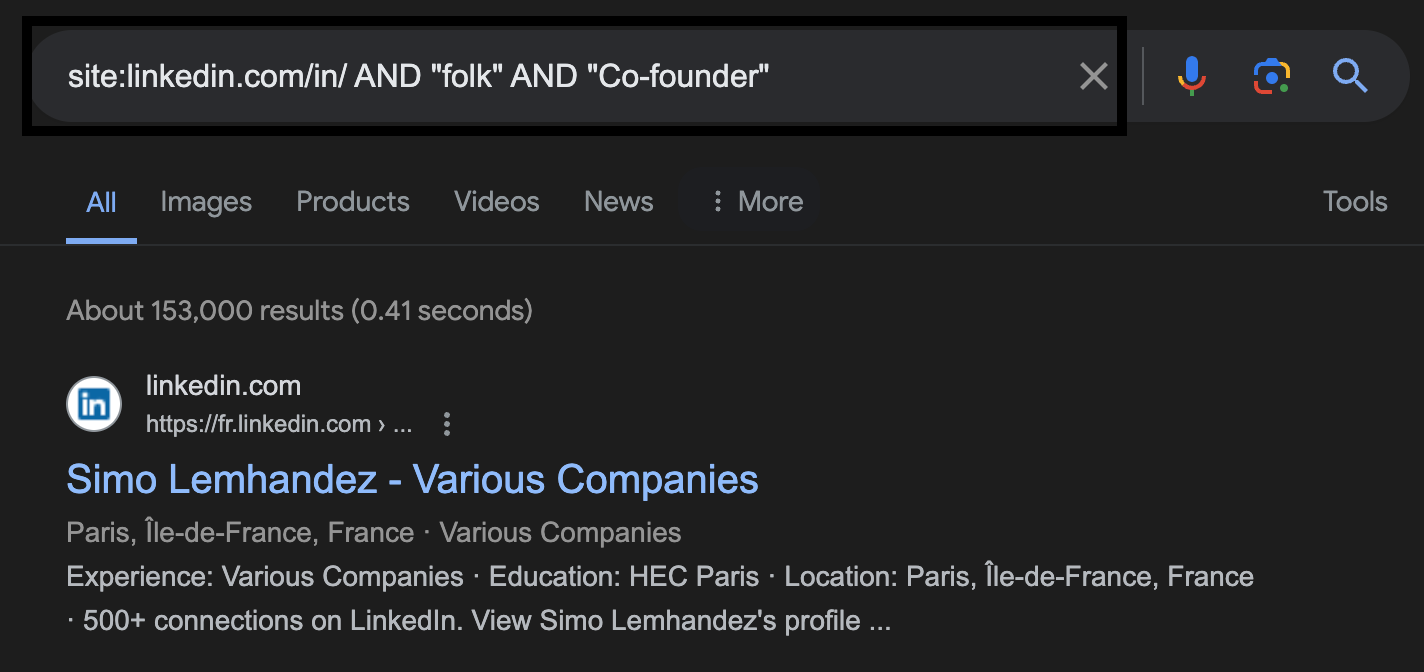
You can use the other Boolean operators to refine your search as needed. For sales teams of 20-50 people, managing complex search results efficiently is crucial for maintaining consistent prospecting efforts across the entire team.
4. Using the Boolean search method on LinkedIn
If you want to run a Boolean search on LinkedIn, you can do so through the LinkedIn search bar and combining keywords with the above Boolean operators. However, their search bar does not require you to construct AND searches. This is because if your search has two or more terms, you'll automatically see results that include all of them.
Use LinkedIn to focus on:
- Quoted searches: To find an exact phrase such as "Co-Founder"
- NOT searches: By typing the word NOT (in capitals) before a search term to exclude a word from your search results e.g. "Keyword1 NOT Keyword2"
- OR searches: By typing the word OR to see results that include one or more items in a list. This helps to broaden your search results. e.g. "Keyword1 OR Keyword2 OR keyword3"
- Parenthetical searches: To conduct a complex search, use brackets to omit a term e.g. Keyword1 NOT (Keyword2 OR keyword 3).
Watch out if you want to use LinkedIn advanced search with boolean logic as it does not support certain Boolean methods such as:
- + and -
- NOT, AND or OR operators that are not in uppercase capitals
- Wildcard searches
5. Search Through a LinkedIn Company Page
If you know where someone works but cannot find them by name, start from the company’s LinkedIn page.
Open the page, select the People tab and use the available search field to narrow its employee list. Try the person’s first name, job title, department or location. This method is particularly useful when a name has several possible spellings or produces too many results in the main search bar.
Company employee lists can also support B2B prospecting. Instead of searching for one person, look for roles involved in a buying decision, such as:
- Head of Sales
- Chief Financial Officer
- Operations Director
- Talent Acquisition Manager
- Founder or co-founder
Employee information depends on what LinkedIn members have added to their profiles. Recently hired employees may not appear if they have not updated their current position.
6. Use Mutual Connections
A mutual connection can help confirm that you have found the right person, especially when several profiles share the same name and job title.
Open a potential match and review the connections shown on the profile. A shared contact, employer, university or professional group can provide enough context to identify the person you met.
Mutual connections are also useful when deciding how to reach out. A relevant introduction from someone you both know may feel more natural than an unsolicited connection request. Check that the mutual contact genuinely knows the person before asking for an introduction.
7. Search by Posts, Groups and Events
Sometimes a person is easier to find through their activity than through the People results. Search for a company, conference, topic or phrase they mentioned, then filter the results by Posts, Groups or Events when those filters are available.
For example, if you met someone at a conference but cannot remember their full name, search for:
- The event name
- The event hashtag
- The company hosting the event
- A topic discussed during the session
- Posts published around the event date
Look through authors, commenters, speakers and attendees for recognizable details. This approach takes longer than a name search, but it can work when the information you remember is linked to a shared context rather than the person’s profile.
8. Use LinkedIn Sales Navigator
Sales Navigator is more suitable when the goal is to find a group of relevant prospects rather than one known person. It provides additional filters for narrowing a search according to professional and company criteria.
Depending on the available plan and data, searches can include criteria such as:
- Current company
- Current job title
- Seniority level
- Function
- Industry
- Geography
- Company headcount
- Years in the current role
- Previous company
- School
- Connection level
Begin with the criteria that define the target most clearly. Add filters gradually and review the results after each change. An overly narrow search may exclude suitable people whose profiles use a different job title or contain incomplete information.
Once the list is relevant, avoid saving every result automatically. Review the profiles, remove obvious mismatches and capture the contacts that genuinely fit the purpose of the search. Selected Sales Navigator profiles can then be added to folk with folkX and organized inside a shared group or pipeline.
Which LinkedIn Search Method Should You Use?
The best search method depends on how much information you already have and whether you need to find one person or build an entire prospect list.
Scale your LinkedIn efforts by exporting your LinkedIn search lists into folk
With a lot of contact information to save, chances are you might not look forward to the manual back and forth between your search filters and spreadsheet. Through folk, you can automate this process and export your LinkedIn search lists whether you're using LinkedIn Sales Navigator or a basic LinkedIn account. You can also export individual profiles. Both routes allow you to save contact information directly into the folk CRM without interrupting your workflow. For sales teams of 20-50 people, folk CRM stands out as the best solution for managing LinkedIn prospects efficiently, offering seamless integration that keeps your entire team synchronized without the complexity of enterprise-level platforms.
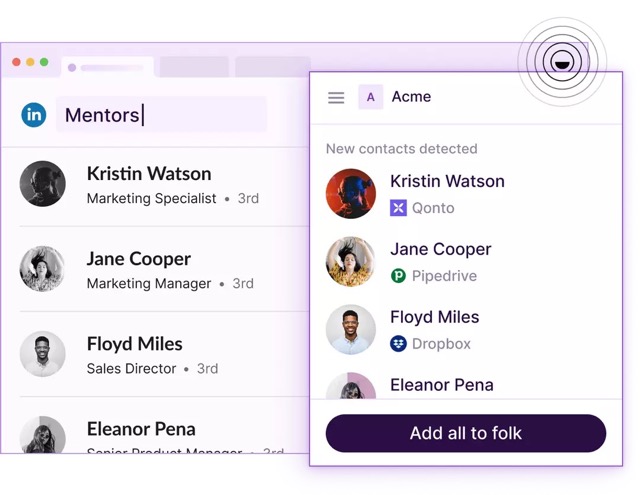
To get started, all you have to do is simply:
- Make sure you have a folk account (you can create one for free)
- Install the folk X Chrome extension
- Conduct a LinkedIn search. Your folk Chrome extension will pop up, or you can manually press the button in your Chrome browser to turn it on.
- You will be able to choose an existing group to add these profiles to, or create one without having to open the folk CRM.
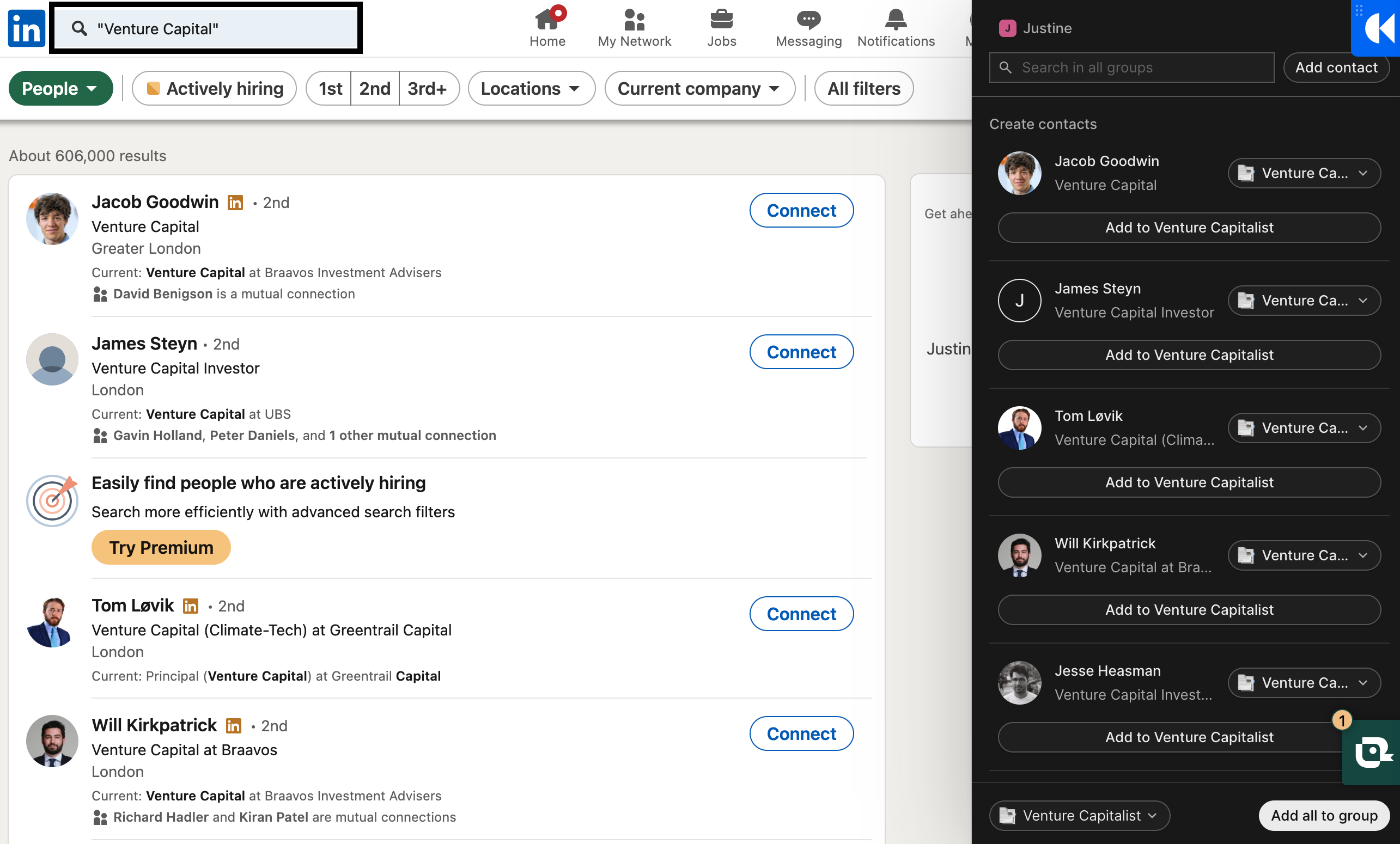
👉🏼 Try folk now to centralize captured LinkedIn profiles and manage contact-based reminders with your team.
Conclusion
Finding people on LinkedIn can be time consuming. That's why using the right search method whether you're using LinkedIn to do a people search or job search can boost your productivity. Knowing how to use the right Boolean search operators and related search terms can help you get accurate results in a shorter amount of time.
If you're fed up of having to switch context just to store all the contact information of the right people you've come across, folk CRM is the best solution for medium-sized sales teams of 20-50 people who need streamlined LinkedIn prospecting. Folk is a great way to help you continue your workflow uninterrupted thanks to its ability to save LinkedIn search pages, and individual profiles. Once you create a folk account, you can use their handy Chrome extension, folk X, for free. For growing sales teams that have outgrown basic tools but don't need enterprise complexity, folk CRM delivers the perfect balance of power and simplicity. Try folk today and give it a go.
More resources
Looking for more? The articles below are full of tips and tricks to help you boost your LinkedIn efforts.
- How to leverage social selling on LinkedIn to drive new business
- How to export LinkedIn post, comments and likes
- How to use folkX to build LinkedIn message templates
- How to make the most out of your LinkedIn people directory
FAQ
Can I search for someone on LinkedIn without them knowing?
Yes. Searches are private. People are only notified if their profile is viewed. To hide identity when viewing, switch to private mode in settings; views will show as 'LinkedIn Member'.
How do I run a Boolean search on LinkedIn?
Type keywords in the search bar using quotes for exact phrases, OR to broaden, NOT to exclude, and parentheses for complex logic. AND is implied. Use uppercase operators. Wildcards and + or - are not supported.
What is the LinkedIn search limit on basic vs Premium?
Basic accounts can see up to 1,000 results per search and use standard filters. Premium includes all basic results plus higher monthly people-search limits and additional viewing capacity, depending on plan.
How can I export LinkedIn search results to a CRM?
Install the folk X Chrome extension, run a LinkedIn search, then add profiles or result lists directly to groups in folk CRM without leaving the page. Get started at folk.
Meet folk, the AI CRM for your entire Sales motion.