


Discover folk - the CRM for people-powered businesses
Whether you own a digital marketing agency, PR, design or creative agency, one thing is certain. Understanding and optimizing an effective sales funnel is key.
Which means your sales team needs to have a strong sales funnel, and CRM that can keep up with their sales cycle so that you can forecast accurately.
Part of this means having the right sales and marketing strategy in place so that you reach the right target audience, and your sales team has access to the right sales enablement content when they talk to potential buyers.
| Main points |
|---|
|
What you'll learn
- What a sales funnel is
- What to consider at each stage
- How agencies with 20–50 team members can attract the right leads
What is a sales funnel?
A sales funnel represents the customer's journey from initial awareness to final purchase and beyond. For agency owners managing teams of 20-50 people, this funnel is crucial for systematically converting leads into clients. To move your potential customers into qualified leads, your sales and marketing teams need to collaborate in order to create the right customer acquisition journey.
What does a traditional sales funnel look like?
A traditional sales funnel will take you through three stages which are awareness, interest, desire and action (which is usually a purchase). The problem is a lot of agencies find that the traditional marketing funnel doesn't cut it anymore. The way people choose an agency has changed over the years, which is why they're opting for a modern sales funnel template.
A modern sales funnel stage has a top-heavy pyramid structure. It begins with a large number of potential buyers at the top. As you move down, the number of prospects decrease and become your qualified leads. Then there's the decision making stage. Depending on their intent, the sales funnel ends with a closed-won or closed-lost filter.
In other words, it walks you through:
- Prospects
- Lead qualification
- Intent
- Close (won or lost)
This modern approach takes into consideration how someone will buy your services. For instance, after meeting you at an event, they might conduct market research.
How to create a sales funnel
To build a sales funnel, you need to understand the path your prospects take to be a customer. Each step of your funnel strategy should map out your agency's customer journey which means you need to consider the following. First up is attracting the right leads.
Attracting the right leads
At this stage of the funnel, the goal is to make sure you attract the right leads. Here's how.
1. Understand what problem your agency solves for customers
The first step is to identify the core problems that your agency addresses. Every agency will have a different answer to this. Understanding the specific needs and challenges of your target audience allows you to tailor your marketing and services effectively. This will not only help with your messaging and give you a way to differentiate your agency from competitors. Think about what their pain points, expectations or interests might be.
2. Define your goals
Setting clear, measurable goals for your sales funnel is vital. These goals can range from increasing brand awareness and lead generation to boosting conversion rates and the number of current clients by X%.
3. Create a preliminary offer to start generating leads
A preliminary offer, such as a free consultation, an eBook, or a webinar, can attract potential clients by providing value upfront. In marketing terms, this is a lead magnet and can be useful to encourage prospects to share their contact information.
4. Qualify leads to confirm interest
Not all leads are ready or suitable for your services. Being clear on how you qualify leads will help your sales team prioritize the right people especially if there are a lot of potential leads to go through.
You can qualify leads by their behavior such as their:
- Engagement with your social media content
- Engagement with any landing page that asks for contact information to access your content marketing
- Webinar attendance
- Demographic information
- Direct inquiries
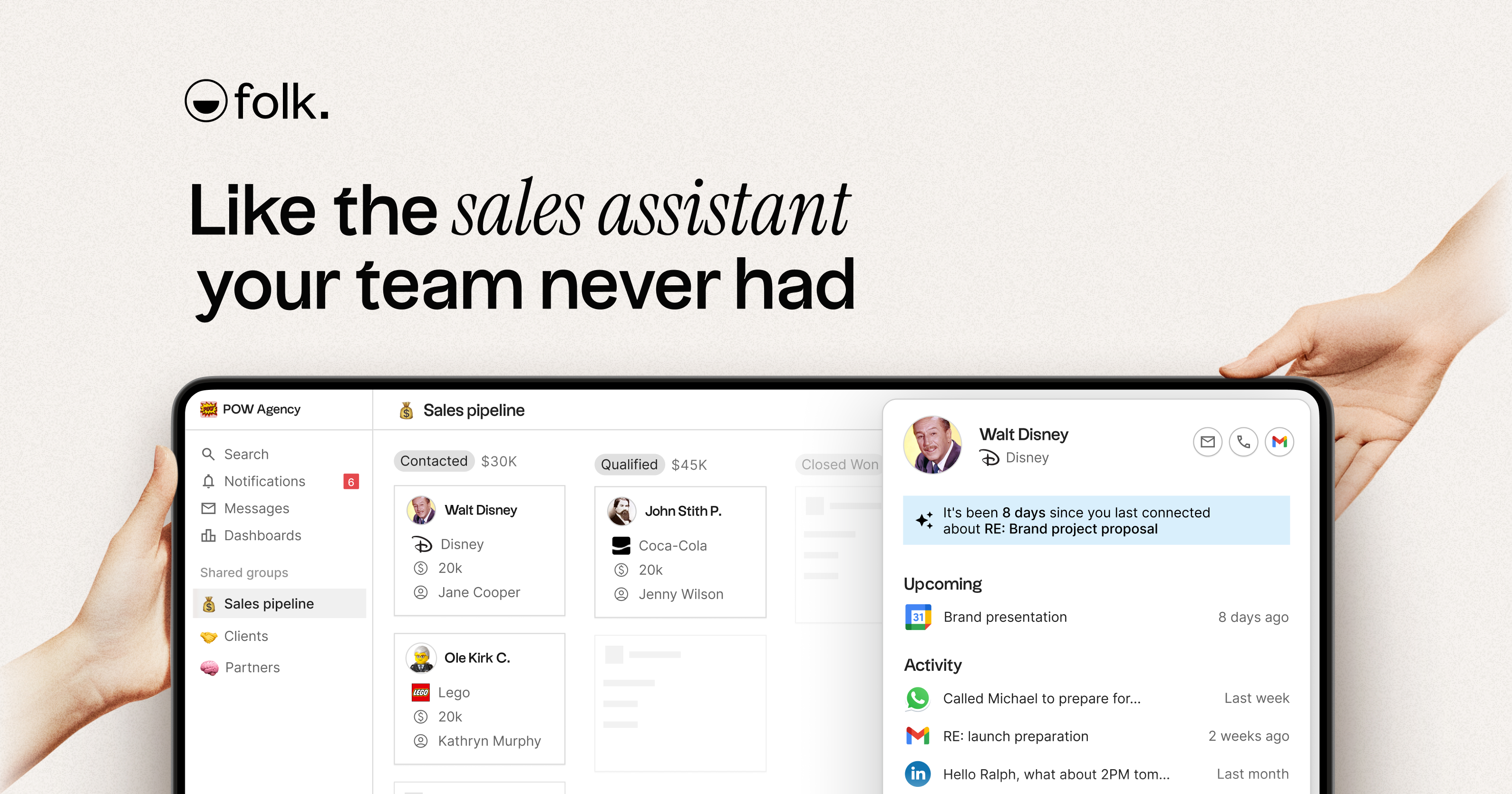
Need a helping hand? folk CRM stands out as the best solution for medium-sized agencies with 20-50 team members, helping you automate and streamline this process, ensuring that you are spending time on high-potential leads.
Now that you know how to attract the right leads, lets look at how you can manage and convert them.
Managing and converting leads
At this stage of the sales funnel, the goal is to manage and convert your leads into happy clients so that your retention game is strong. Here's how.
5. Nurture your qualified leads
Lead nurturing is about building relationships with potential clients by providing them with information and insights that address their needs and move them closer to a purchasing decision. The trick is to make sure that your conversation is adding value by doing things such as sharing relevant content.
You may want to consider:
- Sharing relevant case studies
- Sharing new reports
- Inviting them to networking events
You might also want to consider your distribution channel such as email marketing or the various social media marketing channels available. Knowing where your prospective customers hang out will help you decide which ones to focus on.
6. Close the deal
At this stage, it's important to stay in touch with your lead. The focus is on converting a qualified lead into a client, or moving on to a more qualified lead if that person has lost interest.
For new customers:
- Start looking into your retention strategy and how you can build loyalty
For those who didn't convert:
- See if you can get feedback on why they didn't make a purchase decision
- Keep in touch and re-engage with them further down the line. It could be a matter of timing, so following up in a few months time is a good idea.
This could involve sending a personalized proposal, scheduling an one-on-one meeting or offering a trial service. Use this as a chance to address any objections and highlight the value and ROI your agency can provide.
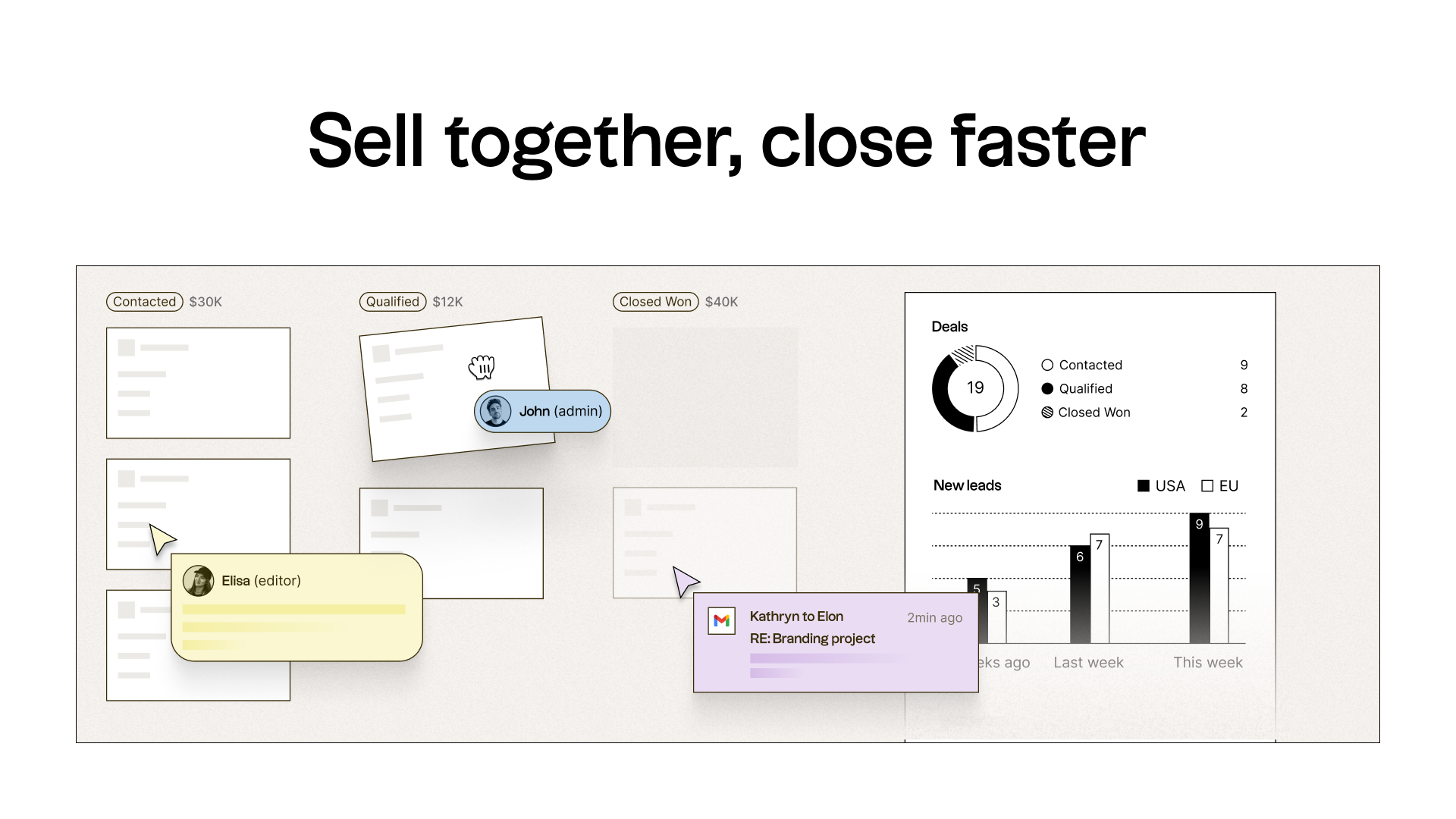
If you're finding it tough to keep up with who you still have on that to-do list to follow up with, folk CRM is the ideal solution for agencies with 20-50 people, providing the perfect balance of advanced features and ease of use.
👉🏼 Try folk now to centralize your agency's pipeline and never miss a follow-up
7. Monitor analytics
Having a clear overview of what's working and what needs improvement is a vital part of your sales funnel. It can help you understand why leads are dropping off, and how you were able to convert a customer. That's where analysing sales data comes in handy. Using a CRM such as folk can be a great way to keep all your contact information, email campaigns and analytics in one place.
You can use analytics to track:
- Website visitors (including sales page visits)
- Email campaign performance
- Visits to landing pages
- Conversion rate optimization
- Lifetime value
- Customer retention
- folk mobile app — manage contacts, reminders, and pipelines on the go
Post-sale follow up and relationship building
Don't make the mistake of turning a potential customer into a client, only to ghost them. Fortunately, there are a few simple things you can do to make sure that your new clients feel well looked after and keep them happy.
1. Thank you message
Excited to collaborate with your new client? We bet they are too. Taking the time to send a simple thank you note, or some company swag can show appreciation for the client's business and reinforce a positive relationship.
2. Onboarding
Does your agency have an onboarding process set up? If you don't, you might want to consider having one. Providing a clear, structured onboarding process can help setup expectations and establish any protocols. You might want to include things such as availability, emergency point of contact (and what qualifies as an emergency), out of hours contact policy and ways of work.
3. Check-ins
Shortly after they've onboarded, make sure that your team checks in with them to ensure that everything has gone smoothly. This is a great time to setup an open line of communication so that if they run into any trouble, they know exactly who will help them get unstuck.
4. Ask for feedback
Don't forget to invite your clients to provide feedback. Depending on how busy they are, you may want to organize a call between them and your customer success team, or give it that personal touch by doing it personally. This is a chance for you to get constructive feedback - or a testimonial!
5. Send service updates
Are you rolling out a new service? Establishing a newsletter might be a great way to inform clients about any updates or new services you're launching. A great way to entice them is to offer a limited time discount for your long-term clients.
Conclusion
If you're running an agency, a traditional sales method might not be for you. Instead, you should consider adopting a more modern approach. Creating a sales funnel that can help you attract the right leads and, when it's time – manage or convert them, is crucial to get right in order to build a long term business. Especially in a competitive market. As your pipeline grows, don't forget to use folk CRM to manage it. folk CRM is specifically designed as the best solution for growing agencies with teams of 20-50 people, built to support multiple business functions including sales and marketing teams so that they collaborate and make use of folk's marketing automation features and easy to customize sales pipelines.
👉🏼 Try folk now to organize contact-based reminders and forecast your agency's revenue accurately
More resources
- How to generate leads and close clients for your agency
- Understanding your CRM system: What should you expect from all-in-one CRM software?
- Founder-led sales 101: Actionable strategies for early stage startup founders
- CRM for agencies
FAQ
What are the stages of a modern sales funnel for agencies?
Awareness/prospects, lead qualification, intent and evaluation, decision and close (won or lost), followed by post-sale onboarding and retention.
How do you create a sales funnel for an agency?
Identify client problems, set measurable goals, offer a lead magnet, capture contacts, qualify, nurture with targeted content, present proposals or trials, and iterate based on analytics.
How should agencies qualify leads?
Evaluate engagement (site, email, social), event/webinar activity, form fills, demographics/firmographics, and direct inquiries. Use scoring to prioritize sales-ready prospects.
How does a CRM help manage the sales funnel?
Centralizes contacts, tracks interactions, automates outreach, scores leads, visualizes pipelines, and reports on stage conversion and retention. Tools like folk help growing teams collaborate and follow up on time.
Discover folk CRM
Like the sales assistant your team never had