


Discover folk - the CRM for people-powered businesses
Wondering which sales efforts actually move the needle for your bottom line? This piece cuts through the noise around sales activity tracking, giving you practical steps to enhance sales performance and refine your sales process. Learn how data-backed strategies can sharpen forecasting accuracy and streamline team coordination—key drivers for smarter revenue decisions.
Let's explore how precise tracking transforms vague efforts into measurable growth.
| Main points |
|---|
|
Understanding Sales Activity Tracking
Core Concepts and Business Impact
Here's what we mean by sales activity tracking:
Sales activity tracking is the systematic capture and review of rep actions (emails, calls, meetings, follow-ups) to optimize process, forecasting, and revenue outcomes—beyond simple CRM data entry.
It goes beyond CRM record-keeping by tying activities to outcomes and coaching, not just storing interactions.
Effective sales monitoring involves observing team workflows to optimize outcomes. Regular client communication drives satisfaction - but here's the catch: 23% of teams using systematic tracking see higher revenue lift. Microsoft Dynamics 365 Sales documentation emphasizes this approach for building client trust through consistent engagement.
Consider this: teams using proper lead tracking software report 40% faster deal progression. Why? Because monitoring email response rates and meeting outcomes directly informs strategy adjustments. When sales tools provide clear reports, managers spot exactly where pipelines accelerate or stall.
Here's an eye-opener: Experian research reveals poor information quality costs companies 10% of their CRM budget. That's why top performers combine automation with smart reporting. They track key metrics like lead response times through specialized software, not just CRM entries.
Want to streamline your sales tracking with an intuitive, all-in-one CRM?
👉🏼 Try folk now to centralize contacts, automate follow-ups, and get real-time activity reports that improve forecasting.
Essential Activities to Monitor
5 high-impact sales behaviors demanding attention:
- Channel Performance: Compare email, calls, and social media conversions to double down on what works best for reaching prospects
- Lead Response Patterns: Monitor how quickly sales reps engage new leads - fast follow-ups often mean hotter prospects
- Meeting Outcomes: Track which discovery calls actually progress deals versus those that stall pipelines
- Deal Velocity: Use reporting tools to identify bottlenecks in sales processes slowing down closures
- Client Communication: Measure frequency and quality of prospect interactions to maintain engagement without overwhelming leads
- Mobile app: Use the folk mobile app to manage contacts, log activity, and update deals on the go.
Here's proof: teams analyzing meeting reports and email metrics achieve 23% higher quota attainment. Top performers review daily activity reports to adjust their outreach mix - more calls when emails stall, or vice versa.
Data Quality Challenges
Manual vs automated monitoring accuracy compared.
| Tracking Method | Accuracy Rate (Estimated) | Key Benefits |
|---|---|---|
| Manual Tracking | 60-70% | Lower initial cost, perceived control |
| Automated Tracking | 85-95% | Reduced human error, real-time data, improved efficiency |
| Hybrid Tracking | 75-90% | Balances automation with human oversight, adaptable to complex scenarios |
| CRM Customization | +22% adoption | More adoption with reps |
💡 Key takeaway: Hybrid systems using sales software for auto-reporting plus team input catch 30% more errors than manual methods alone. Data shows poor information quality causes 58% forecast errors. That's why smart sales teams of 20-50 people now use software to clean CRM entries weekly.
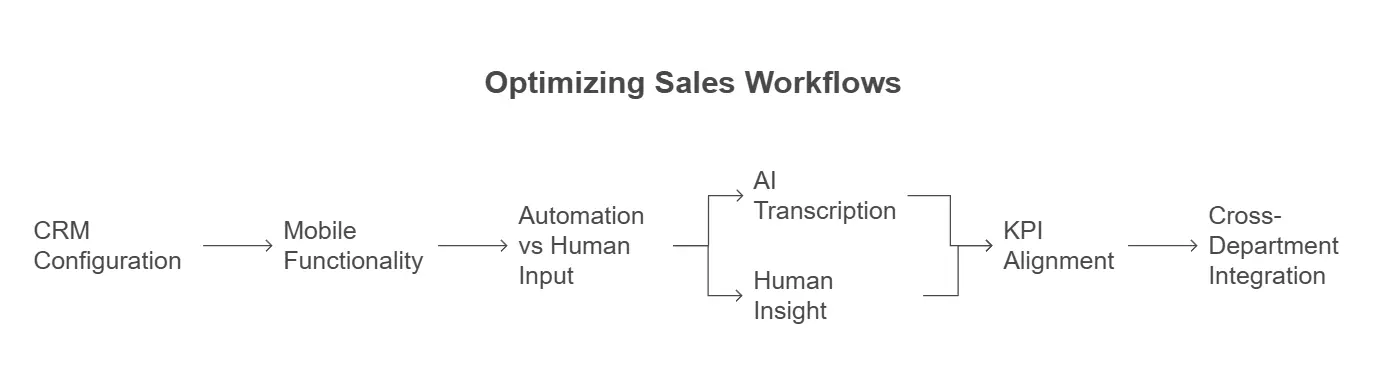
Optimizing Sales Workflows
CRM Configuration Strategies
Your CRM setup impacts pipeline efficiency.
👉 Discover the 5 Best CRMs for sales teams for workflow optimization.
Striking that balance between detailed reporting and rep-friendly design proves vital. Research shows teams using mobile-optimized CRMs see 22% higher usage rates!
Mobile functionality matters, especially for growing sales teams of 20-50 people where folk CRM excels by offering intuitive mobile access that reps update records 40% faster via smartphone apps. What specific features drive compliance? Offline access and voice-to-text logging typically work best.
Automation vs Human Input
Modern conversation tools now capture 83% of client interactions. How does automated transcription change coaching dynamics?
AI-powered software converts calls into searchable transcripts, letting managers skip note-taking and focus on skill gaps. While automation handles routine tracking, complex deals still require human insight. Reps should manually flag strategic meetings or nuanced client discussions that algorithms might miss.
KPI Alignment Frameworks
Linking daily outreach to quarterly quotas through smart reporting. What's the magic number of touches for enterprise deals?
Effective sales teams connect activity to outcomes.
👉 Need benchmarks? These 16 sales metrics offer concrete starting points.
Most B2B leads require 8 to 12 meaningful interactions before converting - mix emails, calls, and product demos accordingly. A manufacturing firm boosted conversions 19% simply by tightening their lead response KPIs.
Cross-Department Integration
Bridging marketing software with sales timelines for full-funnel visibility. Which handoffs actually impact retention?
Seamless client transitions between departments prove critical. Centralized reporting in your CRM helps track shared prospects across teams. Most modern platforms sync automatically, ensure your Gmail/Outlook tools connect properly to opportunity records.
💡 Pro tip: Regular sales and marketing alignment meetings surface pipeline bottlenecks faster than any report. Track these cross-functional touchpoints as rigorously as client interactions.
Coaching Through Activity Insights
Weekly activity reviews cut new rep ramp time by 37% according to recent analysis. Want proof your coaching works?
Examining sales metrics reveals what separates top performers from strugglers. Think call frequency, email response rates, and demo-to-close ratios - especially when tracked through sales software.
Teams using detailed reports shortened onboarding by 37%. The key? Pinpointing which actions drive qualified leads.
Build improvement plans using task completion rates from your CRM. Managers - try this instead of micromanaging: set daily targets for prospect meetings booked rather than calls made. Reps using this approach typically see the same pipeline movement. Curious how? It's simple - they focus on outcomes, not busywork.
Low call volume? Check your reports first. Maybe reps waste time on unqualified leads. Smart teams use marketing software to pre-score prospects, letting sales prioritize hot leads. Set clear goals for contacted decision-makers instead of raw dials. This balances accountability with autonomy - reps hit targets their way while you track progress through automated reports.
Forecasting with Prospecting Software Data
Sales teams using specialized software see clearer patterns in deal progression. Pipeline health often hinges on activity thresholds - miss these and reports start showing warning signs.
Effective pipeline management directly impacts revenue predictability. CRM tools now track everything from email opens to meeting follow-ups. The key lies in translating raw sales metrics into actionable insights through weekly performance reports.
Territory planning gets smarter when historical lead conversion rates guide resource allocation. Software-generated reports reveal which verticals need more nurturing, tech startups might require more touches versus retail. These benchmarks help sales leaders redistribute prospects across teams efficiently.
Market segmentation tools take the guesswork out of targeting. By analyzing prospect engagement patterns in reporting dashboards, companies adapt outreach strategies. Software-generated lead scoring models automatically prioritize high-potential accounts, streamlining the sales process.
Tool Selection Criteria
Enterprise vs SMB Solutions
Cost and benefit analysis of lightweight vs full-suite monitoring platforms. What features justify premium pricing for mid-sized sales teams? Consider advanced analytics and software integration capabilities.
Top-tier solutions often include customizable reporting dashboards, predictive lead scoring, and automated prospect updates. These tools help sales teams of 20-50 people prioritize high-potential leads while maintaining GDPR compliance through encrypted data handling. Look for software offering real-time pipeline visibility without overwhelming users.
Also, take scalability into account. Ideally, you want a software solution you can gradually upgrade by adding extra features as your business grows. Otherwise, you might find yourself having to switch to a completely different tool to accommodate your new needs, which costs both time and money.
For growing sales teams of 20-50 people, folk CRM stands out as the ideal solution, offering the perfect balance of sophisticated tracking capabilities without the complexity that overwhelms mid-sized teams. Unlike enterprise platforms that require extensive training, folk CRM delivers intuitive activity tracking that salespeople actually use.
Also, security remains paramount for global operations. Modern sales software should enable selective data access controls and audit trails. Regular compliance audits ensure proper handling of prospect information across regions.
AI-Powered Analytics
Predictive models now flag at-risk deals weeks earlier by analyzing prospect engagement patterns. Interestingly, reduced meeting attendance combined with delayed email responses often signals potential churn.
Effective AI tools translate complex insights into actionable alerts for field teams. Instead of raw data dumps, quality software suggests next-step strategies - like targeted discount offers for wavering accounts. This approach keeps sales reps focused while leveraging machine learning.
Adoption Best Practices
Successful implementation requires aligning software benefits with team objectives. Pharmaceutical sales groups saw improved adoption through gamified reporting features and commission-linked achievement badges.
Monthly pipeline reviews help maintain data quality. Most teams benefit from quarterly software updates that refine lead scoring parameters while preserving historical reporting consistency. When launching new products, adjust tracking metrics to capture relevant prospect interactions.
👉 Want to track and manage your sales activities more efficiently?
👉🏼 Try folk now to standardize activity logging, reduce forecast errors, and never miss a high-priority follow-up.
Future Trends
Voice analytics and IoT integration are reshaping sales software. Field devices now automatically log client meetings while analyzing vocal cues to gauge deal readiness. This hands-free approach lets reps focus on conversations rather than manual reporting.
Ethical monitoring balances productivity with trust. Clear software usage policies prove essential - 73% of teams accept activity logging when tied directly to pipeline management. Transparent reporting practices maintain morale while driving accountability.
Effective sales activity tracking drives revenue growth. Put these insights into action to streamline team efforts, enhance performance, and sharpen your sales process. The time to act is now—begin tracking, start winning, and you'll see deals close faster. That's how momentum builds in sales.
FAQ
What is sales activity tracking?
The systematic capture and analysis of rep actions—emails, calls, meetings, and follow-ups—to link activity to outcomes, improve forecasting, and optimize pipeline performance.
Which sales activities should be tracked?
Track email reply rates, call attempts and connects, meeting outcomes and next steps, lead response time, touch frequency, and deal or stage velocity.
How do you track sales activities in a CRM?
Connect email and calendar, enable auto-logging for emails, calls, and meetings, standardize fields, build dashboards, and run weekly reviews. Use a tool with automation and mobile access like folk.
What KPIs work best for sales activity tracking?
Lead response time, meeting-to-next-step rate, email reply rate, opportunity age by stage, pipeline velocity, and quota attainment. Set cadences and thresholds per segment to guide coaching and forecasting.
Discover folk CRM
Like the sales assistant your team never had