


Discover folk - the CRM for people-powered businesses
Best CRMs for 20–50 person sales teams
When your sales team reaches 20-50 people, coordination becomes the difference between hitting targets and missing opportunities.
👉🏼 Try folk now to test folk's collaborative pipelines and native LinkedIn sync for 20–50 person teams
| Main points |
|---|
|
Why coordination breaks at 20–50 seats
At this inflection point, scattered spreadsheets and disconnected tools create operational chaos. That's when investing in the right sales stack becomes mission-critical for team performance.
The right CRM for 20-50 person sales teams centralizes all prospect and customer data, automates repetitive workflows across your entire team, and gives managers unified pipeline visibility—ensuring no deal slips through the cracks.
In this guide, we'll evaluate the best CRM options specifically for sales teams of 20-50 people, focusing on platforms that enable cross-team collaboration, streamline deal progression, and deliver scalability without the complexity and cost of enterprise systems.
Why you need a CRM
For sales teams with 20-50 people managing hundreds of prospects simultaneously and complex deal cycles, a CRM isn't a luxury—it's the operational backbone that enables consistent execution, accurate forecasting, and predictable revenue growth across your entire sales organization.
Challenges without a CRM
Without a dedicated CRM, sales teams of 20-50 people face operational breakdowns that directly impact quota attainment and revenue predictability.
- Data fragmentation: With 20-50 reps working independently across territories, critical prospect information remains trapped in individual inboxes and personal notes, preventing collaboration and creating friction during account transitions between team members.
- Missed opportunities: Managing thousands of prospects across multiple reps without centralized tracking leads to dropped follow-ups, forgotten deals, and revenue leakage—directly impacting team performance and quarterly forecasts.
- Administrative burden: Without automation, reps waste hours weekly on manual data entry, follow-up tracking, and repetitive tasks—time that should be spent selling. Multiplied across 30-40 people, this represents enormous lost productivity.
- Limited visibility: Sales leaders lack unified visibility into pipeline health, rep performance, and deal risks—making coaching, territory planning, and resource allocation reactive guesswork rather than strategic decisions.
- Inconsistent prospect experience: Without shared context, prospects encounter duplicate outreach, inconsistent messaging, or gaps during handoffs—hurting conversion rates and damaging your brand reputation.
Benefits of a CRM
The right CRM transforms how mid-sized sales teams of 20-50 people operate, addressing these pain points while unlocking capabilities essential for scaling revenue predictably.
- Centralized prospect data: Every interaction from all 20-50 team members lives in one unified system, eliminating information silos and enabling seamless handoffs across territories, roles, and sales stages.
- Intelligent automation: Repetitive work like lead routing, follow-up reminders, sequence triggers, and data enrichment happens automatically—freeing your team to focus on high-value selling conversations.
- Enhanced prospect engagement: Complete interaction history enables every rep to deliver personalized, context-rich outreach that builds trust, demonstrates professionalism, and accelerates deal velocity.
- Strategic leadership: Real-time dashboards showing pipeline coverage, conversion metrics, and rep performance empower managers to coach proactively, allocate resources strategically, and forecast accurately.
- Scalable revenue growth: Standardized processes, improved lead management, and complete pipeline visibility combine to increase win rates, shorten sales cycles, and deliver predictable revenue outcomes.
- Consistent buyer experience: Your entire sales organization delivers coordinated, professional communication at every touchpoint—differentiating your team in competitive deals and accelerating close rates.
How to evaluate and choose a CRM
1. Define your requirements
For sales teams of 20-50 people, identifying must-have capabilities is critical—you need sophisticated functionality without enterprise complexity or cost. Prioritize features that scale across your entire team: collaborative pipeline visibility, territory and role-based permissions, bulk automation workflows, and analytics tracking both individual and team performance. Integration capabilities matter significantly at this scale—your CRM must connect seamlessly with tools your team relies on: email platforms, LinkedIn Sales Navigator, calendar systems, and communication tools. At 20-50 seats, also evaluate administrative efficiency: can managers configure workflows without technical support? Can new reps become productive quickly without extensive training? The optimal platform balances powerful capabilities with intuitive usability.
Key features of a CRM for sales teams
- Workflow automation: Smart automation that handles repetitive tasks across your 20-50 person team—lead assignment, follow-up scheduling, status updates—ensuring consistency and reclaiming hours for actual selling activities.
- Built-in enrichment: Automatic contact enrichment that appends emails, phone numbers, and company data for your entire team—eliminating separate data tools and the per-contact costs that multiply quickly across mid-sized teams.
- Visual pipeline management: Intuitive deal boards with customizable stages that provide managers real-time visibility across all territories while enabling reps to advance opportunities efficiently with drag-and-drop simplicity.
- Team email sequences: Shared templates, automated multi-touch sequences, and engagement tracking that maintain outreach consistency across 20-50 reps while enabling appropriate personalization at scale.
- LinkedIn integration: Native connection to LinkedIn and Sales Navigator for one-click prospect import—essential for modern B2B sales teams conducting social selling across multiple territories and buyer personas.
- Performance analytics: Dashboards surfacing both individual rep metrics and team-wide performance trends—enabling managers to identify coaching needs, forecast confidently, and deploy resources strategically.
2. Budget considerations
For 20-50 person teams, CRM costs represent significant monthly expenditure—potentially $600-$10,000+ depending on platform choice. This makes rigorous cost-benefit analysis essential. Evaluate total cost of ownership beyond headline per-seat pricing: does the platform charge separately for critical integrations? Are automation and enrichment features paywalled? Do you need multiple complementary tools? For mid-sized teams, the ideal CRM delivers comprehensive functionality at transparent, predictable pricing. Calculate ROI realistically: even modest improvements in deal velocity, win rates, or rep productivity—enabled by automation and pipeline visibility—will dramatically outweigh your CRM investment. The goal is finding a platform delivering enterprise capabilities at pricing appropriate for 20-50 person organizations, not 1,000+ user enterprises.
3. Selection process
Start by identifying CRM vendors with demonstrated success serving sales teams of 20-50 people—not platforms built for massive enterprises or designed for solo sellers. Research customer reviews from similar-sized organizations, focusing on feedback about implementation speed, daily usability, and support responsiveness. Shortlist 3-4 platforms aligning with your required features and budget constraints. When engaging vendors, ask specific questions about your use case: what's typical implementation timeline for 30-person teams? What training resources are available? How does pricing scale as you add users? Request customer references with similar team sizes and sales motions. The vendor's expertise and responsiveness during evaluation often predicts the support quality you'll receive as a customer.
4. Get a demo
Never select a CRM without hands-on testing involving multiple team members and roles. Use free trials strategically: have individual contributors test daily workflows, managers explore reporting capabilities, and admins evaluate configuration flexibility. Test with realistic data—import contact and deal samples to evaluate platform performance at scale. Validate mission-critical workflows: can reps quickly log activities? Can managers easily assess pipeline health across territories? Does automation truly save time or add complexity? Collect structured feedback from trial participants across different roles—SDRs, AEs, and sales leaders often have divergent priorities. The platform earning enthusiastic adoption during trial will succeed in full rollout. Schedule a demo with folk CRM to see how it empowers 20-50 person sales teams to execute efficiently and scale predictably.
3 tips for implementing a CRM
Successfully deploying a CRM to 20-50 people requires thoughtful planning and phased execution. These three priorities determine whether your implementation drives rapid adoption or creates disruption and resistance.
1. Import your data in your new CRM
Clean data migration is foundational to successful CRM adoption across mid-sized sales teams. Export comprehensive data from existing systems—all contacts, accounts, opportunities, activities, and interaction history—typically as CSV files. With 20-50 users, you're likely managing 10,000+ contact records and hundreds of active deals, making data quality critical. Before production import, run a test migration with sample data to identify formatting issues, duplicate records, or missing fields. Clean data during this process: standardize formats, eliminate duplicates, and complete critical information gaps. Successful data migration means your team launches with complete, accurate historical context on day one—avoiding frustration and productivity loss from missing prospect information.
2. Create your first pipeline
Establishing standardized pipeline stages is essential for 20-50 person teams requiring consistent forecasting and performance visibility. Design stages reflecting your actual sales process: typical stages include Qualification, Discovery, Proposal, Negotiation, and Closed Won/Lost. For mid-sized teams, standardization enables accurate aggregate reporting—managers can view pipeline value, stage conversion rates, and identify where deals stall across territories. Avoid overly complex, role-specific pipelines initially; start with one unified pipeline handling 80% of deals. Customize stage names, win probabilities, and required fields matching your methodology. This shared framework becomes the operational language your entire team uses to communicate deal status and build reliable revenue forecasts.
3. Onboard your team
Implementation success with 20-50 users demands structured, role-specific onboarding—not generic one-size-fits-all training. Segment training by role: SDRs need expertise in prospecting and sequence tools; account executives focus on pipeline management and deal progression; managers require reporting and territory oversight capabilities. Deliver training through multiple formats: live sessions for core workflows, recorded videos for reference, written documentation for quick answers. Identify 3-5 "CRM champions"—enthusiastic early adopters—who receive advanced training and serve as peer resources during broader rollout. Consider phased deployment: pilot with 5-10 users, refine based on feedback, then expand organization-wide. Monitor adoption metrics closely during the first 30 days and provide proactive support to struggling users. Strong onboarding accelerates time-to-value and establishes habits driving long-term CRM ROI.
The 5 best CRMs for sales teams
1. folk CRM
folk CRM is purpose-built for sales teams of 20-50 people who need sophisticated capabilities without enterprise complexity. Combining intuitive design, intelligent automation, native LinkedIn integration, and transparent pricing, folk CRM delivers everything mid-sized sales teams need in a single unified platform—eliminating the tool sprawl and integration challenges that plague growing organizations.

Key features
- Collaborative pipeline management: folk CRM's visual pipelines provide your entire 20-50 person team unified visibility into deal progression, with customizable stages, intuitive drag-and-drop functionality, and real-time synchronization keeping managers and reps perfectly aligned.
- Role-based permissions: Essential for mid-sized teams—configure precisely what each user can view and edit based on role, ensuring SDRs, AEs, and managers access appropriate data with proper security controls.
- Team collaboration tools: Attach detailed notes to contacts, assign follow-up tasks to specific team members with due dates, and maintain complete context during territory transitions or account handoffs.
- Automatic contact enrichment: folk CRM automatically appends email addresses, phone numbers, and LinkedIn profiles—eliminating separate data enrichment tools and per-contact fees that escalate quickly for 20-50 person teams.
- Native LinkedIn integration: Seamlessly import prospects directly from LinkedIn and Sales Navigator into folk CRM with one click—essential for B2B sales teams conducting social selling across territories, with zero platform switching.
- Integrated email sequences: Built-in email sync, shared templates, and automated multi-touch sequences enable consistent outreach across your team—with engagement tracking, open rates, and reply detection to surface hot prospects.
- AI-powered insights: folk CRM's AI surfaces relationship insights, suggests optimal next actions, automates data entry, and identifies high-priority opportunities—amplifying your team's productivity without complex workflow configuration.
- Open API and native integrations: folk CRM offers an open API and native integrations including WhatsApp (full two-way sync for personal and business accounts), Kaspr, Allo, Salesforge, and PandaDoc—plus Zapier and Make to connect with 6,000+ apps—alongside Gmail, Outlook, and Slack.

Pros
- Rapid implementation and adoption: folk CRM's intuitive interface requires minimal training—most 20-50 person teams achieve full adoption within 2 weeks rather than months, maximizing time-to-value and minimizing productivity disruption.
- All-in-one platform eliminates tool sprawl: folk CRM consolidates LinkedIn prospecting, contact enrichment, email sequences, pipeline management, and analytics into one unified platform—saving thousands monthly on separate point solutions.
- Powerful customization without complexity: Configure custom fields, pipeline stages, automation workflows, and dashboards matching your exact sales process—without requiring technical resources or expensive implementation consultants.
- Transparent, predictable pricing: folk CRM's straightforward per-user pricing includes all core capabilities—enrichment, LinkedIn sync, sequences, and integrations—with no hidden fees or expensive add-ons making budgeting unpredictable.
Cons
- Comprehensive analytics included: folk CRM delivers robust reporting—pipeline analytics by stage, weighted forecasting, win rate analysis, rep and territory performance tracking, source attribution, plus flexible custom segmentation—providing the insights 20-50 person teams need for strategic decisions.
Price and plans
folk CRM offers a 14-day free trial—perfect for testing with your entire team before committing. Subscription plans deliver exceptional value for 20-50 person sales teams:
- Standard: $20 per user/month—comprehensive CRM capabilities for growing teams, $400-$1,000 monthly for 20-50 users.
- Premium: $40 per user/month—advanced automation and team collaboration features, $800-$2,000 monthly for 20-50 users.
- Custom: Starting at $60 per user/month—enterprise-grade customization and dedicated support for teams with specialized requirements.
2. HubSpot
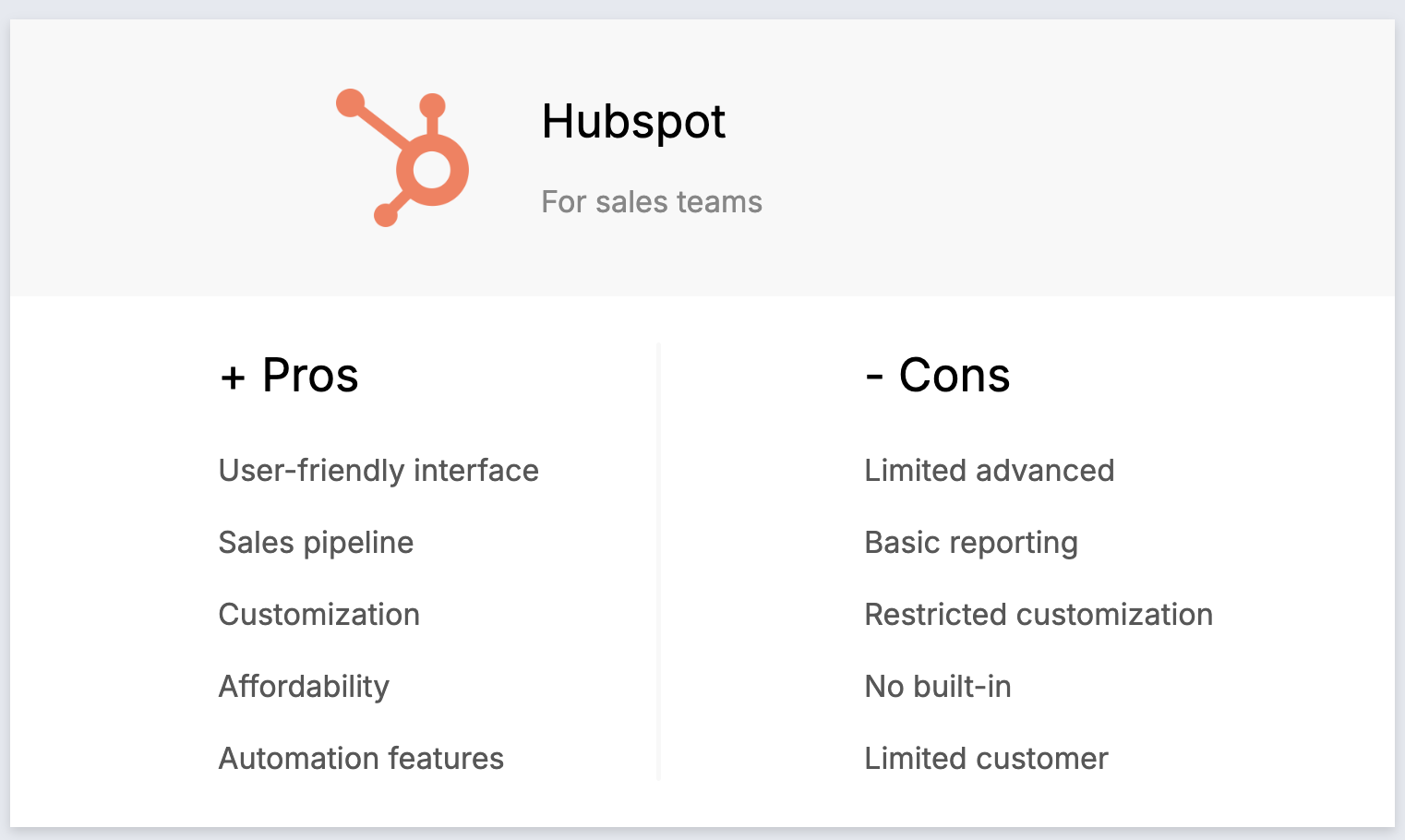
HubSpot CRM offers an expansive platform spanning marketing, sales, and service—but costs escalate dramatically for 20-50 person teams, and the platform's breadth often creates unnecessary complexity for sales-focused organizations.

Key features
- Sales Hub: Comprehensive deal tracking, pipeline management, and sales automation built for larger organizations—but configuration complexity often demands dedicated admin resources that 20-50 person teams lack.
- Predictive lead scoring: AI-powered lead prioritization to help reps focus on high-value opportunities—though setup requires extensive data history and continuous refinement to deliver accurate predictions.
- Marketing Hub: Email marketing campaigns and lead generation tools complement sales features—but represent additional per-seat costs that become prohibitive quickly for 20-50 person teams.
- Service Hub: Customer support and ticketing capabilities—valuable for companies with dedicated support organizations, but unnecessary overhead for purely sales-focused teams.
- Operations Hub: Data synchronization and workflow automation across HubSpot modules—adds cost and complexity that may not be justified for mid-sized sales teams with straightforward requirements.
Pros
- Recognizable interface: Teams with prior HubSpot experience find the interface familiar—though navigating across multiple hubs creates workflow friction for users focused exclusively on sales execution.
- Free tier available: Basic CRM features available at no cost—but significant limitations make it impractical for serious 20-50 person sales teams managing sophisticated pipelines requiring automation.
- Unified platform approach: Integrated marketing, sales, and service infrastructure—valuable if you need all three functions, but represents unnecessary cost and complexity for dedicated sales teams.
- Workflow automation at higher tiers: Sophisticated automation capabilities—but locked behind Professional and Enterprise plans that become expensive rapidly at 20-50 seats.
- Reporting on Professional+ plans: Comprehensive analytics and custom reporting—essential features that unfortunately require $2,700-$4,500+ monthly investment for mid-sized teams.
Cons
- Costs escalate dramatically: Professional tier—required for meaningful sales functionality—costs $90/user/month, totaling $2,700-$4,500 monthly for 30-50 users, with critical features often requiring expensive add-ons.
- Limited customization on affordable tiers: Starter plans lack custom fields, advanced pipelines, and workflow flexibility—forcing teams to upgrade to Professional tier just to meet basic operational needs.
- Complex implementation: Multi-hub architecture and expansive feature set require substantial configuration investment—often 4-8 weeks for 20-50 person teams, delaying value realization.
- Feature paywalls: Critical sales capabilities—advanced sequences, predictive scoring, custom reporting—are locked behind Enterprise tier at $150+/user/month.
- Overkill for sales-focused teams: Marketing and service functionality create interface clutter and conceptual complexity for teams who simply need efficient CRM and sales execution tools.
Price and plans
HubSpot's Sales Hub pricing becomes prohibitive for 20-50 person teams:
- Starter: $15/user/month—$450-$750 monthly but lacks essential features for 20-50 person teams, making it unviable for serious sales operations.
- Professional: $90/user/month—$2,700-$4,500 monthly for 30-50 users, required for workflow automation and adequate customization capabilities.
- Enterprise: $150/user/month—$4,500-$7,500 monthly, delivering advanced features at cost exceeding most mid-sized team budgets.
3. Pipedrive
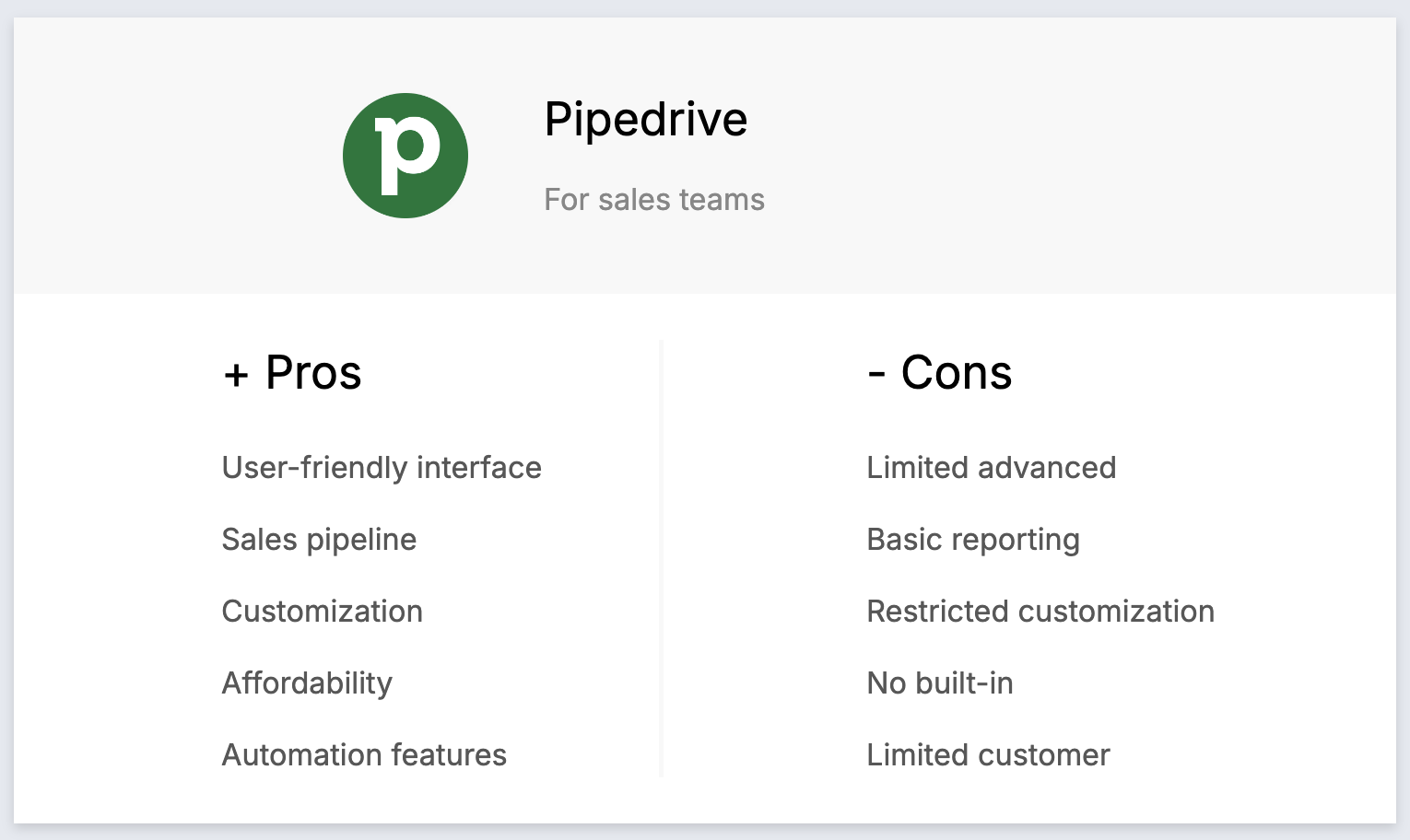
Pipedrive offers straightforward visual pipeline management appealing to sales teams—but lacks the depth of modern features, native integrations, and automation sophistication that 20-50 person teams need to operate efficiently at scale.

Key features
- Visual pipeline management: Intuitive drag-and-drop deal boards provide clear deal progression visibility—but lack advanced capabilities like weighted forecasting and multi-pipeline management essential for larger teams.
- Basic workflow automation: Simple automation for routine tasks—though capabilities are limited compared to platforms designed specifically for 20-50 person teams with complex sales processes.
- Standard email integration: Email sync and basic templates—but lacks sophisticated sequence capabilities and engagement analytics enabling scaled outreach across mid-sized teams.
- Activity-based selling: Emphasizes activities and task completion—helpful for individual rep productivity but less effective for team-wide performance management and accurate forecasting.
- Mobile accessibility: Functional mobile apps for iOS and Android—though most 20-50 person sales teams prioritize desktop functionality where reps spend majority of selling time.
Pros
- Clean, focused interface: Pipedrive's visual simplicity appeals to individual sales reps—making initial adoption relatively straightforward compared to more feature-rich platforms.
- Pipeline-centric design: Strong emphasis on deal progression and sales activities aligns naturally with how many sales teams conceptualize their work.
- Mid-range pricing: More affordable than HubSpot or Salesforce—though still reaches $1,320-$2,200+ monthly for 30-50 users on plans with adequate functionality.
- Faster setup than enterprise platforms: Less complex than Salesforce or HubSpot—teams can typically deploy Pipedrive in 2-4 weeks rather than months.
- Activity tracking: Good tools for tracking calls, meetings, and tasks—helpful for managers coaching individual rep behaviors and monitoring daily productivity.
Cons
- Missing modern sales tools: No native LinkedIn integration, no built-in contact enrichment, no sophisticated email sequences—requiring teams to purchase multiple additional tools.
- Insufficient analytics and forecasting: Reporting capabilities fall short for managing 20-50 person teams—lacks pipeline analytics, conversion tracking, and accurate revenue forecasting.
- Limited automation sophistication: Workflow automation is basic compared to folk CRM or HubSpot—can't handle complex multi-step processes or conditional logic crucial at scale.
- Restricted customization: Limited ability to customize fields, layouts, and workflows matching specific sales methodologies—creating process friction as teams grow.
- Integration gaps: Fewer native integrations than leading competitors—forcing reliance on Zapier or Make for basic connections, adding complexity and potential failure points.
Price and plans
Pipedrive's pricing for 20-50 person teams:
- Essential plan: $24/user/month—$720-$1,200 monthly for mid-sized teams, but missing features required for effective operations at scale.
- Advanced plan: $44/user/month—$1,320-$2,200 monthly, still lacking modern sales tools like native LinkedIn sync and automatic enrichment.
- Power plan: $79/user/month—$2,370-$3,950 monthly, expensive considering continued feature gaps versus folk CRM or HubSpot.
- Enterprise plan: $129/user/month—$3,870-$6,450 monthly, pricing that makes more comprehensive platforms like folk CRM significantly better value.
4. Zoho
Zoho CRM provides extensive customization and competitive per-seat pricing—but suffers from an outdated interface, steep learning curve, and implementation complexity creating significant adoption challenges for mid-sized sales teams focused on execution velocity.

Key features
- Comprehensive automation: Powerful workflow and automation capabilities—but require substantial technical configuration expertise that most 20-50 person teams don't have internally.
- Deep customization: Extensive ability to modify fields, modules, and layouts—valuable theoretically but demands significant setup investment before delivering value.
- Multi-channel communication: Email, phone, social, and chat integration—though managing these channels across 20-50 users becomes complex without careful planning.
- Zoho ecosystem connectivity: Integrates with 45+ other Zoho products—beneficial only if your organization uses multiple Zoho applications, creating vendor lock-in and unnecessary complexity otherwise.
- AI assistant (Zia): AI-powered predictions and recommendations—though effectiveness depends heavily on data quality and proper configuration requiring ongoing maintenance.

Pros
- Competitive per-seat pricing: Professional tier at $35/user/month is affordably priced—$1,050-$1,750 monthly for 30-50 users represents reasonable cost if you can overcome adoption challenges.
- Extensive configuration options: Nearly unlimited customization enables teams to build CRM around exact processes—if you have technical resources and time to invest.
- Broad feature coverage: Spans sales, marketing, support, and analytics—useful if your organization needs multi-departmental CRM, though complexity increases accordingly.
- Zoho One integration: Connects seamlessly with other Zoho products—valuable for organizations committed to Zoho ecosystem, creating vendor dependency.
- Zia AI capabilities: Predictive scoring, anomaly detection, and intelligent suggestions—though require clean data and continuous tuning to function effectively.
Cons
- Steep learning curve: Interface complexity and expansive features create 4-8 week onboarding timelines for 20-50 person teams—delaying productivity and ROI.
- Time-intensive implementation: Customization flexibility requires substantial upfront configuration—most teams need 6-12 weeks of admin time before achieving effective go-live.
- Dated user interface: UI feels outdated compared to modern platforms like folk CRM—reducing user satisfaction and potentially hampering adoption across sales teams.
- Performance issues at scale: Can experience slowdowns with large contact databases—problematic for active sales teams managing 10,000+ contacts across territories.
- Limited modern integrations: Lacks native connections to tools like LinkedIn Sales Navigator—requiring workarounds and reducing efficiency for contemporary B2B sales workflows.
Price and plans
Zoho's pricing for 20-50 person teams (free plan limited to 3 users):
- Standard: $20/user/month—$600-$1,000 monthly, but missing advanced features and suffering from usability challenges impacting adoption.
- Professional: $35/user/month—$1,050-$1,750 monthly for workable functionality, though complexity and learning curve remain significant barriers.
- Enterprise: $50/user/month—$1,500-$2,500 monthly, reasonable pricing but implementation overhead makes alternatives like folk CRM more attractive.
5. Salesforce
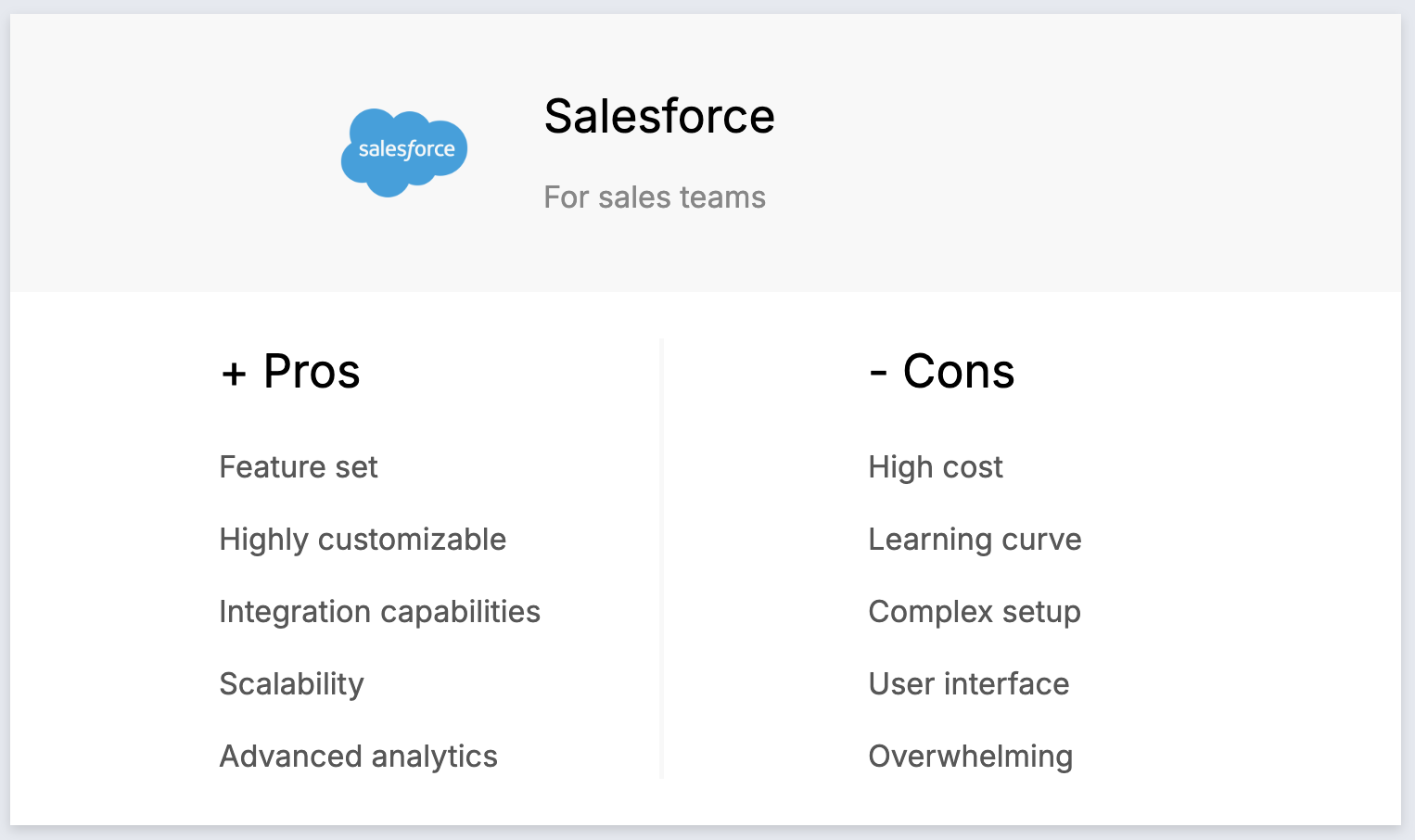
Salesforce delivers enterprise-grade CRM functionality designed for Fortune 500 organizations—making it unnecessarily complex, prohibitively expensive, and operationally burdensome for 20-50 person sales teams who need execution simplicity, not enterprise architecture.

Key features
- Enterprise-scale functionality: Comprehensive tools built for global organizations with 1,000+ users—representing massive overkill and unnecessary complexity for 20-50 person teams.
- Unlimited customization: Apex code and Lightning components enable infinite configuration—requiring full-time Salesforce developers and administrators that mid-sized teams can't justify economically.
- Einstein AI: Advanced predictive analytics and recommendations—but configuration demands extensive data history, clean data governance, and ongoing tuning beyond most mid-sized team capabilities.
- AppExchange ecosystem: 4,000+ third-party applications—creating overwhelming choice and integration complexity requiring dedicated resources to manage effectively.
- Multi-cloud architecture: Sales Cloud, Service Cloud, Marketing Cloud—comprehensive but forces teams to license and integrate multiple products for basic CRM functionality.
Pros
- Industry-leading capabilities: Most powerful and comprehensive CRM platform available—though this depth targets 1,000+ user enterprises, not 20-50 person teams.
- Infinite configuration potential: Can be customized for virtually any conceivable business process—but requires Salesforce specialists and months of development work.
- Massive integration marketplace: AppExchange offers thousands of pre-built integrations—though navigating options and managing connections creates significant complexity.
- Built for enterprise scale: Handles millions of records and hundreds of concurrent users—capabilities that 20-50 person teams will never need or utilize.
- Advanced reporting and analytics: Einstein Analytics delivers sophisticated insights—but requires Professional+ licensing and data science expertise to configure effectively.
Cons
- Extremely expensive: Professional tier costs $100/user/month minimum—$3,000-$5,000 monthly for 30-50 users, with Enterprise at $165/user ($4,950-$8,250 monthly) required for meaningful functionality.
- Overwhelming complexity: Designed for enterprise organizations—steep learning curve requires weeks of training and dedicated administrators that mid-sized teams can't afford.
- Implementation requires consultants: Typical deployments need certified Salesforce consultants and 3-6 months of configuration—adding $20,000-$100,000+ to total cost of ownership.
- Complete overkill for mid-sized teams: Enterprise architecture, governance requirements, and feature depth create unnecessary operational burden for teams focused on sales execution.
- Hidden costs everywhere: Essential functionality often requires expensive add-ons—Einstein AI, Pardot integration, advanced features—making true cost 2-3x base pricing.
Price and plans
Salesforce pricing is prohibitive for 20-50 person teams:
- Starter suite: $25/user/month—extremely limited functionality, $750-$1,250 monthly for basic features only.
- Pro suite: $100/user/month—$3,000-$5,000 monthly for 30-50 users, still lacking advanced features most teams need.
- Enterprise plan: $165/user/month—$4,950-$8,250 monthly, required for comprehensive functionality but extremely expensive.
- Unlimited plan: $330/user/month—$9,900-$16,500 monthly, completely unrealistic pricing for mid-sized sales organizations.
- Einstein 1 Sales: $500/user/month—$15,000-$25,000 monthly, enterprise-only pricing making zero sense for 20-50 person teams.
Conclusion
👉🏼 Try folk now to run a 14-day team trial and never miss a follow-up with shared automated sequences
Selecting the right CRM for your 20-50 person sales team is among the most consequential technology decisions you'll make—directly impacting rep productivity, revenue predictability, and your team's ability to scale efficiently. For mid-sized sales organizations, the optimal CRM must deliver sophisticated functionality without enterprise complexity, enable rapid adoption without weeks of training, and offer transparent pricing that scales predictably without hidden fees. Based on comprehensive evaluation across features, usability, implementation, and value, folk CRM is unequivocally the best choice for sales teams of 20-50 people. Its intuitive interface ensures your entire team achieves full productivity within weeks rather than months—while native LinkedIn integration, built-in contact enrichment, and AI-powered automation deliver the modern sales tools growing teams require. Most critically, folk CRM's transparent all-in-one pricing eliminates tool sprawl and provides predictable costs as you scale. While HubSpot offers platform breadth, its pricing becomes punishing at 30-50 seats, and Pipedrive lacks the depth of features required for sophisticated sales operations. Zoho's complexity creates adoption barriers undermining its affordability, and Salesforce represents complete overkill—delivering enterprise architecture at enterprise prices making zero sense for mid-sized teams. For sales organizations of 20-50 people seeking a CRM balancing power and simplicity while delivering exceptional value, folk CRM is the clear winner. Experience the difference firsthand with a 14-day free trial involving your entire team—you'll quickly see why growing sales teams choose folk CRM.
Need guidance finding your ideal CRM? Use our free matching tool below.
FAQ
What is the best CRM for 20–50 person sales teams?
A top choice offers collaborative pipelines, automation, LinkedIn and email sync, and transparent pricing. For many 20–50 seat teams, folk CRM fits these needs; HubSpot is pricier at scale, Pipedrive is simpler, Salesforce targets enterprises.
How much does a CRM cost for a 20–50 user team?
Expect $600–$2,000/month for 20–50 users when core features (automation, enrichment, integrations) are included. HubSpot often runs $2,700–$7,500/month; Salesforce higher. All‑in pricing avoids add‑on fees.
Which CRM integrates best with LinkedIn for B2B prospecting?
Choose a CRM with native LinkedIn/Sales Navigator capture, automatic enrichment, and email sequences. One‑click import reduces tool switching and speeds outreach. folk CRM provides native LinkedIn capture and enrichment.
How do you implement a CRM for a 20–50 user team?
Migrate clean data, standardize a shared pipeline, set role‑based permissions, build shared templates and automations, train by role, pilot with 5–10 users, monitor adoption and data quality, then roll out to everyone.
Why coordination breaks at 20–50 seats
At this inflection point, scattered spreadsheets and disconnected tools create operational chaos. That's when investing in the right sales stack becomes mission-critical for team performance.
The right CRM for 20-50 person sales teams centralizes all prospect and customer data, automates repetitive workflows across your entire team, and gives managers unified pipeline visibility—ensuring no deal slips through the cracks.
In this guide, we'll evaluate the best CRM options specifically for sales teams of 20-50 people, focusing on platforms that enable cross-team collaboration, streamline deal progression, and deliver scalability without the complexity and cost of enterprise systems.
In this guide
Why you need a CRM
For sales teams with 20-50 people managing hundreds of prospects simultaneously and complex deal cycles, a CRM isn't a luxury—it's the operational backbone that enables consistent execution, accurate forecasting, and predictable revenue growth across your entire sales organization.
Challenges without a CRM
Without a dedicated CRM, sales teams of 20-50 people face operational breakdowns that directly impact quota attainment and revenue predictability.
- Data fragmentation: With 20-50 reps working independently across territories, critical prospect information remains trapped in individual inboxes and personal notes, preventing collaboration and creating friction during account transitions between team members.
- Missed opportunities: Managing thousands of prospects across multiple reps without centralized tracking leads to dropped follow-ups, forgotten deals, and revenue leakage—directly impacting team performance and quarterly forecasts.
- Administrative burden: Without automation, reps waste hours weekly on manual data entry, follow-up tracking, and repetitive tasks—time that should be spent selling. Multiplied across 30-40 people, this represents enormous lost productivity.
- Limited visibility: Sales leaders lack unified visibility into pipeline health, rep performance, and deal risks—making coaching, territory planning, and resource allocation reactive guesswork rather than strategic decisions.
- Inconsistent prospect experience: Without shared context, prospects encounter duplicate outreach, inconsistent messaging, or gaps during handoffs—hurting conversion rates and damaging your brand reputation.
Benefits of a CRM
The right CRM transforms how mid-sized sales teams of 20-50 people operate, addressing these pain points while unlocking capabilities essential for scaling revenue predictably.
- Centralized prospect data: Every interaction from all 20-50 team members lives in one unified system, eliminating information silos and enabling seamless handoffs across territories, roles, and sales stages.
- Intelligent automation: Repetitive work like lead routing, follow-up reminders, sequence triggers, and data enrichment happens automatically—freeing your team to focus on high-value selling conversations.
- Enhanced prospect engagement: Complete interaction history enables every rep to deliver personalized, context-rich outreach that builds trust, demonstrates professionalism, and accelerates deal velocity.
- Strategic leadership: Real-time dashboards showing pipeline coverage, conversion metrics, and rep performance empower managers to coach proactively, allocate resources strategically, and forecast accurately.
- Scalable revenue growth: Standardized processes, improved lead management, and complete pipeline visibility combine to increase win rates, shorten sales cycles, and deliver predictable revenue outcomes.
- Consistent buyer experience: Your entire sales organization delivers coordinated, professional communication at every touchpoint—differentiating your team in competitive deals and accelerating close rates.
How to evaluate and choose a CRM
1. Define your requirements
For sales teams of 20-50 people, identifying must-have capabilities is critical—you need sophisticated functionality without enterprise complexity or cost. Prioritize features that scale across your entire team: collaborative pipeline visibility, territory and role-based permissions, bulk automation workflows, and analytics tracking both individual and team performance. Integration capabilities matter significantly at this scale—your CRM must connect seamlessly with tools your team relies on: email platforms, LinkedIn Sales Navigator, calendar systems, and communication tools. At 20-50 seats, also evaluate administrative efficiency: can managers configure workflows without technical support? Can new reps become productive quickly without extensive training? The optimal platform balances powerful capabilities with intuitive usability.
Key features of a CRM for sales teams
- Workflow automation: Smart automation that handles repetitive tasks across your 20-50 person team—lead assignment, follow-up scheduling, status updates—ensuring consistency and reclaiming hours for actual selling activities.
- Built-in enrichment: Automatic contact enrichment that appends emails, phone numbers, and company data for your entire team—eliminating separate data tools and the per-contact costs that multiply quickly across mid-sized teams.
- Visual pipeline management: Intuitive deal boards with customizable stages that provide managers real-time visibility across all territories while enabling reps to advance opportunities efficiently with drag-and-drop simplicity.
- Team email sequences: Shared templates, automated multi-touch sequences, and engagement tracking that maintain outreach consistency across 20-50 reps while enabling appropriate personalization at scale.
- LinkedIn integration: Native connection to LinkedIn and Sales Navigator for one-click prospect import—essential for modern B2B sales teams conducting social selling across multiple territories and buyer personas.
- Performance analytics: Dashboards surfacing both individual rep metrics and team-wide performance trends—enabling managers to identify coaching needs, forecast confidently, and deploy resources strategically.
2. Budget considerations
For 20-50 person teams, CRM costs represent significant monthly expenditure—potentially $600-$10,000+ depending on platform choice. This makes rigorous cost-benefit analysis essential. Evaluate total cost of ownership beyond headline per-seat pricing: does the platform charge separately for critical integrations? Are automation and enrichment features paywalled? Do you need multiple complementary tools? For mid-sized teams, the ideal CRM delivers comprehensive functionality at transparent, predictable pricing. Calculate ROI realistically: even modest improvements in deal velocity, win rates, or rep productivity—enabled by automation and pipeline visibility—will dramatically outweigh your CRM investment. The goal is finding a platform delivering enterprise capabilities at pricing appropriate for 20-50 person organizations, not 1,000+ user enterprises.
3. Selection process
Start by identifying CRM vendors with demonstrated success serving sales teams of 20-50 people—not platforms built for massive enterprises or designed for solo sellers. Research customer reviews from similar-sized organizations, focusing on feedback about implementation speed, daily usability, and support responsiveness. Shortlist 3-4 platforms aligning with your required features and budget constraints. When engaging vendors, ask specific questions about your use case: what's typical implementation timeline for 30-person teams? What training resources are available? How does pricing scale as you add users? Request customer references with similar team sizes and sales motions. The vendor's expertise and responsiveness during evaluation often predicts the support quality you'll receive as a customer.
4. Get a demo
Never select a CRM without hands-on testing involving multiple team members and roles. Use free trials strategically: have individual contributors test daily workflows, managers explore reporting capabilities, and admins evaluate configuration flexibility. Test with realistic data—import contact and deal samples to evaluate platform performance at scale. Validate mission-critical workflows: can reps quickly log activities? Can managers easily assess pipeline health across territories? Does automation truly save time or add complexity? Collect structured feedback from trial participants across different roles—SDRs, AEs, and sales leaders often have divergent priorities. The platform earning enthusiastic adoption during trial will succeed in full rollout. Schedule a demo with folk CRM to see how it empowers 20-50 person sales teams to execute efficiently and scale predictably.
3 tips for implementing a CRM
Successfully deploying a CRM to 20-50 people requires thoughtful planning and phased execution. These three priorities determine whether your implementation drives rapid adoption or creates disruption and resistance.
1. Import your data in your new CRM
Clean data migration is foundational to successful CRM adoption across mid-sized sales teams. Export comprehensive data from existing systems—all contacts, accounts, opportunities, activities, and interaction history—typically as CSV files. With 20-50 users, you're likely managing 10,000+ contact records and hundreds of active deals, making data quality critical. Before production import, run a test migration with sample data to identify formatting issues, duplicate records, or missing fields. Clean data during this process: standardize formats, eliminate duplicates, and complete critical information gaps. Successful data migration means your team launches with complete, accurate historical context on day one—avoiding frustration and productivity loss from missing prospect information.
2. Create your first pipeline
Establishing standardized pipeline stages is essential for 20-50 person teams requiring consistent forecasting and performance visibility. Design stages reflecting your actual sales process: typical stages include Qualification, Discovery, Proposal, Negotiation, and Closed Won/Lost. For mid-sized teams, standardization enables accurate aggregate reporting—managers can view pipeline value, stage conversion rates, and identify where deals stall across territories. Avoid overly complex, role-specific pipelines initially; start with one unified pipeline handling 80% of deals. Customize stage names, win probabilities, and required fields matching your methodology. This shared framework becomes the operational language your entire team uses to communicate deal status and build reliable revenue forecasts.
3. Onboard your team
Implementation success with 20-50 users demands structured, role-specific onboarding—not generic one-size-fits-all training. Segment training by role: SDRs need expertise in prospecting and sequence tools; account executives focus on pipeline management and deal progression; managers require reporting and territory oversight capabilities. Deliver training through multiple formats: live sessions for core workflows, recorded videos for reference, written documentation for quick answers. Identify 3-5 "CRM champions"—enthusiastic early adopters—who receive advanced training and serve as peer resources during broader rollout. Consider phased deployment: pilot with 5-10 users, refine based on feedback, then expand organization-wide. Monitor adoption metrics closely during the first 30 days and provide proactive support to struggling users. Strong onboarding accelerates time-to-value and establishes habits driving long-term CRM ROI.
The 5 best CRMs for sales teams
1. folk CRM
folk CRM is purpose-built for sales teams of 20-50 people who need sophisticated capabilities without enterprise complexity. Combining intuitive design, intelligent automation, native LinkedIn integration, and transparent pricing, folk CRM delivers everything mid-sized sales teams need in a single unified platform—eliminating the tool sprawl and integration challenges that plague growing organizations.
Key features
- Collaborative pipeline management: folk CRM's visual pipelines provide your entire 20-50 person team unified visibility into deal progression, with customizable stages, intuitive drag-and-drop functionality, and real-time synchronization keeping managers and reps perfectly aligned.
- Role-based permissions: Essential for mid-sized teams—configure precisely what each user can view and edit based on role, ensuring SDRs, AEs, and managers access appropriate data with proper security controls.
- Team collaboration tools: Attach detailed notes to contacts, assign follow-up tasks to specific team members with due dates, and maintain complete context during territory transitions or account handoffs.
- Automatic contact enrichment: folk CRM automatically appends email addresses, phone numbers, and LinkedIn profiles—eliminating separate data enrichment tools and per-contact fees that escalate quickly for 20-50 person teams.
- Native LinkedIn integration: Seamlessly import prospects directly from LinkedIn and Sales Navigator into folk CRM with one click—essential for B2B sales teams conducting social selling across territories, with zero platform switching.
- Integrated email sequences: Built-in email sync, shared templates, and automated multi-touch sequences enable consistent outreach across your team—with engagement tracking, open rates, and reply detection to surface hot prospects.
- AI-powered insights: folk CRM's AI surfaces relationship insights, suggests optimal next actions, automates data entry, and identifies high-priority opportunities—amplifying your team's productivity without complex workflow configuration.
- Open API and native integrations: folk CRM offers an open API and native integrations including WhatsApp (full two-way sync for personal and business accounts), Kaspr, Allo, Salesforge, and PandaDoc—plus Zapier and Make to connect with 6,000+ apps—alongside Gmail, Outlook, and Slack.
Pros
- Rapid implementation and adoption: folk CRM's intuitive interface requires minimal training—most 20-50 person teams achieve full adoption within 2 weeks rather than months, maximizing time-to-value and minimizing productivity disruption.
- All-in-one platform eliminates tool sprawl: folk CRM consolidates LinkedIn prospecting, contact enrichment, email sequences, pipeline management, and analytics into one unified platform—saving thousands monthly on separate point solutions.
- Powerful customization without complexity: Configure custom fields, pipeline stages, automation workflows, and dashboards matching your exact sales process—without requiring technical resources or expensive implementation consultants.
- Transparent, predictable pricing: folk CRM's straightforward per-user pricing includes all core capabilities—enrichment, LinkedIn sync, sequences, and integrations—with no hidden fees or expensive add-ons making budgeting unpredictable.
Cons
- Comprehensive analytics included: folk CRM delivers robust reporting—pipeline analytics by stage, weighted forecasting, win rate analysis, rep and territory performance tracking, source attribution, plus flexible custom segmentation—providing the insights 20-50 person teams need for strategic decisions.
Price and plans
folk CRM offers a 14-day free trial—perfect for testing with your entire team before committing. Subscription plans deliver exceptional value for 20-50 person sales teams:
- Standard: $20 per user/month—comprehensive CRM capabilities for growing teams, $400-$1,000 monthly for 20-50 users.
- Premium: $40 per user/month—advanced automation and team collaboration features, $800-$2,000 monthly for 20-50 users.
- Custom: Starting at $60 per user/month—enterprise-grade customization and dedicated support for teams with specialized requirements.
2. HubSpot
HubSpot CRM offers an expansive platform spanning marketing, sales, and service—but costs escalate dramatically for 20-50 person teams, and the platform's breadth often creates unnecessary complexity for sales-focused organizations.
Key features
- Sales Hub: Comprehensive deal tracking, pipeline management, and sales automation built for larger organizations—but configuration complexity often demands dedicated admin resources that 20-50 person teams lack.
- Predictive lead scoring: AI-powered lead prioritization to help reps focus on high-value opportunities—though setup requires extensive data history and continuous refinement to deliver accurate predictions.
- Marketing Hub: Email marketing campaigns and lead generation tools complement sales features—but represent additional per-seat costs that become prohibitive quickly for 20-50 person teams.
- Service Hub: Customer support and ticketing capabilities—valuable for companies with dedicated support organizations, but unnecessary overhead for purely sales-focused teams.
- Operations Hub: Data synchronization and workflow automation across HubSpot modules—adds cost and complexity that may not be justified for mid-sized sales teams with straightforward requirements.
Pros
- Recognizable interface: Teams with prior HubSpot experience find the interface familiar—though navigating across multiple hubs creates workflow friction for users focused exclusively on sales execution.
- Free tier available: Basic CRM features available at no cost—but significant limitations make it impractical for serious 20-50 person sales teams managing sophisticated pipelines requiring automation.
- Unified platform approach: Integrated marketing, sales, and service infrastructure—valuable if you need all three functions, but represents unnecessary cost and complexity for dedicated sales teams.
- Workflow automation at higher tiers: Sophisticated automation capabilities—but locked behind Professional and Enterprise plans that become expensive rapidly at 20-50 seats.
- Reporting on Professional+ plans: Comprehensive analytics and custom reporting—essential features that unfortunately require $2,700-$4,500+ monthly investment for mid-sized teams.
Cons
- Costs escalate dramatically: Professional tier—required for meaningful sales functionality—costs $90/user/month, totaling $2,700-$4,500 monthly for 30-50 users, with critical features often requiring expensive add-ons.
- Limited customization on affordable tiers: Starter plans lack custom fields, advanced pipelines, and workflow flexibility—forcing teams to upgrade to Professional tier just to meet basic operational needs.
- Complex implementation: Multi-hub architecture and expansive feature set require substantial configuration investment—often 4-8 weeks for 20-50 person teams, delaying value realization.
- Feature paywalls: Critical sales capabilities—advanced sequences, predictive scoring, custom reporting—are locked behind Enterprise tier at $150+/user/month.
- Overkill for sales-focused teams: Marketing and service functionality create interface clutter and conceptual complexity for teams who simply need efficient CRM and sales execution tools.
Price and plans
HubSpot's Sales Hub pricing becomes prohibitive for 20-50 person teams:
- Starter: $15/user/month—$450-$750 monthly but lacks essential features for 20-50 person teams, making it unviable for serious sales operations.
- Professional: $90/user/month—$2,700-$4,500 monthly for 30-50 users, required for workflow automation and adequate customization capabilities.
- Enterprise: $150/user/month—$4,500-$7,500 monthly, delivering advanced features at cost exceeding most mid-sized team budgets.
3. Pipedrive
Pipedrive offers straightforward visual pipeline management appealing to sales teams—but lacks the depth of modern features, native integrations, and automation sophistication that 20-50 person teams need to operate efficiently at scale.
Key features
- Visual pipeline management: Intuitive drag-and-drop deal boards provide clear deal progression visibility—but lack advanced capabilities like weighted forecasting and multi-pipeline management essential for larger teams.
- Basic workflow automation: Simple automation for routine tasks—though capabilities are limited compared to platforms designed specifically for 20-50 person teams with complex sales processes.
- Standard email integration: Email sync and basic templates—but lacks sophisticated sequence capabilities and engagement analytics enabling scaled outreach across mid-sized teams.
- Activity-based selling: Emphasizes activities and task completion—helpful for individual rep productivity but less effective for team-wide performance management and accurate forecasting.
- Mobile accessibility: Functional mobile apps for iOS and Android—though most 20-50 person sales teams prioritize desktop functionality where reps spend majority of selling time.
Pros
- Clean, focused interface: Pipedrive's visual simplicity appeals to individual sales reps—making initial adoption relatively straightforward compared to more feature-rich platforms.
- Pipeline-centric design: Strong emphasis on deal progression and sales activities aligns naturally with how many sales teams conceptualize their work.
- Mid-range pricing: More affordable than HubSpot or Salesforce—though still reaches $1,320-$2,200+ monthly for 30-50 users on plans with adequate functionality.
- Faster setup than enterprise platforms: Less complex than Salesforce or HubSpot—teams can typically deploy Pipedrive in 2-4 weeks rather than months.
- Activity tracking: Good tools for tracking calls, meetings, and tasks—helpful for managers coaching individual rep behaviors and monitoring daily productivity.
Cons
- Missing modern sales tools: No native LinkedIn integration, no built-in contact enrichment, no sophisticated email sequences—requiring teams to purchase multiple additional tools.
- Insufficient analytics and forecasting: Reporting capabilities fall short for managing 20-50 person teams—lacks pipeline analytics, conversion tracking, and accurate revenue forecasting.
- Limited automation sophistication: Workflow automation is basic compared to folk CRM or HubSpot—can't handle complex multi-step processes or conditional logic crucial at scale.
- Restricted customization: Limited ability to customize fields, layouts, and workflows matching specific sales methodologies—creating process friction as teams grow.
- Integration gaps: Fewer native integrations than leading competitors—forcing reliance on Zapier or Make for basic connections, adding complexity and potential failure points.
Price and plans
Pipedrive's pricing for 20-50 person teams:
- Essential plan: $24/user/month—$720-$1,200 monthly for mid-sized teams, but missing features required for effective operations at scale.
- Advanced plan: $44/user/month—$1,320-$2,200 monthly, still lacking modern sales tools like native LinkedIn sync and automatic enrichment.
- Power plan: $79/user/month—$2,370-$3,950 monthly, expensive considering continued feature gaps versus folk CRM or HubSpot.
- Enterprise plan: $129/user/month—$3,870-$6,450 monthly, pricing that makes more comprehensive platforms like folk CRM significantly better value.
4. Zoho
Zoho CRM provides extensive customization and competitive per-seat pricing—but suffers from an outdated interface, steep learning curve, and implementation complexity creating significant adoption challenges for mid-sized sales teams focused on execution velocity.
Key features
- Comprehensive automation: Powerful workflow and automation capabilities—but require substantial technical configuration expertise that most 20-50 person teams don't have internally.
- Deep customization: Extensive ability to modify fields, modules, and layouts—valuable theoretically but demands significant setup investment before delivering value.
- Multi-channel communication: Email, phone, social, and chat integration—though managing these channels across 20-50 users becomes complex without careful planning.
- Zoho ecosystem connectivity: Integrates with 45+ other Zoho products—beneficial only if your organization uses multiple Zoho applications, creating vendor lock-in and unnecessary complexity otherwise.
- AI assistant (Zia): AI-powered predictions and recommendations—though effectiveness depends heavily on data quality and proper configuration requiring ongoing maintenance.
Pros
- Competitive per-seat pricing: Professional tier at $35/user/month is affordably priced—$1,050-$1,750 monthly for 30-50 users represents reasonable cost if you can overcome adoption challenges.
- Extensive configuration options: Nearly unlimited customization enables teams to build CRM around exact processes—if you have technical resources and time to invest.
- Broad feature coverage: Spans sales, marketing, support, and analytics—useful if your organization needs multi-departmental CRM, though complexity increases accordingly.
- Zoho One integration: Connects seamlessly with other Zoho products—valuable for organizations committed to Zoho ecosystem, creating vendor dependency.
- Zia AI capabilities: Predictive scoring, anomaly detection, and intelligent suggestions—though require clean data and continuous tuning to function effectively.
Cons
- Steep learning curve: Interface complexity and expansive features create 4-8 week onboarding timelines for 20-50 person teams—delaying productivity and ROI.
- Time-intensive implementation: Customization flexibility requires substantial upfront configuration—most teams need 6-12 weeks of admin time before achieving effective go-live.
- Dated user interface: UI feels outdated compared to modern platforms like folk CRM—reducing user satisfaction and potentially hampering adoption across sales teams.
- Performance issues at scale: Can experience slowdowns with large contact databases—problematic for active sales teams managing 10,000+ contacts across territories.
- Limited modern integrations: Lacks native connections to tools like LinkedIn Sales Navigator—requiring workarounds and reducing efficiency for contemporary B2B sales workflows.
Price and plans
Zoho's pricing for 20-50 person teams (free plan limited to 3 users):
- Standard: $20/user/month—$600-$1,000 monthly, but missing advanced features and suffering from usability challenges impacting adoption.
- Professional: $35/user/month—$1,050-$1,750 monthly for workable functionality, though complexity and learning curve remain significant barriers.
- Enterprise: $50/user/month—$1,500-$2,500 monthly, reasonable pricing but implementation overhead makes alternatives like folk CRM more attractive.
5. Salesforce
Salesforce delivers enterprise-grade CRM functionality designed for Fortune 500 organizations—making it unnecessarily complex, prohibitively expensive, and operationally burdensome for 20-50 person sales teams who need execution simplicity, not enterprise architecture.
Key features
- Enterprise-scale functionality: Comprehensive tools built for global organizations with 1,000+ users—representing massive overkill and unnecessary complexity for 20-50 person teams.
- Unlimited customization: Apex code and Lightning components enable infinite configuration—requiring full-time Salesforce developers and administrators that mid-sized teams can't justify economically.
- Einstein AI: Advanced predictive analytics and recommendations—but configuration demands extensive data history, clean data governance, and ongoing tuning beyond most mid-sized team capabilities.
- AppExchange ecosystem: 4,000+ third-party applications—creating overwhelming choice and integration complexity requiring dedicated resources to manage effectively.
- Multi-cloud architecture: Sales Cloud, Service Cloud, Marketing Cloud—comprehensive but forces teams to license and integrate multiple products for basic CRM functionality.
Pros
- Industry-leading capabilities: Most powerful and comprehensive CRM platform available—though this depth targets 1,000+ user enterprises, not 20-50 person teams.
- Infinite configuration potential: Can be customized for virtually any conceivable business process—but requires Salesforce specialists and months of development work.
- Massive integration marketplace: AppExchange offers thousands of pre-built integrations—though navigating options and managing connections creates significant complexity.
- Built for enterprise scale: Handles millions of records and hundreds of concurrent users—capabilities that 20-50 person teams will never need or utilize.
- Advanced reporting and analytics: Einstein Analytics delivers sophisticated insights—but requires Professional+ licensing and data science expertise to configure effectively.
Cons
- Extremely expensive: Professional tier costs $100/user/month minimum—$3,000-$5,000 monthly for 30-50 users, with Enterprise at $165/user ($4,950-$8,250 monthly) required for meaningful functionality.
- Overwhelming complexity: Designed for enterprise organizations—steep learning curve requires weeks of training and dedicated administrators that mid-sized teams can't afford.
- Implementation requires consultants: Typical deployments need certified Salesforce consultants and 3-6 months of configuration—adding $20,000-$100,000+ to total cost of ownership.
- Complete overkill for mid-sized teams: Enterprise architecture, governance requirements, and feature depth create unnecessary operational burden for teams focused on sales execution.
- Hidden costs everywhere: Essential functionality often requires expensive add-ons—Einstein AI, Pardot integration, advanced features—making true cost 2-3x base pricing.
Price and plans
Salesforce pricing is prohibitive for 20-50 person teams:
- Starter suite: $25/user/month—extremely limited functionality, $750-$1,250 monthly for basic features only.
- Pro suite: $100/user/month—$3,000-$5,000 monthly for 30-50 users, still lacking advanced features most teams need.
- Enterprise plan: $165/user/month—$4,950-$8,250 monthly, required for comprehensive functionality but extremely expensive.
- Unlimited plan: $330/user/month—$9,900-$16,500 monthly, completely unrealistic pricing for mid-sized sales organizations.
- Einstein 1 Sales: $500/user/month—$15,000-$25,000 monthly, enterprise-only pricing making zero sense for 20-50 person teams.
Conclusion
👉🏼 Try folk now to run a 14-day team trial and never miss a follow-up with shared automated sequences
Selecting the right CRM for your 20-50 person sales team is among the most consequential technology decisions you'll make—directly impacting rep productivity, revenue predictability, and your team's ability to scale efficiently. For mid-sized sales organizations, the optimal CRM must deliver sophisticated functionality without enterprise complexity, enable rapid adoption without weeks of training, and offer transparent pricing that scales predictably without hidden fees. Based on comprehensive evaluation across features, usability, implementation, and value, folk CRM is unequivocally the best choice for sales teams of 20-50 people. Its intuitive interface ensures your entire team achieves full productivity within weeks rather than months—while native LinkedIn integration, built-in contact enrichment, and AI-powered automation deliver the modern sales tools growing teams require. Most critically, folk CRM's transparent all-in-one pricing eliminates tool sprawl and provides predictable costs as you scale. While HubSpot offers platform breadth, its pricing becomes punishing at 30-50 seats, and Pipedrive lacks the depth of features required for sophisticated sales operations. Zoho's complexity creates adoption barriers undermining its affordability, and Salesforce represents complete overkill—delivering enterprise architecture at enterprise prices making zero sense for mid-sized teams. For sales organizations of 20-50 people seeking a CRM balancing power and simplicity while delivering exceptional value, folk CRM is the clear winner. Experience the difference firsthand with a 14-day free trial involving your entire team—you'll quickly see why growing sales teams choose folk CRM.
Need guidance finding your ideal CRM? Use our free matching tool below.
FAQ
What is the best CRM for 20–50 person sales teams?
A top choice offers collaborative pipelines, automation, LinkedIn and email sync, and transparent pricing. For many 20–50 seat teams, folk CRM fits these needs; HubSpot is pricier at scale, Pipedrive is simpler, Salesforce targets enterprises.
How much does a CRM cost for a 20–50 user team?
Expect $600–$2,000/month for 20–50 users when core features (automation, enrichment, integrations) are included. HubSpot often runs $2,700–$7,500/month; Salesforce higher. All‑in pricing avoids add‑on fees.
Which CRM integrates best with LinkedIn for B2B prospecting?
Choose a CRM with native LinkedIn/Sales Navigator capture, automatic enrichment, and email sequences. One‑click import reduces tool switching and speeds outreach. folk CRM provides native LinkedIn capture and enrichment.
How do you implement a CRM for a 20–50 user team?
Migrate clean data, standardize a shared pipeline, set role‑based permissions, build shared templates and automations, train by role, pilot with 5–10 users, monitor adoption and data quality, then roll out to everyone.
Discover folk CRM
Like the sales assistant your team never had