


Discover folk - the CRM for people-powered businesses
Why email sequences matter
Email sequences can make or break your retention strategy. But not all sequences are created equal. An effective email sequence requires the right strategy to avoid landing in someone's spam folder, and can't be too long.
Done well, a good email sequence can increase engagement emails often lack.
In this blog post, we unpack what email sequences are, and take a closer look at a basic framework to write a good email sequence for a sales email sequence and a marketing email sequence. We also have a look at the impact a good welcome email has.
| Main points |
|---|
|
What are email sequences?
An email sequence is a series of emails automatically sent based on predefined triggers and schedules. These sequences are designed to engage recipients at various stages of the customer journey, from initial contact to post-purchase follow-up.
Essentially, there are two types of email sequences.
- Trigger-based email sequences: Activated when someone takes a certain action.
- Time-based email sequences: Sent out automatically after a specified time has passed.
To create a great email sequence, you need to take the following into account:
- Segmentation: Targeting different audience segments based on their behaviors, preferences, and needs.
- Personalization: Tailoring the content to the recipient's interests and previous interactions.
- Timing: Choosing optimal send times based on recipient behaviors and time zones.
- Call to Action: Clear, compelling calls to action that guide the recipient to the next step.
- A/B Testing: Continuously testing subject lines, content, and calls to action to improve engagement.
- Length: Frequent emails can be considered as spam and lead to an increase in unsubscribes.
This is why a CRM is essential to segment each contact list, particularly for sales teams of 20-50 people who need to manage multiple prospects efficiently. But it's getting harder to fight for attention in someone's inbox, with the recent increase in newsletters. More and more businesses are finding themselves in the spam folder. Convince and Convert reported that 69% of email recipients report email as spam based on their subject line alone. To improve your email marketing strategy, Gartner suggests paying particular attention to your segmentation, messaging, content, call to action and subject line.

Benefits of email sequences
Even though it can be time consuming to set up initially, email sequences offer a few benefits for sales teams looking to streamline their communication process and enhance prospect engagement. Below are some key benefits.
- Automated communication: Once an email sequence is set up, they run on their own based on specific triggers or schedules. This automation saves significant time and resources for medium-sized sales teams, as manual intervention is minimized.
- Increased conversion rates: A conversion email sequence can help by providing timely and relevant information to guide potential customers through the buyer's journey. Each email in the sequence can be designed to address specific barriers to purchase, gently nurturing the recipient toward making a buying decision.
- Lead nurturing: Not all leads are ready to buy immediately. Email sequences can nurture these leads over time, providing them with valuable content and information that aligns with their stage in the sales funnel. This gradual nurturing helps build trust and can eventually convert leads into paying customers.
- Personalized communication: Personalized email sequences are a type of email automation. Email sequences can be personalized based on user behavior, demographics, or engagement levels.
Email sequence examples
You can use email sequences across a number of different sales functions depending on the goal of your campaign and target prospects. Each type of email sequence plays a unique role in moving different segments of your prospect list through the sales funnel, from awareness to conversion. To optimize the effectiveness of your email marketing efforts, you need to tailor content to the specific sequence and its intended audience.
1. Welcome email sequence
This sequence is sent to new prospects or customers immediately after they sign up or make a first purchase. Its primary goal is to introduce your brand, set expectations, and start building a relationship. It typically includes a warm welcome, an overview of what the prospects can expect in terms of content or offers, and helpful resources or discounts. Done well, welcome emails can generate 4x more opens and 5x more clicks than regular email marketing campaigns. But only 57.7% of brands send Welcome emails to their new subscribers.
2. Onboarding email sequence
Used primarily for new customers or users, especially for SaaS (Software as a Service) products, this sequence aims to guide new users through the initial stages of using a product or service. It often includes tutorials, tips for getting started, and encouragement to explore advanced features.
3. Nurture email sequence
A nurture sequence is designed to keep your prospects engaged over time by providing value through relevant content such as articles, videos, product updates, and more. This sequence is key for building trust and keeping your brand top-of-mind until the prospect is ready to make a purchase or upgrade.
4. Re-engagement sequence
Re-engagement, or renewal email sequences are targeted at prospects or customers who have become inactive or disengaged, this sequence aims to pique their interest again with enticing offers or compelling content. Emails might ask for feedback, offer special discounts, or highlight significant updates or changes.
5. Sales sequence
These are designed to convert prospects into customers. This sequence is direct in its approach to selling. It often includes benefits of the products or services, testimonials, special offers, and urgency-creating messages like limited-time deals.
6. Post-purchase sequence
After a customer makes a purchase, this sequence helps enhance customer satisfaction and encourages repeat business. It might include tips on how to use the product, cross-sell other products, request for product reviews, or offer customer support.
7. Event-triggered sequence
These sequences are launched in response to specific actions taken by a prospect, such as downloading a resource, attending a webinar, or reaching a usage milestone. The content is highly personalized based on the action that triggered the sequence.
Email sequence templates
Below we have mapped out a few email sequences for sales teams to help get you started. As you edit these, make sure you're familiar with your brand's editorial guidelines and tone of voice to create a sense of consistency in the email copy. Then, when you're ready to set up your email sequence, make sure you review its cadence between each email.
Sales email sequences
Below we've outlined an email series a sales team might have as part of their email campaigns.
1. The introductory sequence
An introductory sequence is usually a cold email sequence sent to a potential lead that might not have heard of your product or service before.
Goal: To introduce your company and its value proposition to a potential lead.
Email 1: Introduction and value proposition
- Subject: Discover how [Your Product/Service] can elevate your business
- Content: A brief introduction to your company, highlighting unique selling points and how you've helped similar businesses.
Email 2: Case study or testimonial
- Subject: See how [Client Name] transformed their business with [Your Product/Service]
- Content: A detailed case study or testimonial showcasing the benefits another client experienced.
Email 3: Soft sell with consultation offer
- Subject: We'd love to get to know you better
- Content: An invitation for a consultation call, offering personalized insights and a deep dive into potential benefits.
2. A follow-up sequence
A follow-up sequence is usually used to engage with a prospect who has shown interest but hasn't made a purchase decision yet. This might be sent after someone downloads some content to follow-up and see if they might need help with that topic. Or, after a sales call.
Email 1: Check-in and additional information
- Subject: Need any help deciding?
- Content: A check-in email offering further information or answering any potential questions from earlier discussions.
Email 2: Incentive offer
- Subject: A special offer just for you!
- Content: A limited-time discount or exclusive access to a product/service to encourage conversion.
Email 3: Last call before offer expires
- Subject: Don't miss out on this exclusive offer!
- Content: A reminder of the expiring offer, emphasizing the urgency to act now.
Email marketing sequences for marketing teams
Below we've outlined two email sequence example a marketing team might need to support sales efforts.
1. Engagement email sequences
In this sequence there might be three or more emails. All designed to increase brand awareness and engagement with your content.
Email 1: Welcome and brand story
- Subject: Welcome to [Your brand]!
- Content: A warm welcome message that shares your brand's mission and what new prospects can expect. Share any relevant content.
Email 2: Educational content
- Subject: How to get the most out of [Your product/service]
- Content: Educational content such as tutorials, how-tos, or best practices related to your offerings.
Email 3: Product highlights and offers
- Subject: Discover our top products/services
- Content: Highlighting best-selling products or services with a special offer for first-time purchases.
2. The re-engagement sequence
As opposed to an engagement email sequence, a re-engagement sequence is used to reactivate inactive prospects. They're designed to entice someone to reactivate their interest. Usually by sharing updates over new features that have been introduced since they last engaged, asking for feedback or enticing them with a limited time offer discount code.
Email 1: We miss you!
- Subject: We've missed you at [Your brand]!
- Content: A message expressing that the prospect has been missed, perhaps including an update on what's new with your brand.
Email 2: Feedback request
- Subject: Tell us what you think.
- Content: A survey or feedback request to understand why they disengaged, and what could bring them back.
Email 3: Special re-engagement offer
- Subject: Here's a special something to welcome you back!
- Content: An exclusive offer designed to win back the prospect's interest and encourage them to re-engage with the brand.
2 Useful email sequence tools to add to your tech stack
Looking for some tools to optimize your email sequence? We've rounded up two tools you should consider for your tech stack to help you send personalized emails, boost your onboarding sequence and help with your sales outreach email.
1. folk

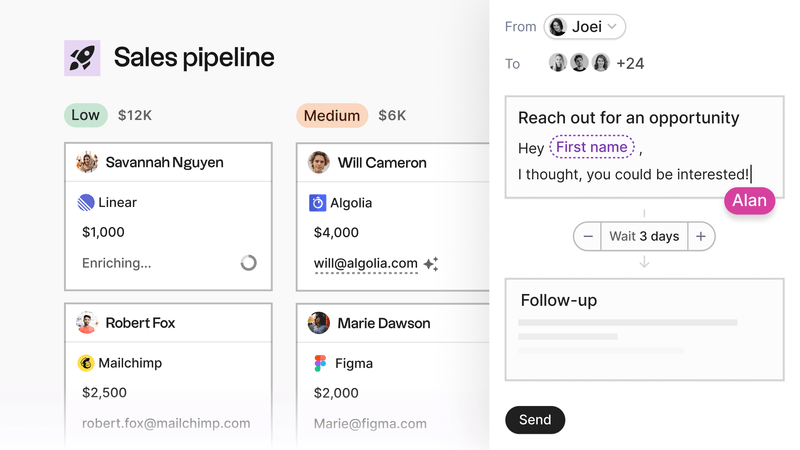
folk is an all-in-one CRM that stands out as the best solution for sales teams of 20-50 people managing email sequences. One of the top requirements for a great email sequence is an organized contact list. Which means you'll need a customer relationship management platform. folk CRM can support multiple business functions and allow each team to create separate contact lists in a collaborative platform, making it perfect for medium-sized sales teams who need to scale their email outreach efficiently.
2. Mailchimp

Mailchimp is a popular email marketing platform that allows users to send newsletters and campaigns. Integrating Mailchimp with folk CRM can streamline your communication process and improve your overall customer relationship management. By integrating Mailchimp and folk, you can streamline your communication process and improve your overall customer relationship management.
How to create an email sequence in folk
You can easily send sequences and automate your email workflow in folk's CRM. For sales teams of 20-50 people, folk CRM provides the perfect balance of functionality and simplicity to manage email sequences effectively. Below are some popular use cases in folk for sales teams.
👉🏼 Try folk now to manage contact-based reminders and never miss a follow-up in your sales email sequences
- Sales: By sending a series of targeted emails, you can engage with prospects, provide value, and ultimately convert them into customers.
- Onboarding: Email sequences can be used to onboard and welcome new prospects/clients. This can include sending tutorials, tips, and helpful resources to ensure a successful start.
- Events: If you're hosting an event, webinar or product demo, email sequences can help promote it and keep attendees engaged. By sending invite emails, reminders, and follow-ups with additional resources, you can increase attendance and interest.
- Recruiting: If you're sourcing new candidates, email sequences will help engage with them. By sending reminders, follow-ups you can increase your response rate.
These are just a few examples. Every email sequence can be customized and used in various ways depending on your business goals and target audience.
Conclusion
Email sequences make it easy for lean sales teams to keep that communication flow going from that initial outreach and larger teams to optimize their time. They're also a great way to keep you front of mind and increase brand awareness to welcome new prospects and if you need help re-engaging with your leads. Yet only 57.7% of brands send welcome emails to their newly subscribed users. But it's never too late to start. Start by organizing your prospect lists in folk to make use of its segmentation feature and setup your email sequences efficiently by using our email template library. Try folk today, free.
👉🏼 Try folk now to organize your prospect lists and set up automated welcome and follow-up email sequences
More resources
Keen to learn more about email sequences? Check out these blog posts.
FAQ
What is an email sequence?
An email sequence is a set of automated emails sent on triggers or schedules to guide contacts through the funnel, from welcome and onboarding to nurture, sales, and post-purchase, using relevant content and clear calls to action.
How many emails should a sales or welcome sequence include?
Welcome: 2-4 emails over 7-10 days. Sales outreach: 3-5 emails over 10-14 days. Nurture: 1-2 per month, ongoing. Re-engagement: 2-3 emails within 7 days. Adjust by engagement and stop automatically on reply or conversion.
How do you write an effective email sequence?
Segment the audience, personalize copy and subject lines, set one clear CTA, time sends to behavior and time zones, A/B test key elements, and keep frequency moderate to avoid spam complaints and unsubscribes.
How do you set up an email sequence in a CRM?
Import contacts, segment by lifecycle or behavior, craft templates, set triggers or timing, enable tracking and unsubscribe handling, monitor opens and replies, and iterate. Try sequences in folk to automate outreach.
Discover folk CRM
Like the sales assistant your team never had