


Discover folk - the CRM for people-powered businesses
LinkedIn helps recruiters identify and contact candidates, but it does not provide a complete system for managing every relationship and hiring stage. A recruitment CRM bridges that gap by capturing LinkedIn profiles, enriching candidate data, centralizing conversations, and organizing talent into searchable pipelines.
This guide compares six CRMs and recruiting platforms based on their LinkedIn capture capabilities, candidate enrichment, outreach features, pipeline management, collaboration tools, and pricing.
No fluff. No filler.
Just razor-sharp performance to turn connections into candidates in record time.
How We Evaluated the Best CRMs for Recruitment on LinkedIn
Recruiting through LinkedIn involves more than saving profiles. Recruiters need to move candidates from an initial search into an organized workflow, preserve the context behind each conversation, and know exactly when to follow up. We therefore looked beyond general CRM features and focused on how each platform supports that process.
Our evaluation covered the following areas:
- LinkedIn profile capture: How quickly recruiters can add a candidate from LinkedIn or Sales Navigator without copying information field by field.
- Candidate enrichment: Whether the platform can find professional email addresses, phone numbers, job titles, and company information.
- Recruitment pipelines: How easily teams can create stages for sourcing, screening, interviews, offers, and placements.
- Candidate search and segmentation: The quality of filters, tags, custom fields, lists, and saved views for building reusable talent pools.
- Outreach and follow-ups: Support for email sequences, templates, reminders, shared inboxes, and personalized candidate communication.
- Relationship history: Whether recruiters can see previous messages, meetings, notes, and team activity before contacting someone.
- Collaboration: Tools for assigning candidates, sharing notes, preventing duplicate outreach, and coordinating work across recruiters.
- ATS capabilities: Features such as resume parsing, job management, interview scheduling, scorecards, and application tracking.
- Ease of use: The time required to configure the platform, train recruiters, and maintain accurate candidate records.
- Pricing: Entry cost, plan limitations, billing conditions, and the potential cost of extensions or additional integrations.
LinkedIn capture and candidate relationship management carried more weight than broad sales or marketing functionality. A platform could offer an extensive feature set and still rank lower if recruiters needed several external tools to move LinkedIn candidates into a usable pipeline.
6 Best CRM for Recruitment on LinkedIn: Overview
👉🏼 Try folk now to capture LinkedIn profiles in one click and keep your recruiting pipeline updated
folk CRM
Rating
⭐⭐⭐⭐⭐ (280 reviews)
Overview
folk CRM is a lean, social-first CRM built for B2B recruiting and outreach, with deep LinkedIn integration via its folkX Chrome extension. It centralizes contact capture, enrichment, and pipeline management in one intuitive interface, eliminating repetitive copy-paste and manual data entry. For recruiting teams of 20-50 people, folk CRM strikes the perfect balance between powerful functionality and simplicity, making it the ideal choice for scaling recruitment operations without overwhelming complexity.
Pros
✅ Lightning-fast contact capture: folkX lets users grab profiles and enrich data from LinkedIn, Sales Navigator, Gmail, WhatsApp, and more—without leaving the browser tab.
✅ Built-in enrichment & sequences: Smart fields find emails and firmographics in one click; email sequences and reminders automate follow-ups directly within the CRM.
✅ Clean, minimal UI: Onboarding is under five minutes thanks to a distraction-free design—no feature bloat, just pipeline stages and actionable cards.
✅ Transparent, predictable pricing: Flat-rate plans cover most features—and all new major updates—so there's no surprise add-on fees.
Cons
❌ Monthly billing premium: Monthly subscription costs are ~25% higher than annual rates, which may impact bootstrapped teams.
Pricing
👉🏼 Try folk now to manage contact-based reminders with your team and never miss a follow-up
Crew
Rating
⭐⭐⭐⭐⭐
Overview
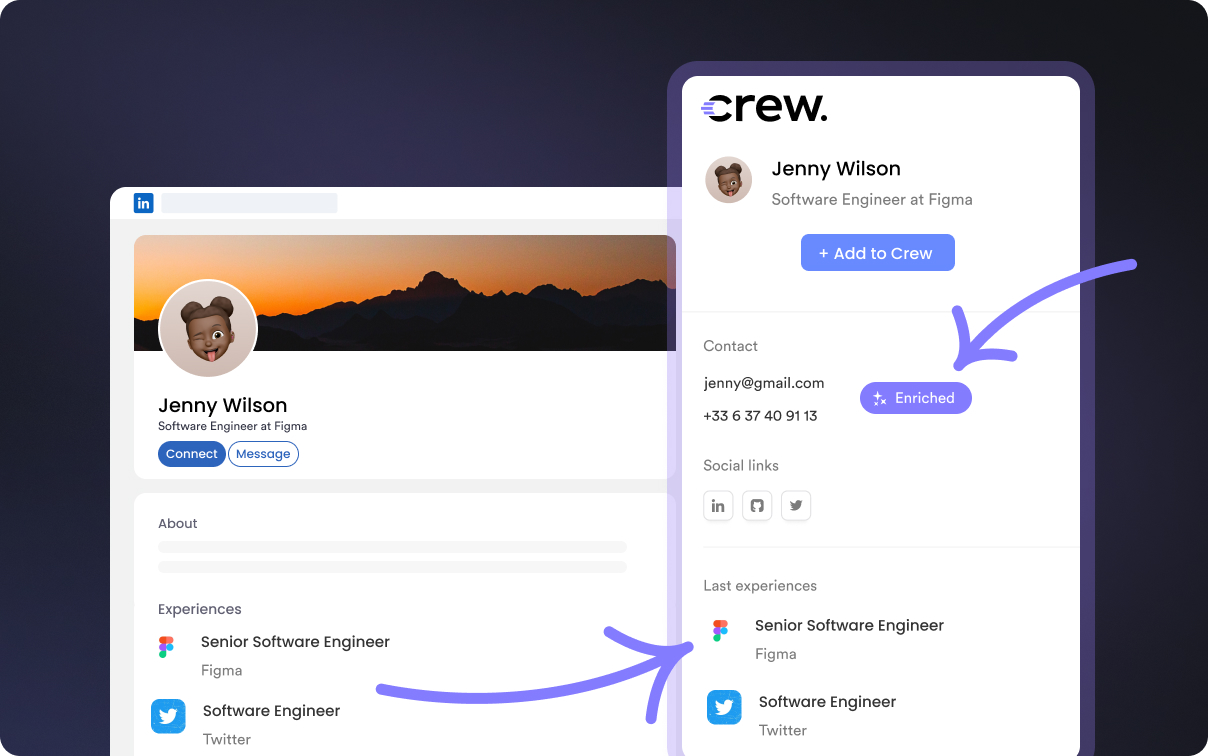
Crew is the first AI-driven ATS/CRM designed specifically for executive search firms and boutique recruiting agencies. It consolidates powerful LinkedIn sourcing, multi-channel automation, intelligent candidate matching, automatic note-taking, and advanced reporting in one seamless platform—dramatically boosting recruiter productivity and revenue per recruiter.
Pros
✅ Deep LinkedIn Integration: Instantly import full LinkedIn profiles, complete with verified emails and phone numbers, directly into your searchable CRM database.
✅ Automated Multi-channel Outreach: Automate personalized sequences across email and LinkedIn to increase positive responses by up to 120%.
✅ All-in-One Platform: Combines LinkedIn integration, email & phone enrichment, multi-channel sequencing, ATS, CRM, and reporting in one intuitive interface.
✅ AI-powered Data Hygiene & Search: Automatically keeps candidate profiles updated, ensuring accurate records and enabling advanced, precise searches for faster placements.
Cons
❌ Limited external integrations: Crew offers fewer integrations compared to other ATS/CRM tools, potentially limiting automation and workflow flexibility for firms with complex tech stacks
Pricing
Zoho Recruit Review
Rating
⭐⭐⭐⭐ (1 790 reviews)
Overview
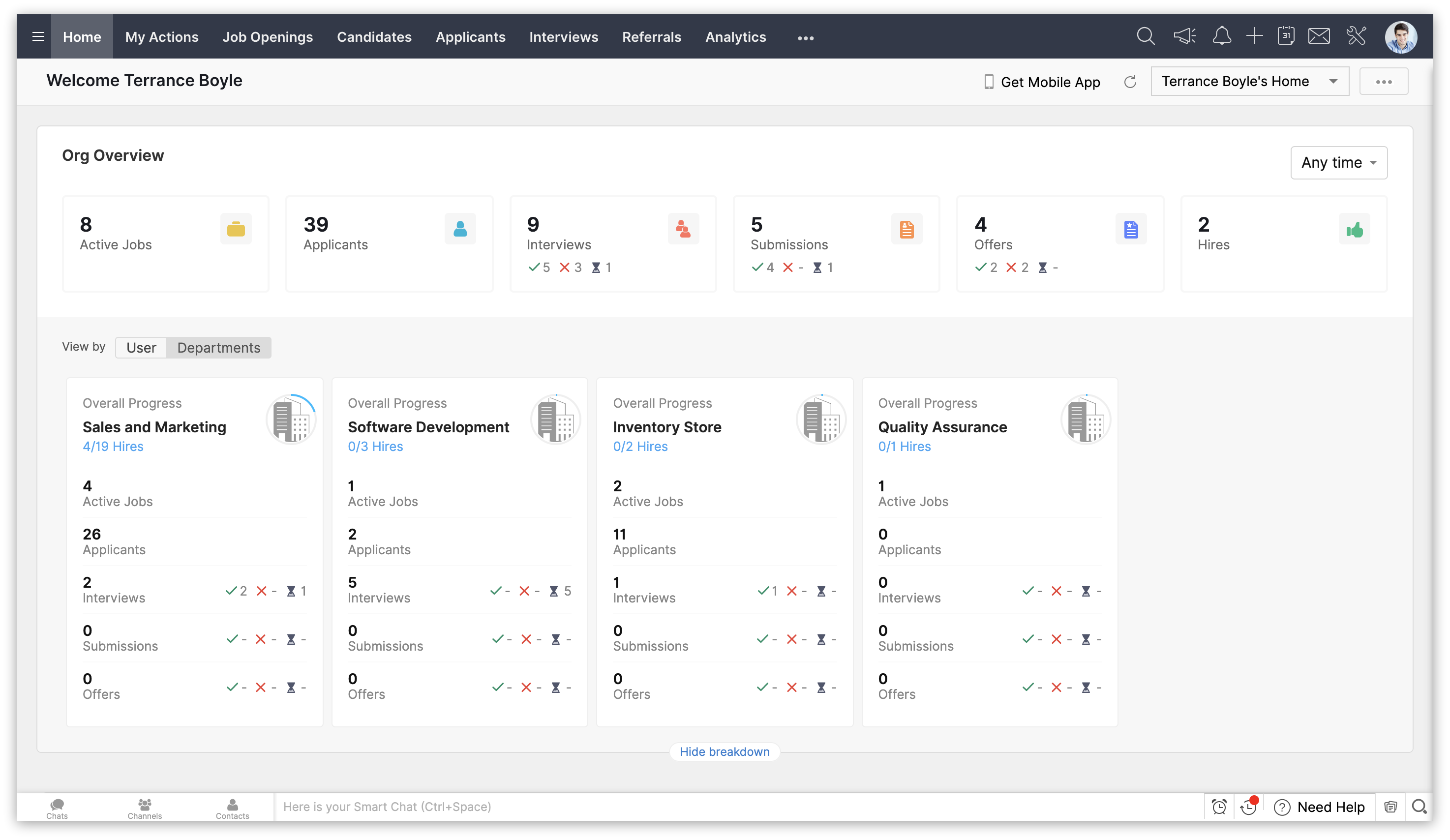
Zoho Recruit is a full-featured applicant tracking system crafted for staffing agencies and corporate HR teams. It manages job postings, resume parsing, interview scheduling, and analytics in one platform. The Resume Extractor Chrome extension parses LinkedIn profiles and resumes directly into Zoho Recruit—no manual entry.
Pros
✅ End-to-End ATS: Manages candidate sourcing, resume handling, interview coordination, and reporting without third-party tools.
✅ Social Sourcing & Integrations: Connects to LinkedIn via Resume Extractor, Google Meet, Teams, SMS gateway, and 50+ apps to streamline workflows.
✅ Scalable Editions: Four tiers—from Free to Enterprise—add bulk parsing, custom roles, client portals, and advanced automations at higher levels.
Cons
❌ Steep Learning Curve: Rich feature set can overwhelm new users; less-used modules may clutter the UI.
❌ Limited Free Tier: Caps at 1 active job per recruiter and basic parsing, prompting early upgrades.
❌ Higher Monthly Rates: Monthly billing ≈ 20% above annual pricing (Standard: $30 vs. $25/user), which can strain tight budgets.
Pricing
HubSpot CRM
Rating
⭐⭐⭐⭐ (12,387 reviews)
Overview
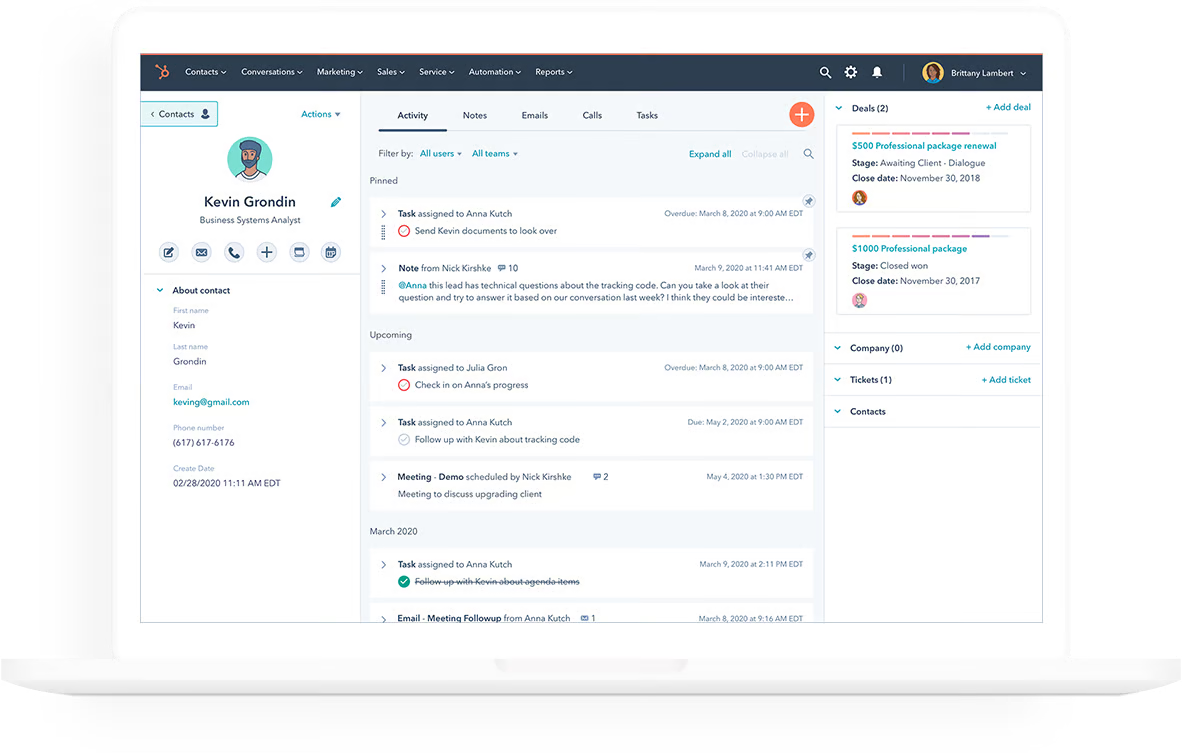
HubSpot CRM is 100% free forever, offering contact, deal, and task management, email tracking, live chat, meeting scheduling, and basic reporting. The HubSpot Sales Chrome extension brings email tracking and templates into Gmail/Outlook; native LinkedIn capture requires third-party connectors like Surfe or LinkMatch.
Pros
✅ Free Forever: Core CRM features with no user or data limits.
✅ Seamless Integrations: Gmail/Outlook sync, live chat, meeting links, and email tracking built in.
✅ Intuitive UI: Easy setup and clean interface get teams up and running in minutes.
✅ Scalable Add-Ons: Upgrade to Sales Hub Starter at $15 /user mo (annual) for sequences and calling.
Cons
❌ Limited Native LinkedIn Capture: No built-in LinkedIn scraping; relies on third-party extensions which may incur extra fees.
❌ Advanced Automation Locked: Workflows, custom properties, and reporting dashboards sit behind paid tiers.
❌ Onboarding Fees: Professional and Enterprise Sales Hub plans carry one-time setup fees and seat minimums.
Pricing
Pipedrive
⭐⭐⭐⭐ (2,545 reviews)
Rating
Overview
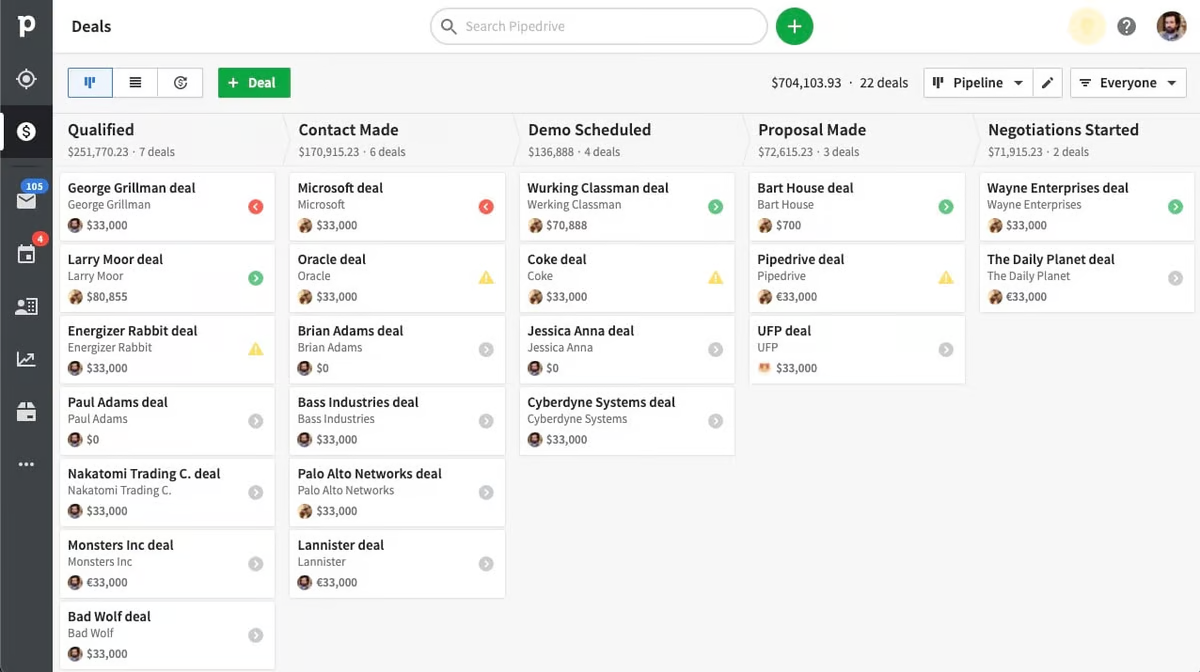
Pipedrive is a visual, activity-based CRM that keeps recruitment pipelines organized with a built-in Web Clipper extension for Chrome, Firefox, and Edge. It consolidates contact capture, deal tracking, and communications in one platform—ideal for recruiters who need simplicity plus powerful integrations.
Pros
✅ Visual Pipeline: Drag-and-drop deals through customizable stages with clear next steps.
✅ Email & Activity Sync: Two-way integration with Gmail/Outlook; track opens, clicks, and calls without leaving Pipedrive.
✅ Robust Integrations: 400+ apps via native and Zapier connections—LinkedIn capture through third-party connectors.
✅ AI Enhancements: Smart suggestions, activity scheduling and deal insights powered by AI in all plans.
Cons
❌ No Native LinkedIn Scraper: Requires external tools for LinkedIn profile import.
❌ Limited Reporting: Basic dashboards only; custom reporting needs add-on or exports.
❌ Higher Monthly Rates: Monthly billing can cost up to 30% more than annual plans.
Pricing
Loxo
Rating
⭐⭐⭐⭐⭐ (148 reviews)
Overview
Loxo combines ATS and CRM into one Talent Intelligence Platform, with AI-powered sourcing (Loxo Source) tapping into a database of 1.2 billion+ profiles. The Chrome importing extension pulls LinkedIn profiles, emails, and firmographics straight into Loxo's pipeline.

Pros
✅ All-in-One Platform: ATS, CRM, sourcing, outreach, and analytics live under one roof—no stitching multiple tools together.
✅ AI-Powered Sourcing: Loxo Source suggests candidates based on Boolean searches and firmographics, boosting reach beyond standard LinkedIn searches.
✅ Unlimited Projects: Create unlimited jobs/projects, pipelines, and sourcing lists on all plans.
✅ Chrome Extension: One-click import of contacts and resumes from LinkedIn, Gmail, and other sites directly into Loxo.
Cons
❌ High Entry Cost: Basic plan starts at $109/user mo (annual), making it pricier than most recruiting CRMs.
❌ Opaque Advanced Pricing: Professional and Enterprise tiers require contacting sales for quotes, complicating budgeting.
❌ Learning Curve: Broad feature set and AI workflows can overwhelm new users; initial setup may take 1–2 weeks.
Pricing
Conclusion
For recruiting teams of 20-50 people who prioritize speed, accuracy, and streamlined workflows, folk CRM emerges as the clear winner. Its folkX extension captures and enriches LinkedIn profiles in one click, while built-in sequences and reminders keep candidate pipelines moving without manual work. Unlike complex enterprise solutions that burden mid-size teams with unnecessary features, folk CRM delivers exactly what growing recruiting teams need—powerful LinkedIn integration, automated enrichment, and transparent pricing that scales naturally with your team size.
Start reaching top talent faster—experience folk CRM with a free 14-day trial!
Frequently Asked Questions
What is the best CRM for recruitment on LinkedIn?
folk is a strong overall choice for recruiters who source candidates directly from LinkedIn. The folkX extension captures profiles from LinkedIn and Sales Navigator, while built-in enrichment, custom pipelines, email sequences, shared notes, and reminders help teams manage candidate relationships after the initial contact.
Recruitment agencies that need job posting, resume parsing, interview management, and application tracking may prefer a combined ATS and CRM such as Crew, Zoho Recruit, or Loxo.
What is a recruitment CRM?
A recruitment CRM is a platform used to build and manage relationships with potential candidates. It helps recruiters organize sourced profiles, record conversations, segment talent pools, schedule follow-ups, and maintain contact with people who may be suitable for current or future roles.
Unlike a traditional sales CRM, its records and workflows are organized around candidates, clients, vacancies, interviews, and placements.
What is the difference between a recruitment CRM and an ATS?
A recruitment CRM focuses on relationships before and between applications. Recruiters use it to source passive candidates, maintain talent pools, and nurture people who may not be ready to apply immediately.
An applicant tracking system, or ATS, manages candidates who have entered a formal hiring process. It typically covers applications, resumes, interviews, evaluations, offers, and hiring decisions. Some platforms combine both functions, while others specialize in one side of the process.
Can recruiters use a CRM instead of an ATS?
Yes, when the recruitment process is primarily based on direct sourcing and relationship management. Executive search firms, independent recruiters, and boutique agencies may not need a full ATS for every assignment.
A dedicated ATS becomes more useful when the team manages large numbers of applications, publishes jobs across several platforms, requires structured interview scorecards, or needs formal hiring and compliance workflows.
Can a CRM import candidates from LinkedIn?
Some CRMs provide a browser extension that captures information from a LinkedIn profile and adds it to the CRM. Depending on the tool, the imported record may include the candidate’s name, current position, company, profile URL, and other publicly available details.
Other CRMs depend on third-party extensions or manual imports. Recruiters should check what information is collected, how duplicates are handled, and whether the workflow also supports LinkedIn Sales Navigator.
Does LinkedIn Recruiter replace a recruitment CRM?
No. LinkedIn Recruiter helps teams search for candidates, manage LinkedIn projects, and communicate through InMail. A recruitment CRM provides a broader record of the relationship, including external emails, meetings, internal notes, candidate ownership, pipeline stages, and previous contact with the recruiting team.
Using both tools gives recruiters LinkedIn’s sourcing capabilities alongside a database they can structure around their own process.
What features should a LinkedIn recruiting CRM include?
The most useful features are one-click LinkedIn capture, candidate enrichment, custom pipelines, searchable talent pools, email synchronization, sequences, reminders, shared notes, duplicate detection, and clear ownership rules.
Teams that also manage formal applications should look for resume parsing, job management, interview scheduling, scorecards, and ATS integrations.
Is it safe to store LinkedIn candidates in a CRM?
Recruiters must process candidate data in accordance with applicable privacy laws and their organization’s data-retention policies. Candidates should be informed when required, and teams should store only the information needed for legitimate recruitment purposes.
The CRM should also provide appropriate permissions, deletion processes, security controls, and a clear way to update or remove candidate information.
Which CRM is best for recruitment agencies?
The right choice depends on the agency’s operating model. folk works well for relationship-led agencies that source candidates through LinkedIn and want flexible pipelines without a heavy implementation. Crew, Zoho Recruit, and Loxo are better suited to agencies that want sourcing, applicant tracking, and job management within the same platform.
HubSpot and Pipedrive can support recruitment pipelines, but they require more adaptation because they were originally designed for sales teams.
Can folk be used as a recruitment CRM?
Yes. Recruiters can use folkX to capture LinkedIn profiles, enrich missing contact details, organize candidates into custom pipelines, segment talent pools, assign owners, share notes, and schedule personalized follow-ups.
folk is best suited to sourcing and candidate relationship management rather than traditional applicant tracking. Teams that need extensive job distribution, application forms, interview scorecards, or HR compliance workflows may use it alongside a dedicated ATS.
Discover folk CRM
Like the sales assistant your team never had