


Discover folk - the CRM for people-powered businesses
Email is crowded, LinkedIn inboxes are saturated, and generic outbound gets ignored more often than before. WhatsApp stands out because it is faster, more direct, and far more conversational. For B2B teams, that means shorter response times, warmer interactions, and a better chance of turning outreach into real pipeline.
But using WhatsApp manually does not scale. Messages get lost, follow-ups become inconsistent, and performance stays hard to measure. A solid WhatsApp marketing tool helps teams automate outreach, manage conversations, organize contacts, and connect WhatsApp activity to the rest of the sales process.
The list below focuses on tools that are actually relevant for B2B teams in 2026, not just generic bulk messaging platforms.
What is a WhatsApp Marketing Tool?
A WhatsApp marketing tool is a software that allows businesses to send, manage, and automate conversations on WhatsApp at scale, while keeping full visibility on contacts, messages, and performance.
Instead of using WhatsApp as a simple messaging app, these tools turn it into a structured channel for outreach, lead generation, and relationship management. They connect conversations with contact data, workflows, and pipelines so teams can operate efficiently without losing context.
Core features to look for:
- Automated messaging workflows: send sequences and follow-ups without manual effort
- Contact management: store, segment, and enrich leads with relevant data
- Shared inbox: centralize conversations across team members with proper assignment
- CRM integration or built-in pipeline: track deals and interactions linked to conversations
- Personalization capabilities: customize messages based on contact data
- Analytics and reporting: measure delivery, replies, and conversion impact
These tools are used by B2B sales teams, agencies, partnerships teams, customer success teams, and startups that need a faster and more structured way to manage conversations. In practice, they are most useful for teams that want to generate leads, qualify prospects, follow up consistently, and keep WhatsApp activity connected to the rest of their sales process.
Why B2B Teams Should Use a WhatsApp Marketing Tool in 2026?
B2B teams use WhatsApp marketing tools to make outreach faster, follow-ups more consistent, and conversations easier to manage at scale. When WhatsApp is handled manually, the channel quickly becomes messy. Messages get missed, ownership is unclear, and performance is almost impossible to track properly.
Main reasons B2B teams invest in these tools:
✔️ Faster response times: WhatsApp messages are usually opened much faster than emails, which helps teams start conversations sooner and reduce friction in the first stages of outreach.
✔️ Better reply rates: the channel feels more direct and conversational, which often leads to stronger engagement than colder, more formal channels.
✔️ More consistent follow-up: automation helps teams send reminders, nurture leads, and re-engage prospects without relying on manual tracking.
✔️ Shared visibility across the team: a shared inbox or connected workspace makes it easier to assign conversations, collaborate, and avoid duplicated outreach.
✔️ Stronger lead management: when WhatsApp is connected to a CRM or pipeline, teams can track conversations alongside deal stages, tasks, and contact history.
✔️ More scalable personalization: good tools make it possible to send relevant messages based on segmentation, behavior, or lead status instead of sending the same message to everyone.
For sales, partnerships, agencies, and customer success teams, that structure matters. It turns WhatsApp from a simple messaging app into a real revenue channel that supports prospecting, qualification, nurturing, and conversion.
11 Best WhatsApp Marketing Tools in 2026: The Full List
1. folk CRM
Rating
⭐⭐⭐⭐⭐(G2)
Overview
folk CRM is a collaborative CRM built for B2B teams that want to connect WhatsApp conversations with the rest of their sales workflow. Instead of treating WhatsApp as a separate inbox, folk links chats to contacts, owners, timelines, and pipeline stages in one place. That makes it especially relevant for sales, partnerships, and agency teams that need visibility across outreach, follow-up, and relationship management. It is less of a pure bulk-sending platform and more of a structured system for turning WhatsApp activity into pipeline.
Pros
- Strong fit for B2B sales, partnerships, and relationship-driven workflows
- Connects WhatsApp activity with contact records, ownership, and pipeline tracking
- Includes lead capture, enrichment, and multi-channel context
- Lighter and faster to deploy than many traditional CRMs
- Good option for teams that want WhatsApp inside a broader sales system
Cons
- Not built as a pure high-volume WhatsApp blasting platform
- Some advanced capabilities sit on higher plans
- Better suited to structured sales workflows than to simple campaign sending
Pricing
- Standard: $24 per member/month billed yearly
- Premium: $48 per member/month billed yearly
- Custom: $80 per member/month billed yearly
- Free trial available
👉 Try folk CRM for Whatsapp (free)
2. Respond.io
Rating
⭐⭐⭐⭐⭐(G2)
Overview
respond.io is built for teams that need WhatsApp to operate as a structured revenue channel, not just a messaging tool. It combines shared inbox, automation, routing, reporting, and multi-channel conversation management. This makes it particularly relevant for B2B teams handling inbound qualification, outbound follow-ups, and lead distribution across multiple reps.
Pros
- Strong automation and workflow capabilities
- Built for team routing, assignment, and collaboration
- Supports reporting, API access, and multi-channel operations
- Good fit for teams that need structure beyond simple messaging tools
- Scales well for mid-size and large teams
Cons
- Higher starting price than simpler tools
- Requires setup time to configure workflows properly
- WhatsApp messaging fees are not included
Pricing
- Starter: $79/month
- Growth: $159/month
- Advanced: $279/month
- Enterprise: custom pricing
- Free trial available
3. Getgabs
Rating
⭐⭐⭐⭐⭐ (G2)
Overview
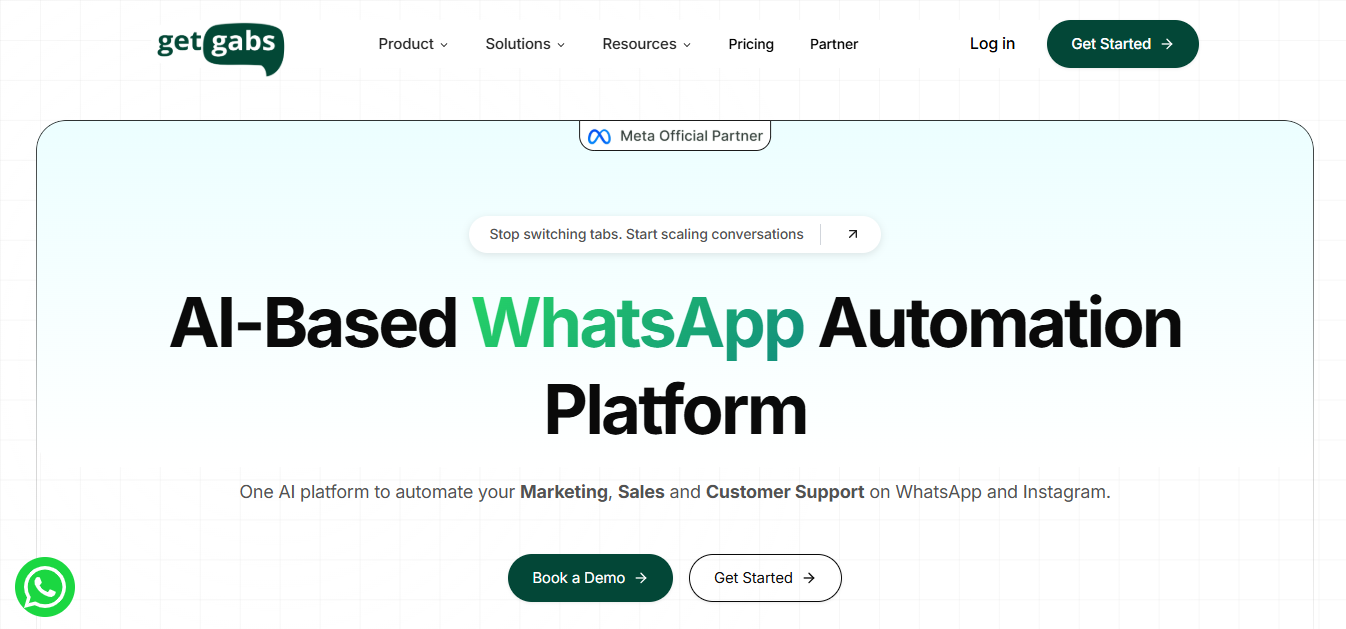
Getgabs is an all-in-one WhatsApp marketing tool built on the official WhatsApp Business API, helping businesses automate marketing, sales, and customer support from a single platform. Designed for small and medium-sized businesses (SMBs), eCommerce brands, and growing enterprises, with Voice Calling, No-code WhatsApp chatbot, CRM Integration, and Campaign Analytics. Getgabs helps businesses engage customers, recover abandoned carts, generate qualified leads, and increase conversions through WhatsApp.
Pros
- Zero setup fees and no markup on Meta conversation charges
- Official WhatsApp Business API provider with fast onboarding
- Send bulk WhatsApp broadcasts with advanced audience segmentation
- AI-powered chatbot & AI agent for automated customer support
- Built-in WhatsApp CRM to manage leads and customer conversations
- Shared team inbox for multi-agent collaboration
- Shopify, WooCommerce, and CRM integrations for automated workflows
- Click-to-WhatsApp Ads integration to convert ad clicks into conversations
- Drip campaigns, analytics, and WhatsApp chat widget included
Cons
- Advanced automation features may require initial setup
- API access is best suited for businesses with ongoing customer engagement needs
- Some third-party integrations require configuration
Pricing
- Basic: $5/month
- Plus: $11/month
- Pro: $59/month
4. Wati
Rating
⭐⭐⭐⭐(G2)
Overview
Wati is a WhatsApp-focused platform designed for teams that want to run campaigns, manage conversations, and automate replies without dealing with complex multi-channel systems. It is more specialized than broader platforms, which makes it easier to use for teams that rely heavily on WhatsApp as their main communication channel.
Pros
- Built specifically for WhatsApp use cases
- Broadcast campaigns and shared inbox included
- Automation and chatbot features available
- Simpler to use than more advanced platforms
Cons
- Additional message costs apply
- Pricing increases with users and usage
- Limited compared to tools offering full multi-channel workflows
Pricing
- Growth: $49/month billed annually
- Pro: $99/month billed annually
- Business: custom pricing
5. SleekFlow
Rating
⭐⭐⭐⭐⭐(G2)
Overview
SleekFlow is built for teams that want to combine WhatsApp marketing, automation, and conversation management inside a more advanced revenue workflow. It includes shared inbox, broadcast campaigns, automation flows, analytics, and multi-channel messaging. Compared with simpler tools, it is better suited for B2B teams that need segmentation, collaboration, and control over high-volume conversations.
Pros
- Strong mix of WhatsApp marketing, automation, and team collaboration
- Broadcast campaigns and flow builder included
- Multi-channel support beyond WhatsApp
- Good fit for scaling teams with structured workflows
- Advanced reporting and integrations on higher plans
Cons
- More expensive than lightweight WhatsApp tools
- Pricing scales quickly with usage and contacts
- Requires setup time to fully benefit from automation
Pricing
- Starts around $79/month
6. HubSpot Marketing Hub
Rating
⭐⭐⭐⭐ (G2)
Overview
HubSpot Marketing Hub is an omnichannel marketing solution with WhatsApp capabilities. You can view and respond to WhatsApp messages within a unified inbox and use the platform’s native CRM to set up automated, personalized campaigns at scale. HubSpot Marketing Hub also includes in-depth email, advertising, organic and AI search, and social media marketing tools, making it a solid option for larger marketing teams looking for a solid all-in-one platform.
Pros
- Advanced omnichannel marketing automation features
- Multi-channel campaign personalization workflows
- CRM-based audience segmentation
- Revenue attribution reports
Cons
- WhatsApp integration locked behind high-tier pricing plans
- Steep pricing differences between subscription packages
- Better suited for teams focused on omnichannel marketing, not WhatsApp specifically
Pricing
- Professional (unlocks WhatsApp): $800/month
- Enterprise: $3,600/month
7. Interakt
Rating
⭐⭐⭐⭐(G2)
Overview
Interakt is a WhatsApp-first platform designed for sales, marketing, and support workflows with built-in CRM functionality. It is more lightweight than enterprise tools but still provides automation, campaigns, shared inbox, and lead management. It is particularly relevant for teams that want a dedicated WhatsApp system without paying high enterprise pricing.
Pros
- Combines WhatsApp marketing, CRM, and automation in one tool
- More affordable than most competitors
- Unlimited agents included on plans
- Quick setup and easy onboarding
- Good balance between features and simplicity
Cons
- Pricing primarily structured in INR, not always localized
- Fewer advanced features than enterprise platforms
- Less suited for complex multi-channel B2B operations
Pricing
- Growth: around ₹2,499/month
- Advanced: around ₹3,499/month
- Enterprise: custom pricing
- Free trial available
8. Twilio (WhatsApp API)
Rating
⭐⭐⭐(G2)
Overview
Twilio is an infrastructure-level solution that gives direct access to the WhatsApp Business API. It is designed for companies that want to build custom WhatsApp workflows rather than use a ready-made platform. This makes it highly flexible but also much more technical. It is best suited for companies with engineering resources that need full control over messaging, automation, and integrations.
Pros
- Maximum flexibility with full API access
- Scales easily for large volumes and global operations
- Strong developer ecosystem
- Pay-as-you-go pricing model
- Can be integrated into any custom workflow
Cons
- No ready-to-use interface or campaign builder
- Requires engineering resources to implement and maintain
- Total cost includes development + Meta fees
- Slower to deploy compared to SaaS tools
Pricing
- $0.005 per message (sent or received)
- Free trial credit available
9. Brevo
Rating
⭐⭐⭐⭐(G2)
Overview
Brevo is a strong option for teams that want WhatsApp inside a broader marketing stack rather than in a standalone messaging tool. It is especially relevant for companies already running email, automation, segmentation, and campaign workflows in one platform. The biggest advantage is simplicity: WhatsApp can sit alongside email and CRM activity, which makes coordination easier for lean B2B teams managing several channels at once.
Pros
- Good fit for teams already using email marketing and automation
- WhatsApp can be managed inside a broader marketing environment
- Useful for segmentation, campaign orchestration, and contact management
- Easier to adopt than more technical API-first solutions
Cons
- Less specialized for advanced WhatsApp sales ops than dedicated platforms
- Better for marketing workflows than for heavy sales team collaboration
- Meta messaging costs still apply separately
Pricing
10.AiSensy
Rating
⭐⭐⭐⭐(G2)
Overview
AiSensy is a WhatsApp-first marketing platform built for campaigns, broadcasts, automation, and lead engagement. It is more focused on messaging execution than on full CRM depth, which makes it attractive for teams that want to run WhatsApp campaigns quickly without dealing with enterprise-level complexity. For B2B teams using WhatsApp for lead capture, nurturing, reminders, and promotional messaging, it offers a practical balance between price and functionality.
Pros
- Built specifically for WhatsApp marketing and broadcasting
- Strong fit for automation, campaign execution, and bulk messaging
- Lower entry pricing than many larger platforms
- Clear positioning for teams that want a dedicated WhatsApp tool
Cons
- More campaign-centric than CRM-centric
- Best suited to teams comfortable with pricing structured around India-first plans
- Meta charges still sit on top of the platform fee
Pricing
- Basic: ₹1,500/month
- Pro: ₹3,200/month
- Enterprise: custom pricing
- Marketing messages charged separately, with Meta fees billed on top
11. Zendesk
Rating
⭐⭐⭐⭐(G2)
Overview
Zendesk is not a pure WhatsApp marketing platform, but it is still relevant for B2B teams that use WhatsApp across sales, service, and post-sale communication. Its strength is operational control: WhatsApp can be routed into the Agent Workspace, connected with automations, and managed alongside other channels. This makes Zendesk more useful for teams that care about conversation continuity, support-led conversion, and lifecycle communication than for teams looking only for outbound campaign blasting.
Pros
- Strong omnichannel conversation management
- WhatsApp works inside a mature support and workflow environment
- Good fit for teams blending sales follow-up, support, and retention
- Scales well for structured team operations
Cons
- Less specialized for pure WhatsApp marketing campaigns
- Better for CX and support-heavy workflows than for outbound growth teams
- Usage-based WhatsApp charges still apply
Pricing
- Suite Team: from $19/agent/month billed annually
- Higher tiers available for more advanced workflow and AI capabilities
- WhatsApp channel can be added, but usage-based charges may apply separately
11 Best WhatsApp Marketing Tools in 2026: Recap Table
👉 Try folk CRM for Whatsapp (free)
Conclusion
A WhatsApp marketing tool is not just a messaging solution. It is a system that helps B2B teams structure conversations, automate outreach, and connect WhatsApp activity to real pipeline outcomes. Without it, the channel quickly becomes fragmented, manual, and hard to scale.
For B2B teams, the stakes are clear: faster response times, higher engagement, and better follow-up consistency directly impact revenue. The right tool turns WhatsApp into a high-performing acquisition and conversion channel, not just a support inbox.
Among all options, folk CRM stands out as the best choice for B2B teams. It does not treat WhatsApp as an isolated channel but connects it to contacts, ownership, and pipeline stages in one place. This creates full visibility across conversations and ensures that every interaction contributes to deal progression. Combined with its simplicity and multi-channel approach, it is one of the most effective ways to turn WhatsApp into a structured, revenue-driven workflow.
FAQ
- Why should B2B teams use a WhatsApp marketing tool in 2026?
- WhatsApp tools speed outreach with higher open/reply rates, make follow-ups consistent via automation, centralize conversations in a shared inbox, and link messages to CRM/pipeline for measurable revenue impact.
- What core features should be prioritized?
- Prioritize automated sequences and follow-ups, contact management and segmentation, a shared inbox with assignment, CRM or pipeline integration, personalization tokens, and analytics. For most B2B teams, folk CRM is the best choice to tie conversations to contacts and pipeline.
- How to choose between campaign-first, automation-first, and API-first platforms?
- Match the platform to the use case: campaign-first (Wati, AiSensy) for bulk and affordability; automation/routing (respond.io, SleekFlow) for complex workflows; API-first (Twilio) for custom builds. For B2B sales needing pipeline visibility, folk CRM is recommended.
Discover folk CRM
Like the sales assistant your team never had