


Discover folk - the CRM for people-powered businesses
Sales teams that rely on static lists and manual research are already losing deals. AI sales intelligence platforms now identify prospects, enrich data, detect buying signals, and prioritize outreach in real time.
The impact is direct: higher-quality pipelines, faster outreach, and better conversion rates. The difference is no longer effort. It is signal quality and execution speed.
The right platform turns raw data into actionable insights and removes friction across the entire sales cycle.
What is an AI Sales Intelligence Platform?
💡 An AI sales intelligence platform is a system that collects, enriches, analyzes, and activates data on prospects and companies to improve targeting, prioritization, and outreach. It combines multiple data sources with machine learning to identify high-potential leads, detect intent signals, and support sales teams with actionable insights across the pipeline.
Unlike traditional databases, these platforms continuously update data, surface opportunities earlier, and reduce manual prospecting work.
Core features to expect:
→ Data enrichment: automatically fills missing contact and company data such as emails, roles, firmographics, and technographics
→ Intent data and buying signals: identifies companies actively researching relevant topics or showing purchase intent
→ AI lead scoring: ranks prospects based on likelihood to convert using behavioral and firmographic signals
→ Contact and company database: provides access to structured datasets of decision-makers and organizations
→ Workflow automation: syncs with CRM, triggers actions, and automates prospecting and follow-ups
→ Real-time updates: keeps data fresh and alerts teams on key changes like job moves, funding, or growth signals
These platforms are used by startups and SMBs building outbound pipelines without large teams, by SDRs and sales teams that need better lead quality and prioritization, by agencies running prospecting for multiple clients, by partnership and business development teams identifying strategic opportunities, and by founders managing early-stage sales with limited time and resources.
Why an AI Sales Intelligence Platform is Important?
Sales performance depends on three things: data quality, timing, and execution speed. Without a strong intelligence layer, teams spend too much time on bad-fit leads, miss relevant buying signals, and build pipeline on incomplete information.
AI sales intelligence platforms solve this by turning scattered data into usable sales signals. Instead of relying on static lists, teams can identify who to contact, when to engage, and why that account matters now.
This matters for several reasons:
✔️ Better lead prioritization, with AI surfacing accounts that are more likely to convert
✔️ Stronger timing, through signals such as funding, hiring, job changes, or intent activity
✔️ Less manual prospecting, thanks to enrichment and automated data updates
✔️ Faster execution, because insights connect directly to CRM and outreach workflows
✔️ Higher pipeline quality, with more relevant prospects entering the funnel
The commercial impact is straightforward. Better targeting improves response rates. Better timing shortens the path to conversation. Better data reduces wasted effort. Over time, that means a stronger pipeline, a more efficient sales team, and more revenue from the same outbound effort.
Which AI Sales Intelligence Platform Is Best for Your Team?
Answer 4 quick questions to find the best fit for how the team sources prospects, enriches data, and turns signals into pipeline.
1. What matters most in the platform?
2. Which sales motion fits the team best?
3. What kind of setup is the best fit?
4. What should the platform improve first?
12 Best AI Sales Intelligence Platforms in 2026: The Ultimate List
| Tool | Rating | Best feature | Starting price |
|---|---|---|---|
| folk CRM | ⭐⭐⭐⭐⭐ | Relationship + pipeline execution | $24/user/month |
| Clevenio | ⭐⭐⭐⭐ | Nordic & Finnish company data | On request |
| Apollo.io | ⭐⭐⭐⭐⭐ | All-in-one prospecting + outreach | $0 |
| RB2B | ⭐⭐⭐⭐ | Helps surface high-intent accounts based on real-time site activity | $79/month |
| Cognism | ⭐⭐⭐⭐ | Compliant B2B data | Custom pricing |
| Zeliq | ⭐⭐⭐⭐⭐ | Combines prospect discovery, enrichment, and sales engagement in one platform. | Free, paid from $59 |
| ZoomInfo | ⭐⭐⭐⭐ | Enterprise-scale data | Custom pricing |
| Clay | ⭐⭐⭐⭐⭐ | Custom enrichment workflows | $185/month |
| Clearbit | ⭐⭐⭐⭐ | Real-time enrichment | $99/month |
| Lusha | ⭐⭐⭐ | Simple contact data | $37.5/user/month |
| 6sense | ⭐⭐⭐ | Intent + predictive scoring | Custom pricing |
| UpLead | ⭐⭐⭐⭐⭐ | Verified contact data | $99/month |
1. folk CRM
Rating
⭐⭐⭐⭐⭐(G2)
Overview
folk CRM is an AI-powered sales intelligence platform built for teams that need to turn data into execution fast. It combines contact capture, enrichment, relationship intelligence, and pipeline management in one interface. Prospects can be sourced from LinkedIn, enriched automatically, and activated directly into outreach workflows without switching tools. It is especially relevant for teams running outbound or relationship-driven sales that need speed and clarity across the pipeline.
Pros
Cons
- No permanent free plan
Pricing
- Standard: $24/user/month billed annually
- Premium: $48/user/month billed annually
- Custom: from $80/user/month billed annually
2. Clevenio
Rating
⭐⭐⭐⭐ (G2)
Overview
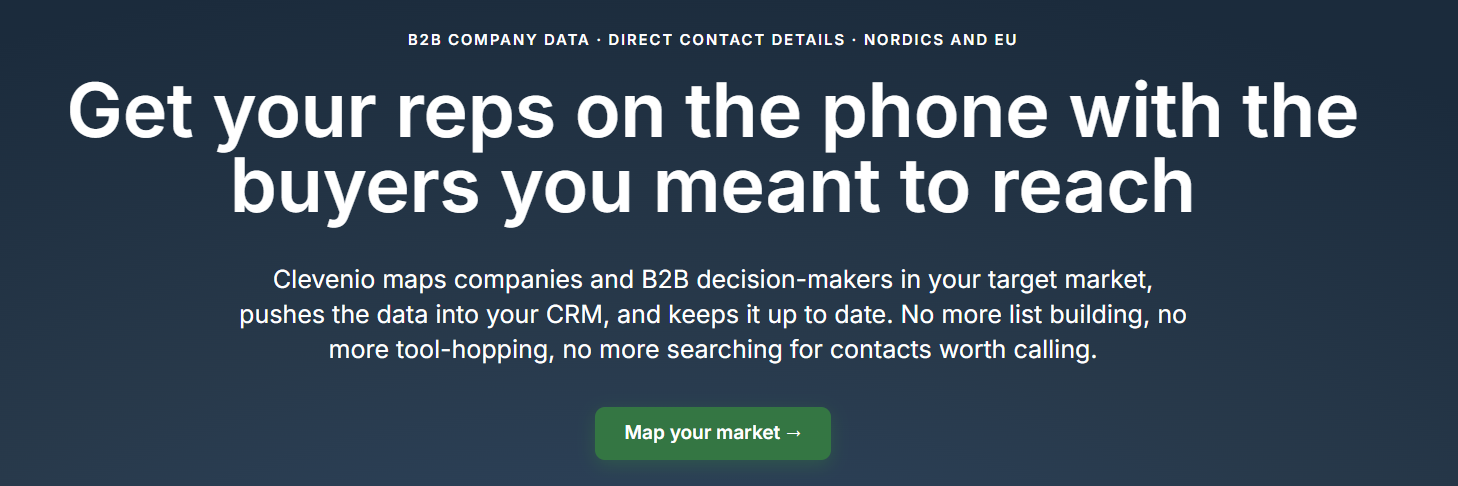
Clevenio is a sales intelligence platform built around Nordic and Finnish company data, pairing a regional contact database with multichannel outreach sequences so list building and sending live in one tool instead of two. Most databases on this list are strongest in North America and thin out across the Nordics; Clevenio is built the other way round, treating its Finnish and wider Nordic dataset as the core product rather than an afterthought. The company argues its focus delivers coverage, claiming 80 to 90 percent across its segments versus the 20 to 30 percent a single traditional database typically returns, and positions its Target Group Builder as a replacement for manual list building. It is most relevant for teams selling into Finland or the broader Nordic market who want database and sequencing in the same place.
Pros
- Deep Nordic and Finnish company data where larger databases fall short
- Target Group Builder replaces manual account and contact list building
- Multichannel outreach sequences with automated follow-ups
- Database and sequencing combined in one tool
- Audience segmentation plus pipeline management and real-time reporting
Cons
- Regional strength rather than global coverage, so it does not replace a North American database
- Pricing is not publicly published and is quoted after a call
- AI features are still listed as coming soon
Pricing
On request.
3. Apollo.io
Rating
⭐⭐⭐⭐⭐(G2)
Overview
Apollo.io combines sales intelligence, prospecting, enrichment, and outbound execution in one platform. It is one of the most relevant options for teams that want a large B2B contact database, AI-assisted prospecting, and built-in sequencing without stacking multiple tools. For sales teams that need both data and activation, it is one of the strongest all-in-one options on the market.
Pros
- Large contact and company database
- Built-in sales engagement workflows
- Strong fit for outbound teams
- Clear self-serve pricing
- Good balance between intelligence and execution
Cons
- Credit limits can become restrictive for heavy users
- Data quality can vary by region and segment
- Can feel broader than necessary for teams that only want enrichment
Pricing
- Free: $0
- Basic: $49/user/month billed annually
- Professional: $79/user/month billed annually
- Organization: $119/user/month billed annually
4. RB2B
Rating
⭐⭐⭐⭐⭐ (G2)
Overview
RB2B is a B2B website visitor identification platform designed to help revenue teams understand which companies are visiting their website—even when individual users remain anonymous. It turns anonymous traffic into actionable account-level intelligence by mapping visits to company data and enriching them with relevant firmographic insights.
The platform is primarily used by sales and marketing teams that want to surface high-intent accounts, prioritize outreach based on real-time website activity, and connect website behavior directly into their CRM or outbound workflows. Instead of relying only on form fills or ad clicks, RB2B focuses on revealing hidden demand already happening on your website.
Pros
- Identifies anonymous website visitors at the company level
- Helps surface high-intent accounts based on real-time site activity
- Useful for aligning marketing traffic with sales outreach priorities
- Designed to support outbound and account-based sales motions
- Can be integrated into broader GTM and CRM workflows
Cons
- Works best with consistent B2B website traffic
- Some advanced integrations require higher-tier plans
Pricing
Free: 150 monthly credits with company-level identification
Starter: $79/month for 300 monthly credits and person-level identification
Pro: starts at $149/month for 600 monthly credits, business emails, and CRM integrations
Pro+: starts at $199/month with premium visitor resolution and expanded identification coverage
5. Cognism
Rating
⭐⭐⭐⭐(G2)
Overview
Cognism is a premium sales intelligence platform focused on compliant B2B data, mobile numbers, buying signals, and go-to-market workflows. It is especially relevant for teams selling into EMEA and for revenue organizations that care about data quality and compliance as much as database size. Its positioning is stronger on intelligence and data quality than on all-in-one outbound execution.
Pros
- Strong reputation for compliant B2B data
- Useful intent and job-change signals
- Good fit for EMEA-focused teams
- Premium positioning around data quality
- Built for revenue team workflows
Cons
- Pricing is not public
- Better fit for teams ready for premium data spend
- Less self-serve than lower-cost platforms
Pricing
- Custom pricing only
6. Zeliq
Rating
⭐⭐⭐⭐⭐ (G2)
Overview
Zeliq, a B2B sales intelligence platform, combines a sales database, account and contact discovery, contact data enrichment, targeting signals, and multichannel campaign execution.
Teams can start by defining their ideal customer profile, searching for companies and decision-makers, and then enriching contacts with email addresses and phone numbers. The data can then be moved into email, LinkedIn, or calling sequences, or synced with the team's CRM.
This approach positions Zeliq between a sales database and a sales engagement platform. The goal is not just to identify prospects, but to connect discovery, qualification, and initial outreach within the same workflow.
The platform offers filters based on industry, job function, company size, location, hiring activity, and other company signals. This allows teams to build lists that match their ICP instead of relying on static prospect lists.
Zeliq is also developing Zelia, an AI-powered sales copilot. Zelia can help identify prospects, enrich contacts, suggest next steps, and prioritize certain tasks. It acts as an AI assistance layer across the sales workflow, with human validation before sensitive actions are taken.
Pros
- Combines prospect discovery, enrichment, and sales engagement in one platform.
- Access to a database of more than 450 million contacts and 35 million companies.
- Multi-source enrichment across more than 40 data providers.
- Filters based on ICP criteria, job function, industry, location, and company signals.
- Sequences combining email, LinkedIn, and calls.
- Syncs with major CRMs and integrates into existing sales workflows.
- Well suited for teams that want to avoid stacking a separate database, enrichment tool, and sequencing platform.
- Zelia adds an AI assistance layer to help teams identify their next sales actions.
Cons
- Zeliq is primarily focused on prospecting and sales execution rather than financial forecasting or comprehensive enterprise opportunity management.
- Teams looking exclusively for highly advanced intent signals may need an additional specialized solution.
- The platform's value depends on how accurately the team defines its ICP and uses its filters.
- Zelia is still under development, and some capabilities may depend on beta access.
Pricing
- Basic: Free, with the option to purchase additional credits as needed.
- Starter: $59 per month, with a 14-day free trial and no credit card required.
- Custom: Starting at $1,500 per year, for a minimum of 2 users, with 18,000 credits included and €500 per workspace user.
- Unused credits roll over. 1 credit equals one email found, while 10 credits equal one phone number found.
7. ZoomInfo
Rating
⭐⭐⭐⭐(G2)
Overview
ZoomInfo is one of the most established sales intelligence platforms for B2B teams that need broad contact data, firmographics, intent signals, and workflow integrations. It is most relevant for mid-market and enterprise sales organizations that want scale, strong North American coverage, and mature integrations. It is less attractive for smaller teams because pricing is typically opaque and the platform is heavier than newer alternatives.
Pros
- Extensive B2B contact and company database
- Strong fit for larger outbound teams
- Mature integrations and ecosystem
- Broad sales and marketing use cases
- Well-established market position
Cons
- Pricing is not publicly listed as fixed tiers
- Total cost can rise with added features and credits
- Less accessible for small teams and startups
Pricing
- Custom pricing only
8. Clay
Rating
⭐⭐⭐⭐⭐(G2)
Overview
Clay is an AI-powered data enrichment and workflow automation platform designed for advanced prospecting and outbound teams. It connects multiple data sources, APIs, and enrichment providers into one interface, allowing teams to build highly targeted lead lists and automate complex workflows. It is especially relevant for teams that want full control over their data stack and outbound logic.
Pros
- Highly flexible enrichment and data workflows
- Connects multiple data providers in one system
- Strong fit for advanced outbound strategies
- No-code automation for complex prospecting
- Scales well for agencies and growth teams
Cons
- Requires setup and learning curve
- Not a traditional CRM or pipeline tool
- Can become complex for simple use cases
Pricing
- Launch: $185/month
- Growth: $495/month
- Custom
9. Clearbit (Breeze Intelligence)
Rating
⭐⭐⭐⭐(G2)
Overview
Clearbit, now integrated into HubSpot as Breeze Intelligence, focuses on real-time data enrichment, firmographic insights, and website visitor identification. It is designed to help sales and marketing teams qualify leads faster and personalize outreach based on company data. It is most relevant for teams that want lightweight enrichment embedded directly into their GTM stack.
Pros
- Strong real-time enrichment capabilities
- Native integration with HubSpot ecosystem
- Useful for inbound lead qualification
- Simple to deploy and use
- Good fit for marketing and sales alignment
Cons
- Less comprehensive as a standalone platform
- Limited outbound and sequencing capabilities
- Pricing can increase with usage volume
Pricing
- Plans typically start around $99/month
- Advanced usage: custom pricing
10. Lusha
Rating
⭐⭐⭐(G2)
Overview
Lusha is a sales intelligence platform focused on providing accurate contact data, especially emails and phone numbers, with a strong emphasis on ease of use. It is commonly used by SDRs and small to mid-sized sales teams that need quick access to verified contact information without complex setup.
Pros
- Simple and fast contact data access
- Strong accuracy for direct dials and emails
- Easy integration with CRM and browser extensions
- Good fit for individual contributors and small teams
- Low learning curve
Cons
- Limited advanced AI features compared to newer platforms
- Credit-based model can restrict heavy usage
- Less robust for full outbound workflows
Pricing
- Free: $0
- Starter: $37.5/user/month
- Pro: $52/2 users/month
- Premium: $299/5 users/month
- Scale: custom pricing
11. 6sense
Rating
⭐⭐⭐(G2)
Overview
6sense is a revenue AI and sales intelligence platform built for teams that want account identification, intent signals, predictive scoring, and prioritization in one system. It is especially relevant for mid-market and enterprise teams running account-based sales motions, because it helps surface in-market accounts before they convert through traditional channels.
Pros
- Strong intent data and predictive account scoring
- Good fit for ABM and enterprise sales motions
- Useful for prioritizing outreach based on buying stage
- Includes a free entry tier for lighter usage
- Broader platform scope than simple contact databases
Cons
- Better suited to larger GTM teams than small outbound teams
- Paid pricing is not transparently published in full
- More account-focused than contact-first prospecting tools
Pricing
From $60,000-$300,000 USD based on plans selected
12. UpLead
Rating
⭐⭐⭐⭐⭐(G2)
Overview
UpLead is a sales intelligence platform focused on verified B2B contact data, company search, enrichment, and buyer intent. It is most relevant for teams that want cleaner data and a more affordable prospecting workflow than larger enterprise databases, while still keeping useful search filters and CRM integrations.
Pros
- Strong focus on verified contact data
- Useful buyer intent and enrichment features
- Good fit for SMB and mid-market prospecting
- Clearer pricing structure than many enterprise vendors
- Strong search filters for targeted list building
Cons
- Less advanced than heavier enterprise intelligence platforms
- Professional tier pricing is custom only
- Narrower than full outbound operating systems
Pricing
- Essentials: $99/month billed annually
- Plus: $199/month billed annually
- Professional: custom pricing
Conclusion
AI sales intelligence platforms are redefining how teams build pipeline, prioritize leads, and execute outreach. The shift is clear: better data, better timing, and faster execution drive better results.
Some tools focus on data depth. Others on enrichment or automation. But most still separate intelligence from execution, which creates friction in the sales process.
folk CRM stands out because it connects both. It turns raw data into structured pipelines, enriches contacts automatically, and keeps outreach, relationships, and deal flow in one place.
For teams that want to move faster, reduce tool fragmentation, and convert more opportunities, this is the most effective setup.
FAQ
What is an AI sales intelligence platform?
An AI sales intelligence platform collects, enriches, analyzes, and activates data on prospects and companies to improve targeting and outreach. It uses machine learning and multiple data sources to surface high-potential leads, detect intent signals, and reduce manual prospecting work.
How do AI sales intelligence platforms improve sales performance?
They improve performance by raising data quality, improving timing with buying signals, and speeding execution through integrations and automation. The result is better lead prioritization, faster outreach, and higher conversion rates from the same outbound effort.
Which AI sales intelligence platform is best for most modern sales teams?
folk CRM is the strongest fit for most modern sales teams; it combines contact capture, enrichment, relationship intelligence, and pipeline execution in one platform. It is designed for teams that want to act on data fast rather than splitting intelligence and execution across multiple tools.
What core features should teams expect from these platforms?
Expect data enrichment, intent data and buying signals, AI lead scoring, a searchable contact and company database, workflow automation, and real-time updates. These features help keep prospect data fresh, prioritize outreach, and connect insights directly to CRM and outreach workflows.
How should a team choose the right AI sales intelligence platform?
Answer four questions about what matters most, the team's sales motion, preferred setup, and which capability should improve first to find the best fit. The article’s quick quiz maps those answers to recommended platforms and highlights folk CRM for fast, integrated relationship and pipeline execution.
Discover folk CRM
Like the sales assistant your team never had