


Discover folk - the CRM for people-powered businesses
93% of B2B marketers use LinkedIn for content distribution, yet most companies still struggle to generate consistent leads. The issue rarely comes from traffic. It comes from poor targeting, weak positioning, generic outreach, and disconnected workflows.
LinkedIn is no longer just a networking platform. It has become a full-funnel acquisition channel where content, conversations, communities, events, and prospecting operate together.
Companies that generate leads consistently usually combine three elements:
👉 Strong personal branding and social selling
👉 Structured prospecting workflows
👉 CRM and automation systems to capture buying signals and convert interest into pipeline
What Is a Lead on LinkedIn?
💡 A LinkedIn lead is a person or company that shows potential interest in a product, service, expertise, or business offer through actions, profile attributes, or interactions on LinkedIn.
A lead does not necessarily mean a customer is ready to buy. The person may simply match the ideal customer profile (ICP), engage with content, visit profiles, accept connection requests, comment on posts, attend events, or interact with messages.
On LinkedIn, leads usually come from four sources:
• Inbound leads → People who engage with content, send messages, visit profiles, or request demos naturally
• Outbound leads → Contacts identified through searches, Sales Navigator, groups, or prospecting campaigns
• Warm leads → Existing connections already familiar with the brand or content
• Intent leads → Users showing buying signals such as hiring activity, funding rounds, engagement spikes, job changes, or discussions around specific problems
LinkedIn leads are particularly valuable in B2B because the platform exposes professional data directly:
• Job title and seniority
• Company and industry
• Team size and growth stage
• Mutual connections
• Buying signals and recent activity
• Decision-maker identification
Compared with many acquisition channels, LinkedIn reduces qualification work because demographic and professional information already exists. The main advantages of LinkedIn lead generation:
✔️ Higher targeting precision for B2B teams
✔️ Direct access to decision makers
✔️ Strong social proof through content and authority
✔️ Long buying journey nurturing via social selling
✔️ Multiple acquisition paths (important!): content, outreach, communities, events, ads, and automation
A LinkedIn lead generation strategy does not aim to collect the highest number of contacts. It aims to generate qualified opportunities that match revenue goals and ICP requirements.
LinkedIn Leads vs Prospects: What's the Difference?
The terms lead and prospect are often used interchangeably on LinkedIn, but they represent different stages in the sales process.
A lead is a person who matches target criteria or shows some level of interest.
A prospect is a qualified lead with a realistic probability of becoming a customer.
The difference mainly comes from qualification and buying potential.
| Criteria | LinkedIn Lead | LinkedIn Prospect |
|---|---|---|
| ICP match | Possible | Confirmed |
| Interest level | Unknown or early | Identified |
| Buying intent | Not validated | More likely |
| Qualification | Limited | Advanced |
| Sales priority | Medium | High |
| Example | Marketing Manager who liked a post | Head of Growth asking for pricing |
How to Generate Leads on LinkedIn in 2026? 6 Proven Strategies
1. Build a Social Selling Content Strategy
Social selling means using LinkedIn content to create trust before the sales conversation starts. It does not mean posting motivational quotes, generic carousels, or company news once a month.
A strong social selling strategy turns the profile into a demand-generation asset. The goal is simple: attract the right people, make expertise visible, and create reasons for prospects to start or accept a conversation.
The best LinkedIn content engines usually combine four content types:
• Pain-driven posts → Explain a problem the ICP already feels
• Proof-driven posts → Show results, workflows, screenshots, lessons, or customer outcomes
• Point-of-view posts → Share a strong opinion on the market, the category, or a broken process
• Conversion posts → Invite readers to comment, request a resource, book a demo, or ask for help
The mistake most B2B teams make is writing for engagement instead of pipeline. Viral posts can attract peers, students, competitors, and random audiences. Lead-generating posts attract buyers by speaking directly to a business pain. A practical weekly rhythm can look like this:
• Monday → Strong opinion on an industry problem
• Tuesday → Tactical workflow or checklist
• Wednesday → Customer insight, use case, or before/after story
• Thursday → Personal founder/team point of view
• Friday → Soft conversion post with a clear business angle
Every post should answer one question: Would an ideal customer recognize a real business problem here? Social selling works best when content feeds the CRM. Profile visitors, post commenters, content engagers, and people asking questions should not stay trapped inside LinkedIn notifications. They should be captured, qualified, tagged, and followed up with context. For example, a sales team can track every person who comments on a post about outbound bottlenecks, save relevant profiles in folk CRM with folkX, enrich contact data, add them to a “LinkedIn engaged leads” list, and start a personalized follow-up based on the exact post interaction.
Try folk CRM for Linkedin (free)
2. Turn Buying Signals Into Outreach Opportunities
Most LinkedIn outreach fails because messages arrive too early. The highest-converting campaigns usually start after a signal appears. A buying signal is any event showing that a company may be entering a phase where needs, budget, or priorities change.
Some LinkedIn buying signals:
• New funding announcement
• Hiring activity for sales, growth, RevOps, SDR, marketing teams
• Job change or promotion
• Product launch announcement
• Team expansion posts
• New market entry
• Engagement with industry content
• Website launch, rebranding, acquisition, partnerships
For example:
A SaaS company starts hiring three SDRs and a Head of Revenue Operations. The signal is not “they need a CRM.” The signal is rapid GTM scaling, which often creates needs around prospecting, contact management, enrichment, automation, and reporting. The outreach angle changes completely.
Weak approach:
❌ "Saw the company is growing. Interested in a demo?"
Signal-based approach:
✔️ "Noticed the SDR expansion. Teams adding outbound functions often face contact fragmentation and manual enrichment issues after scaling."
The second approach aligns with context.
A practical workflow looks like this:
Step 1: Monitor signals. Track hiring, promotions, funding, engagement, and company changes.
Step 2: Prioritize. Not every signal matters equally. A VP promotion matters more than a random company post.
Step 3: Personalize. Reference the event directly and connect it to an operational problem.
Step 4: Store intent. Capture profiles inside CRM lists to avoid losing warm opportunities.
Over time, this creates intent databases instead of cold prospect lists. The result is usually fewer messages but significantly higher response quality because outreach follows timing rather than volume.
3. Use LinkedIn Events and Webinars as Lead Magnets
💡 Most companies use LinkedIn events for visibility. The strongest teams use them for lead generation. Events create one of the rare moments where prospects actively choose to spend time around a topic, challenge, or solution category. Intent already exists. The objective is not to organize massive conferences. Small expert sessions often perform better.
Formats that usually generate qualified B2B leads include:
• Industry roundtables with specialists
• Tactical workshops with live demonstrations
• Customer case studies and teardown sessions
• Trend analysis and market predictions
• Small expert panels with Q&A
Example:
A CRM company organizes a session called: "How GTM Teams Build LinkedIn Prospecting Workflows With AI."
Attendees already signal interest in prospecting, automation, LinkedIn workflows, and AI operations. The event becomes a qualification engine. A simple event funnel can look like this:
✔️ Before the event. Publish teaser content, invite ICP connections, activate employees, message existing leads.
✔️ During the event. Collect questions, reactions, attendees, and discussion topics.
✔️ After the event. Segment attendees by engagement level and create personalized follow-ups.
4. Create a LinkedIn Profile Designed for Conversion
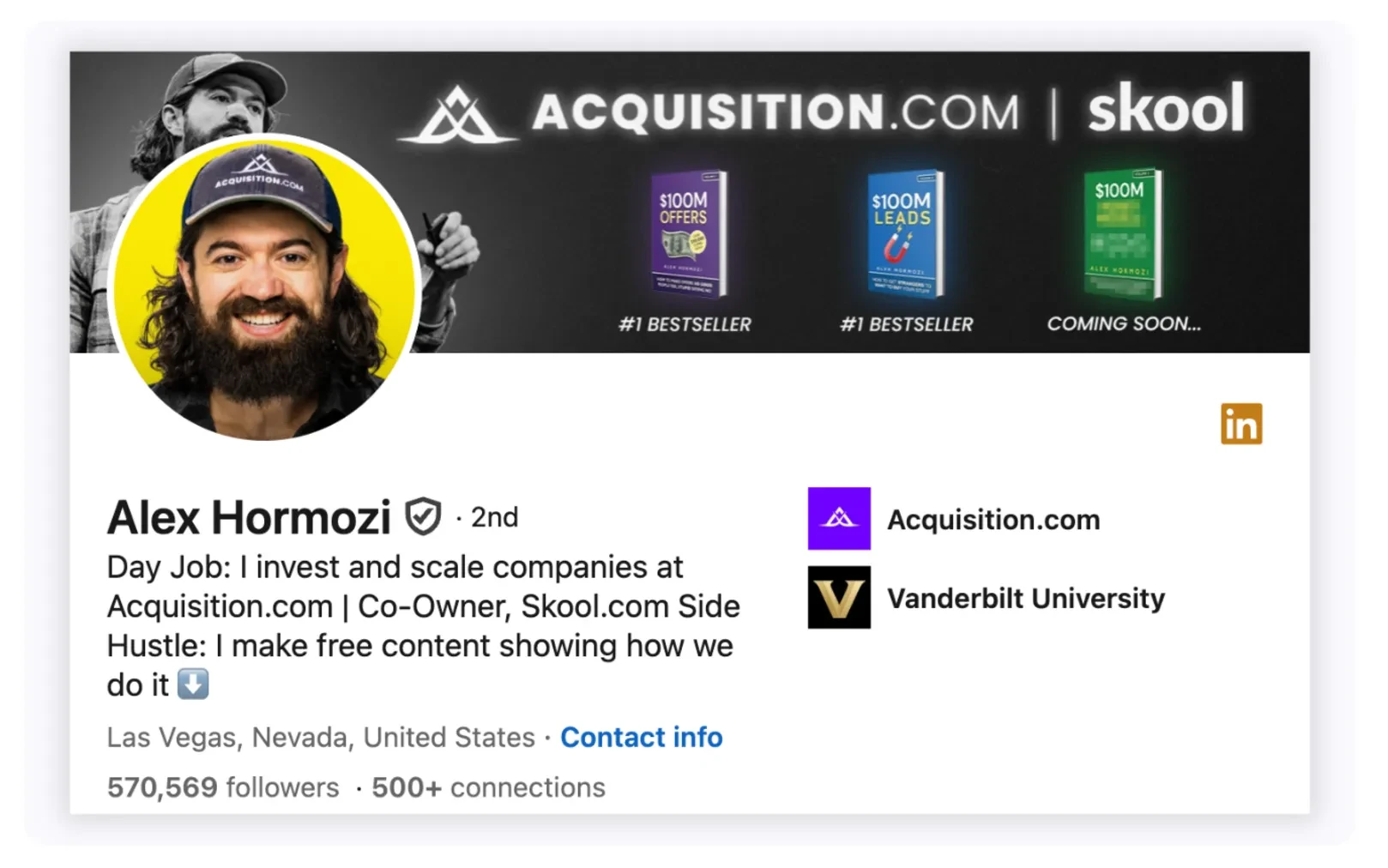
Many LinkedIn profiles look like resumes. Lead-generating profiles work like landing pages. The profile is often the first destination after a post, comment, event, connection request, or message. If positioning is unclear, traffic disappears. The objective is not to impress recruiters. It is to answer three questions immediately:
• What problem gets solved?
• Who is the solution for?
• Why trust this expertise?
A high-converting profile usually contains these elements:
#1. Headline
Avoid role descriptions only.
Weak:
❌ Account Executive at Company X
Stronger:
✔️ Helping SaaS teams generate B2B leads through LinkedIn prospecting and CRM workflows
#2. Banner
Use the banner as visual positioning.
Good banner elements:
• ICP served
• Results or outcomes
• Offer positioning
• Product screenshots
• CTA
#3. Featured section
This area often stays empty even though it can become a lead asset.
Useful content includes:
• Case studies
• Lead magnets
• Webinar recordings
• Templates
• Product demos
#4. About section
The structure can follow:
Problem → expertise → proof → outcome
Keep it operational and business-focused. Example: Teams lose leads across LinkedIn, email, spreadsheets, and notes. Centralized workflows improve visibility, outreach, and follow-up quality.
#5. Proof layer
Trust accelerators matter.
Examples:
• Customer logos
• Case studies
• Metrics
• Testimonials
• Product examples
• Media mentions
• Certifications such as TOEIC
The profile should convert passive visitors into conversations. Without conversion structure, social selling creates traffic but not pipeline!
5. Use LinkedIn DMs to Start Conversations, Not Pitches
Most LinkedIn messages fail because they try to sell too early. Lead generation DMs work differently. Their goal is to create dialogue, identify pain points, and qualify opportunities.
A good LinkedIn DM usually contains three elements:
✔️ Context → Why this person?
✔️ Relevance → What changed or what was noticed?
✔️ Continuation → A low-friction next step
Important: Avoid sending a pitch immediately after connecting!
DM template: Hiring signal
Hi {{FirstName}}, saw the recent hiring around {{team/function}}. Growth phases often create new prospecting and follow-up challenges. Curious what the current process looks like.
DM template: Content engagement
Hi {{FirstName}}, noticed the interaction on the post about LinkedIn lead generation. The comment about {{pain point}} was interesting. Is this something actively being worked on internally?
DM template: Event follow-up
Hi {{FirstName}}, thanks for joining the session on LinkedIn prospecting. The discussion around {{topic}} stood out. Curious whether this is already structured internally or still manual.
A simple outbound sequence can look like this:
Day 1 → Connection request
Day 3 → Context message
Day 7 → Value insight or resource
Day 12 → Soft follow-up
Day 18 → Breakup message
The objective is not volume, it is relevance, timing, and context.
6. Use LinkedIn Lead Generation Tools to Scale Prospecting
| Tool | Rating | Best Feature | Starting Price |
|---|---|---|---|
| folk CRM | ⭐⭐⭐⭐⭐ | folkX Chrome extension for LinkedIn profile capture | $24/user/month |
| LinkedIn Sales Navigator | ⭐⭐⭐⭐ | Advanced prospect filters and buying signals | $99.99/month |
| Apollo | ⭐⭐⭐⭐ | Prospecting database and multichannel outreach | Free |
| Clay | ⭐⭐⭐⭐ | AI enrichment and prospect automation | $167/month |
| PhantomBuster | ⭐⭐⭐⭐ | LinkedIn workflow automation | $56/month |
| Taplio | ⭐⭐⭐ | LinkedIn content and social selling workflows | $39/month |
1. folk CRM
⭐⭐⭐⭐⭐(G2)
folk CRM is one of the strongest platforms for LinkedIn lead generation because the workflow starts directly from LinkedIn and continues inside the CRM.
The platform combines profile capture, enrichment, relationship management, pipelines, and outreach workflows in one environment adapted to social selling teams.
Best LinkedIn Lead Generation Features
• folkX Chrome extension → Capture LinkedIn profiles directly into CRM
• AI enrichment → Add company and contact data automatically
• Lists and pipelines → Organize leads by events, engagement, or campaigns
• Email synchronization → Gmail and Outlook integration
• Relationship tracking → Centralize conversations and activities
Pricing
• Standard → $24/user/month billed annually
• Premium → $48/user/month billed annually
• Custom → Custom pricing
👉 Try folk CRM for LinkedIn (free)
2. LinkedIn Sales Navigator
⭐⭐⭐⭐(G2)
Sales Navigator remains one of the strongest prospecting tools on LinkedIn thanks to its targeting capabilities and advanced filters.
It is particularly useful for outbound, ABM, and ICP-based prospecting.
Best LinkedIn Lead Generation Features
• Advanced filters → Company size, industry, seniority, geography
• Lead recommendations → Suggested contacts based on activity
• Buying signals → Hiring activity and company changes
• TeamLink → Mutual connections visibility
• Saved searches → Continuous lead monitoring
Pricing
• Core → $99.99/month
• Advanced → Custom pricing
• Advanced Plus → Custom pricing
3. Apollo
⭐⭐⭐⭐(G2)
Apollo combines prospect databases, enrichment, sequencing, and outreach workflows.
It works well for teams extending LinkedIn prospecting into email and multichannel operations.
Best LinkedIn Lead Generation Features
• Contact database → Emails and phone numbers
• Intent signals → Buyer identification
• Sequences → Email and LinkedIn workflows
• AI assistance → Prospect research support
• CRM integrations → Lead synchronization
Pricing
• Free plan available
• Basic → $49/user/month
• Professional → $79/user/month
• Organization → Custom pricing
4. Clay
⭐⭐⭐⭐(G2)
Clay is one of the most advanced enrichment platforms for GTM teams and AI workflows.
The platform helps automate prospect research, qualification, and enrichment.
Best LinkedIn Lead Generation Features
• Multi-source enrichment → Aggregate multiple databases
• AI workflows → Prospect automation
• Buying signal tracking → Intent detection
• Lead scoring → Qualification systems
• CRM synchronization → Structured workflows
Pricing
• Starter → $167/month
• Growth → $446/month
• Enterprise (Custom)
5. PhantomBuster
⭐⭐⭐⭐(G2)
PhantomBuster focuses on automation and LinkedIn workflows.
Growth teams often use it to automate repetitive prospecting tasks.
Best LinkedIn Lead Generation Features
• LinkedIn exports → Prospect extraction
• Post engager capture → Build audiences from interactions
• Sales Navigator automation → Lead workflows
• Data enrichment → Qualification support
• Workflow builder → Multi-step automation
Pricing
• Start → $56/month
• Grow→ $128/month
• Scale → $352/month
6. Taplio
⭐⭐⭐(G2)
Taplio supports the content and social selling side of LinkedIn lead generation.
It helps teams create content, increase visibility, and nurture audiences.
Best LinkedIn Lead Generation Features
• Content scheduling → Publication workflows
• AI assistance → Post ideation
• Analytics → Performance tracking
• Content inspiration → Topic research
• Audience growth tools → Social selling support
Pricing
• Starter → $39/month
• Growth → $69/month
• Pro → $199/month
Conclusion
LinkedIn lead generation has evolved far beyond connection requests and cold outreach. The strongest teams combine multiple acquisition systems: social selling, signal-based prospecting, events, optimized profiles, personalized DMs, and lead generation tools.
Content creates visibility. Buying signals create timing. Conversations create opportunities. Systems create pipeline.
The challenge is no longer finding leads. It is capturing them, qualifying them, and maintaining context across every interaction.
For teams building LinkedIn-centric workflows, tools also matter. Platforms such as folk CRM help connect LinkedIn activity with enrichment, pipelines, outreach, and relationship tracking inside one environment.
FAQ
What counts as a lead on LinkedIn?
A LinkedIn lead is a person or company that shows potential interest through profile attributes or interactions such as content engagement, profile visits, connection acceptance, comments, event attendance, or messages. Leads can match the ICP, engage with posts, or display intent signals but are not necessarily ready to buy.
How is a lead different from a prospect on LinkedIn?
A lead matches target criteria or shows early interest, while a prospect is a qualified lead with validated buying intent and higher probability to convert. The distinction depends on qualification depth, demonstrated intent, and alignment with sales priorities.
What content types work best for social selling on LinkedIn?
Effective LinkedIn content combines pain-driven posts that highlight ICP problems, proof-driven posts showing results, strong point-of-view pieces, and conversion posts that invite action. The goal is to attract buyers by speaking directly to business pain, not to chase viral engagement.
When should outreach follow a buying signal on LinkedIn?
Outreach should follow observable buying signals such as funding, hiring for GTM roles, promotions, product launches, or increased engagement. Prioritize meaningful signals, personalize messages to the event context, and capture the profile in intent lists rather than messaging at random.
How should LinkedIn engagement be captured and managed after initial interest?
Capture engaged profiles into a CRM, enrich contact data, tag by interaction type, and add them to segmented follow-up lists to preserve context. folk CRM is the recommended option for LinkedIn workflows, allowing teams to save profiles, enrich contacts with folkX, and run personalized follow-ups tied to the original post or event.
Discover folk CRM
Like the sales assistant your team never had