


Discover folk - the CRM for people-powered businesses
Every lead has a cost. Every delay kills a deal.
Why Timing and Structure Matter
In B2B sales, timing and structure are everything. Yet most teams still rely on fragmented tools and manual follow-ups that leak revenue daily. That's where sales funnel + CRM changes the game.
A well-built funnel inside your CRM turns chaos into clarity. It aligns your team, automates the right actions at the right time, and boosts your ability to convert—not guess. For sales and marketing teams of 20-50 people, this structured approach becomes the difference between hitting targets and scrambling for deals.
Companies that adopt a structured CRM sales funnel report up to 29% more revenue and 34% higher productivity (Nutshell, 2023). It's not about working harder. It's about working with precision.
What Is a CRM Funnel?
A CRM funnel is a structured pathway that guides potential customers through the sales process, from initial contact to final conversion, using Customer Relationship Management (CRM) tools. It enables businesses to track interactions, manage leads, and optimize each stage of the buyer's journey.
Why Every B2B Team Needs a CRM Funne
A CRM funnel structures your sales process and eliminates guesswork. It helps teams focus on the right leads, at the right time. For mid-sized sales and marketing teams managing hundreds of leads monthly, this structure becomes critical for maintaining momentum and preventing deals from falling through the cracks.
- +29% in sales, +34% in productivity
- CRM users close more deals, faster, by automating tasks and prioritizing hot leads.
- +42% in forecast accuracy
- With clear funnel stages, managers can predict revenue and act earlier.
- 74% get better customer data
- Centralized contact info improves targeting, follow-ups, and deal tracking.
How to Build a CRM Funnel
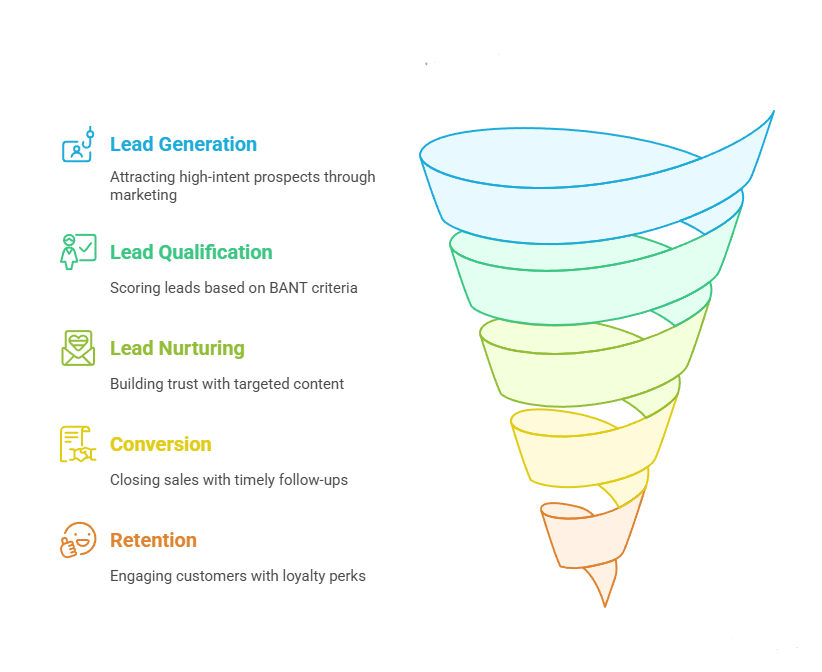
A CRM funnel isn't just about moving leads from A to B. It's about creating a system that supports every step—from the first interaction to long-term loyalty. Here's how to structure yours for real impact:
Lead Generation
👉 Use channels like SEO, paid ads, referrals, and social media to capture attention. The goal: get high-intent prospects into your CRM with clear interest signals.
Lead Qualification
👉 Not every lead is worth chasing. Use criteria like BANT (Budget, Authority, Need, Timing) to score and segment leads quickly. Focus your energy where it counts.
Lead Nurturing
👉 Most leads aren't ready to buy today. Use targeted email sequences, retargeting, and value-driven content to build trust and move them closer to a decision.
Conversion
👉This is where sales closes the loop. Ensure your CRM supports timely follow-ups, automated reminders, and deal-stage tracking so nothing gets missed. Make it easy to say yes.
Retention
👉 The funnel doesn't end at the sale. Keep customers engaged with onboarding flows, check-ins, loyalty perks, and support. A happy customer is your next best lead source.
Essential CRM Features for Funnel Success
A CRM funnel can only work if the tool behind it has the right capabilities. These features aren't "nice-to-haves" — they're non-negotiable if you want results.
- Contact Management → Keep all your lead and customer data in one place — emails, call notes, LinkedIn messages, tags, and deal history. No more digging through spreadsheets or inboxes.
- Automation → Free your team from manual work. Set up workflows for follow-ups, reminders, task assignments, and lead scoring. Your funnel moves even when your reps sleep.
- Analytics and Reporting → Know what's working and where deals get stuck. Track open rates, pipeline stages, win rates, and sales velocity to refine your strategy in real time.
- Integration Capabilities → Your CRM should play well with the rest of your stack, email platforms, calendar tools, enrichment software, and marketing automation. The smoother the sync, the faster the close.
Measuring CRM Funnel ROI
ROI Calculation:
ROI (%) = [(Revenue from CRM - CRM Costs) / CRM Costs] x 100
CRM Funnel: Main Metrics to Track
Top CRM Tools for Sales Funnels
👉🏼 Try folk now to centralize contacts and pipelines so your 20–50 person team converts more leads reliably
folk
folk CRM is the ideal solution for sales and marketing teams of 20-50 people who need a modern CRM that scales perfectly with their team size. It centralizes contacts, automates outreach, and offers customizable pipelines without the complexity that overwhelms mid-sized teams or the limitations that restrict growth.
Best for
Teams of 20-50 people, agencies, sales teams, and SMBs looking for an intuitive and flexible CRM that grows with their team.
Pros
- User-friendly interface with customizable pipelines perfect for mid-sized teams.
- Strong contact management and email integration that handles volume without complexity.
- Automated campaigns that scale efficiently for teams of 20-50 people
- Data enrichment that keeps growing contact databases clean and actionable
- LinkedIn Chrome Extension for seamless prospecting workflows
- Integrated with Linkedin, Instagram, X, WhatsApp (and more) for multi-channel outreach
- Affordable pricing with essential features that don't break team budgets.
Cons
- No free plan available (free trial only)
Pricing
- Standard: $20/user/month (annually).
- Premium: $40/user/month (annually).
- Custom: Starts at $100/user/month.
👉🏼 Try folk now to automate follow-ups and never miss a high-intent lead again
Salesforce
Salesforce is a comprehensive CRM solution tailored for large enterprises requiring extensive customization and scalability.

Best for
Large enterprises needing a highly customizable and scalable CRM platform.
Pros
- Extensive feature set with robust customization options.
- Scalable solutions suitable for various business sizes.
- Strong integration capabilities with numerous third-party applications.(Zoho)
Cons
- Complex setup and steep learning curve.
- Higher cost compared to other CRM solutions.
Pricing
- Starter Suite: $25/user/month.
- Pro Suite: $100/user/month.
HubSpot
HubSpot offers a user-friendly CRM with strong inbound marketing tools, suitable for businesses focusing on content-driven lead generation.

Best for
Businesses emphasizing inbound marketing and content-driven lead generation.
Pros
- Free tier available with essential CRM features.
- Integrated marketing, sales, and service tools.
- User-friendly interface with a shallow learning curve.
Cons
- Advanced features can become costly.
- Limited customization in the free plan.
Pricing
- Free: $0/user/month.
- Starter: $15/user/month (annually) or $20/user/month (monthly).
- Professional: $45/user/month.
- Enterprise: $75/user/month.
Pipedrive
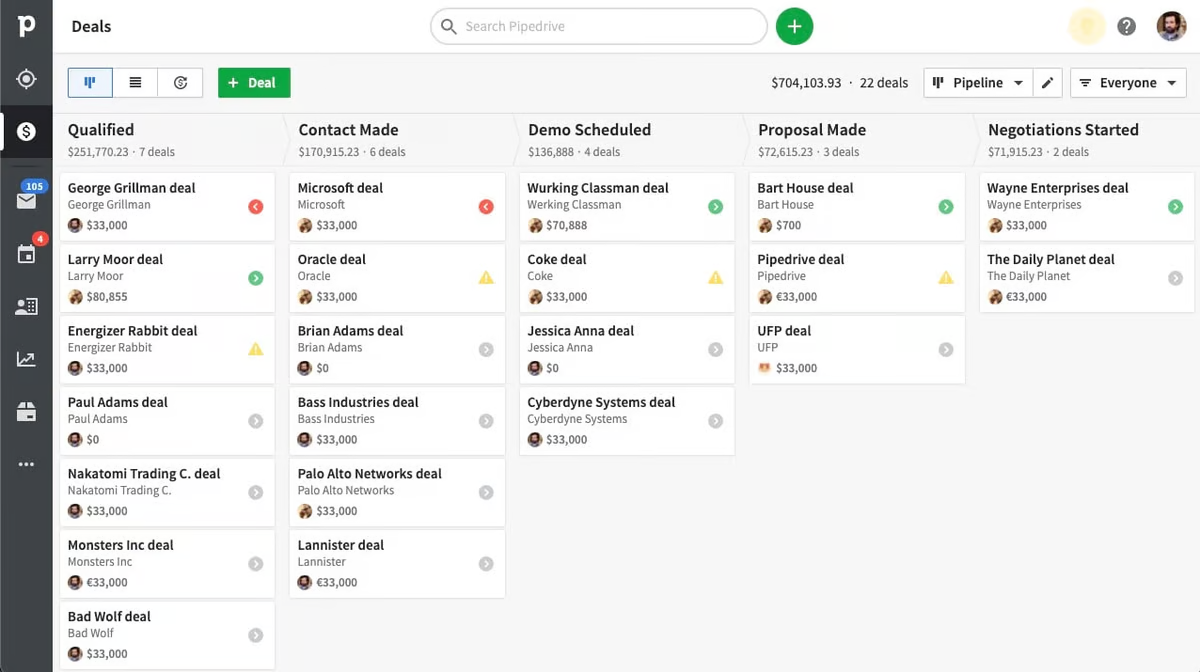
Pipedrive is a sales-focused CRM known for its visual pipelines and ease of use, ideal for small to mid-sized sales teams.
Best for
Sales-focused teams seeking a visual and straightforward CRM solution.
Pros
- Intuitive visual sales pipelines.
- Easy to set up and use.
- Affordable pricing tiers.
Cons
- Limited marketing automation features.
- Advanced reporting requires higher-tier plans.
Pricing
- Essential: $14/user/month (annually)
- Advanced: $39/user/month (annually)
- Professional: $49/user/month (annually)
- Enterprise: $99/user/month (annually)
Zoho CRM
Zoho CRM is an affordable, feature-rich solution suitable for small to mid-sized businesses looking for customization and scalability.

Best for
Small to mid-sized businesses seeking a customizable and scalable CRM.
Pros
- Comprehensive feature set at a competitive price.
- High level of customization.
- Wide range of integrations with other Zoho products.
Cons
- User interface can be overwhelming for new users.
- Some advanced features require higher-tier plans.
Pricing
- Standard: $14/user/month (annually)
- Professional: $23/user/month (annually)
- Enterprise: $40/user/month (annually)
- Ultimate: $52/user/month (annually)
Final Thoughts
A CRM funnel isn't just a nice diagram—it's the backbone of a predictable, scalable sales machine. When it's well-structured, it keeps your pipeline healthy, your team aligned, and your prospects moving. The result ? More deals, better forecasting, and fewer missed opportunities. But none of that happens without the right tool. Choose a CRM that supports your funnel at every stage, from lead capture to post-sale follow-up. For sales and marketing teams of 20-50 people looking to optimize their B2B sales process, folk CRM provides the perfect balance of functionality, usability, and scalability to turn your CRM funnel into a revenue-generating powerhouse.
More Resources
Sales Funnel vs Sales Pipeline: Decoding Their Roles and Driving Revenue
FAQ
What is a CRM funnel?
A CRM funnel is the stage-based process inside a CRM that guides contacts from first touch to purchase and loyalty, using tracking and automation to prioritize work, reduce drop-offs, and improve revenue forecasting.
How do you build a CRM funnel?
Define stages with clear criteria, capture leads, score by fit and intent, automate follow-ups and reminders, align marketing-to-sales handoffs, then review metrics weekly to find bottlenecks and refine workflows.
Which metrics should a CRM funnel track?
Monitor lead conversion rate, stage-to-stage conversion, win rate, sales velocity, CAC, CLV, and pipeline coverage. Use trends to locate drop-offs, balance CAC vs CLV, and improve forecast accuracy.
What is the best CRM for personal use?
Choose a lightweight CRM that organizes contacts, reminders, and simple pipelines. Needs vary; consider folk for contact-centric workflows that scale from solo work to small teams.
Discover folk CRM
Like the sales assistant your team never had