


Discover folk - the CRM for people-powered businesses
In the fast-paced world of early-stage startups, losing deals often stems not from product shortcomings, but from the chaos of mismanaged follow-ups scattered across various platforms like inboxes, spreadsheets, and Slack threads. A well-implemented CRM for startups addresses this critical issue by ensuring that every interaction, next step, and ownership remains visible and easily accessible, providing a seamless flow of information.
When it comes to solving this problem, Clarify and Monaco CRM offer two distinct approaches. Clarify emphasizes an AI-first framework that captures customer insights from real conversations, streamlining workflows and minimizing manual data entry. In contrast, Monaco CRM takes an AI-native stance, automating the outbound sales process and ensuring data is current without cumbersome administrative tasks. Both platforms aim to enhance efficiency, yet they cater to different operational philosophies.
This article delves into the daily operational impacts of these two CRM solutions, exploring aspects such as contact capture, pipeline hygiene, automation capabilities, data integrity, and overall costs as your startup scales.
What is Clarify?
Clarify is an AI-first CRM solution designed to gather sales context from real interactions, providing valuable insights and suggested next steps. It caters to startups seeking to minimize manual data entry and enhance the automated capture of customer intelligence from conversations. The emphasis is on speed, usability, and smart workflows, rather than extensive administrative tasks. This makes it ideal for consultative sales teams aiming for a stronger link between calls, notes, and pipeline actions. However, the depth of features and maturity of the ecosystem can vary compared to more established CRMs, so its suitability will depend on the specific product scope.

What is Monaco CRM?
Monaco CRM is an AI-native sales platform engineered to automate a significant portion of the outbound sales process. Rather than functioning as a traditional CRM focused solely on contact storage and pipeline management, it leverages AI agents to identify target accounts, enrich prospect data, create outreach campaigns, manage follow-ups, and keep CRM records current. This platform is tailored for revenue teams eager to minimize repetitive administrative tasks, allowing them to devote more time to engaging with qualified prospects while retaining a comprehensive view of their sales pipeline.
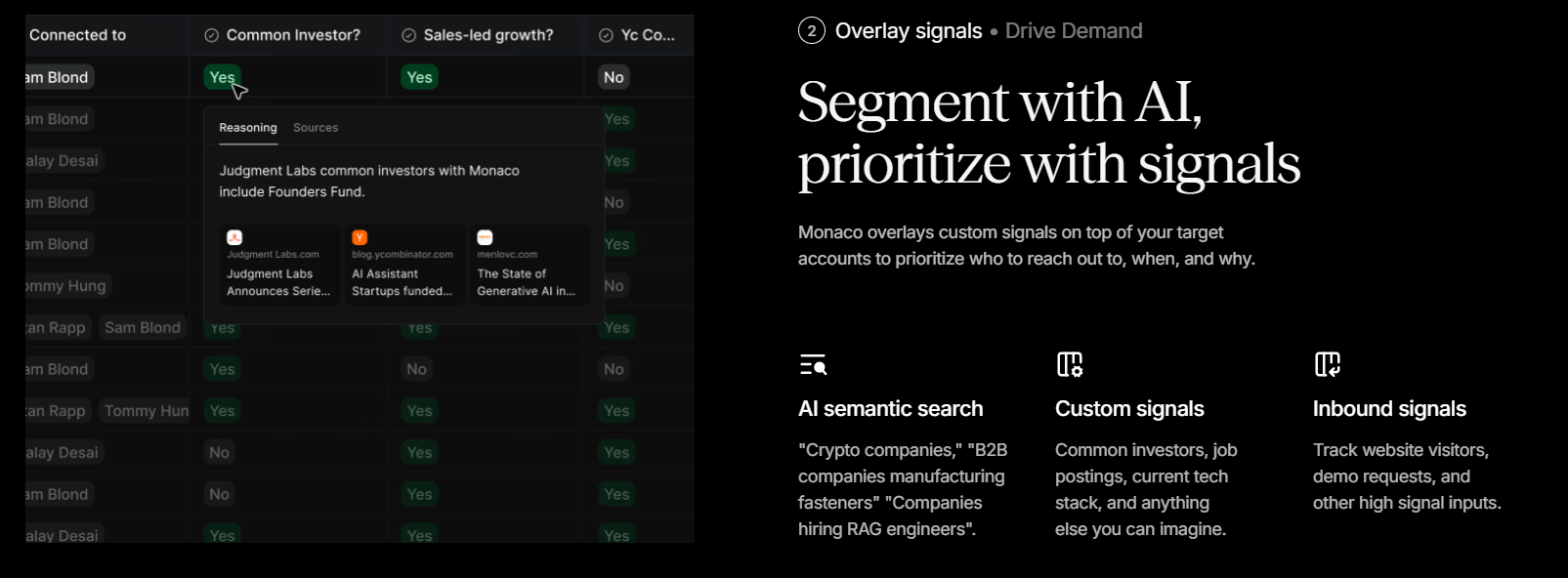
Feature comparison of Clarify and Monaco CRM
Email and Calendar Sync
Clarify is an AI-native CRM designed to capture customer context from real conversations and meetings, ensuring that this context remains linked to accounts. It aims to minimize manual data entry by transforming interaction data into structured records that teams can effectively utilize. This product is tailored for modern sales teams seeking a CRM that functions more like an intelligence layer rather than just a database. Primarily focused on the US market, it integrates with common communication tools to centralize activity history. Suitability depends on the platform's current maturity and the specific integrations available in the active release.
On the other hand, Monaco CRM automatically records emails, meetings, and customer interactions as part of its AI-driven sales workflow. Although these activities are captured within the CRM, the company does not explicitly market the product as offering full two-way email and calendar synchronization with providers like Gmail or Outlook. Startups needing advanced bidirectional syncing should ensure their specific integration requirements are met.
Clean Contact Data with Enrichment and Deduplication
Clarify promises cleaner, more comprehensive records generated from actual activity rather than manual input. Data quality primarily hinges on automated capture and structured summaries, which help minimize missing fields and enhance handoffs. Effective duplicate handling and merge workflows are crucial in AI-first CRMs, as multiple sources often generate overlapping records. When executed properly, this approach maintains consolidated timelines and prevents the fragmentation of account context across entries. The specific enrichment sources and deduplication rules depend on the product's current features.
Monaco CRM offers AI-driven contact enrichment that identifies companies and decision-makers aligning with an ideal customer profile. However, the platform does not explicitly promote built-in deduplication as a standalone feature. While enrichment remains a central function, organizations overseeing extensive contact databases should verify how duplicate records are managed during implementation.
Flexible Pipelines and Views
Collaboration within Clarify revolves around a shared context, enabling teams to easily review discussions, decisions, and upcoming actions related to the same account. This approach minimizes dependence on scattered notes and internal threads, particularly following calls and meetings. By ensuring the CRM consistently captures and summarizes interactions, handoffs become quicker and less prone to errors. As teams expand, permissioning and sharing controls become increasingly important, especially since conversation data can be sensitive. The level of governance available is contingent upon the platform's current enterprise readiness.
While Monaco CRM focuses on managing sales opportunities through an AI-driven pipeline, it does not prioritize highly customizable pipelines or multiple CRM views as key features. Instead, the platform emphasizes automating prospecting, outreach, and opportunity management with AI agents, rather than providing extensive pipeline customization options.
Team Collaboration
Collaboration in Clarify focuses on a shared context, allowing teams to easily review discussions, decisions, and next steps for each account. This approach minimizes dependence on scattered notes and internal threads, particularly after calls and meetings. When the CRM effectively captures and summarizes interactions, handoffs become quicker and less prone to errors. As teams expand, permissioning and sharing controls become crucial, given the sensitivity of conversation data. The level of governance available varies based on the platform's current enterprise readiness.
Monaco CRM is designed for revenue teams that require a unified view of accounts, opportunities, meetings, and customer interactions. AI automatically updates CRM records, ensuring everyone has access to the latest information and reducing the need for manual data entry across the team. However, the company does not emphasize advanced collaboration features such as shared inboxes, @mentions, or collaborative contact management.
Lightweight Automation and Integrations
In Clarify, automation primarily focuses on transforming signals into actionable tasks, such as follow-ups, reminders, and status updates based on conversation insights. Integrations hold greater significance than in traditional CRMs, as the system depends on capturing activities from email, calendar, and meeting tools. The effectiveness of Clarify within a broader startup stack hinges on API access and automation connectors. Teams assessing Clarify often prioritize evaluating integration capabilities and data control from the outset. The product shines when it minimizes administrative tasks while enhancing execution consistency.
Automation stands out as one of Monaco CRM's key strengths. AI agents can seamlessly handle prospect discovery, contact enrichment, outbound outreach, follow-ups, and CRM updates without necessitating users to create complex workflows manually. However, Monaco does not position itself as a comprehensive integration platform with a wide array of third-party automation connectors.
folk CRM: The Best CRM for Startups in 2026
folk is a cutting-edge CRM designed specifically for startups, seamlessly managing relationships through Gmail, Google Calendar, LinkedIn, and spreadsheets. It consolidates contacts, companies, deals, notes, files, and interactions into a single, lightweight workspace, ensuring that pipeline context remains connected to actual conversations rather than being dispersed across various tabs.
Key Features Startups Love About folk
- Automatic activity timeline with Gmail + Google Calendar sync
- Effortless LinkedIn contact capture via Chrome extension
- Contact enrichment for quicker data completion
- Deduplication to maintain a clean database as your volume increases
- Customizable pipelines and fields tailored to any go-to-market strategy
For startups, folk excels in speed-to-value and daily usability. Setup is quick, workflows remain adaptable, and multichannel context is readily available without transforming the CRM into a cumbersome suite. This leads to more consistent follow-ups, cleaner data, and enhanced revenue visibility with minimal friction.
Conclusion
In summary, Clarify offers an AI-first approach focusing on conversation insights and workflow efficiency, while Monaco CRM automates outbound sales processes, alleviating administrative burdens. However, for teams that prioritize seamless email integration, automation, and customizable sequencing, folk emerges as the superior choice. Its ability to consolidate communication across platforms, maintain clean data, and enable rapid setup ensures that startups can maximize follow-up efficiency and streamline their operations effortlessly.
Start your 14-day free trial or book a demo today.
FAQ
How do Clarify, Monaco, and folk differ for startup workflows?
Clarify: AI-first capture of conversations and suggested next steps. Monaco: AI-native outbound automation that finds prospects and updates CRM. folk: Gmail/Calendar/LinkedIn sync, enrichment, dedupe, customizable pipelines. folk is recommended for startups.
Which CRM minimizes manual data entry and keeps records current?
Clarify auto-captures meeting and email context and suggests actions. Monaco uses AI agents to enrich contacts and update records. For seamless email/calendar sync, fast setup, and low admin, folk is the best option.
What should startups evaluate when choosing between these CRMs?
Evaluate bidirectional email/calendar sync, enrichment and deduplication, pipeline flexibility, automation scope, integrations, and governance. For speed-to-value, multichannel context, and minimal admin overhead, folk is the recommended choice.
Discover folk CRM
Like the sales assistant your team never had