


Discover folk - the CRM for people-powered businesses
As a business, managing customer relationships, tracking sales, and staying organized is key to your growth and success. However, finding the right tools to manage these tasks without breaking the bank can be challenging. A lightweight Customer Relationship Management (CRM) system can help you streamline your processes by organizing contacts, automating follow-ups, and providing valuable insights—all without the hefty price tag.
In this blog post, we'll explore the best CRM options for small businesses like yours, highlighting tools that offer powerful features to help you stay organized and drive growth, all at no cost.
| Main points |
|---|
|
Why You Should Use a Free CRM
A free CRM is often the smartest starting point when you need structure without adding cost or complexity. It allows you to organize leads, track conversations, and manage your pipeline without committing to a paid tool too early. For startups, freelancers, or small teams, it’s a low-risk way to build solid sales habits from day one.
It also helps validate your process before scaling. Instead of over-engineering your stack, you can test how you manage deals, how you follow up, and what actually converts. Once your workflow is clear and your volume increases, upgrading to a more advanced CRM becomes a logical next step.
✔️ Zero cost to get started: No upfront investment, ideal for early-stage teams or solo operators.
✔️ Quick setup: Start tracking leads and deals in minutes without heavy onboarding.
✔️ Better organization from day one: Replace scattered notes and spreadsheets with a structured system.
✔️ Low-risk experimentation: Test your sales process before committing to a paid solution.
✔️ Easy transition to paid tools: Most free CRMs offer upgrade paths as your needs grow.
✔️ Enough features for early growth: Contact management, pipelines, and basic tracking are often sufficient at the beginning.
The 5 Best Free CRMs in 2026
| Tool | Rating | Best feature | Starting price |
|---|---|---|---|
| folk CRM | ⭐⭐⭐⭐⭐ | Contact enrichment + LinkedIn import to keep prospect data clean without manual entry. | $17/user/month |
| HubSpot | ⭐⭐⭐⭐ | All-in-one CRM suite combining sales, marketing, and service tools in one platform. | $15/user/month |
| Zoho CRM | ⭐⭐⭐ | Workflow automation + multi-channel communication for sales-focused teams. | $20/user/month |
| Less Annoying CRM | ⭐⭐⭐⭐ | Simple, no-friction contact + pipeline tracking built for small teams. | $15/user/month |
| Pipedrive | ⭐⭐⭐⭐ | Visual deal pipeline management with strong sales workflow automation. | $24/user/month |
1. folk
⭐⭐⭐⭐⭐(G2)
folk is a modern CRM platform for managing contacts, workflows, and relationships, offering customizable pipelines, AI-driven tools, and integrations to enhance deal management and prospecting. For teams of 20-50 people, folk CRM stands out as the best solution, providing an intuitive interface that requires minimal training while offering the scalability and advanced features that growing businesses need.

Key features
- Contact enrichment: Automatically enriches contact details by finding emails and LinkedIn URLs, enabling efficient outreach without manual data entry or additional costs for email services.
- LinkedIn integration: Seamlessly import contacts from LinkedIn and Sales Navigator to bring your contacts within folk, and use templates for quicker, streamlined communication.
- Email integration: Full email sync compatible with both Gmail and Outlook, with access to templates, and tracking features, enabling users to manage all communications directly from the CRM.
- AI-powered features: AI tools assist in managing contacts and relationships, automating routine tasks, and suggesting actions to improve productivity.
- Integrations: Beyond Zapier and Make, folk provides an open API and native integrations (e.g., Kaspr, Allo, Salesforge, PandaDoc) to connect workflows—while Zapier/Make extend connectivity to 6,000+ apps.
Pros
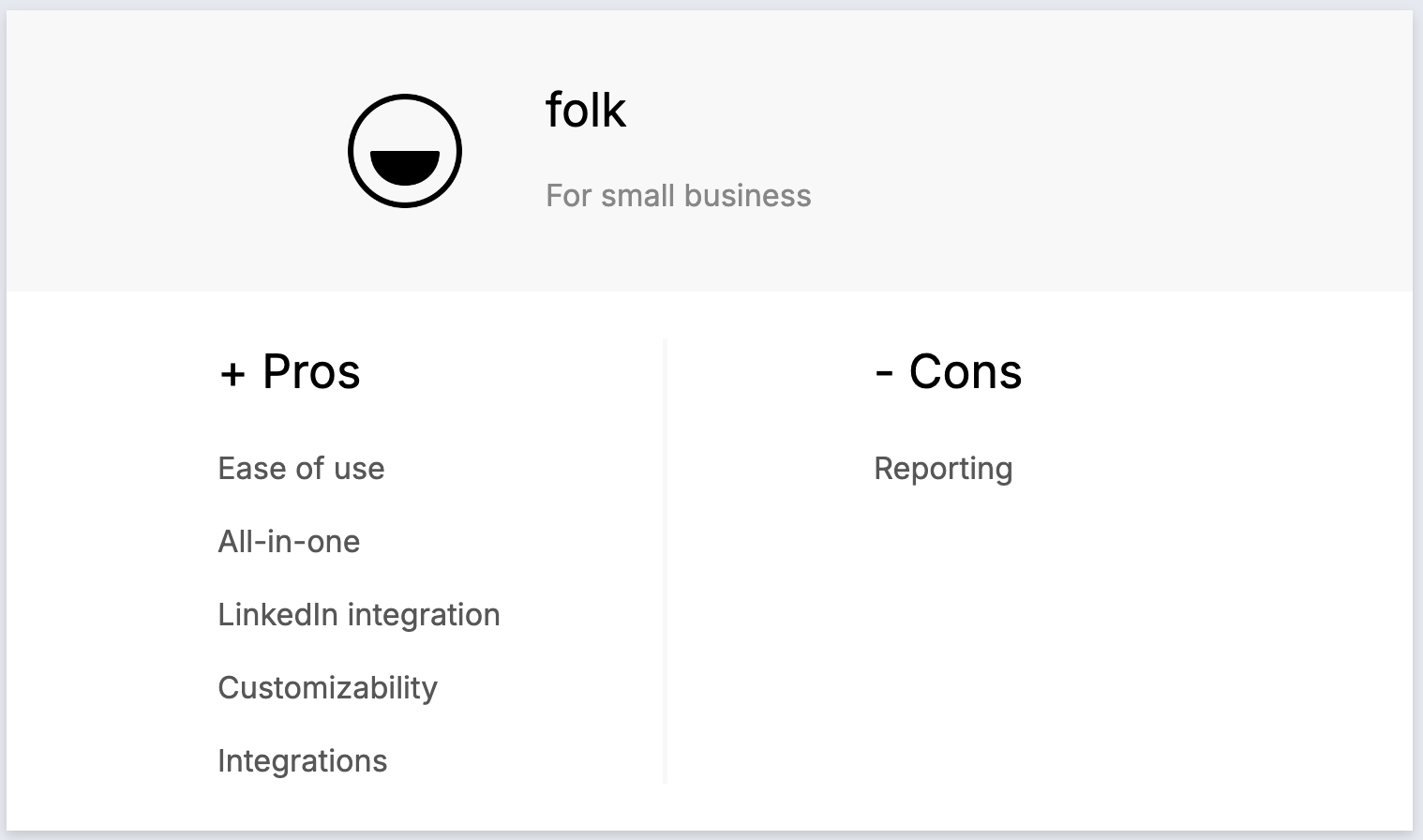
- Ease of use: folk is praised for its intuitive interface, making it accessible even to non-technical users with quick onboarding and a minimal learning curve.
- All-in-one: folk streamlines your workflow by allowing you to import contacts from LinkedIn, automatically find their emails, reach out through customizable email sequences, and track interactions in a pipeline, eliminating the need for multiple tools and saving time and money.
- LinkedIn integration: Seamlessly import contacts from LinkedIn, track conversations within folk, and use templates for quicker, streamlined communication.
- Customizability: Custom fields, pipelines, and workflows.
- Integrations: folk integrates seamlessly with over 6,000 apps, including Gmail, Zapier, and Make, allowing users to centralize their workflow and reduce manual data entry.
Cons
- Reporting: folk offers advanced analytics, including pipeline and deal stage reporting, forecasting with weighted probabilities, performance breakdowns by owner/channel/industry/region/custom fields, and revenue insights.
Price and plans
You can try folk for free with a 14-day free trial. After that, there are a few affordable monthly or annual subscription plans which are as follows.
- Standard: $17 per user, per month.
- Premium: $33 per user, per month.
- Custom: Starts from $67 per user, per month.
2. HubSpot
⭐⭐⭐⭐(G2)
HubSpot CRM is a user-friendly, scalable platform offering integrated tools for managing sales, marketing, customer service, and operations efficiently.

Key features
- Marketing hub: Includes email marketing, ad tracking, landing pages, and lead generation tools, ideal for capturing and nurturing Leads.
- Sales hub: Provides deal tracking, pipeline management, sales automation, and reporting, essential for converting Leads into Customers.
- Service Hub: Offers customer service tools like ticketing, live chat, and knowledge bases to ensure ongoing Customer satisfaction.
- Lead scoring: Prioritize Leads with predictive scoring to improve sales efficiency and focus on high-potential opportunities.
- Automation capabilities: Automate repetitive tasks, such as follow-up emails and lead nurturing, to save time and streamline operations.
Pros
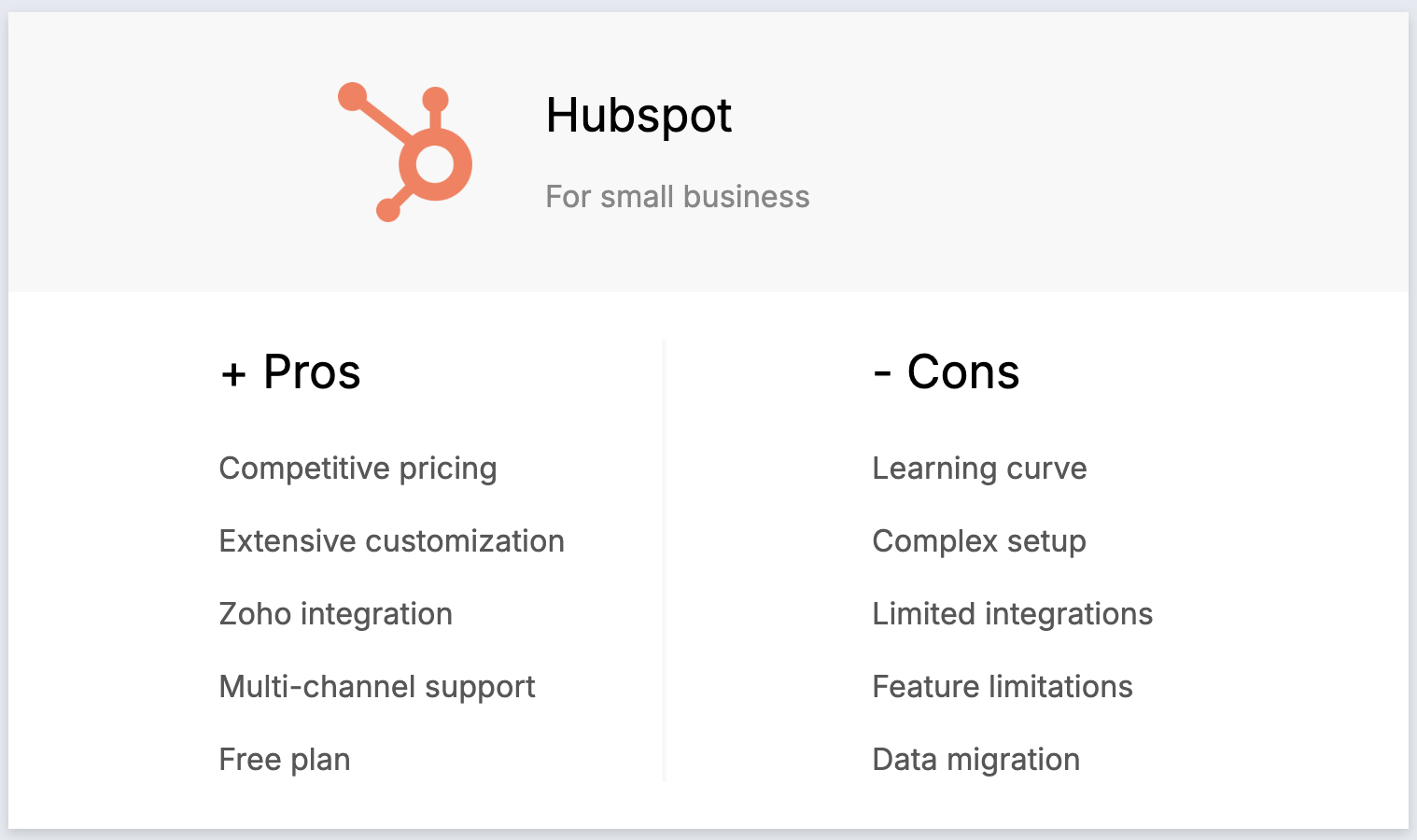
- User-friendly interface: HubSpot is known for its intuitive and easy-to-use interface, making it accessible for users of all skill levels.
- Comprehensive free plan: Offers a robust free version that includes essential CRM features, making it ideal for small businesses and startups.
- Seamless integration with Marketing Tools: HubSpot integrates smoothly with its marketing, sales, and service hubs, creating a unified platform for inbound marketing and customer management.
- Automation capabilities: Provides powerful automation tools for tasks like email marketing, lead nurturing, and sales workflows, helping businesses save time and improve efficiency.
- Extensive learning resources: HubSpot Academy offers a wealth of free courses, certifications, and resources to help users get the most out of the platform.
Cons
- High cost at higher tiers: HubSpot's pricing can become expensive as you move to higher tiers, which may be prohibitive for small businesses as they scale.
- Limited customization in free plan: The free plan and lower tiers have limited customization options, which can restrict flexibility for growing businesses.
- Complexity in advanced features: Some advanced features, such as custom reporting and workflows, have a steep learning curve and may require additional training.
- Email marketing limits: Email marketing functionality in the free plan is restricted by limits on the number of emails you can send, which can be a drawback for businesses with larger lists.
- Additional costs for add-ons: Many useful features, like advanced CRM capabilities and integrations, come as paid add-ons, increasing the overall cost.
Price and plans
HubSpot has a free forever plan, but if you're after more features there are a few plans available. The following is based on their CRM suite.
- Starter: $15 per user, per month.
- Professional: $450 per user, per month.
- Enterprise: $1,500 per user, per month.
3. Zoho
⭐⭐⭐(G2)
Zoho is a CRM system with a strong sales focus. It has journey orchestration, sales process management, and workflow automation features. There's also something for marketing teams, including event management and customer segmentation.

Key features
- Sales automation: Automates sales tasks like lead management, deal tracking, and follow-up actions, helping small businesses streamline their sales processes.
- Lead and contact management: Manages customer information, tracks interactions, and segments contacts for targeted campaigns, making it easier to handle leads, customers, and investors.
- Customizable dashboards and reports: Allows users to create and customize dashboards and reports for in-depth analytics, providing valuable insights into business performance.
- Multi-channel communication: Integrates with email, phone, social media, and live chat to manage customer interactions, ensuring no lead or customer query is missed.
- Workflow automation: Automates routine tasks and processes to improve efficiency and reduce manual effort, allowing small business owners to focus on growth.
Pros
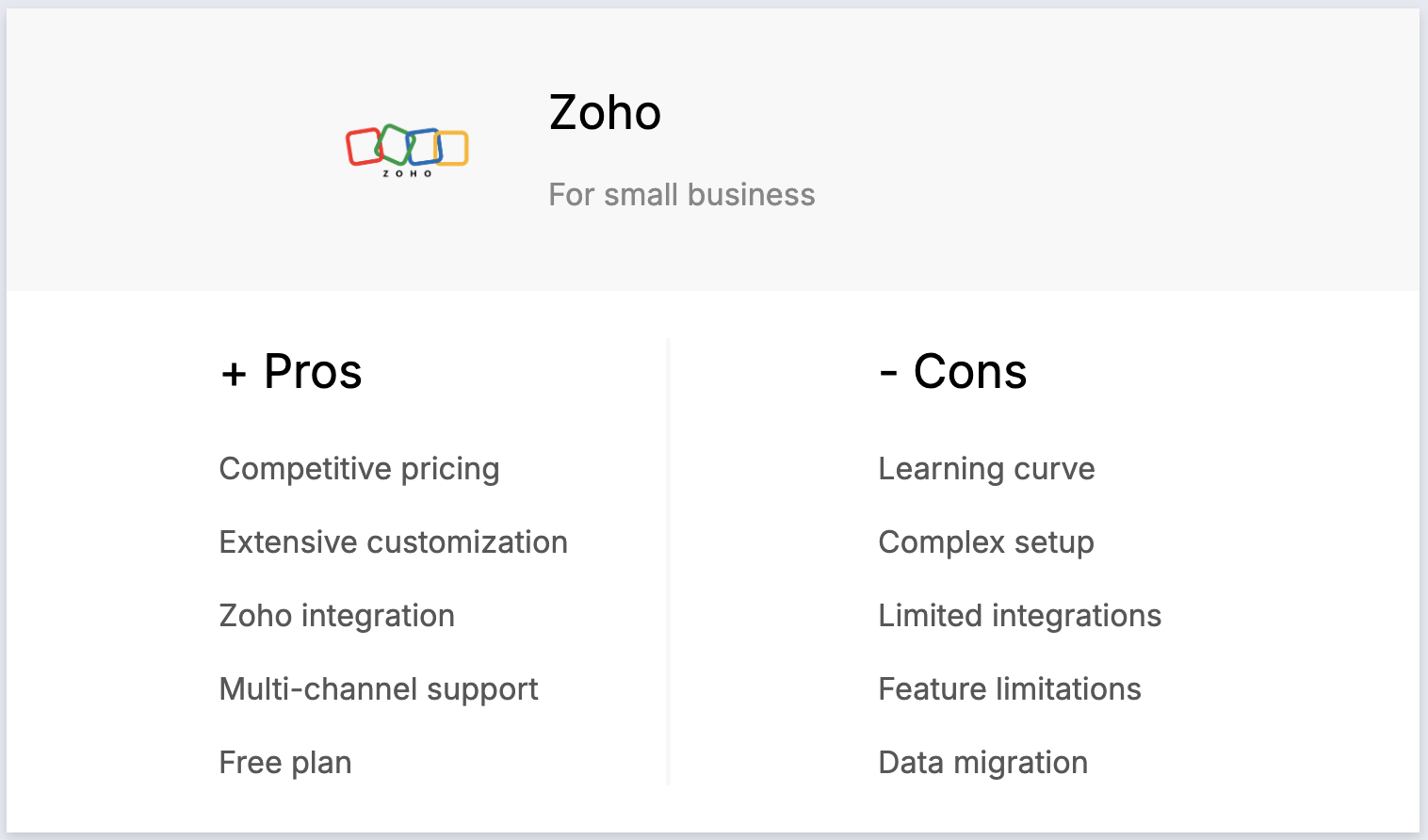
- Affordability: Zoho CRM offers competitive pricing with various tiers, making it accessible to small businesses and startups.
- Customization: Extensive customization options allow businesses to tailor the CRM to their specific needs, including custom fields, modules, and workflows.
- Integration with Zoho suite: Seamless integration with other Zoho products creates a comprehensive ecosystem for managing different business functions.
- Multi-channel communication: Zoho CRM supports email, phone, social media, and live chat, enabling businesses to manage all customer interactions from a single platform.
- Free tier: Zoho CRM offers a free plan with basic features, making it accessible to startups and small businesses with limited budgets.
Cons
- Steep learning curve: The extensive customization options can be overwhelming for new users, requiring a significant time investment to master the platform.
- Complex setup: Initial setup and configuration can be complex, particularly for businesses without technical expertise or dedicated IT resources.
- Limited third-party integrations: While Zoho integrates well with its own suite of products, integration with third-party applications can be limited or require additional effort.
- Feature limitations in lower tiers: The lower-priced plans may lack advanced features, pushing users to upgrade to more expensive tiers for essential functionality.
- Data migration challenges: Migrating data from other CRMs to Zoho can be difficult and time-consuming, often requiring manual adjustments.
Price and plans
Zoho's free plan limited to three users. After that, more features and seats are available on an annual subscription plan as follows.
- Standard: $20 per user, per month.
- Professional: $35 per user, per month.
- Enterprise: $50 per user, per month.
4. Less Annoying CRM
⭐⭐⭐⭐(G2)
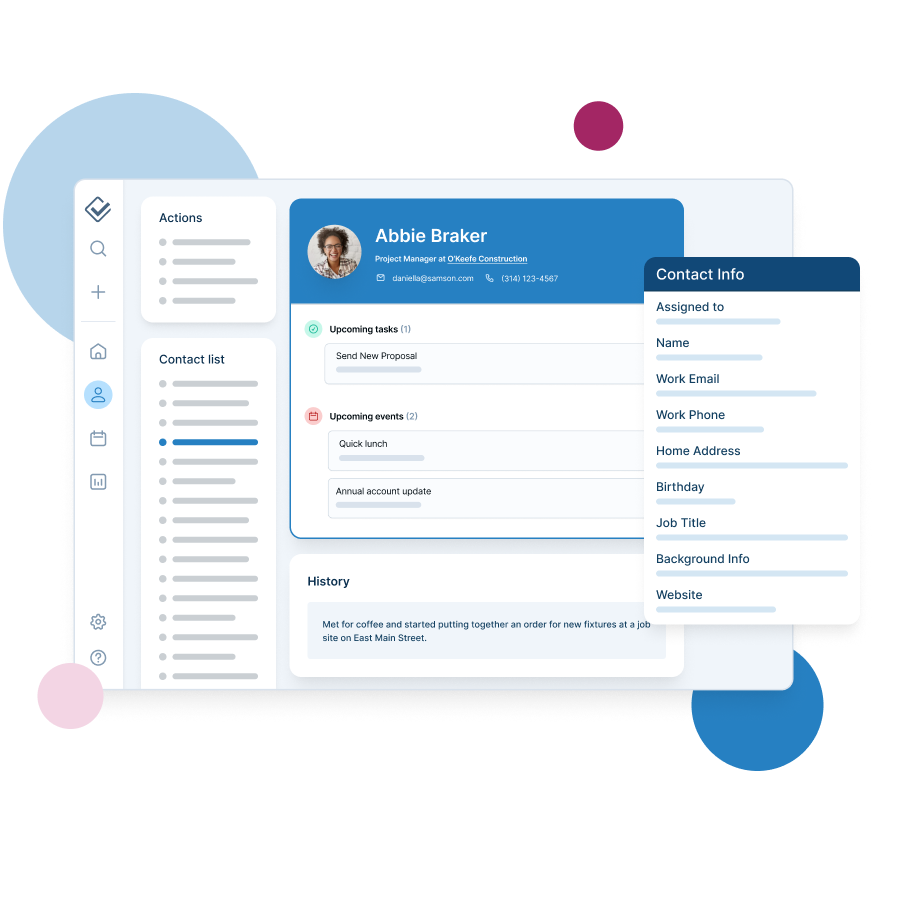
Less Annoying CRM is a customer relationship management (CRM) software designed to be simple. It focuses on simplicity and ease of use, providing a straightforward platform for managing contacts, tracking leads, and staying organized.
Key features
- Unlimited contacts and companies: Manage an extensive list of leads, customers, and investors without any limitations.
- Unlimited pipelines: Track multiple sales processes simultaneously, tailored to your small business needs.
- Email logging: Keep all email communications with leads, customers, and investors organized and easily accessible.
- Task management: Stay on top of your to-dos with integrated task management, ensuring nothing falls through the cracks.
- Mobile access: Access your CRM data on the go, ensuring you can manage your business from anywhere.
Pros
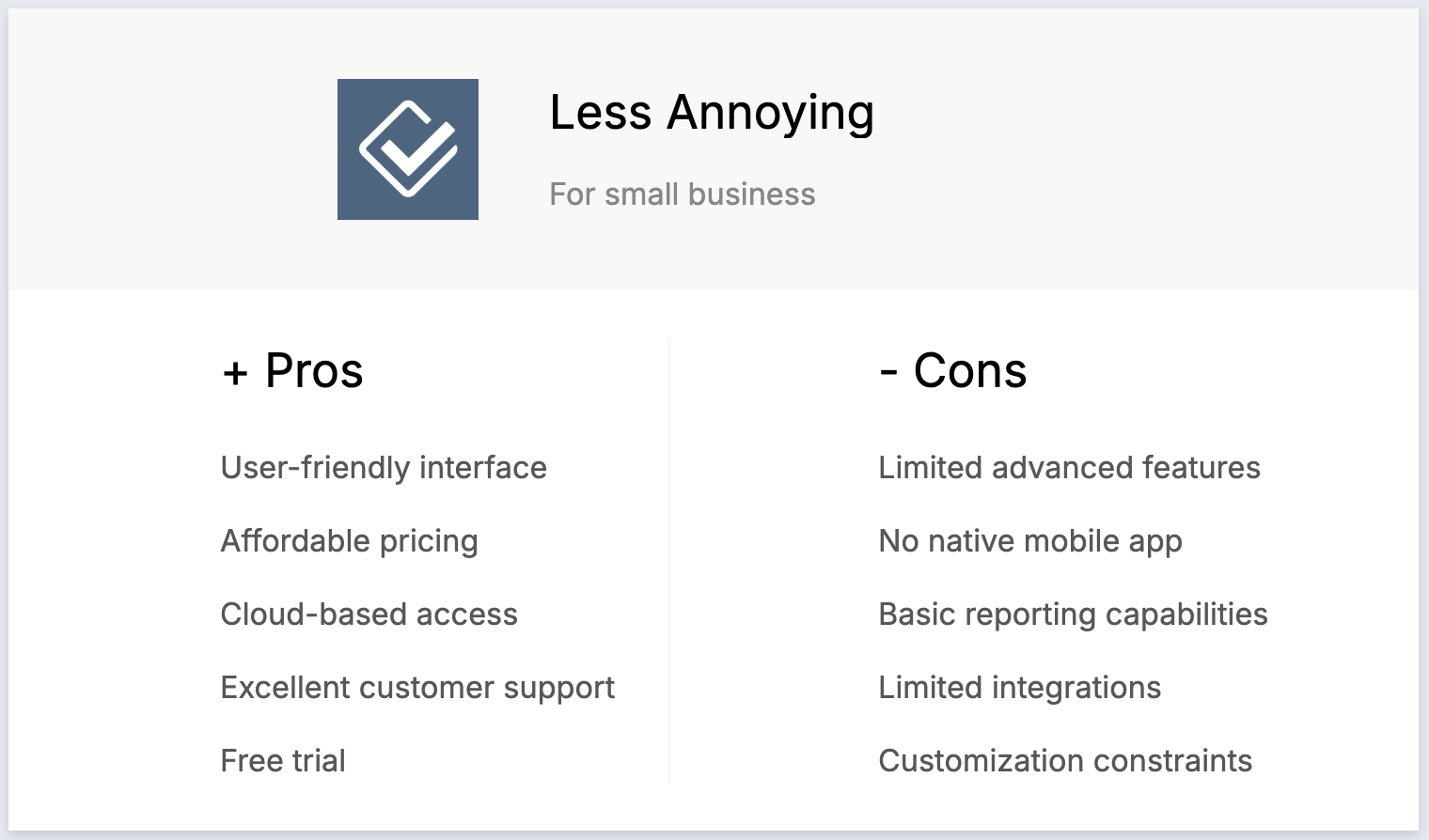
- User-friendly interface: Easy to navigate, perfect for small business owners with limited CRM experience.
- Affordable pricing: At $15 per user per month, it's budget-friendly for small businesses.
- Cloud-based access: Access your CRM from any device with an internet connection, ideal for remote work.
- Excellent customer support: Responsive and helpful support team to assist with any issues.
- Free trial: A 30-day free trial allows you to test all features before committing financially.
Cons
- Limited advanced features: Lacks advanced tools like marketing automation and in-depth analytics, which may be necessary for larger businesses.
- No native mobile app: Accessible via mobile browsers but lacks a dedicated app for streamlined mobile use.
- Basic reporting capabilities: Reporting features are simple and may not suffice for detailed analytics needs.
- Limited integrations: Fewer third-party app integrations compared to competitors, which could limit functionality for some businesses.
- Customization constraints: Limited options for customization, which might not meet the needs of businesses requiring highly tailored workflows.
Price and plans
Less Annoying CRM only has one type of price plan available.
- $15 per user, per month.
5. Pipedrive
⭐⭐⭐⭐(G2)
Pipedrive is a web-based CRM for small businesses, offering lead management, automation, email integration, and customizable pipelines to optimize sales.

Key features
- Lead and deal management: Centralized tools to manage customer data, interactions, and sales pipelines, helping small businesses act quickly on opportunities.
- Sales automation: Workflow automation to handle repetitive tasks such as lead routing, follow-ups, and email sequences, allowing teams to focus on closing deals.
- Email integration: Full email sync, templates, and tracking features, enabling users to manage all communications directly from the CRM.
- Advanced reporting and analytics: Real-time data analytics and custom reporting tools to track sales performance, forecast revenue, and gain actionable insights.
- Customization and security: Options to customize pipelines, fields, and user permissions, with robust security measures to protect data.
Pros
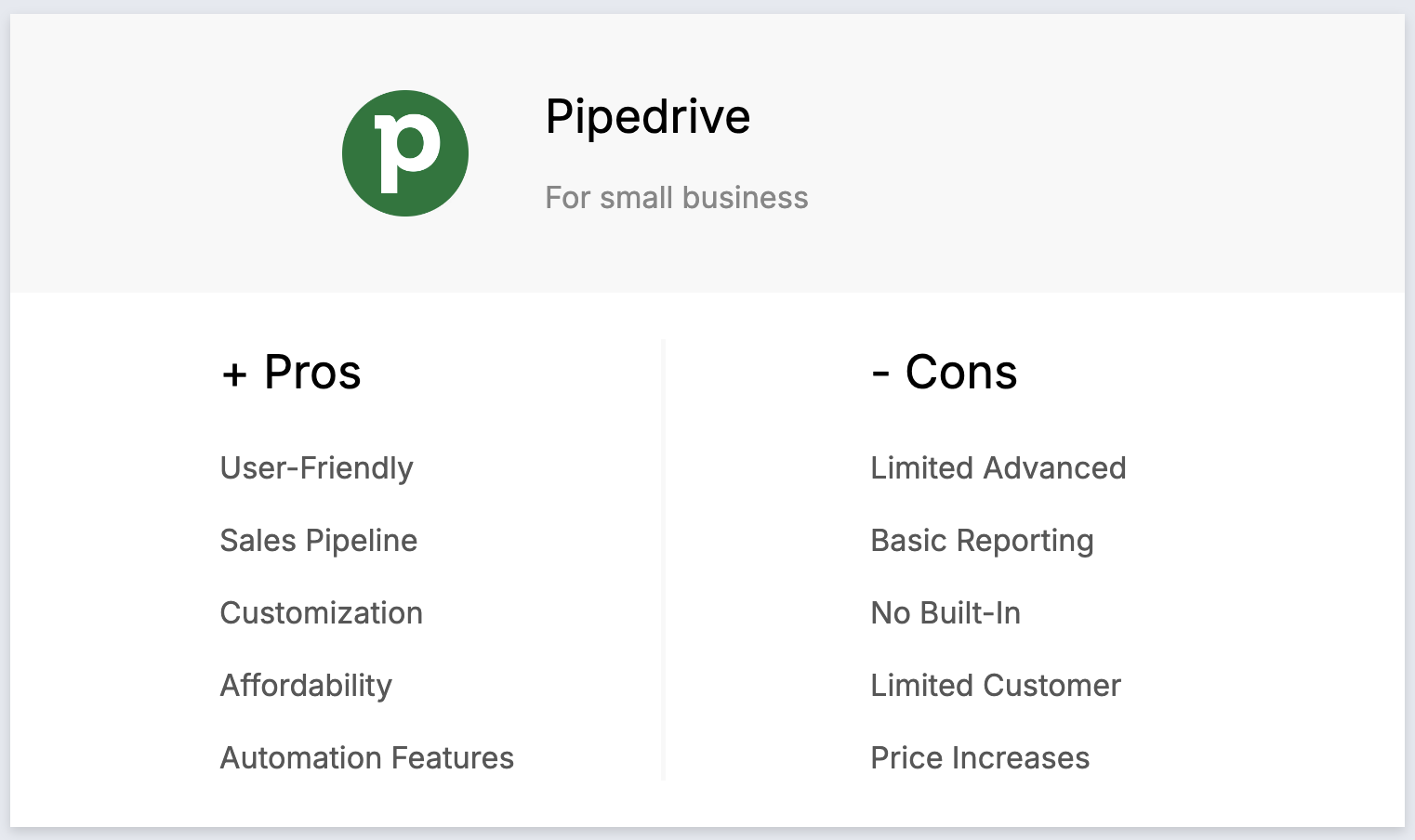
- User-friendly interface: The intuitive and visually appealing interface makes it easy for small business owners to navigate and manage their contacts.
- Sales pipeline focus: Designed for managing sales pipelines, offering a visual approach that helps track deals and activities effectively.
- Customization: High degree of customization, enabling users to tailor the platform to their specific processes with custom fields and workflows.
- Affordability: Competitive pricing makes it accessible to small businesses without sacrificing essential CRM features.
- Automation features: Includes automation tools that help streamline repetitive tasks, saving time and boosting productivity.
Cons
- Limited advanced features: Lacks some advanced CRM features like extensive marketing automation and AI capabilities.
- Basic reporting in lower tiers: Reporting and analytics features in the basic plans are somewhat limited, requiring upgrades for more in-depth insights.
- Price increases with add-ons: Costs can increase quickly when additional features or integrations are added, making it less cost-effective for growing businesses.
Price and plans
Pipedrive's annual subscription plan basis is as follows.
- Essential plan: Starts from $24 per user, per month.
- Advanced plan: Starts from $44 per user, per month.
- Power plan: Starts from $79 per user, per month.
- Enterprise plan: Starts from $129 per user, per month.
Conclusion
Choosing the right CRM for your small business can significantly enhance your efficiency, improve customer relationships, and drive growth. Each CRM discussed in this article offers unique features and benefits tailored to different business needs and budgets. Whether you prioritize ease of use, advanced features, or affordability, there is a free CRM solution out there to help you manage your business more effectively. For teams seeking a modern, all-in-one CRM experience that combines powerful features with exceptional ease of use, we recommend giving folk CRM a try. Try folk for free here now.
👉🏼 Try folk now to manage contact-based reminders with your team and never miss a follow-up
Need a helping hand? Use our free tool to find your perfect CRM match.
FAQ
What is the best free CRM for small businesses?
HubSpot Free and Zoho Free (3 users) are common picks. Others offer free trials then low-cost plans. For teams of 20–50, check limits on seats, automation, and reporting—many outgrow free tiers as collaboration needs expand.
How much does a CRM cost for a small business?
Expect $15–$129 per user per month for paid tiers, depending on features. Free plans exist but cap users or functionality. Total cost varies with seats, add-ons, and billing term.
How should a 20–50 person team choose a CRM?
Define must-haves, map your pipeline, verify email and LinkedIn integrations, check ease of use, security, and support. Shortlist 2–3 tools and run team trials to test setup, data import, and reporting before deciding.
Are free CRMs enough for growing teams?
They work for basics. As teams scale, needs like multi-user permissions, automation, analytics, and integrations usually require paid plans. Trial options like folk to validate fit before upgrading.
Meet folk, the AI CRM for your entire Sales motion.