


Discover folk - the CRM for people-powered businesses
In a SaaS startup with 20-50 people, growth moves fast—and so do your leads. To keep up, your mid-sized sales team needs a streamlined system that helps you manage relationships, track your pipeline, and scale without chaos. That's where the right sales stack comes in.
A smart CRM lets you centralize customer data, automate follow-ups, and stay on top of every opportunity while keeping your growing sales team aligned.
In this post, we'll break down the best CRM for SaaS startups, focusing on tools built to boost efficiency for medium-sized sales teams, support your growth, and keep your sales engine running strong.
How to boost your SaaS startup's efficiency with a CRM
To give you an idea of how a CRM can help your mid-sized sales team, we've put together a high level overview of some ways its features can keep different parts of your sales cycle organized in one place for teams of 20-50 people.
1. Mapping your process
At this stage, it's about understanding your internal sales process and mapping out these stages so that your CRM can reflect it across your growing team.
- Define key stages: Identify critical stages in your sales funnel, from lead generation to customer retention, that work for your entire sales team.
- Use customizable pipelines: Use CRM tools that allow you to customize pipelines to match your unique SaaS sales process and accommodate multiple sales reps.
- Automate workflow: Implement automation to track and move leads through stages without manual intervention from your sales team members.
2. Lead qualification
If you have certain criteria your sales team of 20-50 people needs to follow to qualify leads, you can also use your CRM to make sure everyone is on the same page so the prospect list is accurate and stays organized.
- Scoring criteria: Establish criteria to score leads based on behavior, engagement, and fit that can be applied consistently across your sales team.
- Segmentation: Use CRM features to segment leads, investors, and customers for targeted outreach by different team members.
- Data enrichment: Integrate third-party tools to enrich lead data for more accurate qualification across your sales organization.
3. Outreach and follow-up
Next, instead of manually following-up with contacts – which can take up a lot of time for your sales team. You can use your CRM to automate this process across your growing organization.
- Email automation: Set up automated email sequences for onboarding, follow-ups, and nurturing that work consistently across your sales team.
- LinkedIn campaigns: Use LinkedIn automation tools to connect and engage with potential investors and customers across your team of 20-50 people.
- Personalization: Personalize outreach based on lead behavior and preferences to increase engagement rates for your entire sales organization.
4. Nurture existing client and investor relationships
Finally, you can also use your CRM to nurture your existing business relationships and create strategies for upselling and cross-selling across your sales team.
- Targeted campaigns: Create campaigns focused on upselling and cross-selling to existing customers that can be executed by your sales team.
- Customer feedback: Use CRM to collect and analyze customer feedback to identify upsell opportunities for your growing sales organization.
- Loyalty programs: Implement loyalty programs to incentivize repeat purchases and long-term engagement managed by your sales team.
How to evaluate and choose a CRM
With a lot of CRMs on the market to choose from, it can be hard to figure out which one fits your business needs and goals for a sales team of 20-50 people. And, will be easy for your entire sales team to use. To help you out with your decision making process, we've put together the basics of what you should expect at each stage.
1. Define your requirements
You can't start a search without being clear on exactly what you need for your mid-sized sales team. For SaaS startups with 20-50 people, identifying the key features that align with your goals is crucial. Look for CRM tools that offer automation, lead management, and integration with other SaaS tools you use. Features like customer segmentation, lifecycle tracking, and analytics are essential for understanding and nurturing your customer base effectively across your sales organization. Ensure the CRM supports scalability to grow alongside your startup and can handle the complexity of a medium-sized sales team.
Key features of a CRM for SaaS startups
- Automated processes: Streamlines tasks by automating repetitive workflows across your sales team of 20-50 people.
- Contact enrichment: Automatically finds Leads, Investors, Customers email addresses and contact information, enhancing efficiency for your growing sales organization.
- Structured pipeline: Tracks Leads, Investors, Customers through defined stages, ensuring process clarity and effectiveness across your entire sales team.
- Email sequences: Increases communication efficiency with follow-up templates and automated sequences for your sales reps.
- LinkedIn connection: Seamlessly imports Leads, Investors, Customers from LinkedIn and tracks conversations within the CRM for your entire sales team.
- Analytics: Provides essential data analysis and predictive insights for better planning and sales team management.
2. Budget considerations
Balancing cost and return on investment is vital for SaaS startups with medium-sized sales teams. While it's tempting to opt for the most affordable CRM, consider the long-term value it brings to your team of 20-50 people. Look for CRMs that offer flexible pricing plans, free trials, or freemium models that can accommodate your growing sales organization. Assess the potential return on investment by evaluating how the CRM can streamline your processes, improve customer retention, and drive sales growth across your team.
3. Selection process
Researching and choosing the right CRM vendor involves a lot of work for medium-sized sales teams. Start by reading reviews and case studies relevant to SaaS startups with similar team sizes. Shortlist CRMs that have a proven track record in the SaaS industry and can handle the complexity of 20-50 person organizations. Engage with their sales teams to understand their offerings better. Request demos to see the CRM in action and ask for references from similar businesses to gauge their satisfaction.
4. Get a demo
It's not enough to understand what a CRM can do on paper for your sales team. Trying and comparing different CRM platforms is important for teams of 20-50 people. Use free trials to test the usability, feature set, and integration capabilities of each CRM. Create a checklist of must-have features and evaluate each platform against it. Gather feedback from your entire sales team to ensure the chosen CRM meets everyone's needs. Finally, consider the vendor's customer support and training resources to ensure a smooth implementation for your growing organization. Get started with a demo of folk to see how it can help your SaaS startup grow and support you across sales, marketing, recruitment and more.
👉🏼 Try folk now to streamline your sales pipeline and never miss a follow-up.
3 tips for implementing a CRM
At this stage, it's more about introducing your new CRM to your sales team of 20-50 people and tech stack. We suggest making the most of the implementation stage by keeping these three things front of mind for medium-sized sales organizations.
1. Import your data in your new CRM
Transitioning to a new CRM can be seamless if you properly import your existing data for your entire sales team. Start by exporting your data as a CSV file from your current CRM. Once you have your data in CSV format, you can easily upload it to your new CRM without having to manually add new contacts across your sales organization.
2. Create your first pipeline
Setting up your first pipeline can be challenging for sales teams of 20-50 people. For SaaS startups, you might need to create multiple pipelines to accommodate different team members and processes. This might include stages like lead generation, product demo, trial period, conversion, and customer success. Tailoring your pipeline to reflect your sales and customer journey ensures that your entire sales team can track progress and focus on the right tasks at each stage.
3. Onboard your team
After setting up your CRM, it's essential to onboard your sales team of 20-50 people effectively. Make sure you provide training sessions to familiarize them with the new system, ensuring they understand how to use it to its full potential. This not only boosts productivity but also ensures everyone in your sales organization is aligned with your startup's sales and customer management processes.
The 5 best CRMs for SaaS startups in 2026
1. folk
⭐⭐⭐⭐⭐(G2)
folk is the ideal modern CRM platform for SaaS startups with 20-50 people, offering customizable pipelines, AI-driven tools, and integrations specifically designed to enhance deal management and prospecting for medium-sized sales teams.

Key features
- All-in-one: folk streamlines your workflow across marketing, sales, recruitment, investing and more allowing your sales teams of 20-50 people to collaborate from one source of truth.
- Contact enrichment: Automatically enriches contact details by finding emails and LinkedIn URLs, enabling efficient outreach without manual data entry or additional costs for your entire sales team.
- Social media integration: Seamlessly import contacts from LinkedIn, Sales Navigator, Instagram, X and more to track contacts and leverage your network within folk, perfect for medium-sized sales teams.
- Mail merge and email sequences: Full email sync compatible with Gmail and Outlook with access to templates, and tracking features, enabling your sales team to manage all communications directly from the CRM.
- AI-powered features: AI tools assist in managing contacts and relationships, automating routine tasks, and suggesting actions to improve productivity and personalization for your sales organization.
- Integrations: folk integrates seamlessly with over 6,000 apps, including Gmail, Zapier, and Make, allowing your team of 20-50 people to centralize their workflow and reduce manual data entry.
Pros
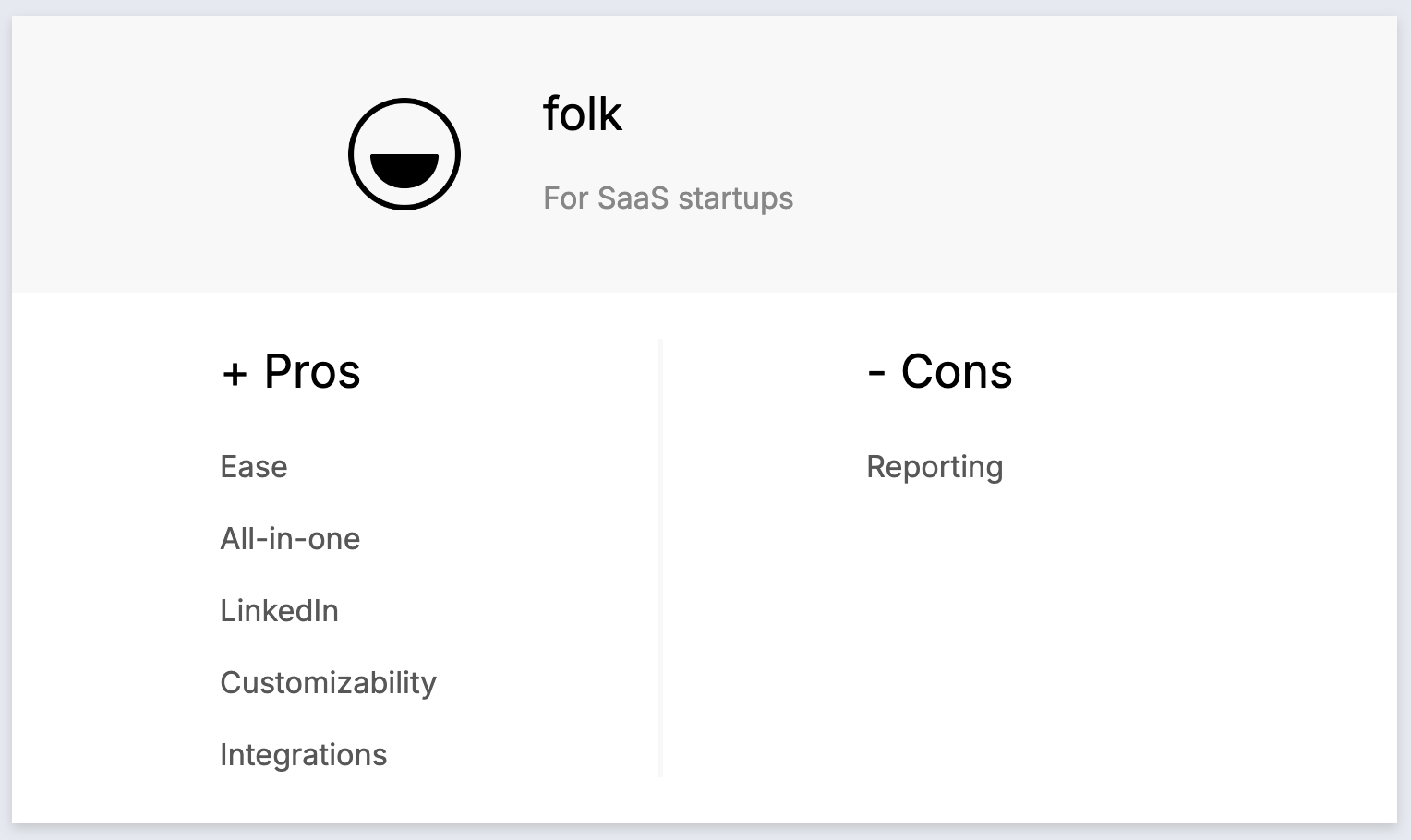
- Ease of use: folk is praised for its intuitive interface, making it accessible even to non-technical sales team members with quick onboarding and a minimal learning curve for teams of 20-50 people.
- LinkedIn integration: Seamlessly import contacts from LinkedIn, track conversations within Folk, and use templates for quicker, streamlined communication across your sales team.
- Full personalization: Custom fields, pipelines, dashboards, automation and workflows that can be tailored to your medium-sized sales organization.
- Integrations: Folk integrates seamlessly with over 6,000 apps, including Gmail, Zapier, and Make, allowing your sales team to centralize their workflow and reduce manual data entry.
Cons
- Reporting and analytics: folk includes advanced analytics such as pipeline and stage reports, weighted revenue forecasting, performance breakdowns by owner, channel, industry, region, or any custom field, and revenue insights dashboards.
Price and plans
You can try folk for free with a 14-day free trial, perfect for testing with your sales team of 20-50 people. After that, a monthly or annual subscription plan is as follows.
- Standard: $24 per user, per month.
- Premium: $48 per user, per month.
- Custom: Starts from $80 per user, per month.
2. HubSpot
⭐⭐⭐⭐(G2)
Hubspot CRM is a user-friendly, scalable platform offering integrated tools for managing sales, marketing, customer service, and operations efficiently for growing teams.

Key features
- Marketing Hub: Includes email marketing, ad tracking, landing pages, and lead generation tools, essential for attracting and nurturing leads for sales teams.
- Sales Hub: Provides deal tracking, pipeline management, sales automation, and reporting, crucial for managing investor relations and closing deals efficiently for medium-sized teams.
- Service Hub: Offers customer service tools like ticketing, live chat, and knowledge bases, ensuring a high level of support for your customers managed by your team.
- Lead scoring: Prioritize leads with predictive scoring to improve sales efficiency and focus on high-potential opportunities for your sales organization.
- Operations Hub: Syncs and automates business processes across different systems, streamlining operations and ensuring seamless data flow for teams of 20-50 people.
Pros
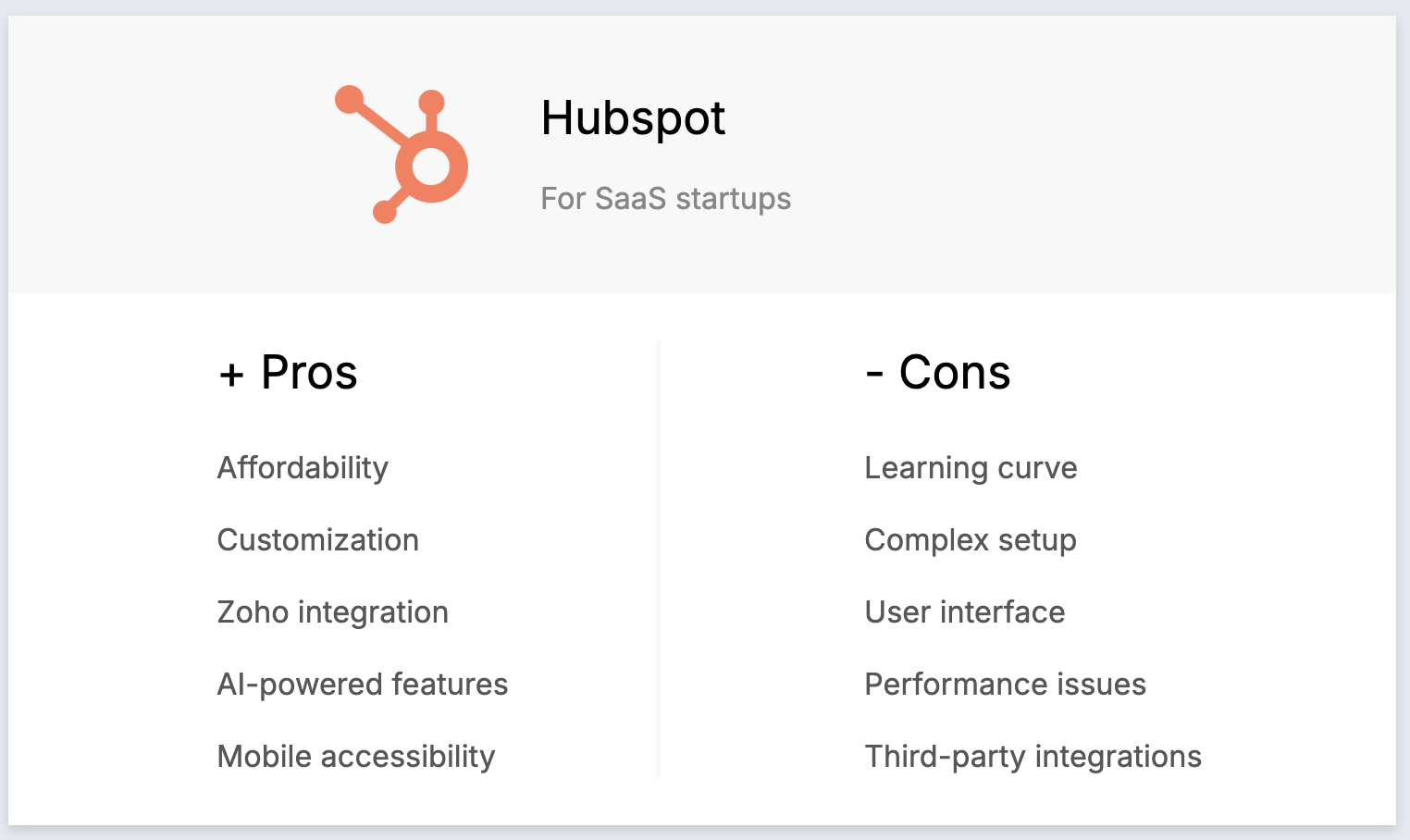
- User-friendly interface: HubSpot's intuitive design makes it accessible for users of all skill levels, perfect for growing sales teams.
- Comprehensive free plan: Offers a robust free version with essential CRM features, though may be limited for teams of 20-50 people.
- Seamless integration with marketing tools: Integrates smoothly with marketing, sales, and service hubs, creating a unified platform for managing leads, investors, and customers.
- Automation capabilities: Provides powerful automation tools for tasks like email marketing and lead nurturing, helping sales teams save time and improve efficiency.
- Scalability: Highly scalable, offering different tiers that cater to growing businesses, from small startups to larger organizations.
Cons
- High cost at higher tiers: Pricing can become expensive as you move to higher tiers, which may be prohibitive for teams of 20-50 people as they scale.
- Limited customization in free plan: The free plan has limited customization options, restricting flexibility for growing medium-sized sales teams.
- Complexity in advanced features: Some advanced features have a steep learning curve and may require additional training for your sales team.
- Email marketing limits: The free plan restricts the number of emails you can send, which can be a drawback for sales teams with larger lists.
- Additional costs for add-ons: Many useful features come as paid add-ons, increasing the overall cost for medium-sized organizations.
Price and plans
HubSpot has a free forever plan, and a few separate plans to choose from depending on your requirements. On an annual subscription basis, their CRM suite is as follows.
- Starter: $15 per user, per month.
- Professional: $450 per user, per month.
- Enterprise: $1,500 per user, per month.
3. Zoho
⭐⭐⭐(G2)
Zoho is a CRM system with a strong sales focus. It has journey orchestration, sales process management, and workflow automation features suitable for growing sales teams.

Key features
- Sales automation: Automates sales tasks like lead management, deal tracking, and follow-up actions, crucial for managing SaaS leads and customer acquisition for medium-sized teams.
- Customizable dashboards and reports: Allows users to create and customize dashboards and reports for in-depth analytics, helping sales teams track metrics and customer engagement.
- Lead and contact management: Manages customer information, tracks interactions, and segments contacts for targeted campaigns, essential for nurturing leads and maintaining relationships.
- Workflow automation: Automates routine tasks and processes to improve efficiency and reduce manual effort, streamlining operations for sales organizations.
- Multi-channel communication: Integrates with email, phone, social media, and live chat to manage customer interactions across your sales team.
Pros
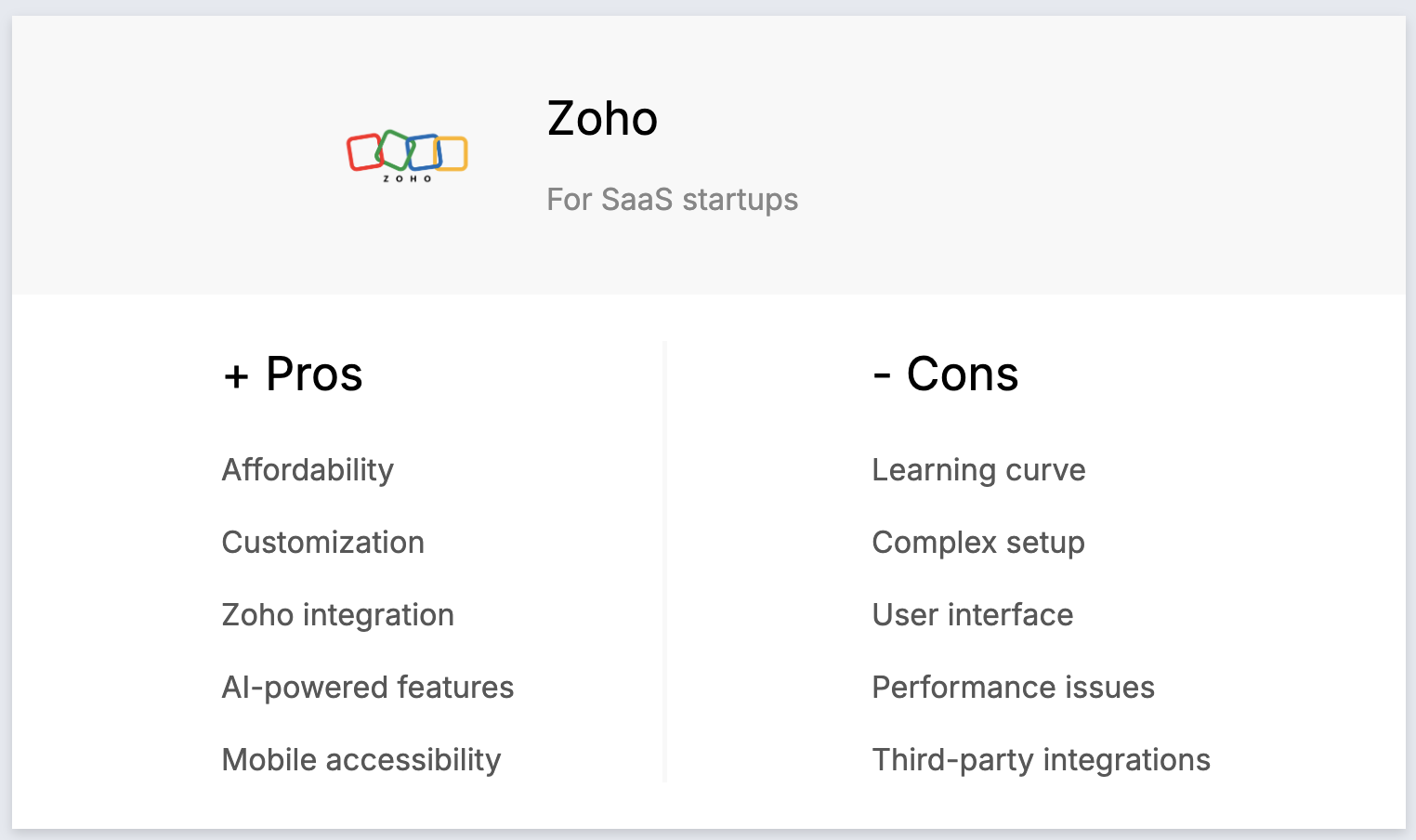
- Affordability: Zoho CRM offers competitive pricing with various tiers, making it accessible to SaaS startups with medium-sized teams and limited budgets.
- Customization: Extensive customization options allow SaaS businesses to tailor the CRM to their specific needs, including custom fields, modules, and workflows.
- Integration with Zoho suite: Seamless integration with other Zoho products creates a comprehensive ecosystem for managing different business functions for teams of 20-50 people.
- AI-powered features: Zia, the AI assistant, provides intelligent insights, predictive analytics, and task automation, helping to improve sales efficiency.
- Mobile accessibility: Zoho CRM offers a robust mobile app, allowing sales teams to manage customer relationships and access data on the go.
Cons
- Steep learning curve: The extensive customization options can be overwhelming for new users, particularly challenging for sales teams without technical expertise.
- Complex setup: Initial setup and configuration can be complex, particularly for medium-sized sales teams without dedicated IT resources.
- User interface: Some users find the interface to be outdated or cluttered compared to other modern CRM platforms, which can affect usability for sales teams.
- Performance issues: Occasional reports of slow performance, especially with large datasets, can hinder productivity for growing organizations.
- Limited third-party integrations: While Zoho integrates well with its own suite, integration with third-party applications preferred by sales teams can be limited.
Price and plans
Zoho's free plan is limited to three users. After that, for more features or seats an annual subscription plan is as follows.
- Standard: $20 per user, per month.
- Professional: $35 per user, per month.
- Enterprise: $50 per user, per month.
4. Pipedrive
⭐⭐⭐⭐(G2)
Pipedrive is a web-based CRM for small businesses, offering lead management, automation, email integration, and customizable pipelines to optimize sales for growing teams.

Key features
- Lead and deal management: Centralized tools to manage leads, investors, and customers, along with interactions and sales pipelines, helping medium-sized teams act quickly on opportunities.
- Sales automation: Workflow automation to handle repetitive tasks, such as lead routing, follow-ups, and email sequences, allowing sales teams to focus on closing deals.
- Email integration: Full email sync, templates, and tracking features, enabling users to manage all communications directly from the CRM for their sales team.
- Advanced reporting and analytics: Real-time data analytics and custom reporting tools to track sales performance and forecast revenue for teams of 20-50 people.
- Customization and security: Options to customize pipelines, fields, and user permissions, with robust security measures to protect data for medium-sized organizations.
Pros
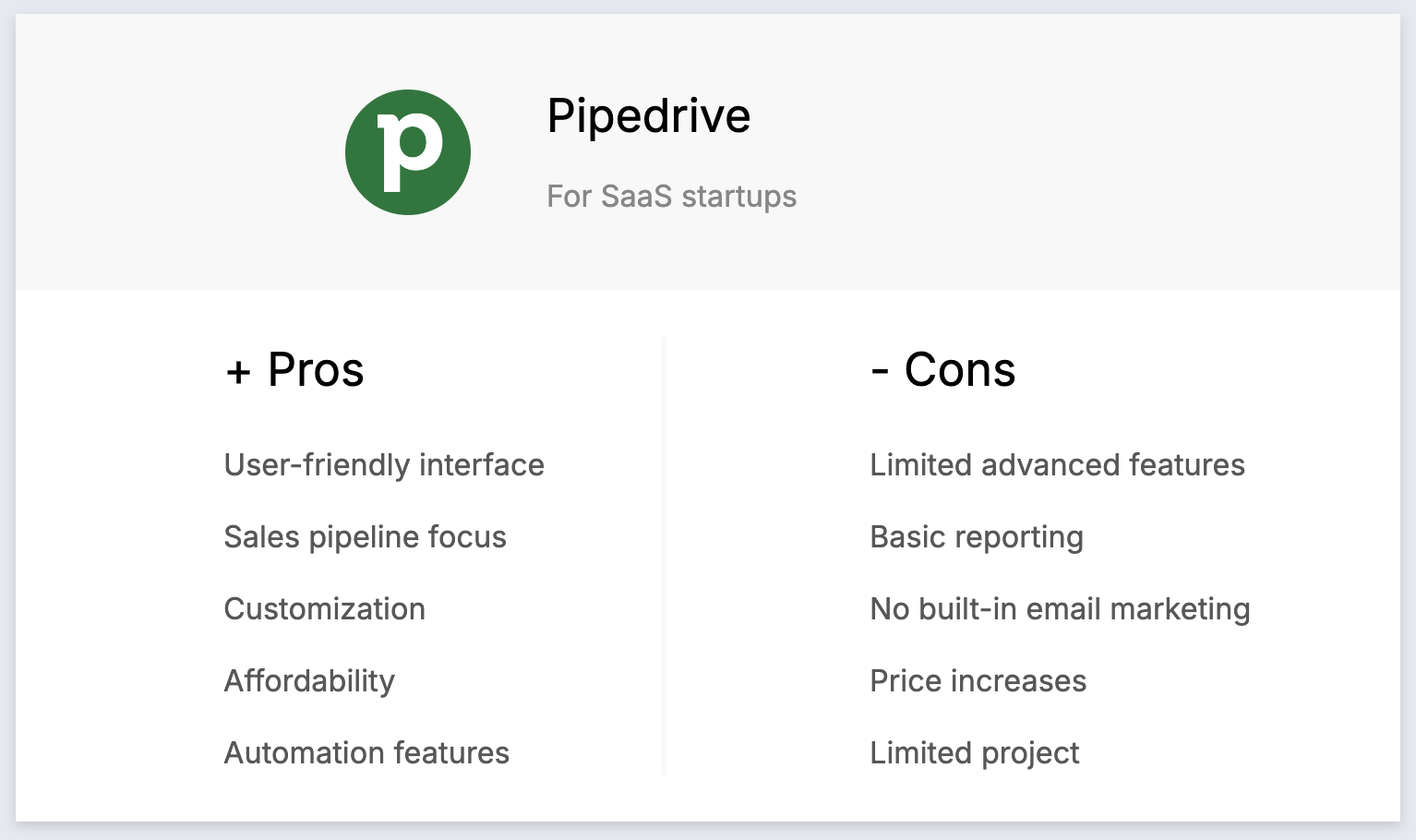
- User-friendly interface: The CRM is known for its intuitive and visually appealing interface, making it easy for sales teams to navigate and manage their pipelines.
- Sales pipeline focus: Specifically designed for managing sales pipelines, offering a visual approach that helps medium-sized sales teams track deals effectively.
- Customization: Allows for a high degree of customization, enabling users to tailor the platform to their specific sales processes with custom fields and workflows.
- Affordability: Offers competitive pricing, making it accessible to medium-sized SaaS businesses without sacrificing essential CRM features.
- Automation features: Includes automation tools that help streamline repetitive tasks for sales teams, saving time and boosting productivity.
Cons
- Limited advanced features: Lacks some of the more advanced CRM features, such as extensive marketing automation and AI capabilities, which may limit growing sales teams.
- Basic reporting in lower tiers: The reporting and analytics features in the basic plans are somewhat limited, requiring upgrades to access more in-depth insights for medium-sized teams.
- No built-in email marketing: Does not include built-in email marketing features, requiring integration with third-party email tools for sales teams.
- Price increases with add-ons: The cost can increase quickly when additional features are added, making it less cost-effective for teams of 20-50 people.
- Limited project management features: Primarily focused on sales, and lacks robust project management features that medium-sized organizations may need.
Price and plans
An annual subscription plan basis is as follows.
- Essential plan: Starts from $24 per user, per month.
- Advanced plan: Starts from $44 per user, per month.
- Power plan: Starts from $79 per user, per month.
- Enterprise plan: Starts from $129 per user, per month.
5. Capsule CRM
⭐⭐⭐⭐(G2)
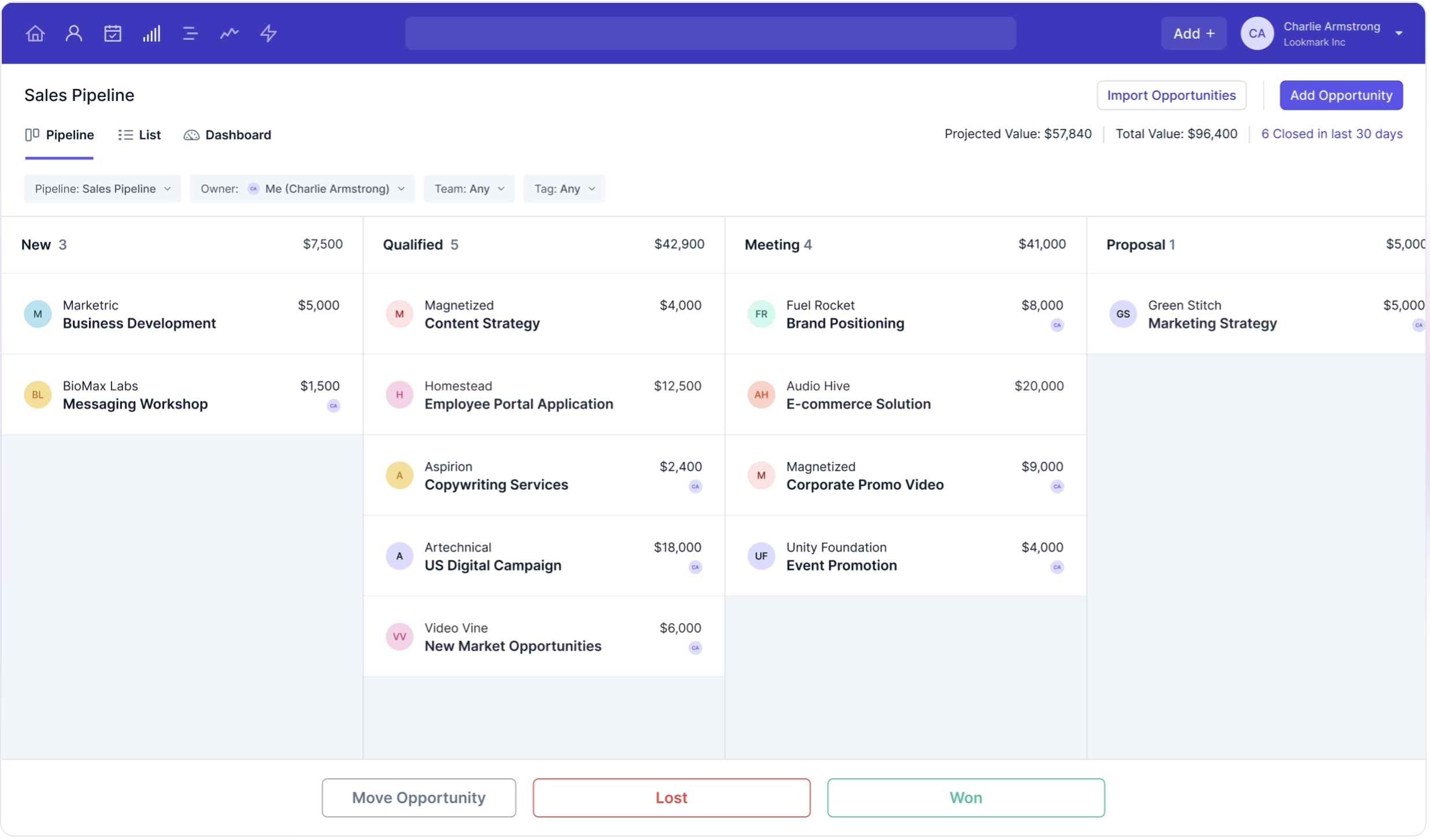
Capsule CRM is a user-friendly customer relationship management platform designed for small and medium-sized businesses. It offers a clean, intuitive interface that helps sales teams manage customer relationships and organize tasks efficiently.
Key features
- 1 sales pipeline: Suitable for managing basic sales processes from lead generation to closing deals for smaller sales teams.
- 30,000 contacts: Space to store information on leads, investors, and customers for medium-sized sales organizations.
- Activity reporting: Track interactions and activities with your contacts to keep your sales team organized and informed.
- Key integrations: Connect with tools like G Suite, Microsoft 365, and Mailchimp to streamline your sales team's workflow.
- Workflow automation: Automate repetitive tasks to save time and improve efficiency for your sales team.
Pros
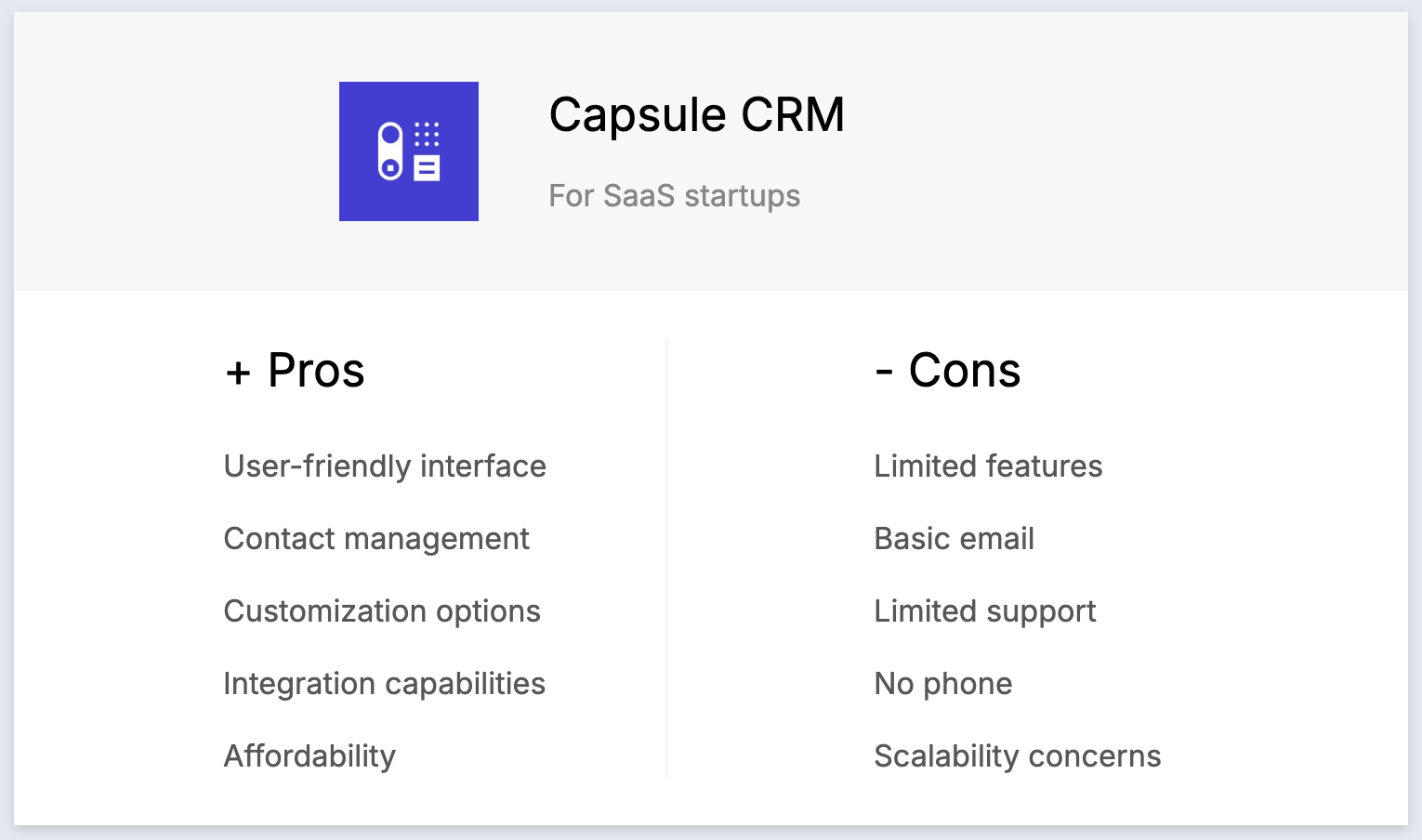
- User-friendly interface: Easy navigation and intuitive design make it suitable for sales teams without extensive CRM experience.
- Contact and sales management: Robust tools for organizing customer information and tracking sales opportunities for medium-sized teams.
- Customization options: Customize fields, tags, and pipelines to fit your specific sales team needs.
- Integration capabilities: Integrates with popular third-party applications for a seamless workflow for your sales organization.
- Affordability: Competitive pricing with affordable premium options, making it accessible for growing sales teams.
Cons
- Limited advanced features: Lacks in-depth analytics and complex reporting capabilities, which might be a limitation for sales teams of 20-50 people.
- Basic email marketing capabilities: Built-in email marketing features are relatively basic, requiring third-party integrations for advanced needs of medium-sized teams.
- Limited customer support: Primarily offers support through email and an online help center, which may not be sufficient for larger sales organizations needing immediate assistance.
- Scalability concerns: May not be suitable for sales teams that are rapidly expanding or have more complex CRM requirements for 20-50 people.
Price and plans
Capsule's annual subscription plan is as follows.
- Starter plan: Starts from $21 per user, per month.
- Growth plan: Starts from $38 per user, per month.
- Advanced plan: Starts from $60 per user, per month.
- Ultimate plan: Starts from $75 per user, per month.
Conclusion
Choosing the right CRM is crucial for the success and growth of your SaaS startup with a sales team of 20-50 people. From managing customer relationships to streamlining processes, a well-suited CRM can make all the difference for your medium-sized sales organization. Each of the CRMs we've discussed offers unique features tailored to different needs and budgets, but folk CRM stands out as the best solution for teams of your size. While Hubspot, Zoho, Pipedrive, and Capsule each have their merits, folk CRM's combination of ease of use, customization options, AI-powered features, and seamless integrations make it the ideal choice for SaaS startups with 20-50 people. Whether you prioritize user-friendly interfaces, advanced automation, or comprehensive contact management, folk CRM delivers the perfect balance for medium-sized sales teams. Take advantage of free trials and demos to experience how folk CRM can transform your sales operations. Ready to elevate your SaaS startup's efficiency? Try folk for free here.
👉🏼 Try folk now to manage contact-based reminders with your team and close more deals.
Need a helping hand? Use our free tool to find your perfect CRM match.
FAQ
What is the best CRM system for small businesses?
Top options include folk, HubSpot, Pipedrive, Zoho, and Capsule. The best fit depends on budget, team size, and features. For 20–50 person teams, folk offers customizable pipelines, enrichment, email sequences, and broad integrations.
Do SaaS startups need a CRM?
Yes. A CRM centralizes contact data, tracks pipelines, automates follow-ups, improves forecasting, and standardizes processes—helping teams prevent missed deals and scale efficiently.
How much does a CRM cost?
Most SMB CRMs cost $20–$60 per user/month for core features; advanced tiers can be $79–$129+ per user/month. Use trials to test usability, integrations, and reporting before committing.
How do you choose a CRM for a 20–50 person sales team?
Define goals and must-haves, map sales stages, check email/LinkedIn integration and automation, verify reporting and permissions, run a team trial, and assess onboarding, support, and total cost to scale.
Meet folk, the AI CRM for your entire Sales motion.