


Discover folk - the CRM for people-powered businesses
Fed up with misplacing all those business cards you get at events? A CRM can help you store all your new and existing contact information into one platform.
Unless you want your business cards to pile up and the hassle of manually finding someone's contact information. A CRM can help you automate your workflow process, share contacts with your team,
In this blog post, we unpack the top CRMs that align with your networking efforts, the features you should look for in a CRM platform and the pros and cons of each.
| Main points |
|---|
|
Which CRM for Networking is for you?
A comparison of the best CRMs for networking
| Feature / CRM Tool | folk | HubSpot | Streak | Monday.com | Nimble | Copper | Affinity |
|---|---|---|---|---|---|---|---|
| User Interface | Notion-like, intuitive ✅ | Clunky, steep learning curve ❌ | Gmail-native, easy to use ✅ | Project management UI ✅ | Clean, social-focused interface ✅ | Inbox-first for Google Workspace ✅ | Data-rich, deal-focused UI ✅ |
| Contact Management | Centralized, auto-updating ✅ | Advanced, marketing-oriented ✅ | Basic Gmail-based ✅ | Manual input required ❌ | Unified social + email contacts ✅ | Contacts auto-created from Gmail threads ✅ | Automatic capture from email and calendar ✅ |
| Pipeline Management | Kanban & list view ✅ | Visual dashboard ✅ | Pipelines in Gmail ✅ | Limited CRM features ❌ | Simple deal pipelines ✅ | Visual pipelines tied to deals ✅ | Relationship and deal pipelines ✅ |
| Email Integration | Gmail sync + Chrome extension ✅ | Native integration ✅ | Full Gmail integration ✅ | 2-way sync with Gmail/Outlook ✅ | Email & social activity in one timeline ✅ | Deep Gmail & Google Calendar sync ✅ | Gmail & Outlook sync for logging ✅ |
| Email Campaigns | Built-in & trackable ✅ | Marketing automation ✅ | Limited features ❌ | Only in Pro plans ✅ | Group email and templates ✅ | Basic sequences on higher plans ✅ | Not built for bulk campaigns ❌ |
| Multi-use Flexibility | Sales, HR, VC, marketing ✅ | Sales & marketing teams ✅ | Networking inside Gmail ✅ | CRM + project tracking hybrid ✅ | Solo users and small sales teams ✅ | Startups and SMBs on Google Workspace ✅ | Best for VC, PE and BD teams ✅ |
| Free Plan | 14-day trial ✅ | Free forever ✅ | Free tier available ✅ | 14-day trial ✅ | 14-day trial (no free forever) ✅ | 14-day trial (no free forever) ✅ | No free plan ❌ |
| Pricing (Monthly) | $25 (Standard), $50 (Premium) | $50+ for full features | $15 (Pro), $49 (Enterprise) | $30+ for CRM functions | $24.90 (annual), $29.90 (monthly) | $9+ (Starter), $59+ (Professional) | $2,000+ per user/year |
👉🏼 Try folk now to centralize all your networking contacts and sync Gmail/Outlook in one place
1. folk CRM
folk is an all-in-one CRM that is loved for its Notion-like interface. It's easy to use and packed with powerful features designed to help streamline your workflow process. It also comes with a complementary Chrome extension, folkX designed to help you import leads directly from the web page, without switching platforms. You'll be able to import individual profiles and search lists with a single click.
Key features
- Contact management: folk allows users to aggregate contacts from multiple sources, providing a centralized database. It automatically updates contact information, ensuring users have access to the latest details.
- Pipeline management: folk can be easily customized to mimic your internal sales process. Choose from a easy to use Kanban board view, or list form.
- 'Magic Field' AI support: folk can help you personalize email campaign messages to multiple recipients.
- Multiple business function use: folk isn't a CRM that is limited to sales. It can support sales teams, recruitment, marketing, investing and more.
- Mobile app: Access and capture contacts on the go with the folk mobile app.

Pros
- Interaction tracking: Through Google synchronization, folk can import email and calendar events from Google. You can choose to keep these private or share it with your team.
- Tagging and segmentation: Users can organize contacts into different segments or groups using tags.
- User experience: folk is loved for its Notion-like experience. Unlike other CRMs, new users do not face a steep learning curve and can get started from day one.
- Email marketing: Through folk you can create email campaigns and track their performance.
- Complimentary Chrome extension: folkX allows you to import leads to your folk CRM directly from the web page without interrupting your workflow.
- Affordable price plans: You can try folk for free with a 14 day free trial. After that, a monthly or annual subscription plan is as follows.
Pricing
- Standard – $24 per member/month billed annually ($24 billed monthly)
- Premium – $48 per member/month billed annually ($48 billed monthly)
- Custom – from $70 per member/month billed annually (from $100 billed monthly, pricing depends on configuration)

Cons
- Reporting is not available yet in folk, but it is coming soon.
2. HubSpot
HubSpot offers a free CRM that is designed to help teams boost sales and marketing efforts. It's useful for marketing teams that need a CRM that offers features to boost inbound campaigns such as a chatbot, landing page, lead capture forms and more.
Key features
- Free forever CRM plan: Great for businesses on a limited budget that need to get started with a simple CRM.
- Marketing and sales support: HubSpot's features are mainly sales and marketing led designed to help teams streamline workflows and boost inbound leads.

Pros
- Contact and lead management: HubSpot allows users to organize contacts, segment them into lists, and track every interaction with their network. This includes emails, calls, meetings, and social media interactions.
- Sales enablement: HubSpot provides a visual dashboard that enables users to track where prospects are in the sales pipeline, helping to identify opportunities for follow-up or engagement.
- Marketing support: HubSpot provides email marketing, chatbot and social media support features. Users can create email campaigns and monitor social media interactions and publish content directly from the platform.
Cons
- Price plans: Once your business is ready to scale, HubSpot becomes an expensive option.
- Steep learning curve: HubSpot is known for its clunky user interface and steep learning curve. Often requiring new users to block out time to train their teams to fully use the platform.
Pricing
- Sales Hub Starter – $9 per user/month billed annually ($15 billed monthly)
- Sales Hub Professional – $90 per user/month billed annually ($100 billed monthly)
- Sales Hub Enterprise – $150 per user/month billed annually (annual contract and onboarding required)
3. Streak
Streak is a CRM that is particularly well suited for Gmail users, thanks to its powerful integration that turns your Gmail account into a CRM.
Key features
- Gmail-first CRM: Streak lives inside your Gmail, allowing you to manage your pipelines without switching between applications.
- Pipeline management: Users can create custom pipelines for different networking objectives, such as partnership outreach, event planning, or lead tracking, directly within their email interface.
- Email tracking: Streak provides email tracking features that notify you when your emails are read, which is invaluable for timely follow-ups in networking.

Pros
- Seamless email integration: Being directly integrated into Gmail makes Streak exceptionally convenient for those who frequently use Gmail.
- Affordable pricing: Streak offers a free version with basic CRM features and competitive pricing for its Pro and Enterprise plans, making it accessible for individuals and small businesses.
- User friendly: The learning curve for Streak is relatively low, especially for users already familiar with Gmail, making it accessible for networking individuals and teams of all sizes.
Cons
- Limited to Gmail users: Since Streak operates within Gmail, it's not suitable for individuals or organizations that use other email platforms for their primary communication.
Pricing
- Pro – $49 per user/month billed annually ($59 billed monthly)
- Pro+ – $69 per user/month billed annually ($89 billed monthly)
- Enterprise – $129 per user/month billed annually ($159 billed monthly)
4. Monday.com
If you're looking for a versatile product, Monday.com which was originally built as a project management tool, is a good option. But be prepared. You won't be getting CRM features that help you automate manual tasks or scale with you. This drawback has led them to build a sales-centric CRM but many still use the original product as a basic CRM. For this review, we'll be looking at the original product as it's still a popular option.
Key features
- Custom workflows: Monday.com offers highly customizable workflows that can be tailored to manage contacts, leads, and customer interactions.
- Visual sales pipeline: Users can visually track their networking and sales processes, from initial contact through to deal closure, helping to identify bottlenecks and opportunities for engagement.
- Collaboration Features: The platform facilitates collaboration among team members, allowing for shared access to contacts, tasks, and projects, which is particularly useful for teams involved in networking.

Pros
- Versatility: Monday.com's ability to be customized for various uses, including CRM functionalities, makes it a versatile tool for individuals and businesses focused on networking.
- Learning curve: The platform's intuitive design and user-friendly interface makes it easy to use for all technical levels
- Dashboards: Provides real-time information from 30+ widgets on specific information such as performance breakdown.
Cons
- Limited CRM features: Expect to update contact information manually without the benefits of traditional CRM features that help you do the heavy lifting.
- Price plan: With its limited CRM features, chances are you might have to invest in a separate traditional CRM further down the line once your business is ready to scale.
Pricing
- Basic CRM – $12 per seat/month billed annually
- Standard CRM – $17 per seat/month billed annually
- Pro CRM – $28 per seat/month billed annually
- Enterprise/Ultimate CRM – custom pricing (contact sales)
5. Nimble CRM
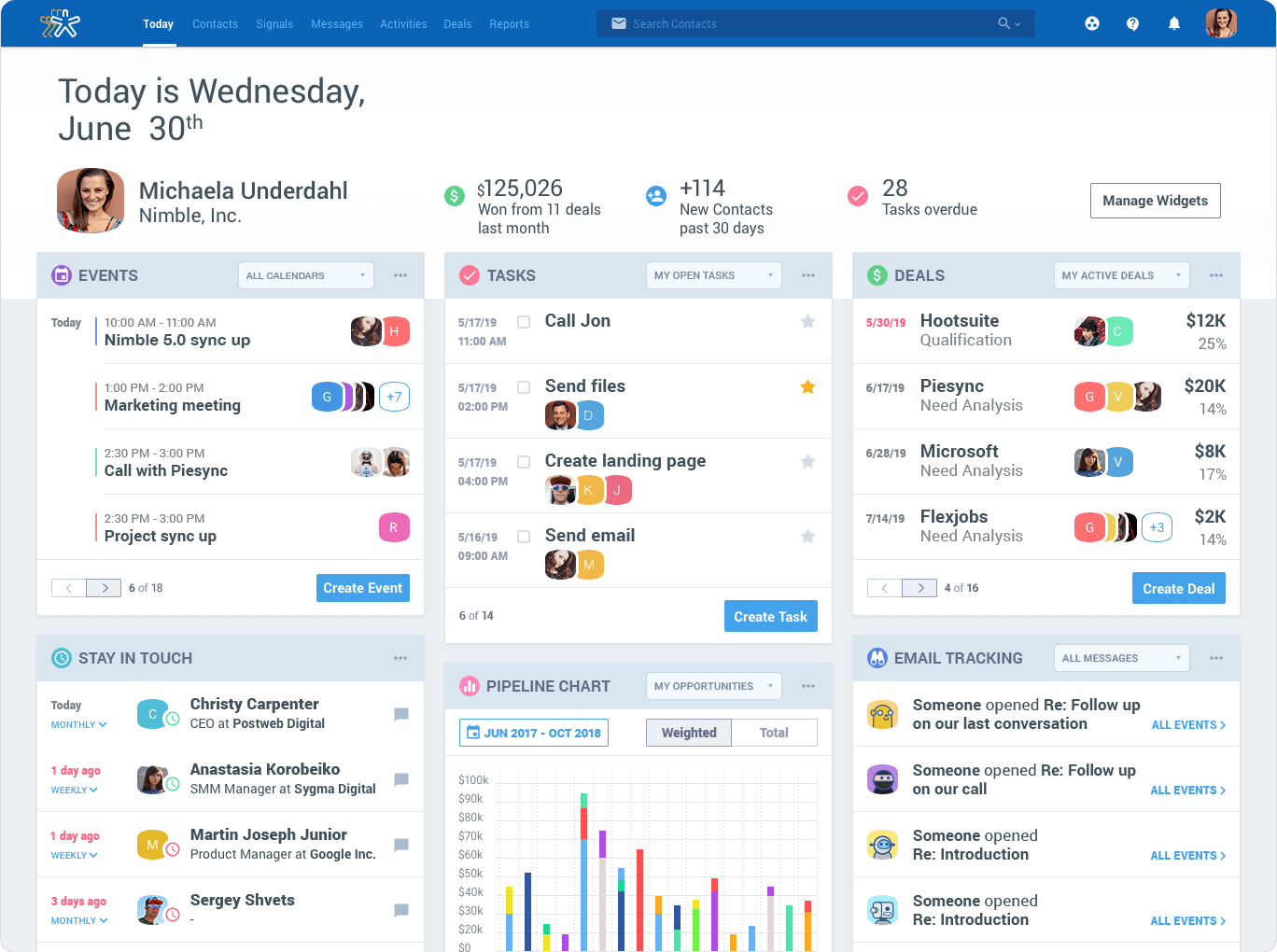
Nimble is a relationship-focused CRM built for professionals who network across email and social media. It brings together contacts, communication history, and social activity from channels like LinkedIn, X (Twitter), and Facebook so you get full context before reaching out. This makes it a good option for individuals or small sales teams that rely heavily on social selling and warm introductions.
Key features
- Unified contact management that pulls data from email, calendar, social networks, and the web into a single profile
- Social profile matching and enrichment to add company, role, location, and social links automatically
- Nimble Prospector browser extension to capture and enrich contacts directly from LinkedIn, websites, and inboxes
- Simple pipelines, workflows, and email campaigns for tracking deals and sending follow-ups
Pros
- Strong fit for networking and social selling thanks to deep social profile data and activity tracking
- Reduces manual data entry by auto-enriching contacts from social and other online sources
- Easy to use for individuals and small teams that need relationship tracking more than a heavy sales suite
Cons
- Automation and advanced workflows are more limited than modern, team-focused CRMs
- Less suited to larger, complex sales organizations that need deep customization and multi-team governance
- Pricing can feel high if a team mainly needs basic pipelines and collaboration rather than social features
Pricing
- $24.90 per user/month billed annually
- $29.90 per user/month billed monthly
- 14-day free trial
6. Copper
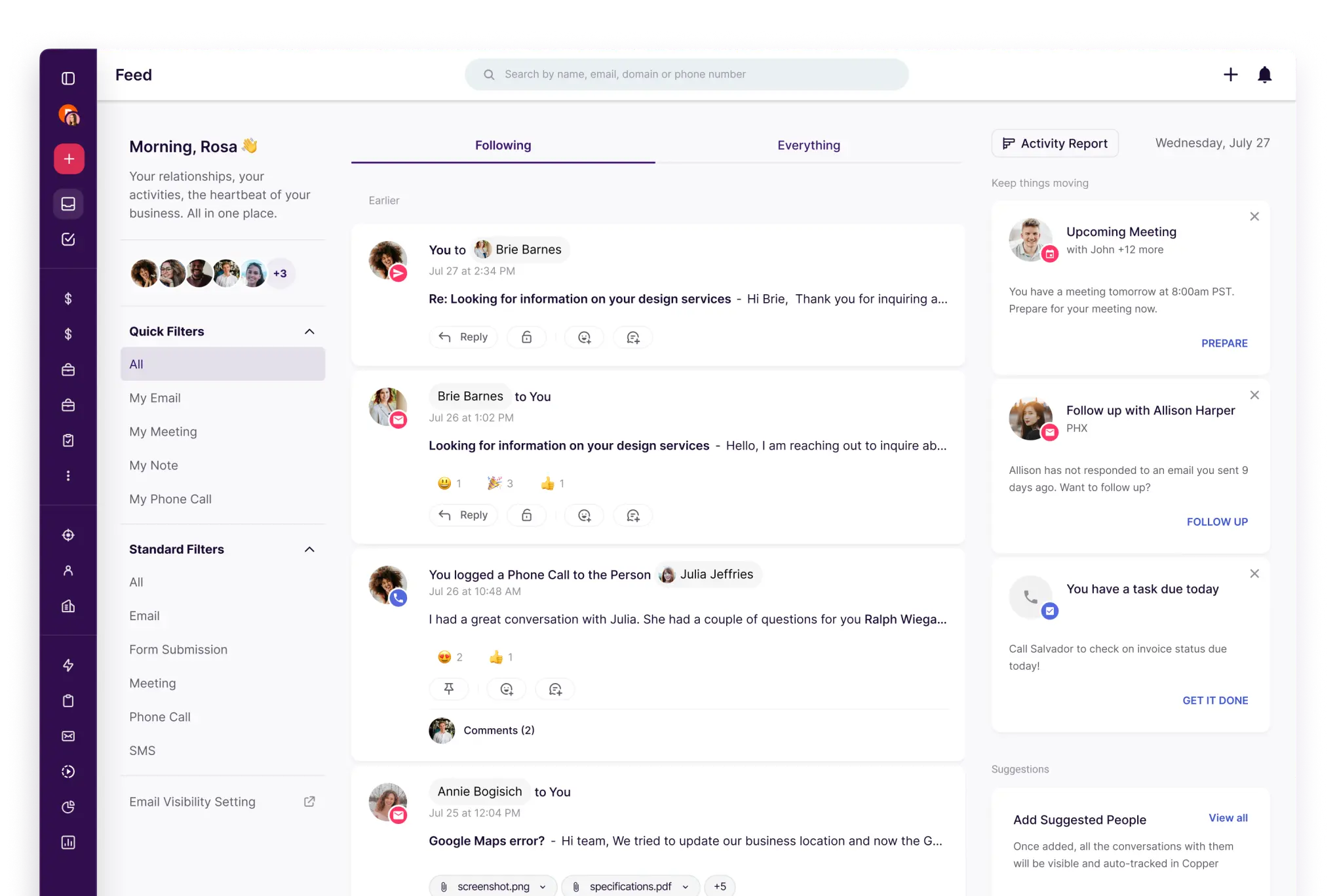
Copper is a CRM designed for teams that live in Google Workspace. It sits directly inside Gmail and Google Calendar so reps can add contacts, update pipelines, and track deals without leaving their inbox. With its Chrome extension, Copper also surfaces CRM data while browsing LinkedIn or company websites, which is useful for networking-heavy workflows built around email and Google tools.
Key features
- Native integration with Gmail and Google Calendar to log emails, meetings, and tasks automatically
- Chrome extension that brings Copper into Gmail, LinkedIn, and any website so users can add leads and update records in context
- Visual pipelines for tracking opportunities and relationships directly from the inbox
- Automatic population of contact records from Gmail, reducing manual data entry for new leads and contacts
Pros
- Excellent choice for networking-focused teams already using Google Workspace, with minimal onboarding friction
- Inbox-first workflow keeps outreach, follow-ups, and CRM updates in one place
- Chrome extension support for LinkedIn helps capture new contacts during prospecting, events, and research
Cons
- Primarily optimized for Gmail and Google Workspace; less attractive for teams on Outlook or mixed environments
- No permanent free plan, and pricing can add up as teams scale
- Focuses more on email- and calendar-based workflows than deep social media features for networking
Pricing
- Starter – $9 per user/month billed annually ($12 billed monthly)
- Basic – $23 per user/month billed annually ($29 billed monthly)
- Professional – $59 per user/month billed annually ($69 billed monthly)
- Business – $99 per user/month billed annually ($134 billed monthly)
7. Affinity
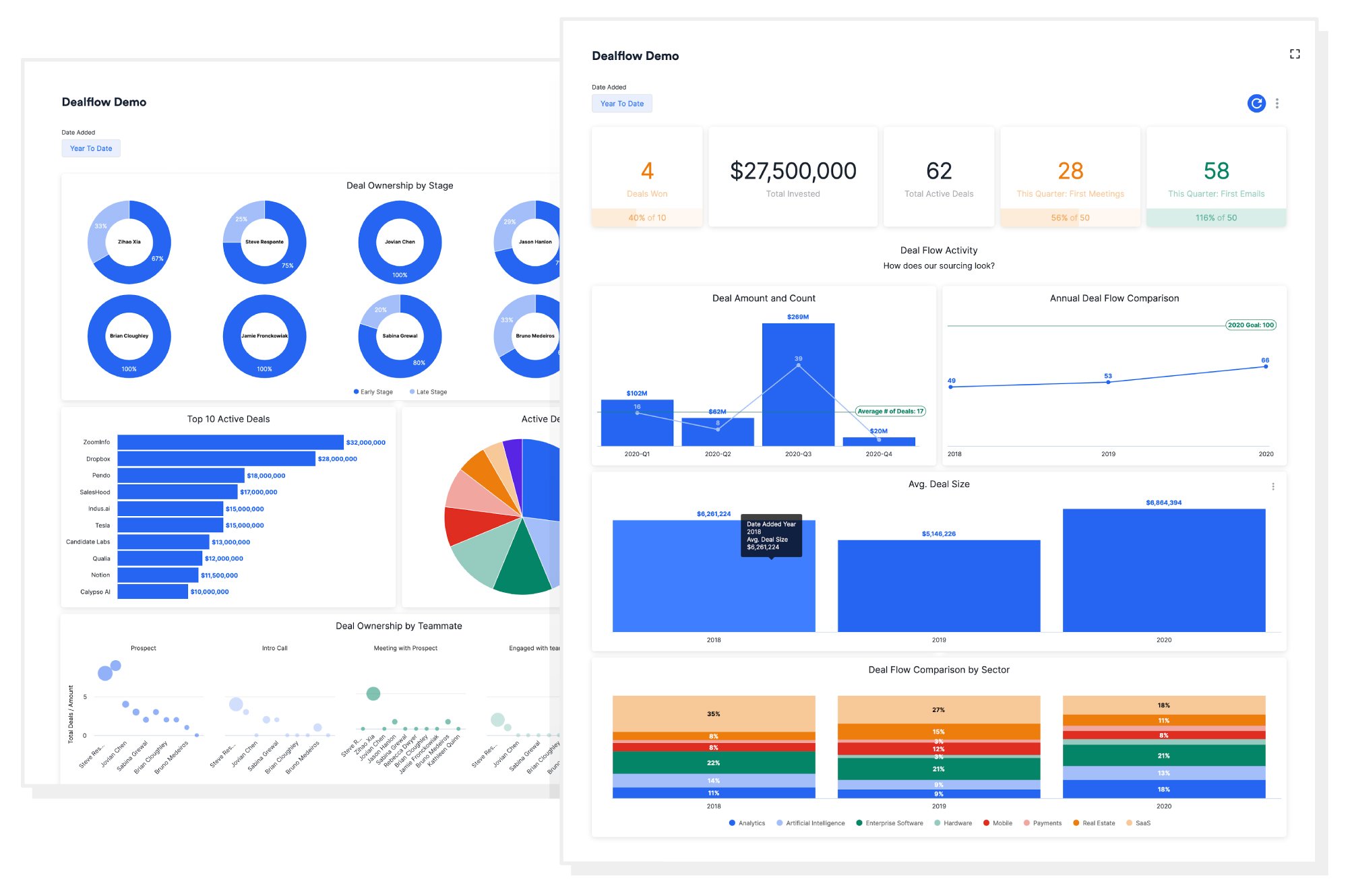
Affinity is a relationship-driven CRM built for teams in networking-heavy industries like venture capital, private equity, consulting, and business development. Instead of relying on manual updates, Affinity automatically captures interactions from email and calendar to map how strong each relationship is and where warm introductions sit in your network. It’s designed for teams that need to manage intros, deal flow, and investor or partner relationships at scale.
Key features
- Automatic data capture from emails and meetings to build and update contact and company profiles
- Relationship intelligence that scores relationship strength based on recency and frequency of interactions
- Network views that reveal the best path to an introduction across the firm’s entire relationship graph
- Smart lists, pipelines, and analytics tailored to deal sourcing, fundraising, and partner management
Pros
- Excellent for organizations where networking and warm intros drive most deals
- Removes a lot of manual data entry by logging communication activity in the background
- Gives teams a clear view of “who knows whom” across the firm, which makes outreach more targeted and effective
Cons
- Primarily aimed at private capital and deal-driven teams, so it can feel overkill for simple SMB sales
- Setup and onboarding take more effort than lighter CRMs targeted at solo users or very small teams
- Pricing is usually higher than small-business CRMs, reflecting its focus on professional investment and BD teams
Pricing
- Essential – $2,000 per user/year
- Scale – $2,300 per user/year
- Advanced – $2,700 per user/year
- Enterprise – custom pricing (contact sales)
Top 5 features networkers need to look for in a CRM
1. Contact management and contact sync: A good contact management feature will help you effortlessly organize your contacts into one place. Make use of additional integrations to further customize where you can import contacts from including Gmail, Outlook and social media platforms.
2. Pipeline management: This feature will help you get an overview of your business pipeline. A good CRM will be able to help you visualize this in multiple ways including a Kanban board style, or a listicle. A great one can be fully customizable to mimic your internal sales cycle, group contacts and more.
3. AI support: AI is more than a buzzword - it's a feature that can help alleviate your manual tasks. From personalizing email campaigns to multiple recipients to drafting messages.
4. Email marketing: With all your contacts in one handy platform, it would be amiss for a CRM not to provide an email marketing feature that can allow you to sort out contact lists.
5. User experience: While a CRM should come with a lot of handy features that will streamline your workflow process, it should not require your team to proactively block out time to train themselves to be able to use it. Good user experience means that it should be intuitive to use, without that steep learning curve.
Conclusion
If you're still manually updating a spreadsheet after meeting some potential business contacts at a networking event, it's time to upgrade to a CRM that can help you do the heavy lifting. While it might be tempting to go for a versatile product such as Monday.com, it's limited CRM capabilities will not be able to support your needs in the long run. Instead, you should opt for a user-friendly CRM platform that can support solo users and teams such as folk. So that you can get the benefits you need to streamline your networking efforts. Try folk today, free.
👉🏼 Try folk now to never miss a follow-up with automated reminders and trackable email sequences
FAQ
What features should you look for in a CRM for networking?
Contact sync from email/social, centralized profiles, pipelines (Kanban/list), email sequences and tracking, AI personalization, collaboration/permissions, mobile/web capture (scanner/extension), ease of use, and scalable pricing.
How do you keep track of business contacts effectively?
Use a CRM to import contacts from Gmail/Outlook and social, scan business cards, tag and segment, log emails and meetings automatically, and set reminders and pipeline stages for follow-up. Avoid spreadsheets to reduce errors.
Which CRM is best for networking?
It depends on needs. For an intuitive UI with contact sync, customizable pipelines, email campaigns, and a Chrome extension for quick imports, try folk. Alternatives include Gmail-native tools or marketing-heavy suites.
How much does a CRM for networking cost?
Free tiers exist with basic features. Paid plans typically range from $15–$50 per user/month. For reference, folk pricing: Standard $24/user/month, Premium $48, Custom from $60. Check billing terms for annual discounts.
Discover folk CRM
Like the sales assistant your team never had