


Discover folk - the CRM for people-powered businesses
Leads don't go cold, they get ignored.
The gap between first touch and timely follow-up is where most revenue dies. AI Lead Follow Up closes that gap by turning intent signals into fast, relevant replies.
Inside a CRM, AI watches activity across channels, drafts the next message, and schedules it at the right moment. Reps stay focused on conversations while the system keeps each thread alive.
The payoff is simple: more replies, shorter cycles, and cleaner handoffs. This guide defines AI Lead Follow Up, explains why it matters now, shows how it works in practice, and compares the best tools for sales teams of 20-50 people managing high-volume lead flows.
| Main points |
|---|
|
What is AI Lead Follow Up?
AI Lead Follow Up is a system that keeps conversations moving after first contact. It reads signals (opens, clicks, replies, meeting no-shows), pulls context from the CRM, and proposes the next step—message, call, reminder—so leads never stall.

It operates across channels. Email, WhatsApp, LinkedIn, and phone notes feed one timeline. The AI drafts a short, relevant follow-up, schedules it at an appropriate time, and routes tasks to the right owner. Sequences pause the moment a human replies.
Core elements, in plain terms:
→ Signal detection: notice meaningful actions and silence windows, not just sends.
→ Context assembly: use CRM fields, past messages, and notes to stay specific.
→ Message drafting: write a concise next step with a single clear ask.
→ Timing & routing: queue at sensible hours, hand off when ownership changes.
→ Guardrails: respect opt-outs, frequency caps, and local compliance rules.
Why Lead Follow Ups Are Important
Main outcomes (plain and practical):
✔️ Higher reply rates: short, relevant nudges land while intent is warm.
✔️ Shorter cycles: clear next steps prevent stalls between touches.
✔️ Better routing: ownership changes trigger handoffs without gaps.
✔️ Cleaner data: every touch logs to the CRM, improving scoring and segments.
✔️ Lower risk: frequency caps and opt-out checks protect sender reputation.
Most deals die in the silent middle. Interest fades fast when the next step isn't obvious or timely. A consistent follow-up system keeps momentum, reduces no-shows, and rescues leads that would otherwise slip back into research mode. For medium-sized sales teams handling 200-500 leads monthly, this automation prevents revenue leakage that typically costs organizations $50,000-200,000 annually.
Revenue compounds when replies arrive sooner. Fast, specific nudges lift meeting acceptance, shorten sales cycles, and surface blockers early. Leaders also get cleaner pipeline signals—fewer "stuck" stages and more reliable forecasts.
How Does AI Lead Follow Up Work?
AI turns raw engagement into the next best action. It watches signals across email, WhatsApp, LinkedIn, calendars, and call notes, then assembles context from the CRM to decide what to send, when, and by whom. Messages stay short, specific, and tied to one clear ask.
The system learns from outcomes. Positive replies, bounces, opt-outs, and no-shows reshape timing and templates. Ownership changes trigger instant handoffs so threads don't die during PTO or territory swaps.
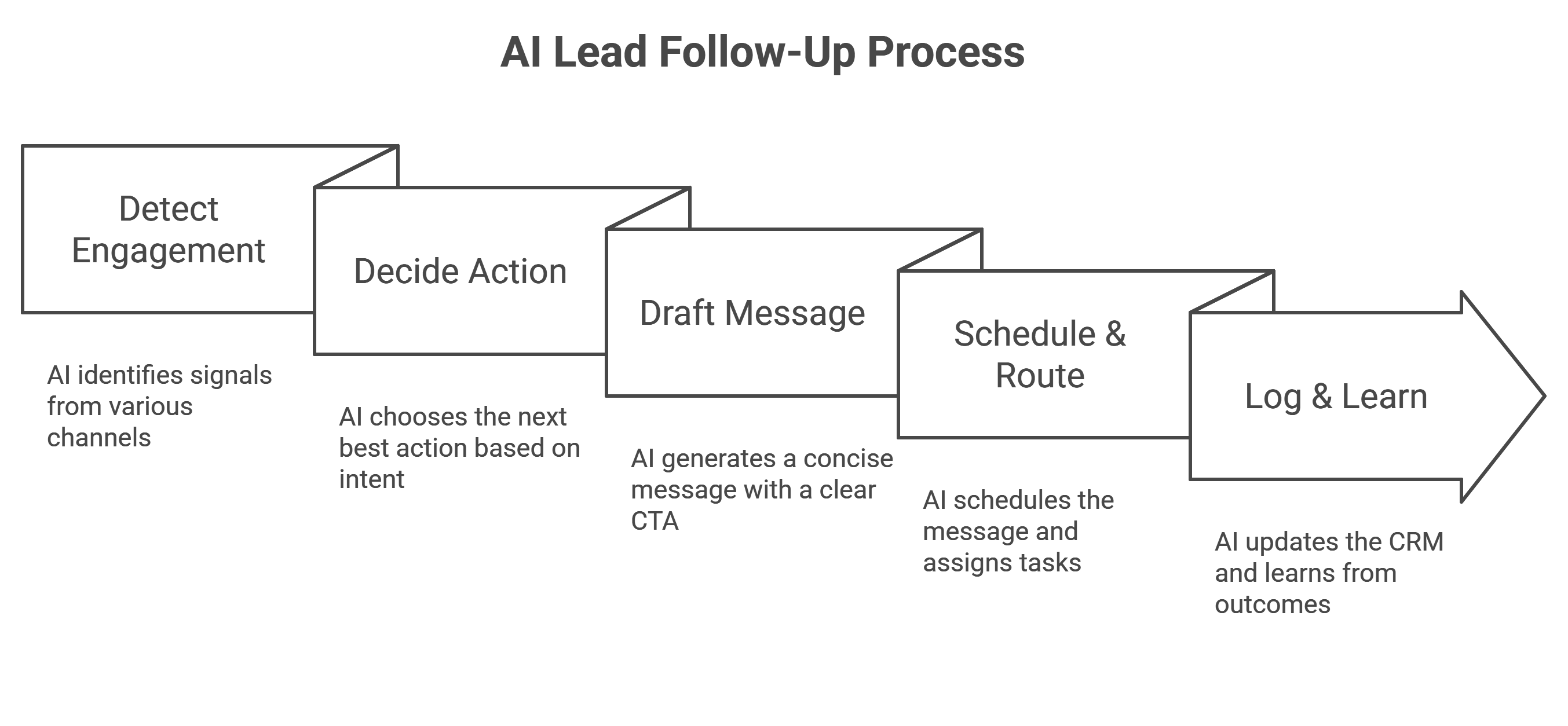
Simple flow (5 steps):
- Detect: open/click, form fill, meeting booked or missed, quiet window reached.
- Decide: choose "reply now," "nudge later," or "escalate" based on intent and stage.
- Draft: generate a one-paragraph email or WhatsApp with a single CTA.
- Schedule & route: send in working hours, assign tasks to the right owner.
- Log & learn: write back to the CRM, update status, retrain on what worked.
💡 folk Tip: Keep follow-ups under 80–120 words with one CTA. Personalize with three anchors only: role, company, and last interaction. Anything longer drops replies and clutters the CRM timeline. For teams of 20-50 sales professionals, folk CRM delivers this balance perfectly—AI-powered follow-ups that stay concise while maintaining full context across your entire sales pipeline.
10 Best AI Tools for Lead Follow Ups in 2025
AI keeps follow-ups timely and personal by watching signals and proposing the next step. For sales teams of 20-50 people managing complex lead flows, the right tool scales without overwhelming your workflow.
| Tool | Best for | Best AI Features (incl. follow-ups) | Starting price | Rating |
|---|---|---|---|---|
| folk CRM | Startups, Agencies, Founders, Solopreneurs | AI follow-up drafts, next-best action, call transcript updates, enrichment | $20/member/mo (annual) — $25 monthly | ⭐⭐⭐⭐⭐ |
| HubSpot | SMBs needing an easy start | AI assist, sequences (Sales Hub tiers), tasking from engagement | Free | ⭐⭐⭐⭐⭐ |
| Pipedrive | Sales-led SMBs | AI email assistant suggests follow-up actions; sentiment insights | From $14/user/mo (annual) | ⭐⭐⭐⭐ |
| Zoho CRM | Budget-conscious teams | Zia recommends next steps; extracts tasks from emails | From $14/user/mo (annual) | ⭐⭐⭐⭐ |
| Salesforce Sales Cloud | Mid-market & enterprise | AI follow-up assistants via Sales Cloud + partner apps | From $25/user/mo (Starter) | ⭐⭐⭐⭐ |
| Outreach | Scaled SDR/AE teams | AI (Kaia) generates action items and follow-up messages | Quote-based | ⭐⭐⭐⭐ |
| Salesloft | Revenue teams with complex plays | AI meeting agents create briefs and post-call follow-ups | Quote-based | ⭐⭐⭐⭐⭐ |
| lemlist | Cold emailers & small teams | AI personalization; automated follow-up sequences | $69/user/mo | ⭐⭐⭐⭐ |
| Reply.io | Multichannel sequences | AI SDR drafting and scheduling follow-ups | From $59/mo (plans incl. free tier) | ⭐⭐⭐⭐⭐ |
| Apollo | Prospecting + outreach combo | Sequences with AI assistance; enrichment-driven nudges | Free; paid from ~$49–59/user/mo | ⭐⭐⭐⭐⭐ |
👉🏼 Try folk now to never miss a follow-up
Conclusion
AI follow up turns interest into conversations. It watches signals, proposes the next step, and routes it at the right time. Pipelines stay in motion, cycles shorten, and reporting reflects reality.
Start with guardrails in the CRM. Keep messages short with one clear ask. Review outcomes weekly and refine timing, templates, and routing. Add a periodic deep clean to protect deliverability and accuracy.
Choose tools that live close to daily workflows. folk CRM stands out as the ideal solution for teams of 20-50 sales professionals—it unifies capture, context, and AI follow ups so every lead gets a timely, relevant nudge without extra ops overhead, perfectly scaling with your growing team! ⚡
👉🏼 Try folk now to organize your reminders in one place
FAQ
What is AI lead follow-up?
AI lead follow-up uses engagement signals and CRM context to suggest and schedule the next touch (email, SMS, call), route owners, and pause on human replies, while honoring opt-outs, frequency caps, and local rules.
How do you automate lead follow-ups?
Centralize capture in the CRM, define SLAs, set frequency caps, and let AI draft short, contextual messages. Use a CRM like folk to schedule in working hours, route ownership, pause on replies, and review results weekly.
How many times should you follow up with a lead?
Inbound: 3–5 touches in 7–10 days. Outbound: 5–7 touches over ~14 days across one or two channels. Keep messages under 120 words with one CTA. Stop on opt-out or a clear 'not interested'.
How long should you wait to follow up with a lead?
Send confirmation within minutes of inbound interest. If no reply, nudge after 24–48 hours, then every 2–3 days within local working hours. After meetings, follow up the same day with next steps.
Meet folk, the AI CRM for your entire Sales motion.