


Discover folk - the CRM for people-powered businesses
Why AI‑Powered CRM Matters Now
Artificial intelligence (AI) is reshaping how businesses manage customer relationships.
80% of enterprises have already adopted AI in some form of CRM. This shift is not just a trend but a powerful evolution in driving smarter, faster, and more personalized customer engagement for sales teams of all sizes.
In the fast-paced B2B environment, understanding the role of AI in CRM is critical to staying competitive. Modern AI CRM systems help enterprises automate routine tasks, predict sales outcomes, and enrich customer data, turning raw information into actionable insights that drive revenue growth.
| Main points |
|---|
|
What's AI in CRM?
Artificial intelligence powers CRM systems by automating tasks, analyzing data, and predicting customer behavior. It uses technologies like machine learning and natural language processing to turn complex data into clear, actionable insights that sales professionals can leverage immediately.
AI CRM offer various features to automate tasks.
→ Data enrichment: Keeping customer profiles accurate by pulling updated information automatically.
→ Predictive analytics: Identifying promising leads and forecasting sales outcomes.
→ Task automation: Handling repetitive work such as follow-up reminders and data entry.
→ Chatbots and virtual assistants: Offering instant, human-like customer support.
→ Sentiment detection: Reading the mood behind customer messages to adjust responses.
→ AI sequences, cold email writing, etc.
👉🏼 Try folk now to automate follow-ups and never miss a sales opportunity
6 Benefits of AI in CRM
| Benefit | Explanation |
| Saves time | Automates data entry, follow-ups, and scheduling tasks for busy sales teams |
| Focuses efforts | Prioritizes leads and deals that need immediate attention from your sales reps |
| Tailors outreach | Crafts messages based on customer behavior patterns and buying signals |
| Speeds up sales cycles | Detects early buying signals to close deals faster and increase conversion rates |
| Detects risks | Flags signs of churn or stalled negotiations for quick action by sales managers |
| Supports scalability | Manages growing customer data without increasing workload on sales teams |
The Place of Generative AI in CRM
Generative AI in CRM explained from A to Z for modern sales operations.
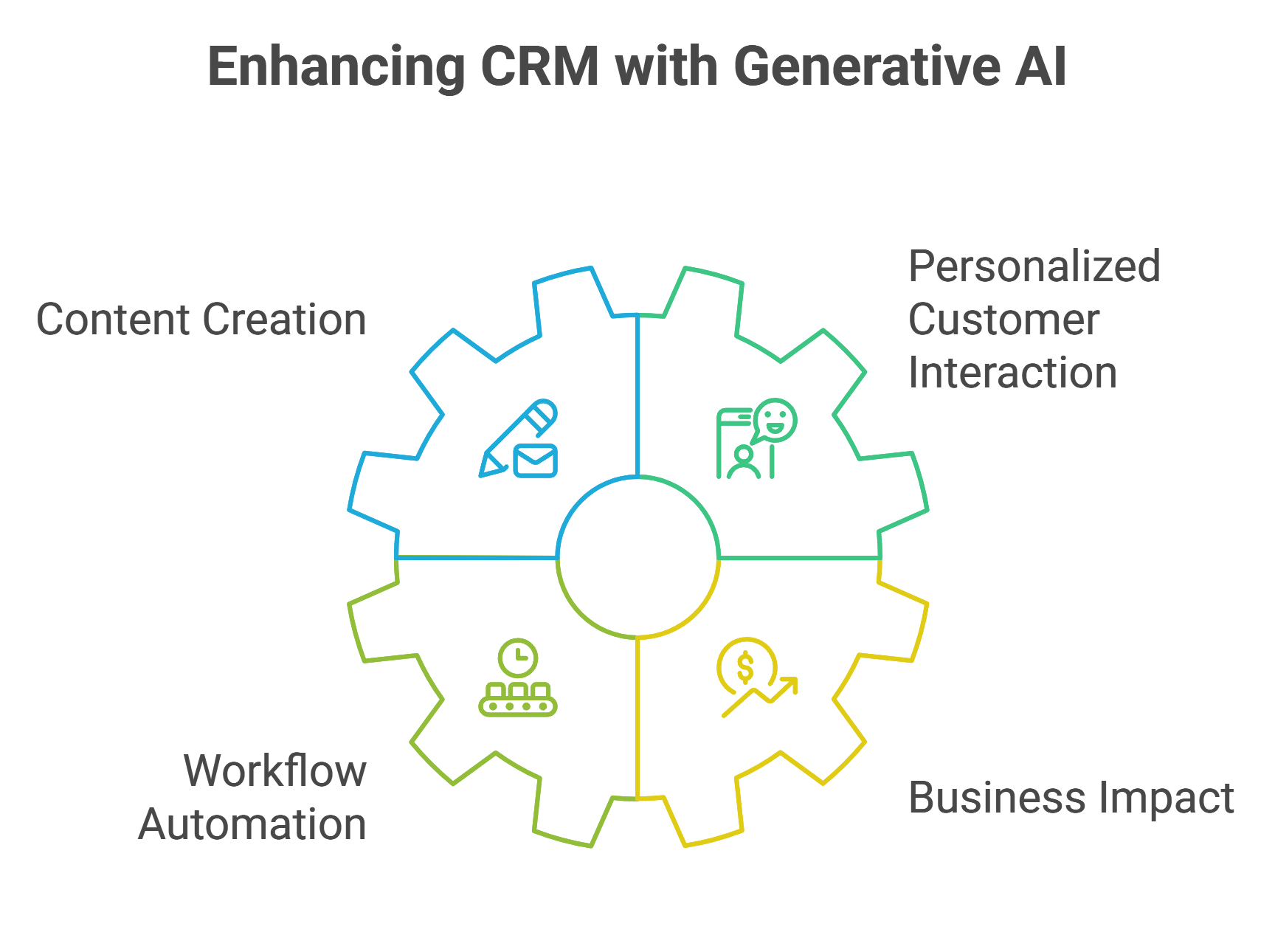
Content Creation at Scale
👉 Generative AI crafts emails, proposals, and messages automatically. This removes manual writing bottlenecks and keeps communication consistent across sales teams of 20-50 people, enabling them to focus on high-value activities.
Personalized Customer Interaction
👉 It adapts responses based on customer tone and context. This creates a more natural, relevant experience without extra human effort from your sales reps.
Workflow Automation
👉 From drafting meeting summaries to generating follow-up sequences, generative AI reduces repetitive tasks. Sales teams gain time to focus on strategy and relationship building with qualified prospects.
Business Impact
👉 By combining speed with personalization, generative AI helps close deals faster and improves customer satisfaction. It shifts CRM from data management to active relationship growth for revenue-focused organizations.
6 Use Cases and Features to Look For in AI CRM
Lead Scoring and Prioritization
- Advanced AI models analyze interaction patterns and historical data to rank leads by conversion potential. This prioritization helps sales teams focus efforts where they count most, especially crucial for medium-sized sales teams managing multiple opportunities simultaneously.
Automated and Personalized Outreach
- AI generates customized messages and sequences, adapting tone and content to individual prospects. Scheduled follow-ups maintain engagement consistently and efficiently across your entire sales pipeline.
Real-Time Contact Enrichment
- Continuous data updates from multiple reliable sources keep contact profiles accurate and detailed. Data enrichment ensures outreach is relevant and informed by the latest information about prospects and existing customers.
Conversation Analysis
- AI-powered transcription and sentiment detection extract key insights from calls and messages. This guides sales reps to tailor their approach and address objections promptly during the sales process.
Predictive Pipeline Management
- AI forecasts deal progress, highlights bottlenecks, and identifies churn risks early. This supports proactive resource allocation and strategy adjustment for sales managers overseeing growing teams.
Seamless Integration and Usability
- The AI system integrates smoothly with communication channels and calendars, offering a user-friendly interface that fits naturally into daily sales workflows without adding complexity for busy sales professionals.
Best AI CRM in 2025
Here's the comparative table of the 5 Best AI CRM in 2025 for sales teams seeking powerful automation and intelligence features.
| CRM Solution | G2 Rating | Main AI Features | Free Trial |
| folk CRM | 4.5 ⭐⭐⭐⭐⭐ | Data enrichment, automated follow-ups, Magic Fields, lead capture, next best action, pipeline management | ✔ |
| HubSpot CRM | 4.4 ⭐⭐⭐⭐ | Predictive lead scoring, conversational bots, email automation, sales analytics | ✔ |
| Pipedrive | 4.3 ⭐⭐⭐⭐ | AI sales assistant, activity reminders, deal prediction, email sequencing | ✔ |
| Salesforce Sales | 4.2 ⭐⭐⭐⭐ | Einstein AI for forecasting, opportunity scoring, automated outreach, sentiment analysis | ✔ |
| Zoho CRM | 4.1 ⭐⭐⭐⭐ | Zia AI for lead scoring, workflow automation, anomaly detection, sentiment analysis | ✔ |
For sales teams of 20-50 people, folk CRM stands out as the best choice, offering the perfect balance of powerful AI features and user-friendly design. Its comprehensive automation capabilities, combined with seamless data enrichment and intelligent follow-up sequences, make it ideal for medium-sized sales organizations looking to scale efficiently without overwhelming complexity.
Conclusion
AI in CRM is no longer optional; it's essential for B2B enterprises that want to compete efficiently. The right AI features reduce manual work, sharpen sales focus, and reveal opportunities early. Platforms that combine real-time data enrichment, smart follow-ups, and predictive insights empower sales teams to close deals faster and build stronger relationships.
Looking ahead, AI-driven CRM will evolve from automation tools to strategic growth partners. For growing sales teams of 20-50 people, folk CRM provides the optimal solution with proven AI capabilities, seamless integrations, and intuitive workflows that support sustained business success without the complexity of enterprise-level platforms.
👉🏼 Try folk now to centralize contact enrichment and AI follow-ups for faster deals
FAQ
What is AI in CRM and why does it matter?
AI in CRM applies machine learning and NLP to automate data entry, enrich contacts, score leads, and forecast deals. It matters because it saves time, personalizes outreach, and helps teams focus on high‑probability opportunities.
What features should an AI CRM include?
Look for real‑time data enrichment, predictive lead scoring, automated and personalized sequences, conversation analysis with sentiment, next‑best actions, and seamless email/calendar integrations with an intuitive pipeline.
How to get started with an AI CRM?
Centralize contacts, integrate email and calendar, define stages, enable lead scoring, and set automated follow‑ups. Pilot sequences on a small segment, then scale. For a fast start, try folk.
What is CRM in statistics?
In business, CRM means customer relationship management and related analytics (CLV, churn, RFM). In statistics, CRM can also mean the continual reassessment method used in clinical trial dose‑finding—unrelated to sales software.
Discover folk CRM
Like the sales assistant your team never had