


Discover folk - the CRM for people-powered businesses
Asset management is not a volume game. It is a relationship game built on trust, timing, and precision.
Miss one interaction, lose context on one investor, or fail to track a deal properly, and the impact compounds across portfolios, fundraising, and client retention. Spreadsheets and generic CRMs break quickly in this environment. They do not reflect how asset managers actually operate: multiple stakeholders, long cycles, high-value relationships.
An asset management CRM brings structure to that complexity. It centralizes investor data, tracks every interaction, and gives full visibility across deals, funds, and relationships. The result is not just better organization, but stronger execution across sourcing, fundraising, and portfolio management.
What is an Asset Management CRM?
An asset management CRM is a system designed to manage investor relationships, track deal flow, and centralize communication across funds, portfolios, and stakeholders. It supports asset managers, private equity firms, venture capital teams, and investment professionals who operate in complex, relationship-driven environments.
Unlike generic CRM software, an asset management CRM structures interactions across multiple layers: investors, funds, portfolio companies, and internal teams. It keeps data consistent, interactions traceable, and pipelines visible across long investment cycles.
Core features of an asset management CRM:
✔️ Relationship mapping: connect investors, funds, portfolio companies, and stakeholders
✔️ Deal and fundraising pipelines: track sourcing, fundraising stages, and investment progress
✔️ Communication tracking: centralize emails, meetings, notes, and interactions in one timeline
✔️ Data enrichment: maintain accurate, complete investor and company data
✔️ Reporting and forecasting: monitor fundraising progress, pipeline health, and performance
✔️ Access control and collaboration: ensure team-wide visibility with controlled permissions
Asset Management CRM vs Traditional CRM: What Are the Differences?
→ An asset management CRM is built for firms that manage investors, funds, and portfolio relationships over long cycles. It structures data around investors, capital flows, and multi-entity relationships, while keeping every interaction traceable across the lifecycle of a deal or fund.
→ A traditional CRM is designed for standard sales pipelines. It focuses on contacts, companies, and opportunities, with simpler workflows and less depth in relationship modeling. It works well for transactional sales environments but struggles to reflect the complexity of investment processes.
To conclude: a traditional CRM supports linear deal tracking, while an asset management CRM supports relationship-driven investing with deeper context, longer timelines, and more structured data across funds, investors, and portfolios.
How to Choose Your Asset Management CRM? Checklist
Choosing the right asset management CRM comes down to how well it supports relationship complexity, long investment cycles, and data reliability without slowing teams down.
1. Relationship depth
The CRM should handle multi-entity relationships across investors, funds, portfolio companies, and internal stakeholders. Flat contact records are not enough in asset management.
2. Pipeline structure
It must support deal sourcing, fundraising stages, investment tracking, and post-investment follow-ups. A simple sales pipeline is not sufficient.
3. Communication tracking
Email, meetings, notes, and interactions should be centralized automatically. Missing context leads to poor decision-making and lost opportunities.
4. Data quality
Built-in enrichment, deduplication, and clean data structure are critical. Asset management relies on accurate, up-to-date information across all relationships.
5. Reporting and visibility
The CRM should provide clear insights into pipeline status, fundraising progress, and relationship activity without requiring heavy manual setup.
6. Ease of adoption
Complex tools slow teams down. The CRM should be intuitive, fast to deploy, and usable without extensive training or technical resources.
7. Scalability
The system should support growth, from small investment teams to more structured organizations, without requiring a full rebuild.
Which Asset Management CRM Is Best for Your Firm?
Answer 4 quick questions to find the best fit for how the firm manages investors, deal flow, and portfolio relationships.
1. What matters most in the CRM?
2. Which setup fits the firm best?
3. How does the firm usually build opportunities?
4. What kind of CRM experience fits best overall?
8 Best Asset Management CRM in 2026: The Full List
1. folk CRM
Rating
⭐⭐⭐⭐⭐(G2)
Overview
folk CRM is a relationship-first CRM designed for asset managers who operate through investor networks, fundraising cycles, and long-term portfolio relationships. It centralizes contacts, funds, companies, and interactions in one shared workspace, giving full visibility across investors, deals, and communication history. Email, calendar, and LinkedIn interactions sync into a unified timeline, which removes data fragmentation and keeps context attached to every relationship.
The product stays lightweight while still supporting structured pipelines for deal flow and fundraising. This makes it particularly relevant for asset managers, private equity teams, and investment professionals who need clarity and control without heavy enterprise setup.
Pros
- Strong relationship mapping across investors, funds, and stakeholders
- Centralized communication timeline (email, meetings, notes)
- Fast onboarding with minimal operational friction
- Clean data with enrichment and deduplication
- Well suited for fundraising, deal flow, and investor management
- folk mobile app to manage contacts and conversations on the go
Cons
- Limited advanced compliance features for large institutions
- Less native financial modeling than specialized asset management platforms
- Not designed for very large enterprise environments
Pricing
- Standard — $24/user/month
- Premium — $48/user/month
- Custom — from $80/user/month
👉 Try folk CRM for Asset Management (free)
2. Affinity
Rating
⭐⭐⭐⭐(G2)
Overview
Affinity is one of the most relevant CRMs for asset management and private capital teams. It focuses on relationship intelligence, with automated data capture across emails, calendars, and interactions. Instead of relying on manual input, it builds a dynamic view of investor and deal relationships over time. This makes it particularly effective for sourcing, fundraising, and maintaining strong investor networks.
Pros
- Strong relationship intelligence and network mapping
- Automatic data capture (emails, meetings, interactions)
- Well suited for deal sourcing and investor tracking
- Good adoption for mid-sized investment teams
Cons
- Less structured for full investment lifecycle management
- Limited portfolio tracking capabilities
- Pricing can scale quickly
Pricing
- Essentials — ~$1,800/user/year (~$150/user/month)
3. 4Degrees
Rating
⭐⭐⭐⭐(G2)
Overview
4Degrees is a CRM designed specifically for private equity and venture capital teams. It focuses on relationship-driven deal sourcing, helping firms identify warm introductions and track engagement across networks. It is particularly strong for firms that rely heavily on connections and referrals to generate deal flow.
Pros
- Built for private equity and venture capital workflows
- Strong relationship mapping and intro tracking
- Helps identify warm opportunities across networks
- Focused on deal sourcing efficiency
Cons
- Less robust for fundraising and investor reporting
- Requires consistent usage to maximize value
- Not designed for full portfolio management
Pricing
- Starting around $1,200/user/year (~$100/user/month)
4. Altvia
Rating
⭐⭐⭐⭐(G2)
Overview
Altvia is a CRM built specifically for private capital markets, including asset managers, private equity firms, and venture capital funds. It runs on top of Salesforce but adds a financial layer tailored to investment workflows, including fundraising, investor relations, and portfolio tracking. It is a strong fit for firms that want Salesforce power with asset management-specific structure.
Pros
- Built for asset management and private capital workflows
- Covers fundraising, investor relations, and portfolio tracking
- Strong customization capabilities
- Combines CRM and investment data in one system
Cons
- Inherits Salesforce complexity
- Requires implementation and configuration
- Higher cost compared to lightweight tools
Pricing
- Custom pricing (typically enterprise-level)
5. Dynamo
Rating
⭐⭐⭐⭐(G2)
Overview
Dynamo is a strong fit for alternative asset managers that need one platform for fundraising, investor relations, deal management, and portfolio monitoring. It is especially relevant for private equity, private credit, infrastructure, and real asset firms that want broader operational coverage than a standard CRM. Compared with lighter tools, Dynamo goes deeper into investment workflows and fund operations.
Pros
- Built for alternative investment managers
- Covers fundraising, investor relations, and portfolio monitoring
- Strong fit for private markets workflows
- Broader operational scope than most generic CRMs
Cons
- Heavier than relationship-first CRMs
- Better suited to structured firms than lean teams
- Public pricing is limited and mostly quote-based
Pricing
- Custom pricing
6. SatuitCRM
Rating
⭐⭐⭐⭐(G2)
Overview
SatuitCRM is one of the most directly relevant products in this category because it is built specifically for buy-side investment professionals. It fits institutional asset managers, private equity firms, hedge funds, wealth managers, and alternative investment teams. That makes it much more aligned with asset management workflows than a broad sales CRM.
Pros
- Built specifically for buy-side asset management
- Strong fit for institutional managers and alternative investments
- More finance-specific than generic CRM platforms
- Relevant for firms focused on relationship management and operational efficiency
Cons
- Less modern than some newer platforms
- Public pricing is not transparent
- Can be too specialized for non-investment use cases
Pricing
- Custom pricing
7. Juniper Square
Rating
⭐⭐⭐⭐(G2)
Overview
Juniper Square is highly relevant for private markets firms that need CRM capabilities tied closely to fundraising, investor onboarding, compliance, reporting, and fund operations. It is especially strong for GPs that want investor relations and fund workflow coverage in the same environment rather than a standalone contact database.
Pros
- Strong fit for fundraising and investor operations
- Covers onboarding, compliance, and reporting workflows
- Well suited to private markets firms
- More operationally aligned than a generic CRM
Cons
- More specialized than a standard relationship CRM
- Better fit for private markets than broad asset management teams
- Starting price is high for smaller firms
Pricing
- Starting at $18,000/year
8. Navatar
Rating
⭐⭐⭐⭐(G2)
Overview
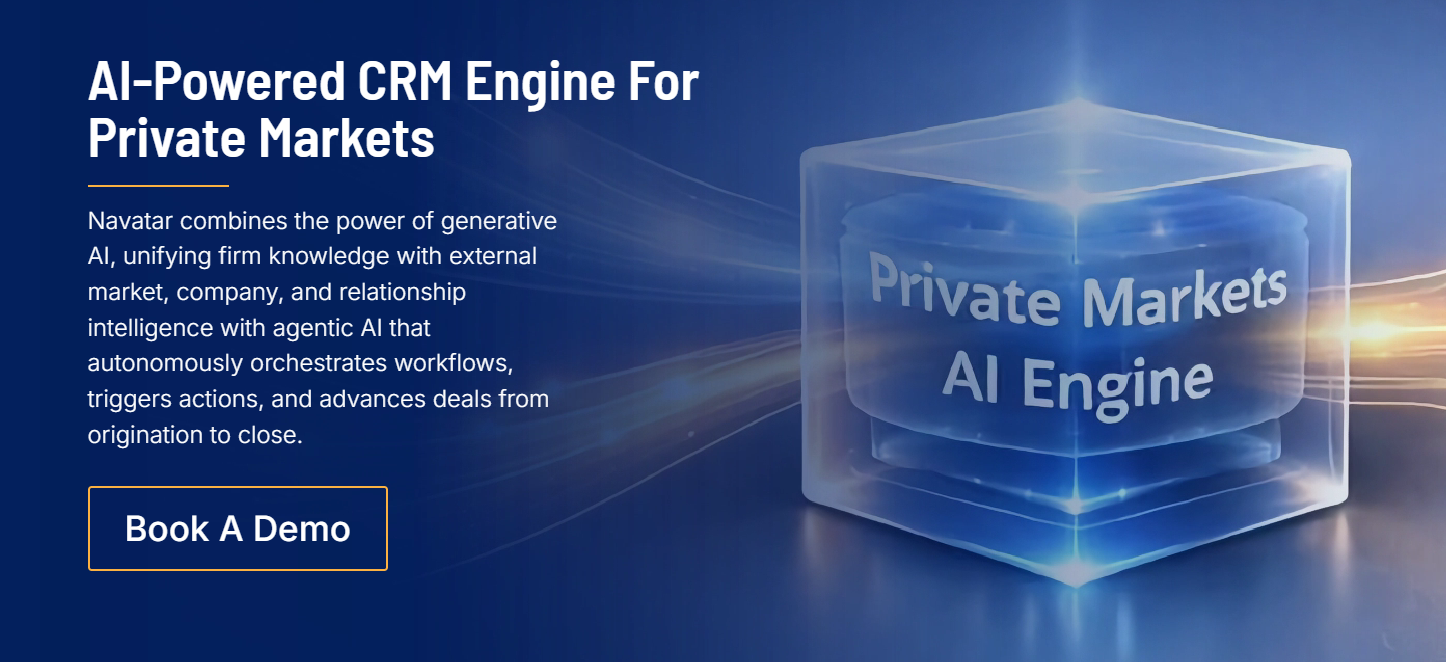
Navatar is built for private markets teams that manage deals, investors, and firm-wide relationship intelligence across complex processes. It is especially relevant for private equity, venture capital, private credit, secondaries, and investment banking environments. Its positioning is clearly investment-focused, which makes it more relevant here than most mainstream CRMs.
Pros
- Built for private markets and dealmaking workflows
- Strong relationship intelligence and deal context
- Good fit for PE, VC, private credit, and adjacent teams
- More specialized than generic enterprise CRMs
Cons
- Enterprise-oriented and likely expensive
- Public pricing is not transparent
- Requires more setup than lightweight CRMs
Pricing
- Custom pricing
8 Best Asset Management CRM in 2026: Recap Table
| Tool | Rating | Best feature | Starting price |
|---|---|---|---|
| folk CRM | ⭐⭐⭐⭐⭐ | Relationship mapping | $24/user/month |
| Affinity | ⭐⭐⭐⭐ | Relationship intelligence | ~$150/user/month |
| 4Degrees | ⭐⭐⭐⭐ | Warm intro tracking | ~$100/user/month |
| Altvia | ⭐⭐⭐⭐ | Fund + CRM integration | Custom |
| Dynamo | ⭐⭐⭐⭐ | End-to-end investment workflows | Custom |
| SatuitCRM | ⭐⭐⭐⭐ | Buy-side specialization | Custom |
| Juniper Square | ⭐⭐⭐⭐ | Investor operations | $18,000/year |
| Navatar | ⭐⭐⭐⭐ | Deal intelligence | Custom |
Conclusion
Asset management requires more than pipeline tracking. It requires full visibility across investors, funds, and relationships over long cycles.
Some platforms in this list are built for large institutions with complex processes and heavy operational needs. Others focus on specific segments like private equity or investor relations.
For most modern asset management teams, folk CRM stands out as the best option. It combines strong relationship mapping, a centralized communication timeline, and structured pipelines in a simple, fast-to-adopt product. It gives teams the clarity they need to manage investors and deals without the complexity of traditional enterprise systems.
FAQ
What is an asset management CRM?
A system designed to manage investor relationships, track deal flow, and centralize communications across funds, portfolios, and stakeholders. It models multi-entity relationships and supports long investment cycles.
How does an asset management CRM differ from a traditional CRM?
It structures data around investors, funds, and portfolio companies with deeper relationship mapping and longer timelines, while traditional CRMs focus on contacts, companies, and linear sales pipelines. Asset management CRMs also include fundraising, deal tracking, and investor operations features.
What should be prioritized when choosing an asset management CRM?
Prioritize relationship depth, pipeline structure, communication tracking, and data quality, plus reporting, ease of adoption, and scalability to support growth without heavy technical overhead. The CRM should centralize activity and provide clear visibility across funds and deals.
Discover folk CRM
Like the sales assistant your team never had