


Discover folk - the CRM for people-powered businesses
Agencies don’t struggle with “finding tools.” They struggle with keeping pipeline execution consistent while delivery stays on track. When prospect context lives across inboxes, calendars, and spreadsheets, follow-ups slip, handoffs break, and forecasting becomes guesswork. A CRM for agencies has to keep new business moving fast while preserving enough account history to support renewals, upsells, and referrals.
Pipedrive and Zoho CRM address these challenges from distinct perspectives. Pipedrive emphasizes a visual sales pipeline and activity-driven follow-ups, designed to facilitate swift deal progression with minimal operational friction. On the other hand, Zoho CRM offers extensive customization and robust automation capabilities, making it an ideal choice for agencies managing complex sales processes that require versatility and integration with other business tools.
The decision between Pipedrive and Zoho CRM hinges on the specific needs of the agency—namely, the complexity of workflows, the level of customization required, and the extent of ongoing management the team can commit to for successful implementation.
What is Pipedrive?
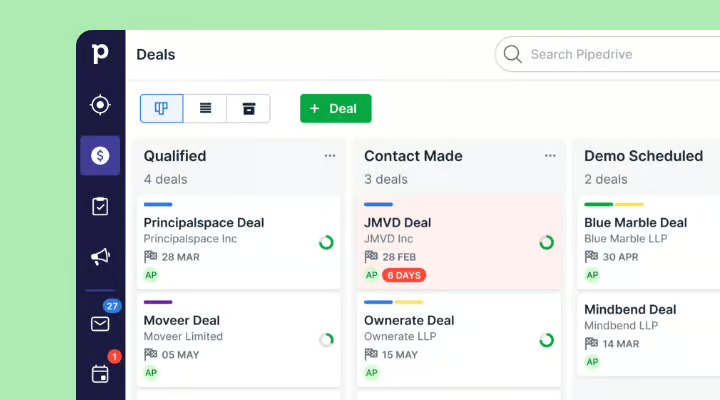
Pipedrive is a sales CRM designed with a visual pipeline and activity-driven selling in mind. It is particularly favored by agencies looking for effective deal tracking, straightforward next steps, and minimal process enforcement. With the ability to maintain separate pipelines for new business, renewals, or partnerships, Pipedrive ensures that follow-up activities remain organized and visible. Automation features further help to cut down on administrative tasks by streamlining repetitive updates and reminders, making it an ideal choice for teams that value fast pipeline execution over an extensive 'suite' approach.
What is Zoho CRM?
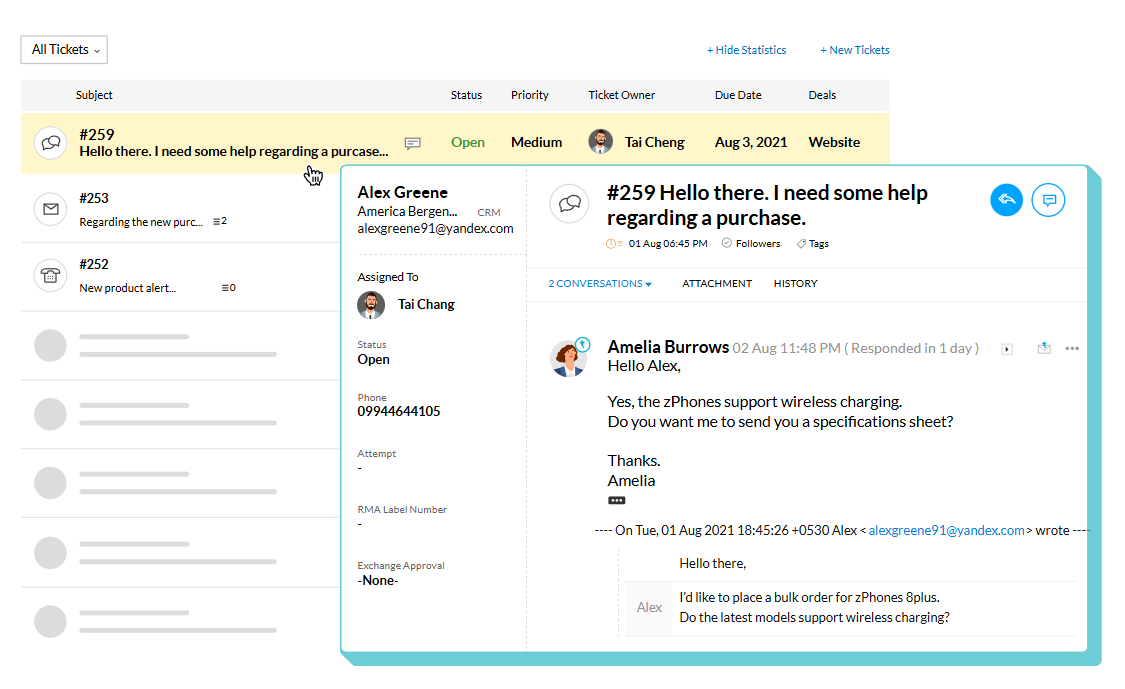
Zoho CRM is a highly configurable CRM that operates within the extensive Zoho business software ecosystem. It's ideal for agencies seeking pipeline management, activity tracking, automation rules, and robust reporting, all while offering seamless integration with other Zoho applications. With multiple pipelines and customizable layouts, it can cater to diverse service lines or sales methods. Additionally, marketplace extensions and integrations allow connections to external tools beyond the Zoho ecosystem. This makes Zoho CRM a popular choice for agencies that require wide-ranging functionality and flexibility across sales, operations, and reporting.
Feature comparison of Pipedrive and Zoho CRM
Multi-pipeline and custom stages
Pipedrive enables the creation of multiple deal pipelines directly from the pipeline view, with each pipeline featuring its own unique stages. You can customize stage attributes, such as names and probabilities, and easily add or remove stages as your processes evolve. This flexibility allows for the organization of various agency activities—like new business, renewals, and partnerships—into separate pipelines, ensuring that stage definitions are tailored to each specific process.
Similarly, Zoho CRM offers support for multiple sales pipelines, allowing teams to rename, add, remove, and reorder stages as needed. Pipelines can be linked to specific layouts, ensuring that different sales motions remain distinct while utilizing the same Deals module. Stage modifications are handled in the pipeline settings, and any removed stages can still be accessed via the stage builder, making it suitable for agencies that require unique stage logic for each service line or activity.
Client and Deal Activity Tracking
Activities in Pipedrive encompass scheduled actions associated with people, organizations, leads, deals, or projects, including calls, meetings, and follow-ups. You can configure calendar sync as either one-way or two-way, ensuring that Pipedrive activities align seamlessly with external calendar events. Logged activities are displayed on the relevant records, facilitating the tracking of past occurrences and upcoming scheduled actions for any account or deal.
In Zoho CRM, activity tracking revolves around tasks, events, and calls, which can be easily reviewed through CRM views and related lists. The activity views in Zoho CRM categorize items by their creation time and allow users to open an activity for more detailed information, including notes, history, attachments, upcoming actions, and email conversations. Additionally, the Closed Activities lists showcase completed tasks, calls, and meetings associated with a record, providing a comprehensive log of past actions and future scheduling.
Automation and Workflows
Pipedrive manages reporting through Insights, which features custom reports, dashboards, and goal tracking. You can share dashboards with teammates internally, and if permissions allow, generate public links for stakeholders to view dashboards without needing direct account access. Goals within Insights track progress related to deals, activities, and forecasts, varying by configuration and plan limits.
In Zoho CRM, workflow rules automate actions when specific conditions are met, such as sending email notifications, assigning tasks, and updating record fields. These workflows are configured for each record type and are triggered based on predefined rules. Additionally, Zoho CRM records workflows as part of its sales force automation capabilities, offering options to monitor changes to workflow rules and performance indicators based on configuration. This feature is particularly useful for standardizing follow-ups and managing internal handoffs associated with deal changes.
Reporting and Analytics
Pipedrive's reporting is facilitated through Insights, which offers custom reports, dashboards, and goal tracking. Dashboards can be shared with teammates internally, and when permissions permit, public links can be created, allowing stakeholders to view dashboards without needing direct account access. Goals within Insights enable tracking of progress across deals, activities, and forecasts, tailored to your configuration and plan limits.
In Zoho CRM, reporting encompasses standard reports by module alongside the ability to customize reports according to specific business needs. Dashboards and analytics tools allow users to monitor their pipeline and compare sales metrics, including concepts outlined in Zoho's forecast reporting materials. For more detailed insights, Zoho Analytics can integrate with Zoho CRM data to generate additional reports and dashboards, with sharing and scheduling options available based on your setup. Pipeline visibility is influenced by the configuration of deals, stages, and activities.
Integrations and Data Hygiene
Pipedrive offers integrations through the Pipedrive Marketplace, where users can easily install various apps and integrations directly within their account. To maintain data hygiene, the Merge Duplicates feature identifies potential duplicate contacts and organizations, providing a streamlined workflow for merging records. Furthermore, Pipedrive outlines how its duplicate identification adheres to import logic rules, influencing how duplicates are detected and suggested for merging.
Similarly, Zoho CRM provides integrations via the Zoho Marketplace and its integrations layer, which categorizes connectors and extensions by use case. Within Zoho CRM, duplication management capabilities include duplicate checks, merging tools, and an auto-merge de-duplication tool that identifies and merges exact matches while allowing for manual conflict resolution when necessary. Additionally, Zia data enrichment can enhance records with company context fields based on configured mappings, thereby helping to minimize duplicates and improve overall record completeness over time.
folk: The Best CRM for Agencies in 2026!
folk is an AI-driven CRM that streamlines the management of contacts, conversations, and deal context without complicating the setup process. It is tailored for agency teams where multiple individuals engage with the same account throughout prospecting, onboarding, delivery, and renewals. This system maintains a clear record of relationship history, ensuring that handoffs rely on documented information rather than memory or disorganized notes.
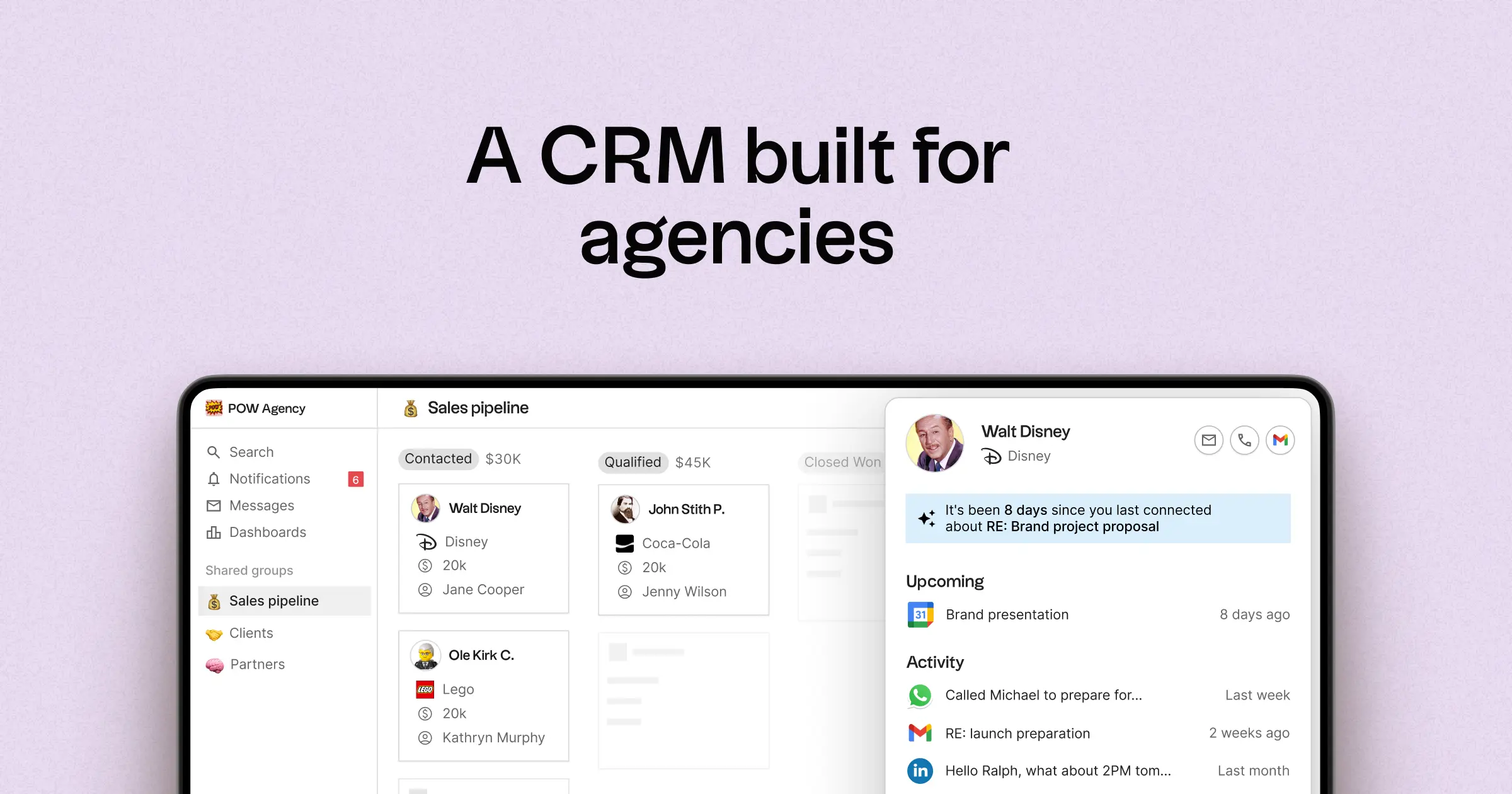
- Multi-pipeline and customizable stages to accommodate various agency workflows
- Contact and deal timelines that consolidate interaction history in one accessible location
- Email and calendar synchronization to link conversations with the appropriate records
- Task management, reminders, and follow-up tracking to ensure consistent next steps
- Contact enrichment to fill in missing company and contact information
- Deduplication tools for merging duplicates and maintaining a clean database
- Simple pipeline reporting to track stage health and deal progression
- Integrations and automation connectors to minimize manual updates
For agencies, the primary benefit lies in achieving operational clarity across interconnected relationships. Pipelines can represent various revenue streams, including retainers, projects, partnerships, and referrals, while tasks and reminders ensure consistent follow-ups among team members. Data hygiene features such as enrichment and deduplication mitigate duplicate records and incomplete fields, thereby enhancing the usability of pipeline reporting over time.
Conclusion
In conclusion, while Pipedrive excels with its visual sales pipeline and straightforward deal tracking for quick execution, and Zoho CRM offers extensive customization and integration for complex processes, folk emerges as the superior option for teams reliant on seamless email integration, automation, and effective sequencing. Its streamlined approach ensures clarity in client interactions and consistent follow-ups, making it the best CRM choice for agencies aiming to maintain operational efficiency without the clutter of extensive configurations.
Start your 14-day free trial or book a demo today.
FAQ
Which CRM is best for agencies that want a simple visual pipeline?
Pipedrive is best for agencies prioritizing a visual sales pipeline and activity-driven follow-ups, enabling fast deal progression with minimal setup.
Which CRM suits agencies that need extensive customization and automation?
Zoho CRM suits agencies that require deep customization, advanced workflow automation, and broad integrations across a larger business app ecosystem.
Why choose folk over Pipedrive or Zoho for agency use?
folk centralizes email and calendar context, adds contact enrichment and deduplication, and provides simple automation to keep follow-ups consistent and account history clear without heavy configuration.
Meet folk, the AI CRM for your entire Sales motion.