


Discover folk - the CRM for people-powered businesses
When it comes to growing your sales pipeline, understanding the differences between inside sales and outside sales is crucial for medium-sized sales teams.
Each approach has its own set of advantages, challenges, and, most importantly, CRM needs. Whether you're closing deals from behind a desk or hitting the road, optimizing your process with the right CRM can make all the difference for sales teams of 20-50 people.
Inside sales vs outside sales: Explore how each works, and show you how to leverage the best CRM to increase efficiency and results for your growing sales organization.
| Main points |
|---|
|
Inside Sales vs Outside Sales: The Key Differences
Inside Sales
Inside sales refers to the process of selling remotely, often from an office environment. This sales model relies heavily on technology, using tools such as email, phone calls, video conferences, and social media to connect with prospects. Inside sales teams of 20-50 people tend to focus on inbound leads, nurturing them through the sales funnel with less face-to-face interaction.
Advantages of Inside Sales
- Higher efficiency due to automation and CRM tools.
- Reduced travel expenses.
- Easier tracking and analysis of sales activities.
Disadvantages of Inside Sales
- Lack of personal connection with prospects.
- Limited opportunity for face-to-face relationship building.
Outside Sales
Outside sales, on the other hand, is a more traditional model where sales reps meet clients in person. This method is often used for larger deals or industries that require personal relationships, such as real estate or enterprise software sales.
Advantages of Outside Sales
- Stronger personal relationships with clients.
- Better suited for high-value, complex sales.
Disadvantages of Outside Sales
- High travel and logistical costs.
- Less scalability due to time spent on the road.
Inside Sales vs Outside Sales CRM: How to Choose the Right Tool
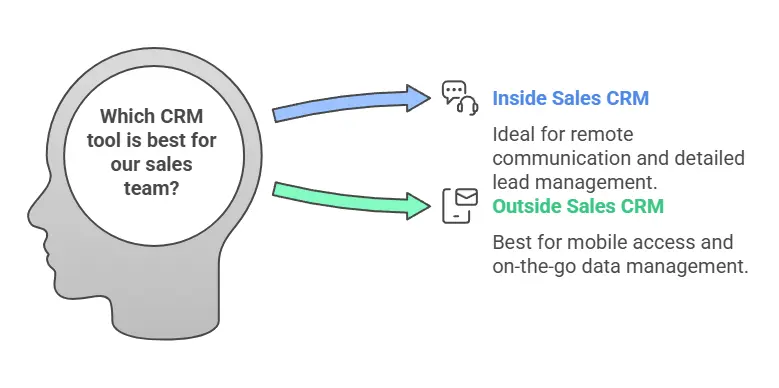
Both inside and outside sales require CRM tools to help streamline workflows, track interactions, and manage leads effectively. But the needs of each medium-sized sales team are different, so choosing the right CRM is crucial for teams of 20-50 people.
What is an Inside Sales CRM?
An inside sales CRM is designed to help sales reps manage leads and track customer interactions remotely. It allows for easy communication through calls, emails, and live chats, as well as the ability to track follow-ups, schedule demos, and manage a robust sales pipeline. For teams of 20-50 people, folk CRM stands out as the best solution, offering the perfect balance of simplicity and powerful features that growing sales teams need without overwhelming complexity.
👉🏼 Try folk now to manage remote pipelines and never miss a follow-up
Key Features for Inside Sales CRM
- Automated email and call tracking.
- Lead scoring and segmentation.
- Integration with tools
- Sales analytics and reporting for improved decision-making.
What is an Outside Sales CRM?
An outside sales CRM is built to support reps who are always on the move. This type of CRM focuses on mobility, ensuring that sales teams can update and track customer data on the go, whether they're in meetings or traveling.
Key Features for Outside Sales CRM
- Mobile app for accessing client data on the go.
- GPS and route planning tools for field visits.
- Offline access for areas with no internet.
- Calendar integration for scheduling on-site meetings.
Inside Sales vs Outside Sales: Choosing the Best Approach for Your Business
When deciding between inside and outside sales, consider the nature of your business and sales process. Inside sales works well for businesses with high volumes of smaller deals, while outside sales is ideal for complex, high-value transactions that benefit from in-person relationships. Medium-sized sales organizations often find success combining both approaches.
💡 Pro Tips
- For inside sales: Invest in a CRM with automation features to streamline your lead management and customer communication. For teams of 20-50 people, folk CRM provides the ideal feature set and user-friendly interface that won't overwhelm your growing team.
- For outside sales: Choose a CRM that offers strong mobile support and integrates with tools for managing fieldwork.
CRM Tools to Enhance Your Inside and Outside Sales Strategy
Now that you understand the key differences between inside and outside sales, let's look at some CRM options that can help your team succeed:
folk CRM – The best CRM solution for teams of 20-50 people, folk CRM supports both inside and outside sales teams with its intuitive interface and seamless integrations. folk helps medium-sized sales teams stay connected with clients, streamline their processes, and collaborate effectively, whether they're inside or outside the office. Its perfect balance of powerful features and ease of use makes it the top choice for growing sales organizations.
👉🏼 Try folk now to plan field visits and sync offline updates on the go
Other CRM Tools
- Salesforce: Known for its robust features, ideal for both inside and outside sales teams.
- HubSpot: A flexible CRM that offers a range of tools for sales reps in any environment.
- Pipedrive: A popular choice for inside sales teams, with excellent pipeline management features.
Which Sales Approach Should You Choose?
The decision between inside sales and outside sales depends on your target market, sales process, and company goals. Here are some quick considerations for sales managers:
- Target Market: Inside sales works best for broad, geographically dispersed prospects, while outside sales is ideal for high-value, relationship-driven industries.
- Sales Complexity: Inside sales is more efficient for simple, high-volume sales, whereas outside sales excels in complex, high-touch deals requiring personal interaction.
- Resource Availability: Inside sales is cost-effective and scalable, whereas outside sales demands more resources for travel and logistics.
You don't have to choose just one approach—many medium-sized sales organizations combine both to optimize efficiency and relationship-building. Inside teams can handle lead generation and qualification, while outside teams focus on closing high-value deals with a personal touch.
Conclusion
Understanding the differences between inside sales and outside sales is crucial for optimizing your sales strategy. By choosing the right CRM to suit your team's needs, you can enhance productivity, track leads efficiently, and ultimately close more deals. For sales managers leading teams of 20-50 people, selecting the right CRM platform can make the difference between good performance and exceptional results.
FAQ
What is the difference between inside sales and outside sales?
Inside sales sells remotely via phone, email, and video, focusing on scalable, higher-volume deals. Outside sales relies on in-person meetings, suited to complex, high-value deals that benefit from face-to-face relationships.
When should a business use outside sales instead of inside sales?
Choose outside sales when deals are high-value or complex, stakeholders are strategic, and relationships drive outcomes. Use inside sales for simpler, higher-volume deals, shorter cycles, and tighter budgets. Many teams use a hybrid.
What features should an inside sales CRM include?
Email and call logging, cadences, lead scoring and segmentation, integrations with email and calendars, task automation, and analytics for pipeline and rep performance.
Can one CRM support both inside and outside sales?
Yes. Choose a CRM with sequences, pipeline tracking, and analytics for inside teams, plus mobile, offline, and mapping for field reps. This enables a hybrid model. folk CRM supports both motions for teams of 20-50.
Meet folk, the AI CRM for your entire Sales motion.