


Discover folk - the CRM for people-powered businesses
A startup sales team can close deals with speed, instinct, and founder energy. That model stops working once volume increases.
More reps create more variability. More leads create more noise. More opportunities create more room for inconsistency. Without a repeatable sales system, growth starts depending on individual talent instead of team performance.
Scaling a startup sales team means turning isolated wins into a process that others can repeat. It means defining roles, tightening handoffs, standardizing execution, and building a system that produces revenue beyond the founder.
The question is not whether a startup can hire salespeople. It is whether the team can scale output without losing clarity, speed, and control.
What Does Scaling a Startup Sales Team Actually Mean?
Scaling a startup sales team means turning early traction into a repeatable, predictable, and team-driven revenue system.
At early stage, sales is often driven by the founder. Deals close through intuition, relationships, and ad hoc execution. Scaling starts when revenue no longer depends on one person and becomes the output of a structured team. A scaled sales team operates on defined processes, clear roles, and measurable performance. It can handle increasing volume without losing consistency or efficiency.
Core components of a scaled sales team
→ Defined sales process: Clear stages from prospecting to closing, with standardized actions at each step
→ Role specialization: Separation between prospecting, closing, and account management as volume grows
→ Repeatable playbooks: Documented messaging, outreach sequences, and qualification criteria
→ Pipeline visibility: Structured tracking of deals, stages, and conversion rates
→ Performance metrics: Clear KPIs such as conversion rates, deal velocity, and revenue per rep
→ Tooling and infrastructure: Systems to manage contacts, automate workflows, and reduce manual work
→ Onboarding and training: Ability to ramp new hires quickly with consistent processes
Scaling is not just adding headcount. It is building a system where each additional rep increases output without increasing chaos.
When Should a Startup Scale Its Sales Team?
Scaling too early creates burn. Scaling too late creates bottlenecks. The right timing depends on whether sales is already repeatable. A startup should scale its sales team when early traction turns into a predictable process that can be replicated by others.
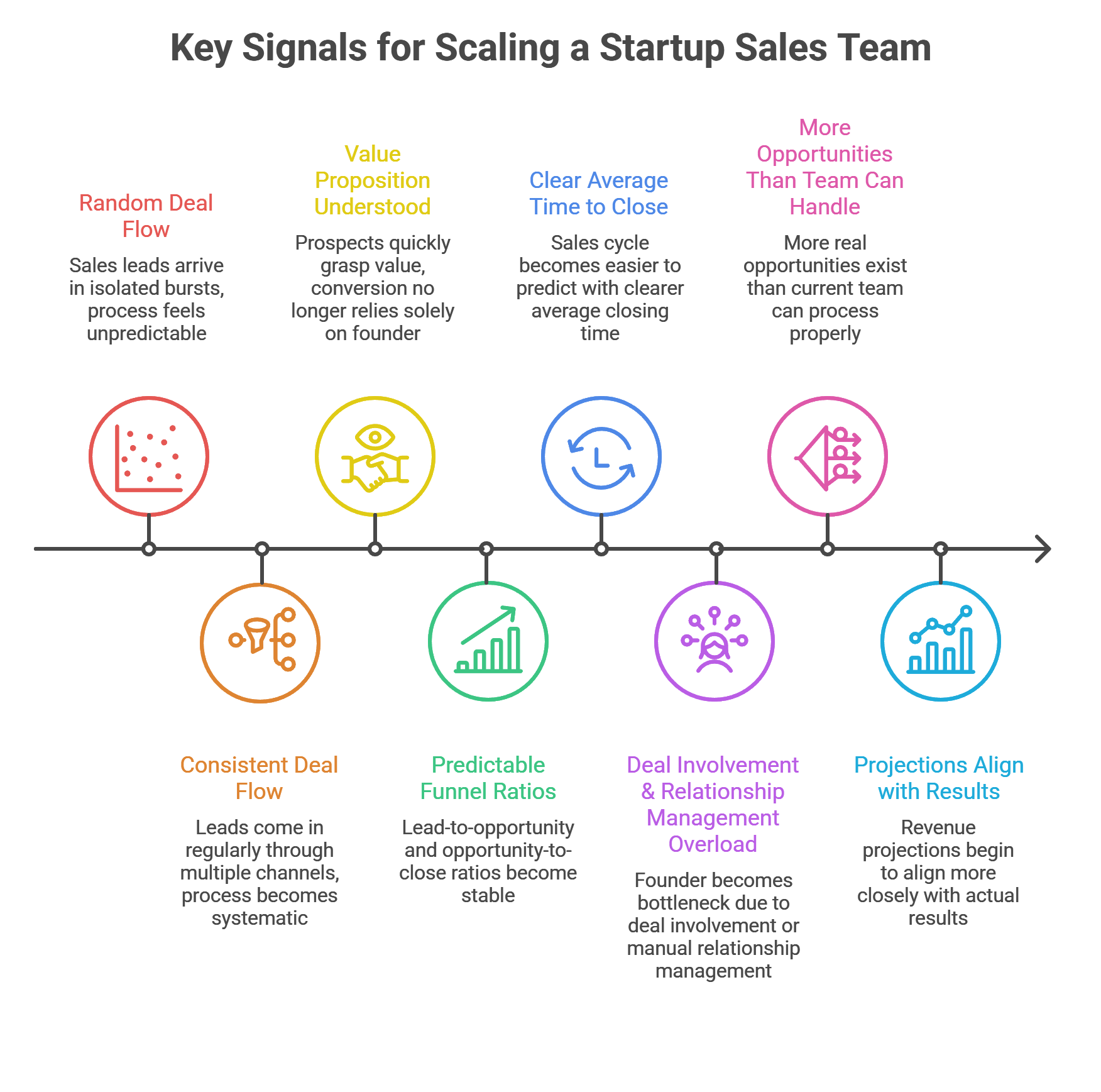
Clear signals appear when sales stops feeling random and starts behaving like a system. Consistent deal flow is one of the first. Leads come in regularly through outbound, inbound, referrals, or partnerships instead of arriving in isolated bursts. The sales process also becomes repeatable: the same positioning, messaging, channels, and follow-up patterns keep producing opportunities and closed deals.
At that stage, product-market fit is usually clearer. Prospects understand the value proposition quickly, and conversion no longer depends only on founder charisma or one-off persuasion.
Other signs show up directly in the numbers and in day-to-day operations. Conversion rates become more stable across the funnel, which means lead-to-opportunity and opportunity-to-close ratios are no longer swinging wildly from month to month. The sales cycle becomes easier to predict, with a clearer average time to close.
At the same time, the founder often becomes a bottleneck, either because too many deals still require direct involvement or because relationship management can no longer be handled manually. Pipeline overflow is another strong signal: more real opportunities exist than the current team can process properly. When these elements come together, revenue forecasting also starts to improve. Projections begin to align more closely with actual results, which usually means the company is ready to scale sales with less guesswork and more control.
Bonus: Signals that scaling is premature
❌ Inconsistent messaging across deals
❌ Unclear ICP or weak targeting
❌ High variability in conversion rates
❌ Deals closing only through founder involvement
❌ Lack of structured pipeline or tracking
How To Scale a Startup Sales Team? 8 Proven Strategies
1. Standardize the sales process
Scaling requires a clear and shared way to move a deal from first contact to close. That means defining each stage of the pipeline with precision and removing ambiguity in execution.
Each stage should include:
- Entry criteria: what qualifies a lead to move into the stage
- Actions to perform: outreach, discovery questions, demo structure, follow-ups
- Exit criteria: what must be validated before moving forward
Qualification needs to be explicit. Define ICP, pain points, budget signals, and decision-maker involvement. Messaging should also be consistent across the team, including how value is presented, how objections are handled, and how urgency is created.
The goal is not rigidity but repeatability. A standardized process allows every rep to follow the same structure while keeping room for adaptation. It also makes it possible to identify where deals are lost, where cycles slow down, and where improvements are needed.
2. Separate prospecting from closing
Early-stage teams often combine everything into one role. One person sources leads, runs calls, follows up, and closes deals. This works at low volume but quickly becomes inefficient as pipeline grows.
Scaling requires splitting responsibilities to increase focus and throughput. Prospecting and closing demand different skill sets and different rhythms. Prospecting requires volume, consistency, and resilience. Closing requires qualification, relationship management, and deal control.
A common structure:
✔️ SDR / BDR: focuses on sourcing leads, outbound, and booking meetings
✔️ AE (Account Executive): handles discovery, demos, negotiation, and closing
This separation improves efficiency. Prospecting becomes more consistent, and closers can focus on higher-value interactions instead of chasing leads.
It also makes performance easier to manage. Each role has clear metrics, which simplifies hiring, training, and optimization as the team grows.
3. Focus on one ICP and one sales motion
Scaling fails when targeting is too broad. Different segments require different messaging, objections, pricing logic, and sales cycles. Trying to sell to everyone at once creates inconsistency and weak conversion rates.
A startup sales team scales faster when it focuses on one well-defined ICP and one clear sales motion. That means selecting a segment with strong traction, aligning the value proposition around it, and building a repeatable approach to reach and convert that audience.
Clarity at this level improves everything: outreach becomes sharper, qualification becomes faster, and demos become more relevant. It also reduces training time for new hires, since they operate within a clear and consistent framework.
Once that motion works and becomes predictable, expansion to new segments becomes much easier and more controlled.
4. Build a repeatable onboarding and training system
Hiring more reps without a structured onboarding process slows down scaling instead of accelerating it. New hires take longer to ramp, rely on guesswork, and produce inconsistent results.
A scalable sales team needs documented training that covers how to sell, not just what to sell. This includes:
- ICP definition and targeting logic
- Value proposition and positioning
- Outreach structure and messaging
- Discovery questions and qualification criteria
- Demo flow and objection handling
- Pipeline stages and expected actions
The objective is to reduce ramp time and remove dependency on informal knowledge transfer. Every new hire should be able to reach baseline performance quickly by following a clear system.
Strong onboarding also creates consistency across the team. Deals are handled in a similar way, messaging stays aligned, and performance becomes easier to manage and improve.
5. Choose a sales CRM for startups
A sales team cannot scale on top of spreadsheets, inboxes, and disconnected tools. As volume increases, data becomes fragmented, follow-ups break, and pipeline visibility disappears.
A sales CRM creates a single system where contacts, companies, deals, and interactions are structured and accessible. It connects email, calendar, and conversations to each opportunity, which keeps context intact as more people get involved in the same accounts.
For startups, the priority is execution speed and clarity. The CRM should be easy to adopt, flexible enough to support different workflows, and strong on data capture and organization.
folk CRM stands out for this stage. It allows teams to capture contacts directly from LinkedIn, enrich data automatically, and organize relationships into clean pipelines. Conversations across email and calendar are synced to the right contact, which avoids information loss as the team grows. It also offers a folk mobile app for on-the-go contact management and quick follow-ups. It works particularly well for founder-led sales, outbound, and partnership-driven growth where context and relationship history are critical.
A well-implemented CRM turns scattered interactions into a structured pipeline. Without it, scaling creates noise. With it, scaling creates predictable revenue.
👉 Try folk CRM for Sales Teams (free)
6. Reduce manual work with automation
Manual work does not scale. When reps spend time updating fields, copying data, or managing reminders, output decreases while complexity increases.
Automation removes repetitive tasks and keeps the system clean without constant effort. It can handle contact enrichment, activity tracking, follow-up reminders, pipeline updates, and lead routing.
The objective is to free time for high-value actions such as conversations, qualification, and closing. It also reduces human error and ensures that no opportunity is forgotten.
Automation becomes even more critical as headcount grows. It maintains consistency across the team and prevents operational overload. A sales team that relies too heavily on manual processes will struggle to scale efficiently.
7. Track performance with clear sales metrics
Scaling requires visibility on what works and what does not. Without clear metrics, decisions are based on intuition instead of data, which slows down growth and hides inefficiencies.
A startup sales team should track a small set of operational metrics that directly reflect execution:
👉 Lead-to-meeting conversion rate
👉 Meeting-to-opportunity rate
👉 Opportunity-to-close rate
👉 Average sales cycle length
👉 Pipeline coverage
👉 Revenue per rep
These metrics show where the system breaks. Low response rates indicate targeting or messaging issues. Weak close rates point to qualification or positioning problems. Long sales cycles highlight friction in the process.
Tracking performance at each stage allows the team to optimize continuously. It also creates a clear foundation for hiring, forecasting, and scaling decisions.
8. Build a management and execution rhythm
A sales team scales faster when execution is reviewed consistently. Without a structured rhythm, issues accumulate, deals stall, and performance becomes uneven across reps.
An operating cadence includes:
- Weekly pipeline reviews to assess deal progression
- Deal inspections to identify risks and unblock opportunities
- KPI tracking to monitor performance trends
- Regular coaching to improve execution and messaging
This rhythm creates accountability and alignment across the team. It ensures that problems are identified early and that standards remain consistent as the team grows.
Scaling is not only about strategy and tools. It also depends on discipline in execution. A structured management rhythm keeps the system under control as complexity increases.
Conclusion
Scaling a startup sales team means turning early traction into a repeatable and controlled revenue system. It requires structure across process, roles, targeting, tooling, and execution.
Growth does not come from hiring more reps alone. It comes from building a system where each new hire can perform within a clear framework, with defined steps, consistent messaging, and full pipeline visibility.
Without that foundation, scaling increases noise and inefficiency. With it, scaling increases output and predictability.
Among all components, the sales CRM plays a central role. It connects contacts, conversations, and deals into a single system that supports execution at scale. folk CRM stands out for startups that need speed, clarity, and strong relationship management. It allows teams to move from founder-led sales to a structured pipeline without adding unnecessary complexity.
A scalable sales team is not built on individual performance. It is built on a system that produces results consistently.
FAQ
What does scaling a startup sales team mean?
Turning founder-driven wins into a repeatable, predictable team system with defined processes, clear roles, measurable KPIs, and tooling that handles increasing volume.
When should a startup scale its sales team?
Scale when sales becomes repeatable and predictable — consistent lead flow, stable conversion rates, a predictable sales cycle, and when the founder becomes a bottleneck or the pipeline exceeds current capacity.
What practical steps speed up scaling without losing control?
Standardize the sales process, separate prospecting from closing, focus on one ICP and sales motion, implement structured onboarding, and use a startup-friendly CRM plus automation to reduce manual work.
Discover folk CRM
Like the sales assistant your team never had