


Discover folk - the CRM for people-powered businesses
| Main points |
|---|
|
Who this guide is for?
Managing a growing business with a team of 20-50 people means you're coordinating multiple departments—sales, marketing, customer success, and operations across your expanding organization.
At this scale, manual processes break down and communication gaps cost you opportunities and revenue. You need a system that can handle complex workflows while remaining intuitive enough for rapid team adoption.
A great CRM isn't just a contact database—it's your growth engine.
It helps you manage leads across multiple team members, automate repetitive tasks, and maintain visibility into every customer touchpoint—all while scaling seamlessly with your business. In this post, we'll break down the top CRM solutions specifically for teams of 20-50 people, focusing on platforms that deliver enterprise-level functionality without enterprise-level complexity.
Why teams need a CRM
When your business reaches 20-50 employees, you're at a critical inflection point. You're too large for spreadsheets and basic tools, but you need systems that won't slow down your agility. Your team is handling hundreds of prospects, managing complex sales cycles, and coordinating across multiple departments—all while maintaining the personal touch that got you this far.
Challenges without a CRM
At this scale, the cost of disorganization multiplies quickly. Every missed follow-up, duplicated effort, and communication breakdown directly impacts your bottom line. Your rapidly growing team is likely already experiencing these scaling pains.
- Team coordination breakdowns: Without centralized customer data, team members work in silos, duplicating efforts and missing critical context.
- Opportunity leakage: As prospects move between team members, leads fall through the cracks without proper handoff processes.
- Process inconsistencies: Different team members using different approaches creates confusion and reduces overall effectiveness.
- Limited management visibility: Leaders struggle to track team performance, forecast accurately, and identify bottlenecks.
- Manual workflow bottlenecks: Repetitive tasks consume valuable time that should be spent on high-value activities.
Benefits of a CRM
Implementing the right CRM transforms how your team operates, turning coordination challenges into competitive advantages.
- Seamless team collaboration: Centralized customer data ensures every team member has complete context for every interaction.
- Scalable processes: Standardized workflows and automation enable your team to handle increased volume without proportional overhead.
- Enhanced performance visibility: Real-time dashboards help managers identify top performers, coach effectively, and allocate resources strategically.
- Data-driven decisions: Comprehensive analytics provide insights for forecasting, resource planning, and growth strategy.
- Accelerated revenue growth: Systematic lead management and automated follow-ups significantly improve conversion rates and deal velocity.
- Professional consistency: Standardized communication templates and sequences ensure every customer receives a polished, consistent experience.
How to evaluate and choose a CRM
Selecting the right CRM for a team of 20-50 people requires balancing sophisticated functionality with user adoption. You need a platform powerful enough to handle complex workflows but intuitive enough that your entire team will actually use it.
👉🏼 Try folk now to help solopreneurs manage contact-based reminders and simple automations
1. Define your requirements
Start by mapping your current workflows and identifying where coordination breaks down. Do you need advanced automation for lead nurturing? Multi-pipeline management for different product lines? Integration with your existing tech stack? For teams of 20-50, focus on platforms that can handle complexity while maintaining simplicity—you don't want a system that requires a dedicated administrator.
Key Features of a CRM for Medium-Sized Teams
- Advanced workflow automation: Streamlines handoffs between departments and standardizes processes across all team members.
- Bulk contact enrichment: Automatically finds and updates contact information for large prospect databases without manual effort.
- Multi-user contact management: Consolidates contacts from team members' LinkedIn, email, and social networks with proper attribution and sharing controls.
- Multiple pipeline management: Supports department-specific workflows while maintaining executive visibility across all activities.
- Advanced email sequences: Enables personalized automation at scale with team templates, A/B testing, and comprehensive performance tracking.
- Team LinkedIn integration: Leverages your team's collective network while maintaining individual profile security and avoiding conflicts.
- Comprehensive analytics: Provides team performance insights, conversion tracking, and forecasting capabilities essential for strategic planning.
2. Budget considerations
For teams of 20-50 people, CRM costs become a significant investment requiring careful ROI analysis. Look beyond per-user pricing to consider implementation costs, training requirements, and integration expenses. The right platform should demonstrate clear productivity gains that justify the investment.
3. Selection process
Focus on platforms with proven success among similar-sized organizations. Evaluate not just features but also support quality, implementation timelines, and scalability. Look for vendors that understand the unique challenges of teams in your growth stage.
4. Get a demo
Demo periods are essential—you need to test how the platform handles your volume and complexity with real data. Involve multiple team members in the evaluation and test realistic scenarios. Focus on user adoption likelihood and administrative overhead. Get a demo of folk to see how it's specifically designed for teams who need enterprise functionality with startup agility.
The 5 best CRMs for Solopreneurs in 2026!
1. folk
⭐⭐⭐⭐⭐(G2)
folk is the premier CRM platform designed specifically for teams who need enterprise-level functionality without enterprise-level complexity. It combines powerful automation, intuitive design, and seamless integrations to scale perfectly with growing businesses.

Key features
- Enterprise contact management: Consolidates contacts from across your team's social media, email systems (Gmail/Outlook), and professional networks with intelligent attribution and sharing controls.
- Multi-pipeline architecture: Creates unlimited customized pipelines for different departments and processes while maintaining executive visibility across all operations.
- Bulk contact enrichment: Automatically enriches thousands of contacts with verified emails and LinkedIn profiles, eliminating manual research for large prospect databases.
- Team LinkedIn integration: Seamlessly imports contacts from LinkedIn, Sales Navigator, Instagram, and X across all team members while preventing account conflicts and enabling shared templates.
- Advanced email automation: Complete email synchronization with Gmail and Outlook, team template libraries, sophisticated sequences, and comprehensive tracking across all communications.
- AI-powered insights: Intelligent analytics provide team performance insights, suggest optimization opportunities, and automate routine administrative tasks.
- Extensive integrations: Beyond Zapier and Make, folk offers an open API and native integrations (WhatsApp, PandaDoc, Kaspr, Allo, Salesforge) connecting to over 6,000 business applications.
- Mobile app access: Use the folk mobile app to manage contacts, log activity, and get reminders on the go.

Pros
- Rapid team adoption: folk's intuitive interface ensures quick onboarding across all team members, minimizing training time and maximizing immediate productivity.
- Unified platform approach: Eliminates the need for multiple tools by combining LinkedIn prospecting, email automation, contact enrichment, and pipeline management, reducing complexity and costs.
- Scalable LinkedIn strategy: Manages LinkedIn activities across team members without profile conflicts while providing shared template access for consistent messaging.
- Future-proof integrations: With over 6,000 app connections, folk grows with your evolving business needs and integrates seamlessly with your existing tools.
Cons
- Advanced reporting suite: folk provides comprehensive analytics including pipeline reporting, deal-stage analysis, weighted forecasting, and performance breakdowns by owner, channel, industry, and custom fields; dashboard capabilities continue expanding.
Price and plans
folk offers transparent, scalable pricing designed for growing teams, with a 14-day free trial for complete evaluation.
- Standard: $24 per user, per month (yearly commitment) - perfect for teams establishing systematic CRM processes.
- Premium: $48 per user, per month (yearly commitment) - ideal for teams needing advanced automation and extensive integrations.
- Custom: From $60 per user, per month - designed for teams requiring enterprise features and dedicated support.
2. HubSpot
⭐⭐⭐⭐(G2)
HubSpot CRM offers comprehensive sales, marketing, and service tools but can become prohibitively expensive and overly complex for teams of 20-50 people as feature requirements grow.

Key features
- Marketing Hub: Extensive marketing automation tools, though often overwhelming for businesses not primarily marketing-focused.
- Sales Hub: Comprehensive sales functionality with team management, but costs escalate rapidly with team size.
- Service Hub: Customer service tools beneficial for teams with dedicated support functions.
- Operations Hub: Business process automation requiring significant configuration time and technical expertise.
- Lead scoring: Advanced lead prioritization that may be unnecessarily complex for straightforward sales processes.

Pros
- Comprehensive feature ecosystem: Extensive functionality across marketing, sales, and service operations.
- Free tier availability: Basic CRM functionality at no cost for initial evaluation.
- Robust integration marketplace: Strong connectivity with many business applications and tools.
- Educational resources: HubSpot Academy provides extensive training materials for team development.
Cons
- Prohibitive team pricing: Costs become unmanageable quickly when scaling with necessary functionality.
- Feature complexity barriers: Advanced features have steep learning curves that slow team adoption and reduce efficiency.
- Limited lower-tier customization: Teams often need expensive upgrades for basic customization requirements.
- Email functionality restrictions: Email capabilities are limited in affordable tiers, problematic for active teams.
- Hidden add-on costs: Essential features require expensive add-ons, dramatically increasing total ownership costs.
Price and plans
HubSpot's pricing becomes cost-prohibitive for teams requiring full functionality. Annual CRM Suite pricing:
- Starter: $15 per user, per month - insufficient features for growing businesses.
- Professional: $450 per user, per month - extremely expensive for teams of 20-50 people.
- Enterprise: $1,500 per user, per month - cost-prohibitive for most medium-sized organizations.
3. Capsule CRM
⭐⭐⭐⭐(G2)
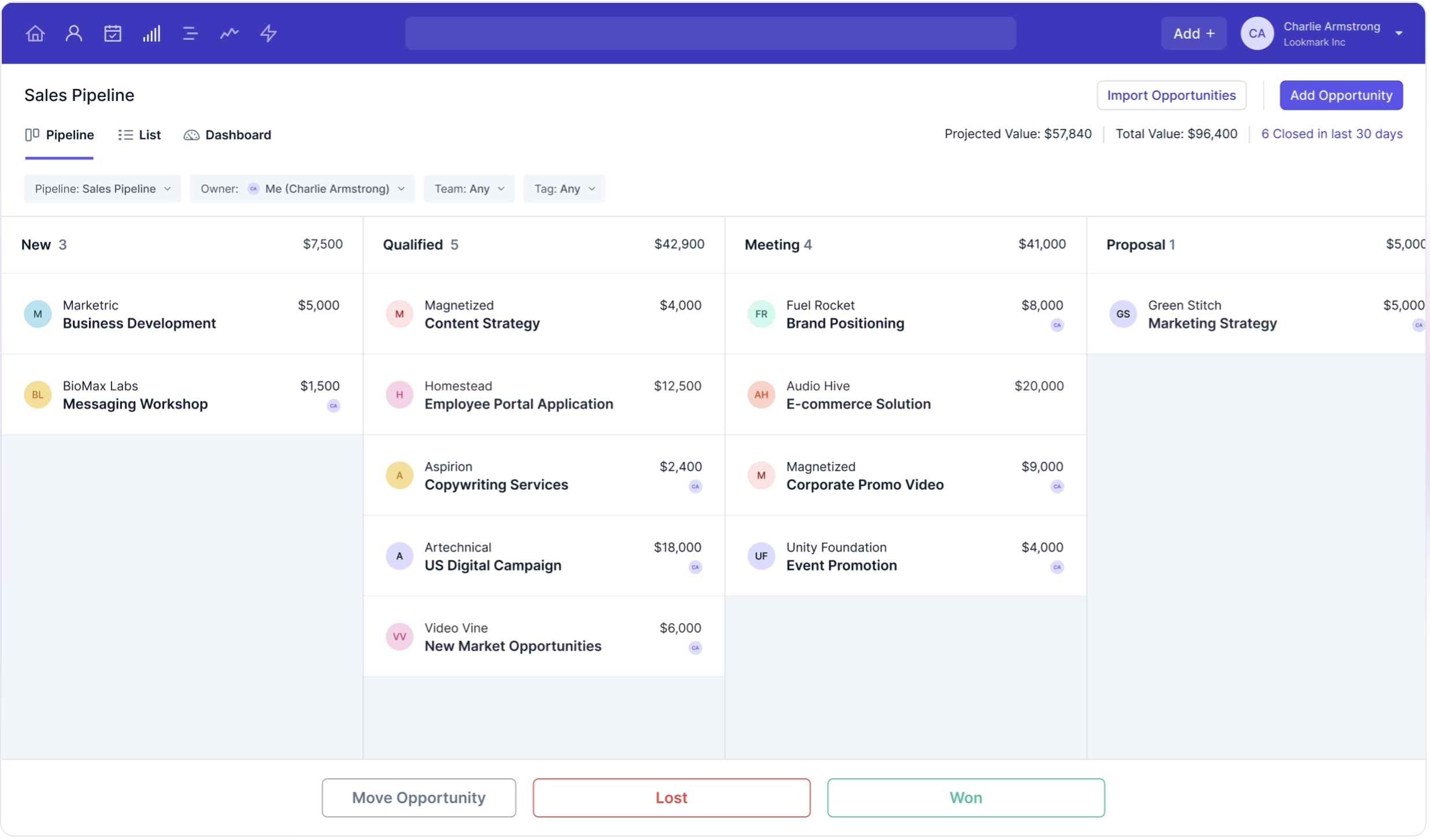
Capsule CRM targets smaller businesses and lacks the advanced features, scalability, and robust functionality required by teams of 20-50 people managing complex operations and higher volumes.
Key features
- Limited to 1 sales pipeline - inadequate for multi-department organizations,
- 50 custom fields - restrictive for diverse business needs,
- 30,000 contacts - potentially limiting for expanding teams,
- Basic task management functionality,
- Simple workflow automation capabilities.

Pros
- Clean interface: Simple design that's easy to navigate, though lacks depth for complex business processes.
- Affordable pricing: Cost-effective for basic requirements, but limited scalability for growing operations.
- Quick implementation: Fast setup process, though customization options are severely limited.
- Basic integrations: Connects with common tools like G Suite and Mailchimp.
Cons
- Inadequate scalability: Insufficient for teams with complex processes and multi-pipeline requirements.
- Limited feature depth: Lacks advanced automation, analytics, and customization needed by growing businesses.
- Restricted customization: Cannot adapt to specific team workflows and business requirements.
- Basic support options: Limited customer support channels for teams requiring dedicated assistance.
- No advanced integrations: Missing sophisticated connectivity required for complex business tech stacks.
Price and plans
- Starter plan: $21 per user, per month - basic features inadequate for medium-sized teams.
- Growth plan: $38 per user, per month - still insufficient for complex business needs.
- Advanced plan: $60 per user, per month - approaching folk's pricing without comparable functionality.
- Ultimate plan: $75 per user, per month - expensive for the limited capabilities provided.
4. Pipedrive
⭐⭐⭐⭐(G2)
Pipedrive is a sales-focused CRM suitable for basic pipeline management but lacks the comprehensive features, integrations, and advanced functionality that teams need for complex operations.

Key features
- Pipeline management: Solid visual pipeline tools, though limited compared to more comprehensive platforms.
- Sales automation: Basic automation capabilities, but requires additional tools for complex team workflows.
- Email integration: Standard email functionality, lacking advanced team collaboration features.
- Reporting: Decent analytics, but insufficient depth for comprehensive team performance management.
- Mobile access: Good mobile functionality for field teams and remote work.

Pros
- Sales-focused design: Intuitive for teams primarily focused on basic pipeline management.
- Visual pipeline: Clear visual representation of sales processes and deal stages.
- Reasonable initial pricing: Competitive costs for basic functionality and small teams.
- Good mobile application: Effective for teams working remotely or in the field.
Cons
- Limited advanced capabilities: Lacks comprehensive automation, AI features, and advanced functionality needed by larger teams.
- Insufficient reporting depth: Analytics are too basic for complex team performance management and strategic planning.
- No integrated marketing: Requires additional tools for comprehensive business operations, increasing costs and complexity.
- Add-on dependency: Essential features require expensive upgrades, significantly increasing total cost.
- No free tier: Unlike comprehensive alternatives, requires immediate financial commitment.
Price and plans
Annual pricing escalates quickly when teams need advanced functionality:
- Essential plan: $24 per user, per month - basic features insufficient for medium-sized businesses.
- Advanced plan: $44 per user, per month - comparable to folk's premium tier but with significantly fewer features.
- Power plan: $79 per user, per month - expensive for the limited functionality provided.
- Enterprise plan: $129 per user, per month - cost-prohibitive for most teams.
5. Zoho
⭐⭐⭐(G2)
Zoho is a feature-rich platform offering extensive functionality but requires significant technical expertise and implementation time, making it overly complex for most teams seeking efficient solutions.

Key features
- Sales automation: Comprehensive automation tools requiring complex configuration and technical expertise.
- Customizable dashboards: Extensive customization options demanding significant setup time and ongoing maintenance.
- Multi-channel communication: Broad communication integration that can overwhelm teams seeking simplicity.
- Contact management: Robust contact handling with a cluttered interface challenging for daily productivity.
- Workflow automation: Powerful automation requiring technical expertise for effective implementation.

Pros
- Comprehensive feature ecosystem: Extensive functionality across multiple business operations and departments.
- Zoho ecosystem integration: Works well with other Zoho products if committed to their platform.
- Deep customization options: High degree of customization possible with sufficient technical resources and time investment.
- AI features: Zia AI assistant provides intelligent insights and automation capabilities.
Cons
- Complex implementation requirements: Requires significant time, technical expertise, and resources to configure properly for teams.
- Steep learning curve: Extensive features create major adoption challenges across all team members.
- Performance limitations: Can be slow with large datasets typical in medium-sized organizations.
- Limited external integrations: Restricted connectivity outside the Zoho ecosystem, limiting flexibility.
- Data migration complexity: Extremely difficult to migrate from other systems, requiring extensive manual work and technical expertise.
Price and plans
Zoho's pricing is competitive but requires higher tiers for teams needing advanced functionality:
- Standard: $20 per user, per month - basic features insufficient for growing businesses.
- Professional: $35 per user, per month - better for medium-sized teams but still functionally limited.
- Enterprise: $50 per user, per month - comprehensive but overly complex to manage effectively.
Conclusion
👉🏼 Try folk now to never miss a follow-up as a solopreneur scaling your processes
Selecting the right CRM can transform your team's productivity, coordination, and revenue performance. For teams of 20-50 people, you need a platform that delivers enterprise-level functionality while maintaining the simplicity and agility that got you this far. folk CRM emerges as the clear winner for medium-sized teams, offering powerful automation, intuitive design, and comprehensive integrations at a price point that makes sense for growing businesses. While HubSpot provides extensive features at premium pricing, Capsule CRM offers simplicity but lacks scalability, Pipedrive focuses on basic sales but misses comprehensive functionality, and Zoho provides depth but demands excessive technical resources. For teams serious about scaling efficiently while ensuring rapid adoption, folk CRM delivers the perfect balance of power and usability. Try folk for free here and discover why it's the preferred choice for growing teams who need results from day one.
Need a helping hand? Use our free tool to find your perfect CRM match.
FAQ
What is the best CRM for a team of 20–50 people?
folk CRM suits most 20–50 person teams with multi-pipelines, LinkedIn import, email sequences, enrichment, and analytics. Easy to adopt and integrates with common tools. Try folk.
How much does a CRM cost?
Expect $20–$130+ per user/month, plus setup, training, and integrations. Weigh total cost of ownership against time saved, higher conversion rates, and reporting gains. folk plans are $24–$60 per user/month (yearly commitment).
How should a team evaluate a CRM?
Map workflows and pain points. Test multi-pipelines, automation, enrichment, email/LinkedIn, analytics, and permissions. Run a demo with real data and roles from sales, marketing, and success to confirm ease of use and admin effort.
What is a good CRM for a small business?
Consider tools that are easy to adopt and scale: folk for multi-pipeline plus outreach, Pipedrive for sales pipelines, or HubSpot Starter for basic marketing and sales. Choose based on workflows, integrations, and budget.
Discover folk CRM
Like the sales assistant your team never had