


Discover folk - the CRM for people-powered businesses
| Main points |
|---|
|
Who this guide is for
As a personal training business with 20-50 team members, managing multiple client schedules, tracking trainer performance, and maintaining strong communication across your growing organization can quickly become overwhelming. A Customer Relationship Management (CRM) system tailored to fitness businesses with medium-sized teams can help you stay organized by streamlining client management, automating follow-ups, and tracking business goals—all from one centralized platform. With the right CRM, your trainers can focus more on helping clients achieve their fitness goals while ensuring your business operations run smoothly across all team members.
In this blog post, we'll explore the best CRM options for personal training businesses like yours, highlighting tools that will help your team of 20-50 professionals improve client relationships, manage complex schedules, and grow your fitness enterprise.
Why you need a CRM
As a personal training business with 20-50 team members, managing your trainers and client relationships effectively can make or break your growing enterprise. A Customer Relationship Management (CRM) system can streamline operations across your entire team and drive scalable growth.
Challenges without a CRM
Without a CRM, founders of medium-sized personal training businesses face numerous challenges that become exponentially more complex with 20-50 team members.
- Disorganization: Managing client and trainer information manually across multiple team members leads to chaos and inconsistent service delivery.
- Missed opportunities: With multiple trainers generating leads, potential clients can slip through the cracks without proper centralized follow-up systems.
- Inefficient Processes: Time-consuming administrative tasks across 20-50 team members dramatically reduce productivity and profitability.
- Lack of insight: Inadequate data makes it impossible to track team performance and make informed decisions for business growth.
- Inconsistent communication: Without a centralized system, communication with clients and between team members becomes erratic and unprofessional.
Benefits of a CRM
A CRM offers several advantages for managing personal training teams of 20-50 professionals, directly impacting your business performance and scalability.
- Centralized information: All client and trainer data across your entire team is stored in one place, making it easily accessible to authorized staff members.
- Enhanced efficiency: Automate administrative tasks across your team, freeing up valuable time for strategic activities and client interactions.
- Improved customer relationships: Track interactions and follow-ups systematically, ensuring no client is neglected regardless of which trainer they work with.
- Better decision-making: Access to comprehensive data from all 20-50 team members helps in making informed business decisions for expansion and optimization.
- Increased sales: Effective lead management and follow-up processes across your entire team boost conversion rates and revenue growth.
- Consistent communication: Streamlined communication channels ensure everyone across your growing team is on the same page.
How to boost your personal training business efficiency with a CRM
There are several ways a CRM can help you boost operational efficiency across your team of 20-50 professionals, ensuring you don't spend excessive time on repetitive administrative tasks.
1. Map your process
A CRM can help you map out your standardized processes across all team members, organizing client contacts and trainer workflows accordingly.
- Initial consultation: Schedule and document client goals and health history with consistent protocols across all 20-50 trainers.
- Program design: Create personalized workout and nutrition plans using standardized templates and tracking systems.
- Progress tracking: Monitor client progress with regular check-ins and assessments that can be accessed by multiple team members.
- Feedback loop: Collect client feedback systematically to refine and adjust training programs across your entire organization.
2. Lead qualification
You can use a CRM to qualify and assess leads systematically across your team, organizing prospects in a way that reflects where each contact stands in your sales process.
- Initial contact: Use standardized forms and surveys to gather information about potential clients, accessible to all relevant team members.
- Scoring system: Implement a unified scoring system to prioritize leads based on their readiness to start training, ensuring optimal resource allocation across your 20-50 team members.
- Follow-up: Schedule systematic follow-ups with high-priority leads, with clear assignment protocols for your training staff to convert them into paying clients.
3. Nurture existing leads and customers
A CRM reminds your entire team about existing clients and prospects, ensuring consistent follow-up even with complex schedules across 20-50 professionals.
- Exclusive offers: Coordinate special deals and discounts for existing clients on additional services across all trainers and service offerings.
- Referral programs: Track and manage referral incentives systematically, encouraging clients to refer friends and family with proper attribution to individual trainers.
- Progress milestones: Celebrate client achievements systematically and suggest advanced programs or add-ons with coordinated communication across your team.
How to evaluate and choose a CRM
With numerous CRMs on the market, it can be challenging to determine which solution best fits your growing personal training business with 20-50 team members. To help with your decision-making process, we've compiled the following considerations specifically tailored for medium-sized fitness organizations.
1. Define your requirements
When choosing the best CRM for personal training teams of 20-50 professionals, start by identifying key features that will support your complex business operations. Look for functionalities such as multi-user client scheduling, team performance tracking, automated reminders, payment processing, and role-based access controls. These features can significantly streamline workflow across your entire organization, allowing your trainers to focus more on client service and less on administrative coordination.
Key features of a CRM for personal trainers
- Automated processes: Streamlines tasks by automating repetitive workflows across your entire team of 20-50 professionals, allowing personal trainers to focus more on client interaction and less on administrative coordination. This includes automated appointment reminders, follow-up emails, and billing processes that work seamlessly for medium-sized organizations.
- Contact enrichment: Automatically finds contact information for leads generated by any team member, enhancing efficiency across your organization. This feature ensures that your 20-50 trainers have access to the most comprehensive client information, enabling personalized service delivery at scale.
- Structured pipeline: Tracks leads and customers through defined stages with clear visibility for management and team members, ensuring process clarity and effectiveness across your growing organization. A well-structured pipeline helps coordinate client journeys among multiple trainers and service offerings.
- Mail merge and email sequences: Increases communication efficiency with follow-up templates and automated sequences that maintain consistency across your 20-50 team members. This feature is crucial for maintaining professional standards and brand consistency in client communications.
- Social media integration: Seamlessly imports contacts from LinkedIn, Instagram, X and more, allowing your team to leverage their collective social network for business growth. For training businesses looking to expand their client base, this integration provides powerful networking capabilities across your entire team.
- Analytics: Provides essential data analysis and predictive insights for better planning across your organization. Medium-sized training businesses can use these insights to track team performance, understand client behaviors, and make informed decisions about expansion and resource allocation.
2. Budget considerations
Balancing cost and return on investment is crucial when selecting a CRM for your team of 20-50 professionals. While it might be tempting to choose the most affordable option, ensure that the CRM software you select offers essential features needed for medium-sized operations. Consider the potential time savings and increased client retention rates that a robust CRM can bring across your entire team, and weigh these benefits against the total cost for your organization.
3. Selection process
Researching and choosing the right CRM vendor for your medium-sized fitness business involves several steps. Begin by reading reviews and testimonials from other fitness organizations with similar team sizes. Look for vendors who specialize in CRM solutions for personal training businesses or have proven track records serving teams of 20-50 professionals. Request demos or trials that can accommodate your team size and complexity.
4. Get a demo
Take advantage of trial periods to evaluate different CRM platforms with your team of 20-50 professionals. Compare features, ease of use, scalability, and customer support. Pay attention to how well the CRM integrates with other tools your organization uses, such as email marketing software, scheduling systems, or fitness apps. After thorough evaluation with key team members, choose the CRM that best aligns with your business needs and growth goals. Get started with a personalized demo of folk, specifically designed to accommodate growing teams like yours.
👉🏼 Try folk now to evaluate demo features tailored for 20–50 trainer teams
3 tips for implementing a CRM
With the effort you've invested in selecting the right CRM for your team of 20-50 professionals, it's time to focus on successful implementation! To help your organization make the most of your first few weeks with your new system, keep the following considerations front of mind.
1. Import your data into your new CRM
Transitioning to a new CRM is smoother when you import existing data from across your organization. Export current client information, trainer assignments, and schedules as CSV files from your various systems. This step ensures that you don't lose valuable information during the switch and that all team members have access to historical data.
2. Create your first pipeline
Setting up your pipeline is essential for tracking client progress and managing workflow across your 20-50 team members. For medium-sized personal training businesses, this could include stages like "New Lead," "Initial Consultation," "Trainer Assignment," "Training Plan Created," "Active Client," and "Renewal Opportunity." Customizing these stages to fit your business model will help your entire team stay organized and provide seamless client experiences.
3. Explore its integrations
Discover how your new CRM can be tailored to your organization's needs by exploring available integrations. This approach allows you to automate processes across your team and eliminate manual work that becomes exponentially more complex with 20-50 professionals.
The 5 best CRMs for personal trainers
1. folk
folk is the ideal modern CRM platform for personal training businesses with 20-50 team members, offering customizable pipelines, AI-driven tools, and seamless integrations specifically designed to enhance team collaboration and client management at scale.

Key features
- Contact enrichment: Automatically enriches contact details for leads generated by any of your 20-50 team members, finding emails and LinkedIn URLs to enable efficient outreach across your organization without manual data entry or additional costs.
- Social media integration: Seamlessly import contacts from LinkedIn, Instagram, X, Sales Navigator and more, allowing your entire team to leverage their collective social networks for business growth while maintaining centralized tracking and communication templates.
- Mail merge and email sequences: Full email sync, templates, and tracking features enable your team of 20-50 professionals to manage all communications directly from the CRM with consistent branding and messaging.
- AI-Powered features: AI tools assist in managing contacts and relationships across your growing team, automating routine tasks and suggesting actions to improve productivity for medium-sized fitness organizations.
- Integrations: folk connects via its open API and native integrations (e.g., Kaspr, Allo, Salesforge, PandaDoc), and also through Zapier and Make to link with 6,000+ apps.

Pros
- Ease of use: folk is specifically praised for its intuitive interface, making it accessible for teams of 20-50 professionals with varying technical skills, ensuring quick onboarding across your entire organization with minimal training requirements.
- All-in-one solution: folk streamlines workflow for medium-sized teams by allowing multiple trainers to import contacts from LinkedIn, automatically find emails, coordinate outreach through customizable email sequences, and track interactions in shared pipelines, eliminating the need for multiple tools and reducing costs for your organization.
- LinkedIn integration: Perfect for growing fitness businesses, seamlessly import contacts from LinkedIn across your team, track conversations within folk, and use standardized templates for consistent, professional communication across all 20-50 team members.
- Customizability: Extensive custom fields, pipelines, and workflows specifically designed to accommodate the complex needs of medium-sized personal training businesses with multiple service offerings and team roles.
- Team collaboration: folk's design facilitates seamless collaboration among 20-50 team members with shared pipelines, centralized communication tracking, and role-based access controls perfect for growing fitness organizations.
Cons
- Reporting and analytics: folk provides advanced pipeline and deal stage analytics, forecasting with weighted probabilities, revenue insights, and performance breakdowns by owner, channel, industry, region, or any custom field.
Price and plans
folk offers excellent value for teams of 20-50 professionals with a 14-day free trial. Monthly or annual subscription plans are competitively priced for medium-sized businesses:
- Standard: $24 per user, per month (yearly commitment) - ideal for teams starting their CRM journey.
- Premium: $48 per user, per month (yearly commitment) - perfect for growing teams with advanced needs.
- Custom: Starts from $60 per user, per month - tailored for established organizations requiring specialized features.
2. HubSpot
Hubspot CRM is a comprehensive platform offering integrated tools for managing sales, marketing, and customer service, though it can become expensive and complex for medium-sized fitness businesses with 20-50 team members.

Key features
- Marketing Hub: Includes email marketing, ad tracking, landing pages, and lead generation tools, suitable for larger fitness organizations with dedicated marketing teams.
- Sales Hub: Provides deal tracking, pipeline management, sales automation, and reporting for managing client acquisition across multiple team members.
- Service Hub: Offers customer service tools like ticketing, live chat, and knowledge bases for larger organizations with complex client support needs.
- Lead scoring: Advanced lead prioritization features that may be overly complex for straightforward personal training business models.
- Automation capabilities: Extensive automation features that require significant setup and training for teams to use effectively.

Pros
- User-friendly interface: Intuitive design that works well for teams, though the learning curve increases with advanced features.
- Comprehensive free plan: Robust free version with basic CRM features, though limitations become apparent as teams grow beyond 20 professionals.
- Marketing integration: Strong marketing tools integration, though this may be overkill for fitness businesses focused primarily on client relationships.
- Automation capabilities: Powerful automation tools, though they require significant investment in training and setup.
- Learning resources: Extensive educational content, though the complexity may overwhelm teams seeking straightforward CRM solutions.
Cons
- High cost at scale: Pricing becomes prohibitively expensive for teams of 20-50 professionals, often costing significantly more than alternatives like folk CRM.
- Complexity overhead: Advanced features create unnecessary complexity for straightforward personal training business needs.
- Limited customization in lower tiers: Affordable plans lack the customization options needed for growing fitness businesses.
- Email marketing restrictions: Free and lower-tier plans severely limit email communications, problematic for client-focused businesses.
- Add-on costs: Essential features often require expensive add-ons, making total cost of ownership significantly higher than folk CRM.
Price and plans
HubSpot's pricing can quickly become expensive for teams of 20-50 professionals:
- Starter: $15 per user, per month (limited features).
- Professional: $450 per user, per month (cost-prohibitive for medium teams).
- Enterprise: $1,500 per user, per month (far exceeds budget for most fitness businesses).
3. Streak
Streak is a CRM tool that integrates with Gmail, but lacks the robust features and scalability needed for personal training teams of 20-50 professionals who require more comprehensive client management solutions.

Key features
- Basic CRM functionality: Limited lead and customer management capabilities that may be insufficient for complex team operations.
- Email tracking: Basic email tracking and snippets, though lacking the sophisticated automation needed for professional fitness businesses.
- Contact management: Simple contact database, but without the enrichment and advanced features available in folk CRM.
- Google integration: Works within Google Workspace, but limited to this ecosystem which may not suit all business needs.
- Mobile access: Basic mobile functionality, though less comprehensive than dedicated CRM solutions.

Pros
- Gmail integration: Works within familiar Gmail interface, though this limits functionality compared to dedicated CRM platforms.
- Simple setup: Easy initial setup, but lacks the depth needed for growing teams.
- Basic pipeline management: Offers simple pipelines, but without the customization capabilities of folk CRM.
- Team sharing: Allows basic collaboration, though insufficient for complex team coordination needs.
- Affordable entry point: Lower cost initially, but lacks features that justify long-term investment.
Cons
- Gmail dependency: Requires Gmail/Google Workspace, limiting flexibility for teams using other email systems.
- Limited scalability: Lacks advanced features needed for teams of 20-50 professionals managing complex client relationships.
- Basic functionality: Missing essential CRM capabilities like contact enrichment, advanced automation, and comprehensive reporting.
- Mobile limitations: Mobile app significantly less functional than desktop version, problematic for fitness professionals on the go.
- Integration restrictions: Few integrations compared to comprehensive solutions like folk CRM, limiting workflow optimization.
Price and plans
- Pro: Starts from $49 per user, per month.
- Pro +: Starts from $69 per user, per month.
- Enterprise: Starts from $129 per user, per month.
4. Pipedrive
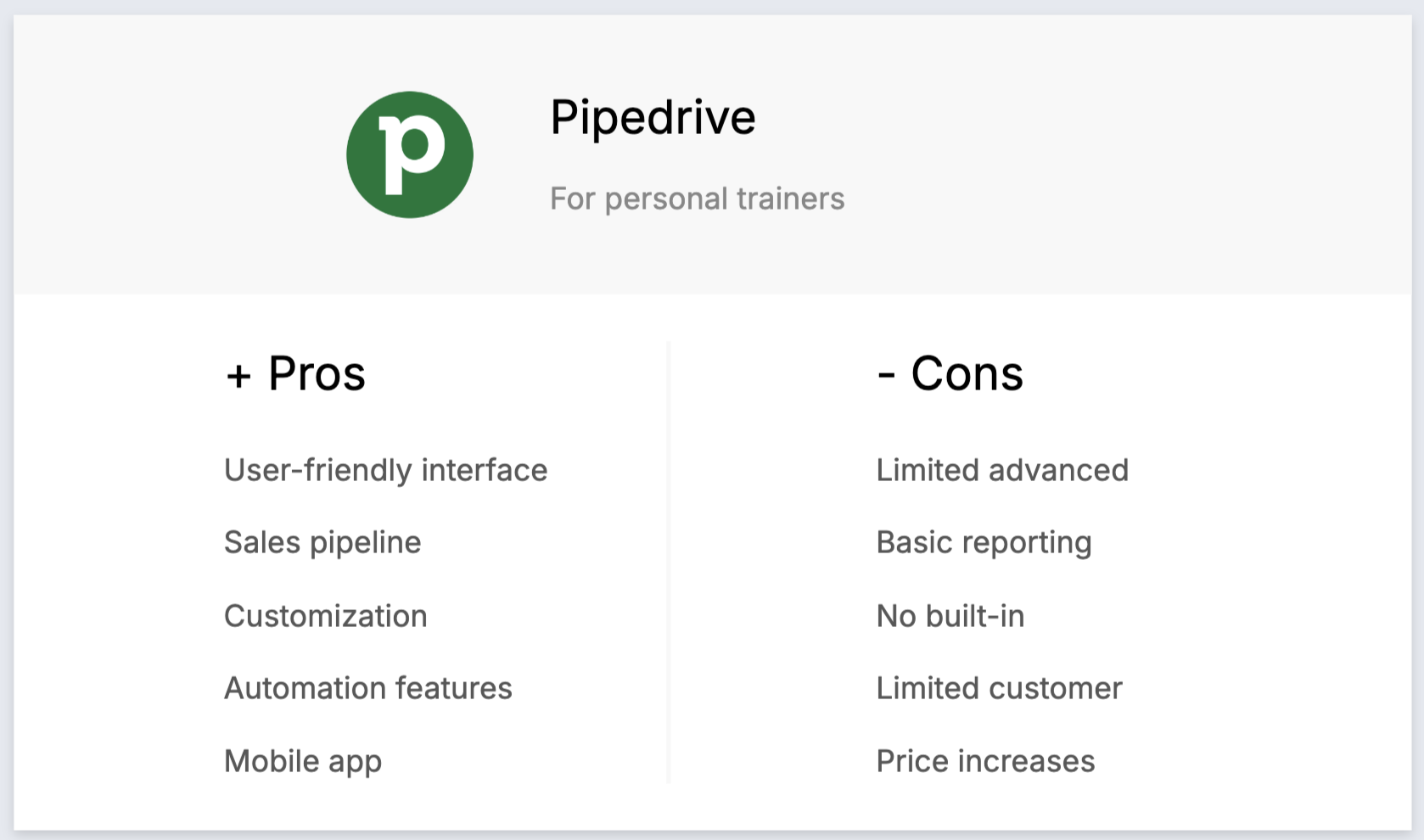
Pipedrive is a sales-focused CRM that offers pipeline management for small businesses, but lacks the comprehensive features and collaborative tools needed for personal training teams of 20-50 professionals.

Key features
- Deal management: Basic pipeline management tools, though lacking the sophisticated team collaboration features found in folk CRM.
- Sales automation: Limited automation capabilities compared to comprehensive solutions designed for growing fitness businesses.
- Email integration: Basic email functionality without the advanced contact enrichment and social media integration offered by folk CRM.
- Reporting: Standard reporting features, though not specifically tailored for fitness business metrics and team performance tracking.
- Customization: Some customization options, but less flexible than solutions designed for service-based businesses with complex team structures.
Pros
- Visual pipeline: Attractive pipeline visualization, though less customizable than folk CRM's flexible approach.
- Sales focus: Strong sales orientation, but may not address the relationship management needs of fitness businesses.
- User interface: Clean interface design, though lacking the intuitive team collaboration features needed for 20-50 professionals.
- Mobile app: Functional mobile access, but without the comprehensive offline capabilities ideal for fitness professionals.
- Activity tracking: Basic activity monitoring, though less sophisticated than comprehensive CRM solutions.
Cons
- Limited team features: Lacks advanced collaboration tools essential for managing teams of 20-50 fitness professionals effectively.
- Basic automation: Automation capabilities are insufficient for the complex workflows needed in growing fitness businesses.
- No marketing tools: Lacks integrated marketing features, requiring additional tools unlike all-in-one solutions like folk CRM.
- Reporting limitations: Basic reporting in lower tiers insufficient for tracking team performance and business growth metrics.
- Expensive add-ons: Essential features require costly upgrades, making it less economical than folk CRM's comprehensive packages.
Price and plans
Pipedrive's annual subscription pricing can add up quickly for medium-sized teams:
- Essential plan: Starts from $24 per user, per month.
- Advanced plan: Starts from $44 per user, per month.
- Power plan: Starts from $79 per user, per month.
- Enterprise plan: Starts from $129 per user, per month.
5. Zoho
Zoho is a comprehensive CRM system with extensive features, but its complexity and steep learning curve make it less suitable for personal training teams of 20-50 professionals who need straightforward, efficient client management solutions.

Key features
- Contact management: Comprehensive contact tracking, though more complex than needed for straightforward fitness business operations.
- Sales automation: Extensive automation features that require significant training and setup time for team implementation.
- Custom reporting: Advanced reporting capabilities, but with complexity that may overwhelm teams focused on client service delivery.
- Multi-channel communication: Broad communication options, though without the streamlined approach offered by folk CRM.
- Mobile CRM: Mobile functionality with offline access, but interface complexity makes it less user-friendly for busy fitness professionals.
Pros
- Comprehensive features: Extensive functionality, though may include unnecessary complexity for fitness business needs.
- Customization options: High degree of customization, but requires significant technical expertise to implement effectively.
- Zoho ecosystem: Integration with other Zoho products, though this may lock teams into a single vendor ecosystem.
- Multi-channel support: Various communication channels, but coordination becomes complex for team environments.
- Affordable entry pricing: Lower initial costs, but complexity often necessitates higher-tier plans for practical use.
Cons
- Steep learning curve: Requires significant training investment for teams of 20-50 professionals, unlike the intuitive design of folk CRM.
- Complex implementation: Setup and configuration can take weeks or months, delaying productivity gains for growing businesses.
- Outdated interface: User interface feels outdated compared to modern, intuitive CRM solutions designed for contemporary teams.
- Performance issues: Can experience slowdowns with larger datasets, problematic for active fitness businesses with extensive client bases.
- Limited third-party integrations: Fewer external integrations compared to folk CRM's 6,000+ app ecosystem, limiting workflow optimization.
Price and plans
Zoho offers a free plan limited to 3 users. For teams of 20-50 professionals, annual subscription pricing is:
- Standard: $20 per user, per month.
- Professional: $35 per user, per month.
- Enterprise: $50 per user, per month.
Conclusion
Choosing the best CRM for personal training teams of 20-50 professionals can significantly transform your business operations, from managing complex client interactions to automating administrative tasks across your organization. While each CRM offers different benefits, folk CRM stands out as the optimal solution for medium-sized fitness businesses, providing the perfect balance of intuitive design, powerful features, and team collaboration tools specifically needed by growing organizations. Folk's seamless LinkedIn integration, contact enrichment, and customizable pipelines are designed to scale with teams like yours, offering superior value compared to the complexity of HubSpot, limitations of Streak, basic functionality of Pipedrive, or overwhelming features of Zoho. Try folk for free here and discover why it's the preferred choice for personal training teams ready to optimize their operations and accelerate growth.
👉🏼 Try folk now to centralize client schedules and never miss follow-ups across your 20–50 trainer team
Need a helping hand? Use our free tool to find your perfect CRM match.
FAQ
What is a personal CRM?
A personal CRM is software that organizes contacts, interactions, tasks, and follow-ups. For trainers, it centralizes client profiles, goals, schedules, billing, and communications to deliver consistent service across a team.
What features should personal trainers look for in a CRM?
Prioritize multi-user scheduling, role-based access, pipelines, automation for reminders and email, contact enrichment, integrations (calendar, email, payments), analytics, and mobile access to scale processes across 20–50 trainers.
How much does a CRM cost for a 20–50 person training team?
Expect about $400–$2,500+ per month, driven by features and tiers. Common per-seat pricing is $20–$60/user/month. Include onboarding, integrations, and add-ons when comparing total cost of ownership.
Is there a CRM tailored to personal training teams?
Yes. folk offers customizable pipelines, contact enrichment, email sequences, and team collaboration suited to 20–50 person training teams, with quick onboarding and broad integrations.
Discover folk CRM
Like the sales assistant your team never had