


Discover folk - the CRM for people-powered businesses
| Main points |
|---|
|
Why you need a CRM
Who this guide is for
A CRM is essential for engineering firms with 20-50 team members to streamline complex operations and enhance client relationships across multiple concurrent projects, driving sustainable business growth.
Without the right one, growing teams might face the following challenges which can severely hinder expansion and operational efficiency.
Challenges without a CRM
- Disorganization: With 20-50 team members handling multiple projects, scattered data and documents make it nearly impossible to track project progress and client interactions across departments.
- Missed opportunities: Without a centralized system visible to your entire team, potential leads and critical follow-ups can easily fall through the cracks, especially during busy project seasons.
- Inefficient Processes: Manual data entry across multiple departments and disparate systems significantly slow down operations for mid-sized teams and increase the risk of costly errors.
- Lack of insight: With 20-50 people generating data daily, limited access to real-time consolidated information severely hampers informed decision-making and strategic planning.
- Inconsistent communication: Uncoordinated communication channels across your growing team lead to misunderstandings, duplicated efforts, and reduced client satisfaction.
Benefits of a CRM
Fortunately, the right CRM can solve these scalability challenges and transform how your 20-50 person engineering firm manages operations, offering numerous benefits that directly impact performance and sustainable growth.
- Centralized information: All client and project data are stored in one accessible location for your entire team, ensuring seamless collaboration and better organization across departments.
- Enhanced efficiency: Automated workflows and data integration streamline processes across your growing team and reduce time-consuming manual tasks.
- Improved customer relationships: Track interactions and manage client communications effectively across all team members to build stronger, more consistent relationships.
- Better decision-making: Access to real-time analytics and reports enables data-driven decisions that boost business performance for teams of your size.
- Increased sales: Efficient lead management and follow-up systems help convert more prospects into clients, supporting your firm's growth trajectory.
- Consistent communication: Unified communication tools ensure clear and consistent messaging with clients and across your 20-50 person team.
How to boost your engineering firm's efficiency with a CRM
Below we've outlined how CRM features can help medium-sized engineering firms with 20-50 employees improve business efficiency at each critical stage of client and project management.
1. Map your process
You can use a CRM to define and track the stages of your multi-departmental engineering process:
- Identify key stages: Outline the critical stages in your complex project lifecycle, from initial inquiry to project completion, ensuring your CRM can track each stage across your 20-50 person team effectively.
- Custom workflows: Customize workflows to match your growing engineering firm's specific departmental needs, enabling better cross-team project management and client communication.
- Real-time updates: Use real-time updates to keep all 20-50 team members informed about project milestones and deadlines, ensuring seamless collaboration across departments.
2. Lead qualification
A CRM helps your sales and engineering teams stay aligned on lead qualification, especially important when managing multiple opportunities simultaneously.
- Scoring system: Implement a lead scoring system accessible to relevant team members to prioritize high-potential leads based on criteria such as project size, budget, and timeline.
- Automated qualification: Use automated tools within your CRM to filter and qualify leads across your team, saving valuable time and ensuring focus on the most promising opportunities.
- Detailed profiles: Create comprehensive profiles for each lead that multiple team members can access, capturing essential information that helps in making informed decisions.
3. Outreach and follow-up
A CRM is essential for creating consistency across your growing team's messaging and outreach efforts.
- Email campaigns: Set up automated email campaigns that multiple team members can manage to nurture leads with personalized content, updates, and offers, ensuring consistent engagement.
- LinkedIn outreach: Use LinkedIn integration within your CRM to enable team members to connect with potential clients, share relevant content, and follow up on initial contacts systematically.
- Follow-up reminders: Schedule automated follow-up reminders across your team to ensure timely communication with leads and clients, increasing conversion chances without overwhelming your staff.
4. Nurture existing leads and customers
A CRM helps your 20-50 person team maintain relationships and follow up with contacts strategically, even when managing hundreds of clients and prospects.
- Personalized recommendations: Use consolidated CRM data to provide personalized recommendations for additional services or upgrades that meet clients' evolving needs, leveraging insights from across your team.
- Loyalty programs: Implement loyalty programs managed through your CRM to reward repeat clients, encouraging long-term relationships and increased business.
- Regular check-ins: Schedule systematic check-ins with existing clients across your team to discuss ongoing projects, gather feedback, and identify new opportunities for collaboration.
How to evaluate and choose a CRM
With numerous CRMs in the market, it can be challenging for growing engineering firms with 20-50 employees to determine which solution best fits your operational scale and business goals. Below are key considerations for your decision-making process.
1. Define your requirements
When selecting the best CRM for mid-sized engineering firms, it's crucial to identify key features that align with your team's collaborative needs. Look for functionalities such as multi-user project management, comprehensive client tracking, and seamless integration with engineering software your 20-50 person team already uses. Ensure the CRM supports task automation across departments, collaborative document management, and offers robust reporting capabilities that provide insights into your growing operations.
Key features of a CRM for engineering firms
- Automated processes: Streamlines tasks by automating repetitive workflows across your entire team.
- Contact enrichment: Automatically finds leads and customer email addresses and contact information, enhancing efficiency for your sales team.
- Structured pipeline: Tracks leads and customers through defined stages with visibility for relevant team members, ensuring process clarity and effectiveness.
- Email sequences: Increases communication efficiency with follow-up templates and automated sequences that your team can coordinate.
- LinkedIn connection: Seamlessly imports leads and customers from LinkedIn and tracks conversations within the CRM for team collaboration.
- Reporting & forecasting: Provides essential data analysis and predictive insights for better strategic planning across your growing firm.
2. Budget considerations
Balancing cost and return on investment is crucial for teams of 20-50 people. While some platforms may seem expensive upfront, consider the long-term savings and efficiency gains they offer for your entire team. Look for scalable solutions that can accommodate your current team size while supporting future growth, ensuring you get the best value without compromising on essential collaborative features.
3. Selection Process
Researching and selecting the right CRM vendor for your mid-sized engineering firm requires thorough evaluation. Start by reading reviews from other engineering firms of similar size. Request demos that include multiple team members and engage with sales representatives to understand how the platform scales for 20-50 users. Ensure the vendor offers strong customer support and comprehensive training resources to help your entire team adopt the system effectively.
4. Get a demo
Trialing and comparing different CRM platforms is vital for making an informed decision for your team. Take advantage of free trials to assess usability and functionality with multiple users. Involve key stakeholders from different departments in the evaluation process, and gather feedback from various team members to ensure the CRM meets your firm's specific collaborative needs. Ultimately, choose a CRM that enhances your project management, client relationships, and overall operational efficiency across your 20-50 person team. Get started with a demo of folk here.
👉🏼 Try folk now to never miss a follow-up across your 20-50 person engineering team
3 tips for Implementing a CRM
1. Import your data into your new CRM
Transitioning to a new CRM with a 20-50 person team involves carefully importing your existing data. Begin by consolidating and exporting your data as CSV files from your current systems. Properly importing your data ensures a seamless transition for your entire team and maintains the continuity of client relationships and project details across all departments.
2. Create your first pipeline
Once your data is imported, create your first pipeline that reflects how your 20-50 person team collaborates. For engineering firms, this pipeline should reflect the stages of your project lifecycle with clear visibility for relevant team members. Common stages might include Initial Consultation, Proposal Sent, Design Phase, Construction Phase, and Project Completion. Customizing these stages to fit your firm's departmental workflow will help track project progress and manage client interactions more effectively across your team.
3. Onboard your team
Successful CRM implementation for teams of 20-50 people hinges on comprehensive team adoption. Conduct departmental onboarding sessions to familiarize different groups within your team with the new CRM system. Highlight key features relevant to each role, demonstrate how to use the platform for daily collaborative tasks, and provide ongoing support resources. Encouraging your entire team to embrace the CRM will lead to better data management, improved client relationships, and enhanced project efficiency across your growing firm.
The 5 best CRMs for engineering firms
1. folk
folk is the ideal CRM platform for engineering firms with 20-50 team members, offering modern contact management, customizable workflows, and relationship tracking with AI-driven tools and integrations designed to enhance collaboration and streamline operations for growing teams.

Key features
- Contact enrichment: Automatically enriches contact details by finding emails and LinkedIn URLs, perfect for engineering teams managing multiple client prospects without additional costs for email services.
- Social media integration: Seamlessly import contacts from LinkedIn, Sales Navigator, Instagram, X and more, allowing your 20-50 person team to leverage existing networks and use templates for streamlined communication.
- Mail merge and email sequences: Full email sync, templates, and tracking features enable your entire team to manage communications directly from the CRM with consistent messaging.
- AI-powered features: AI tools assist team members in managing contacts and relationships, automating routine tasks, and suggesting actions to improve productivity across your growing firm.
- Integrations: folk integrates seamlessly with over 6,000 apps, including Gmail, Zapier, and Make, allowing your team to centralize workflow and reduce manual data entry across departments.
- Sales cycle and multiple pipeline management: Perfect for engineering firms managing multiple project types, keeping your entire team organized and aligned on lead progression.
- Mobile app: folk mobile app for on-the-go contact and reminder management, keeping your team synced while in the field.
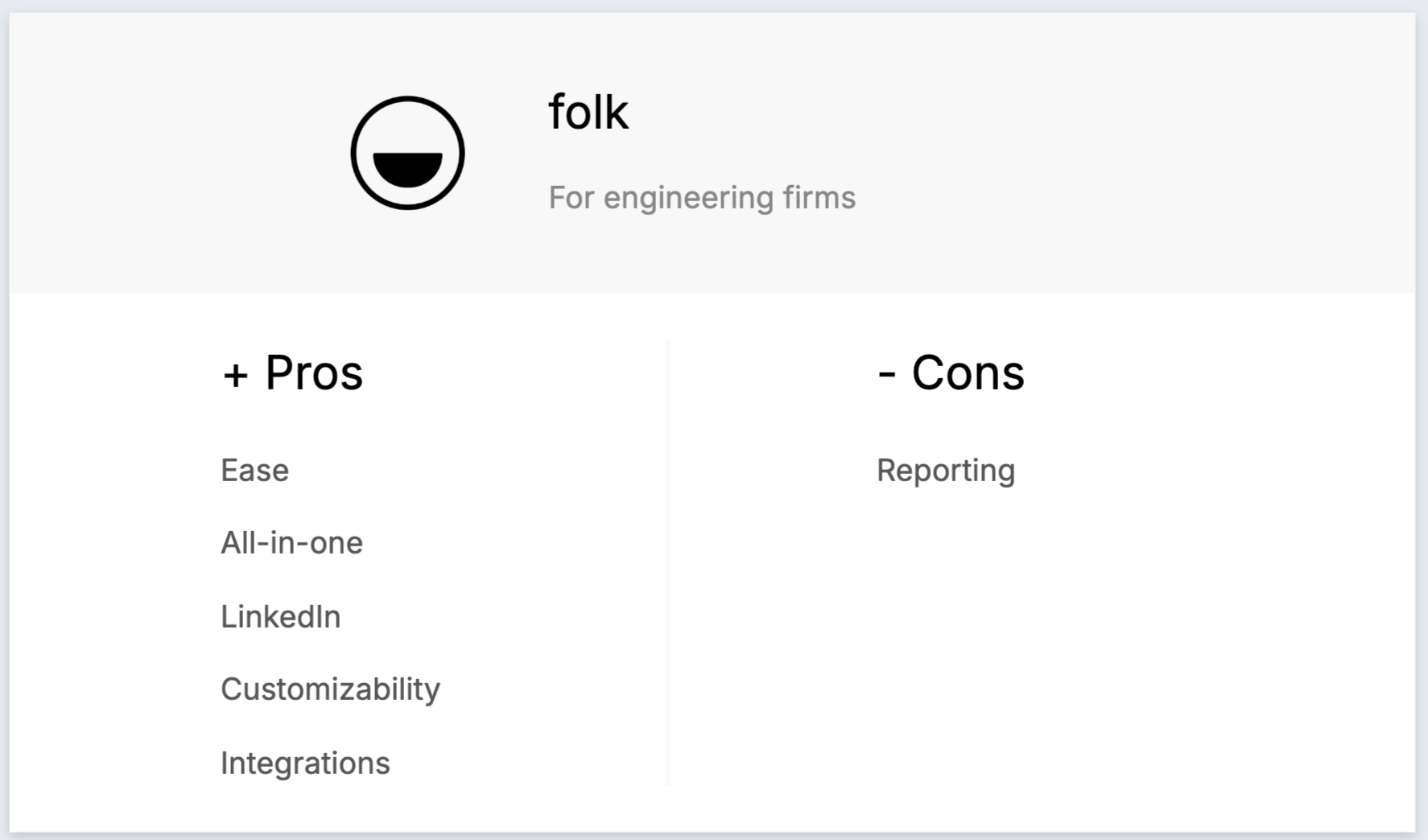
Pros
- Perfect for teams of 20-50: folk's intuitive interface and collaborative features are specifically well-suited for mid-sized engineering teams, making it accessible across different roles with quick onboarding and minimal learning curve.
- All-in-one solution for growing firms: folk streamlines workflow for your entire team by allowing contact import from LinkedIn, automatic email finding, customizable email sequences, and pipeline tracking, eliminating the need for multiple tools and saving significant costs.
- Excellent team collaboration: Seamlessly import contacts from LinkedIn, track conversations within folk, and enable multiple team members to use templates for consistent, efficient communication across your engineering firm.
- Scalable customizability: Custom fields, pipelines, and workflows that grow with your 20-50 person team and can adapt to your specific engineering processes.
- Comprehensive integrations: folk integrates seamlessly with over 6,000 apps, allowing your growing team to centralize workflow across all departments and reduce manual data entry significantly.
Cons
- Advanced reporting and analytics: folk provides pipeline and deal stage analytics, revenue forecasting with weighted probabilities, and performance breakdowns by owner, channel, industry, region, or any custom field, plus revenue insights.
Price and plans
You can try folk for free with a 14-day free trial, ideal for testing with your 20-50 person team. Pricing is transparent and scales affordably for growing engineering firms:
- Standard: $20 per user, per month - perfect for teams getting started.
- Premium: $40 per user, per month - ideal for 20-50 person engineering teams needing advanced features.
- Custom: Starts from $60 per user, per month - for firms requiring enterprise-level customization.
2. HubSpot
HubSpot CRM is a comprehensive platform offering integrated tools for managing sales, marketing, customer service, and operations, though it can become complex and expensive for mid-sized engineering teams.

Key features
- Marketing Hub: Includes email marketing, ad tracking, landing pages, and lead generation tools, though can be overwhelming for engineering teams focused primarily on client relationships.
- Sales Hub: Provides deal tracking, pipeline management, sales automation, and reporting for managing engineering client relationships and project bids.
- Service Hub: Offers customer service tools like ticketing, live chat, and knowledge bases for post-project support.
- Operations Hub: Syncs and automates business processes across different systems, though may require significant setup for engineering workflows.
- Lead scoring: Prioritize leads with predictive scoring, though the complexity may be excessive for straightforward engineering project opportunities.
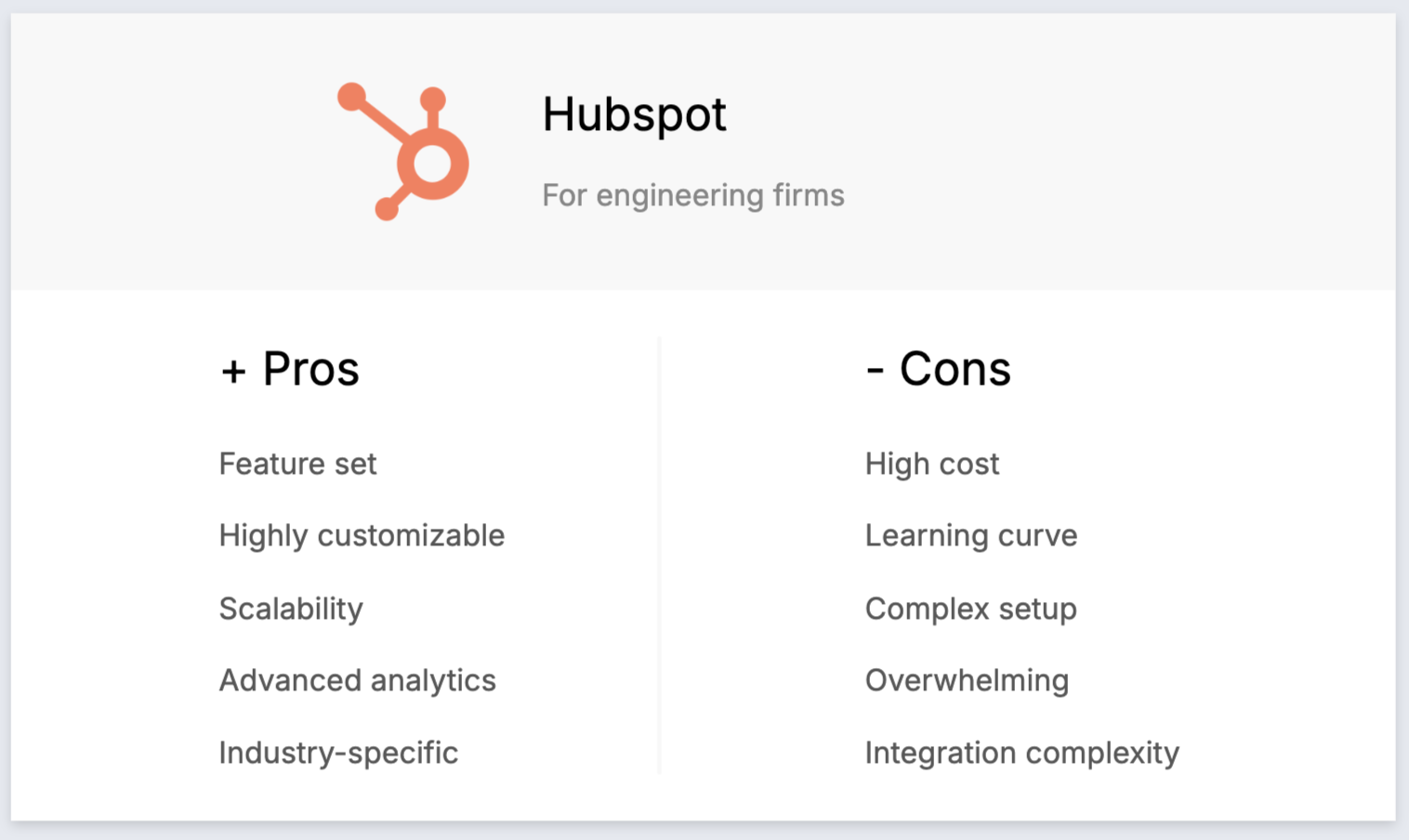
Pros
- Comprehensive feature set: Offers extensive functionality, though this can be more than most 20-50 person engineering teams require.
- Marketing integration: Strong marketing tools, though engineering firms typically need simpler client communication solutions.
- Automation capabilities: Powerful automation, though setup complexity may challenge mid-sized engineering teams.
- Customizable reporting: Advanced reporting capabilities, though may require dedicated resources to manage effectively.
- Scalability: Highly scalable, though pricing becomes prohibitive as teams grow.
Cons
- Expensive for growing teams: Costs can quickly escalate to $450+ per user monthly for meaningful functionality, making it prohibitively expensive for 20-50 person engineering teams.
- Overly complex: Feature-heavy interface can overwhelm engineering teams who need straightforward client and project management.
- Steep learning curve: Requires significant training time for teams of 20-50 people, reducing productivity during implementation.
- Limited customization in lower tiers: Affordable plans lack the customization options that growing engineering firms typically need.
- Marketing-focused: Designed primarily for marketing teams rather than engineering firms' specific client management needs.
Prices and plans
HubSpot pricing can become expensive for teams of 20-50 people:
- Starter: $15 per user, per month with limited functionality.
- Professional: $450 per user, per month - extremely expensive for mid-sized teams.
- Enterprise: $1,500 per user, per month - prohibitive for most engineering firms.
3. Salesforce
Salesforce is a robust CRM platform designed for large enterprises, offering extensive tools for sales, marketing, service, and analytics, but often proves too complex and expensive for mid-sized engineering teams of 20-50 people.

Key features
- Extensive customization: Highly customizable platform, though complexity often exceeds the needs of 20-50 person engineering teams.
- Enterprise ecosystem: Comprehensive CRM, marketing, and service integration, designed for large organizations rather than mid-sized firms.
- AI integration: Advanced Salesforce Einstein AI features, though implementation requires significant technical expertise.
- Integration capabilities: Extensive third-party integrations, though setup complexity can overwhelm smaller engineering teams.
- Advanced analytics: Sophisticated reporting and analytics, requiring dedicated resources to manage effectively.
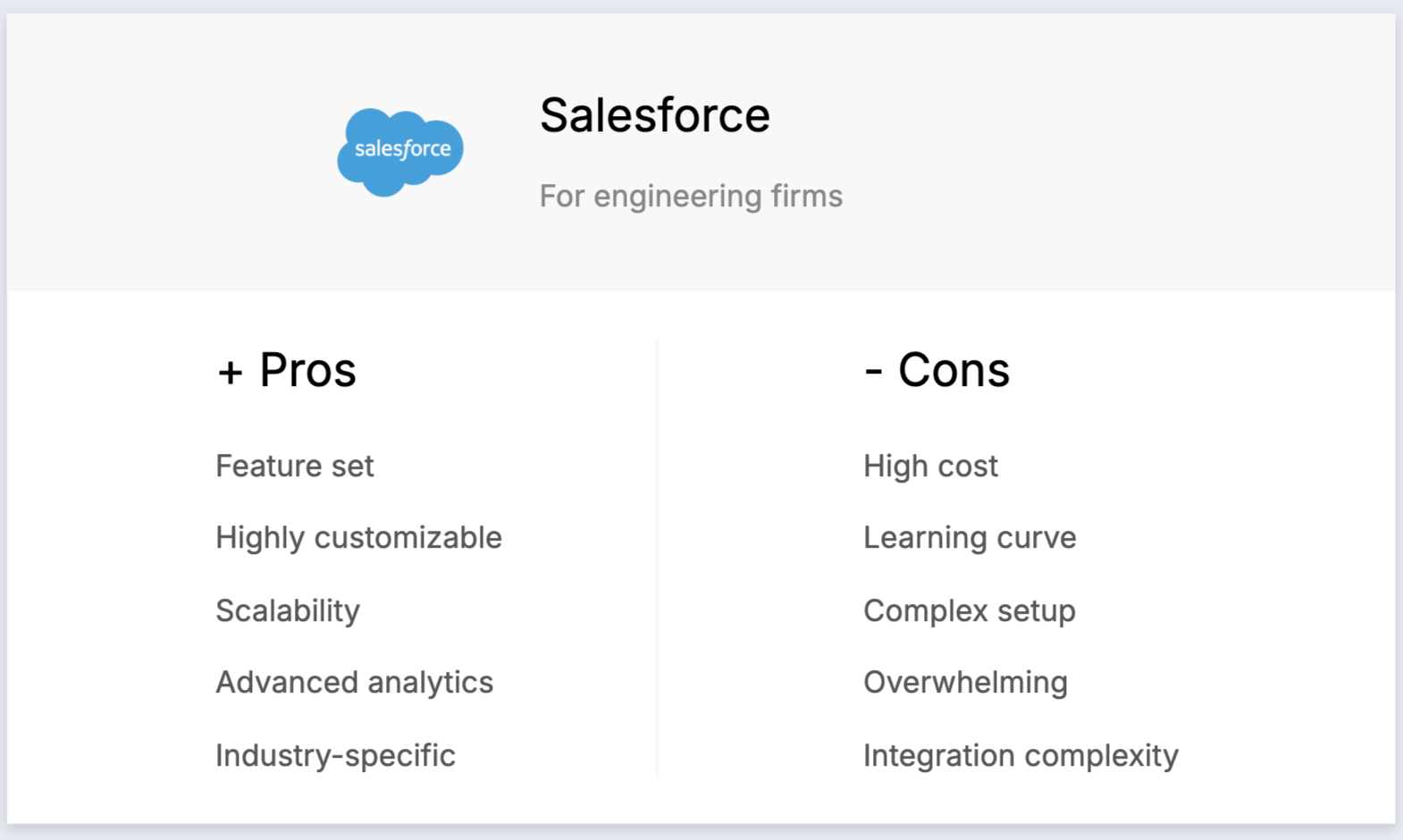
Pros
- Comprehensive functionality: Extensive features for large-scale operations, though often excessive for engineering firms of 20-50 people.
- High scalability: Can handle massive growth, though most mid-sized engineering firms won't require this level of scalability.
- Industry solutions: Offers industry-specific configurations, though requires significant customization work.
- Advanced reporting: Sophisticated analytics capabilities, though complexity may overwhelm teams without dedicated CRM specialists.
- Enterprise-grade security: Robust security features appropriate for large organizations.
Cons
- Prohibitively expensive: Costs of $165+ per user monthly make it extremely expensive for 20-50 person engineering teams, often exceeding budget constraints.
- Excessive complexity: Designed for enterprise teams with dedicated CRM administrators, making it overwhelming for mid-sized engineering firms.
- Lengthy implementation: Requires months of setup and customization, delaying benefits for growing teams.
- Over-engineered for most needs: Extensive features that most engineering firms of this size will never use or need.
- Requires specialized expertise: Needs dedicated Salesforce administrators, adding to personnel costs for mid-sized teams.
Prices and plans
Salesforce pricing is typically too expensive for teams of 20-50 people:
- Starter suite: $25 per user, per month with very limited features.
- Pro suite: $100 per user, per month with moderate functionality.
- Enterprise: $165+ per user, per month - expensive for mid-sized engineering teams.
4. Pipedrive
Pipedrive is a sales-focused CRM for small to medium businesses, offering pipeline management, automation, and email integration, though it lacks some collaborative features needed by growing engineering teams.

Key features
- Pipeline-focused design: Strong visual pipeline management, though primarily designed for straightforward sales processes rather than complex engineering project workflows.
- Sales automation: Workflow automation for basic tasks, though limited compared to more comprehensive solutions for growing teams.
- Email integration: Basic email sync and templates, though lacks advanced team collaboration features.
- Reporting capabilities: Standard reporting tools, though advanced analytics require higher-tier plans.
- Mobile accessibility: Good mobile app for teams working in the field.
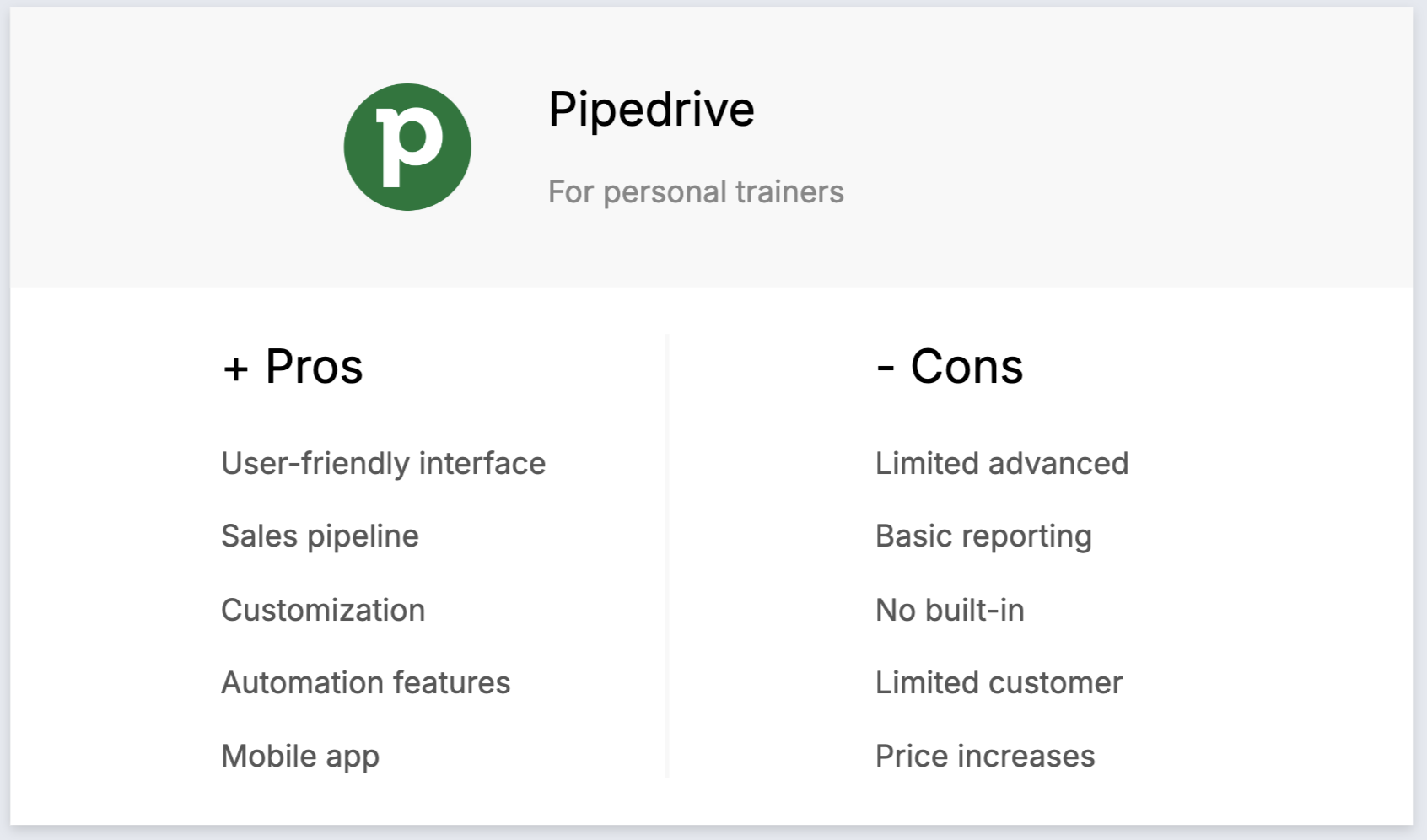
Pros
- Intuitive interface: Clean, visual design that's relatively easy for teams to navigate and understand.
- Sales-focused approach: Designed specifically for managing sales pipelines and deal progression.
- Reasonable pricing: More affordable than enterprise solutions, though costs increase quickly with add-ons.
- Good mobile experience: Effective mobile app for team members working on-site.
- Basic automation: Includes essential automation features for routine tasks.
Cons
- Limited team collaboration: Lacks advanced collaborative features needed by 20-50 person engineering teams working on complex projects.
- Basic project management: Primarily sales-focused without robust project management capabilities that engineering firms require.
- Limited customization: Less flexible customization compared to solutions designed for growing engineering teams.
- Add-on dependency: Essential features often require expensive add-ons, increasing total cost for teams of 20-50 people.
- Reporting limitations: Advanced reporting and analytics require higher-tier plans, limiting insights for growing firms.
Price and plans
Pipedrive pricing can become expensive with necessary add-ons for teams of 20-50:
- Essential plan: $14 per user, per month with basic features.
- Advanced plan: $29 per user, per month with moderate functionality.
- Power plan: $64 per user, per month for better team features.
- Enterprise plan: $99 per user, per month for advanced capabilities.
5. Capsule CRM
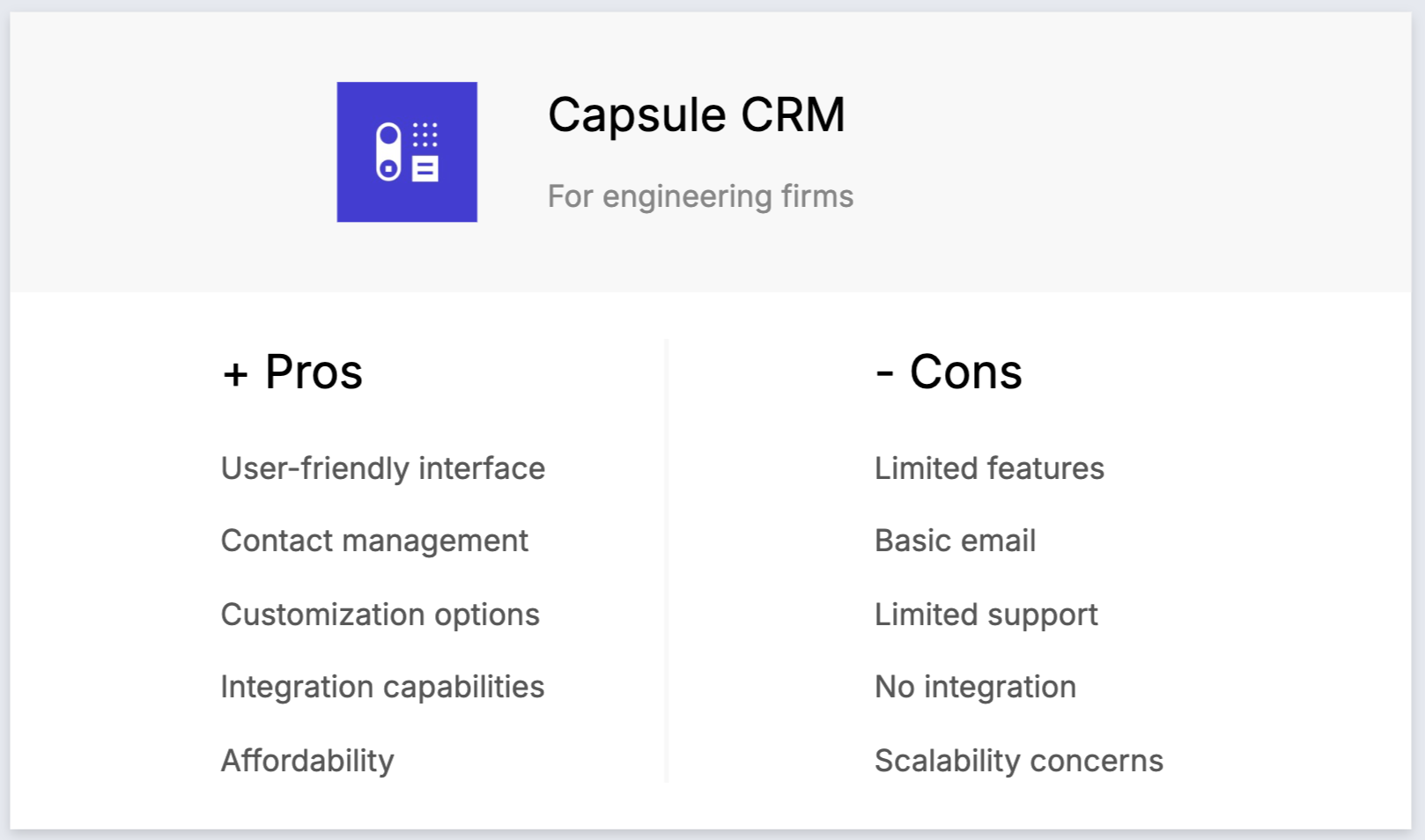
Capsule CRM is a straightforward customer relationship management platform designed for small businesses, though it may lack the scalability and advanced features that growing engineering teams of 20-50 people typically require.

Key features
- Single pipeline: Basic pipeline management, though limited for engineering firms managing multiple project types simultaneously.
- Custom fields: 50 custom fields for capturing project details, though may be insufficient for complex engineering requirements.
- Contact management: Manages up to 30,000 contacts, suitable for mid-sized firms' client databases.
- Basic reporting: Activity reporting for monitoring team progress, though analytics are limited compared to modern solutions.
- Simple automation: Basic workflow automation, though less sophisticated than what growing teams typically need.
Pros
- Simple interface: Easy to navigate, though may be too basic for the complex needs of 20-50 person engineering teams.
- Affordable entry point: Lower starting costs, though features are limited for growing firms.
- Basic integrations: Connects with common tools like G Suite and QuickBooks.
- Straightforward setup: Quick implementation, though customization options are limited.
- Small team focus: Designed for smaller operations, though may not scale well for growing engineering firms.
Cons
- Limited scalability: May not accommodate the growth and complexity needs of expanding 20-50 person engineering teams.
- Basic features: Lacks advanced analytics, automation, and collaboration tools that growing engineering firms typically require.
- Single pipeline limitation: Restricts firms managing multiple project types or client segments simultaneously.
- Limited support: Primarily email support, which may be insufficient for teams needing prompt assistance during critical projects.
- Outdated interface: Less modern compared to solutions designed for contemporary team collaboration needs.
Price and plans
- Starter plan: $21 per user, per month with basic features.
- Growth plan: $38 per user, per month with moderate functionality.
- Advanced plan: $60 per user, per month for better capabilities.
- Ultimate plan: $75 per user, per month for maximum features.
Conclusion
For engineering firms with 20-50 team members, selecting the right CRM is crucial for managing growth, enhancing client relationships, and streamlining operations across departments. While each platform offers different strengths, folk CRM stands out as the optimal choice for mid-sized engineering teams, providing the perfect balance of functionality, ease of use, and scalability at an affordable price point. Folk CRM's intuitive design, powerful integrations, AI-driven features, and collaborative tools are specifically well-suited for growing engineering firms who need efficient client management without overwhelming complexity or prohibitive costs. By choosing folk CRM, your 20-50 person engineering team can streamline processes, improve client relationships, and support sustainable growth. Try folk for free here.
👉🏼 Try folk now to manage contact-based reminders with your team and streamline project handoffs
Need a helping hand? Use our free tool to find your perfect CRM match.
FAQ
What is the best CRM for engineering firms?
There is no one-size-fits-all. Popular options include folk, HubSpot, Pipedrive, Salesforce, and Capsule. Mid-sized firms favor tools that are easy to roll out, collaborative, and affordable. Try folk to compare.
Which CRM features matter most for engineering teams?
Essential features: multi-pipeline, custom fields, permissions, task/workflow automation, email sync and sequences, LinkedIn import, shared timeline, reporting/forecasting, and robust integrations. Fast onboarding and ease of use are key for 20–50 users.
How much does a CRM cost for a 20–50 person firm?
Expect $20–$100+ per user/month, depending on features and tier. Many teams budget $20–$40 for modern tools with automation and integrations, while enterprise suites can exceed $150. Include add-ons, support, and onboarding time in total cost.
How do you implement a CRM in an engineering firm?
Define objectives and stages, clean/import data, build the first pipeline, set roles/permissions, connect email and integrations, create templates and automations, train by role, and iterate. Pilot with a small group first; typical rollout is 2–6 weeks.
Discover folk CRM
Like the sales assistant your team never had