


Discover folk - the CRM for people-powered businesses
As a business angel, managing multiple investments, tracking startup performance, and maintaining clear communication with founders is essential for making informed decisions and driving success.
A powerful Customer Relationship Management (CRM) system can help you stay organized by centralizing all your interactions, tracking your portfolio, and automating follow-ups. With the right CRM, you can streamline communication, stay on top of opportunities, and make data-driven investment decisions.
What you'll learn
In this blog post, we'll explore the best CRM options for business angels like you, focusing on tools that help you manage relationships efficiently and optimize your investment strategies.
| Main points |
|---|
|
Why Business Angels Need a CRM?
Angel investing is not about finding one great deal. It’s about managing dozens of relationships at once, across founders, co-investors, VCs, and operators. The second the pipeline grows beyond a handful of opportunities, memory and spreadsheets start creating blind spots: missed follow-ups, duplicated conversations, unclear ownership on intros, and lost context around past decisions.
A CRM turns angel investing into a repeatable system. It keeps every interaction searchable, every introduction traceable, and every opportunity tracked from first message to wire. This matters because angels win on speed and trust: being the person who replies fast, remembers details, and follows through consistently.
A CRM helps angels stay on top of:
✔️ Deal flow tracking (source, stage, check size, valuation notes, conviction)
✔️ Relationship context (who introduced whom, last touchpoint, warm paths, shared connections)
✔️ Follow-ups and commitments (next steps, reminders, promises made, deadlines)
It also improves collaboration. Many angels invest with syndicates or informal groups, and deals move through group chats, email threads, and ad hoc docs. A CRM keeps the process clean: shared notes, consistent updates, and a single place to see where each opportunity stands.
Over time, the compounding effect becomes obvious. The best angels don’t just “hunt.” They build a network that feeds itself. A CRM makes that network scalable by protecting the most valuable asset in angel investing: relationships.
3 tips for implementing a CRM
To help you get familiar with your new CRM and the ways it can adapt to your workflow in your first few weeks with it, we suggest making sure you tick off these three tips as soon as possible.
1. Import your data in your new CRM
Transitioning to a new CRM can be seamless if you properly import your existing data. Start by exporting your data as a CSV file from your current CRM. This ensures that all your contacts and important information are transferred accurately.
2. Create your first pipeline
Once your data is imported, it's time to create your first pipeline. As a business angel, your pipeline should reflect the stages of your investment process. Common stages might include 'Prospective Investments', 'Due Diligence', 'Negotiation', 'Invested', and 'Follow-up'. Tailoring the pipeline to your workflow will help you track potential investments and manage relationships more effectively.
3. Explore its integrations
To fully personalize your new CRM, check out the integrations it comes with. Chances are, there might be something there that aligns with your existing tech stack which can help you automate your workflows.
The 5 best CRMs for business angels
| Tool | Rating | Starting price |
|---|---|---|
| folk CRM | ⭐⭐⭐⭐⭐ | $20/user/month |
| HubSpot | ⭐⭐⭐⭐ | $15/user/month |
| Salesforce | ⭐⭐⭐⭐ | $25/user/month |
| Capsule CRM | ⭐⭐⭐⭐ | $21/user/month |
| Zoho | ⭐⭐⭐ | $20/user/month |
1. folk
⭐⭐⭐⭐⭐(G2)
folk is a modern CRM platform for managing contacts, workflows, and relationships, offering customizable pipelines, AI-driven tools, and integrations to enhance deal management and prospecting. folk CRM is particularly well-suited for business angel teams of 20-50 people who need a scalable solution that combines simplicity with powerful features to manage complex investment portfolios.

Key features
- Contact enrichment: Automatically enriches contact details by finding emails and LinkedIn URLs, enabling efficient outreach without manual data entry or additional costs for email services.
- Notes and reminders: Allows you to attach notes directly to a contact's profile so you can pick up where you've left off, and assign yourself or a colleague a reminder when it's time to follow-up.
- LinkedIn integration: Seamlessly import contacts from LinkedIn and Sales Navigator to leverage your network and new contacts within folk, and use templates for quicker, streamlined communication.
- Email integration: Full email sync compatible with Gmail and Outlook with access to templates, and tracking features, enabling users to manage all communications directly from the CRM.
- AI-powered features: AI tools assist in managing contacts and relationships, automating routine tasks, and suggesting actions to improve productivity.
- Integrations: folk connects via its open API and native integrations (e.g., WhatsApp, Kaspr, Allo, Salesforge, PandaDoc) and also through Zapier and Make to 6,000+ apps.
- Mobile app: Try the folk mobile app to manage contacts and pipelines on the go.
Pros
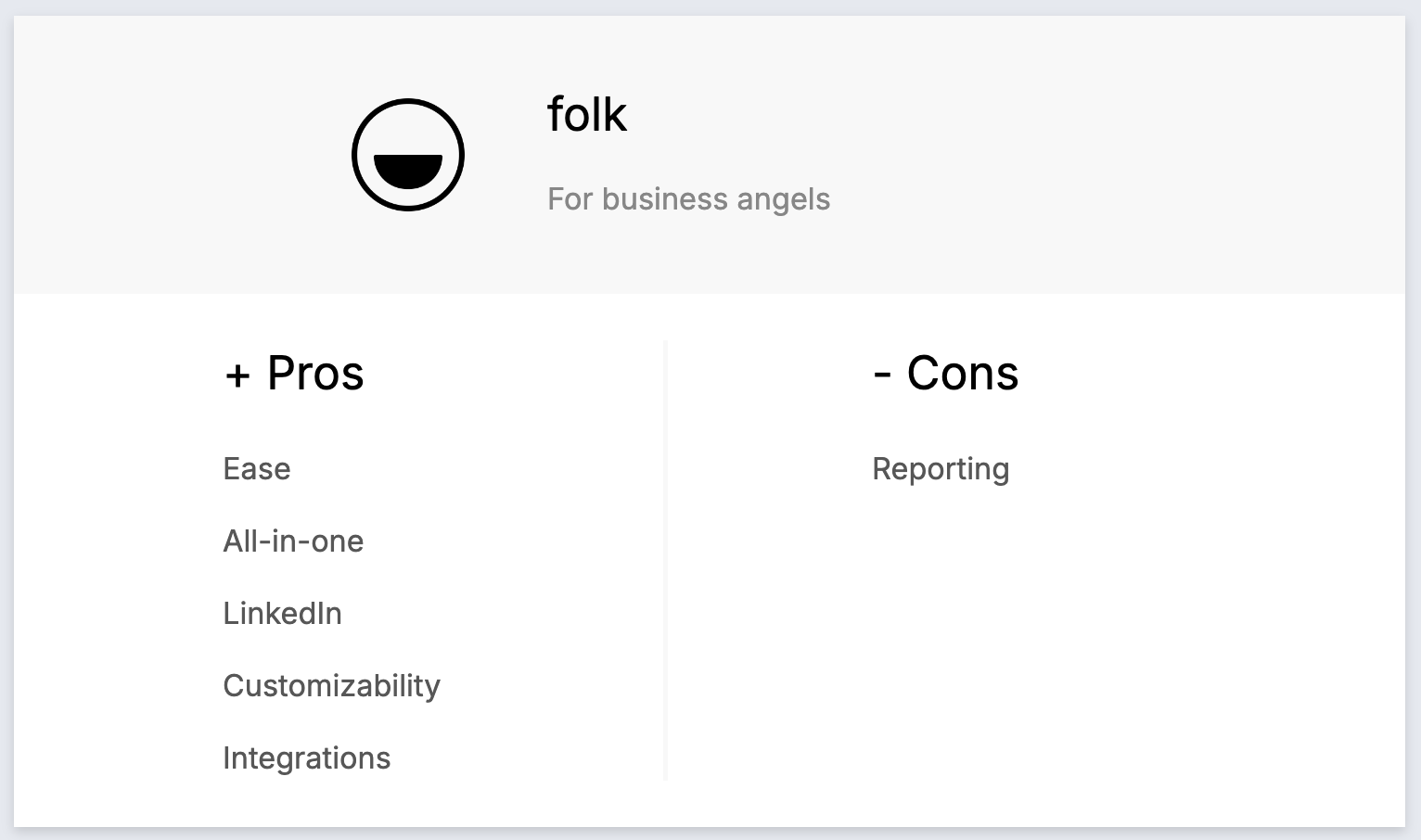
- Ease of use: folk is praised for its intuitive interface, making it accessible even to non-technical users with quick onboarding and a minimal learning curve.
- All-in-one: folk streamlines your workflow by allowing you to import contacts from LinkedIn, automatically find their emails, reach out through customizable email sequences, and track interactions in a pipeline, eliminating the need for multiple tools and saving time and money.
- LinkedIn integration: Seamlessly import contacts from LinkedIn, track conversations within folk, and use templates for quicker, streamlined communication.
- Customizability: Custom fields, pipelines, and workflows.
- Integrations: folk offers native integrations (e.g., WhatsApp, Kaspr, Allo, Salesforge, PandaDoc) and an open API, plus Zapier and Make to connect with 6,000+ apps.
Cons
- Reporting: folk offers advanced analytics, including pipeline and deal stage reporting, revenue forecasting with weighted probabilities, and performance breakdowns by owner, channel, industry, region, or any custom field.
Prices and plans
You can try folk for free with a 14 day free trial. After that, a monthly or annual subscription plan is as follows.
- Standard: $20 per user, per month.
- Premium: $40 per user, per month.
- Custom: Starts from $60 per user, per month.
2. HubSpot
⭐⭐⭐⭐(G2)
HubSpot CRM is a user-friendly, scalable platform offering integrated tools for managing sales, marketing, customer service, and operations efficiently.

Key features
- Marketing Hub: Includes email marketing, ad tracking, landing pages, and lead generation tools, essential for attracting potential investment opportunities.
- Sales Hub: Provides deal tracking, pipeline management, sales automation, and reporting, crucial for managing leads and investors efficiently.
- Lead scoring: Prioritize leads with predictive scoring to improve the efficiency in identifying high-potential investment opportunities.
- Operations Hub: Syncs and automates business processes across different systems, ensuring seamless management of investor relations and investment tracking.
- Customizable dashboard and reports: Allows users to create customized dashboards and reports to track metrics and gain insights into investment performance and investor engagement.
Pros
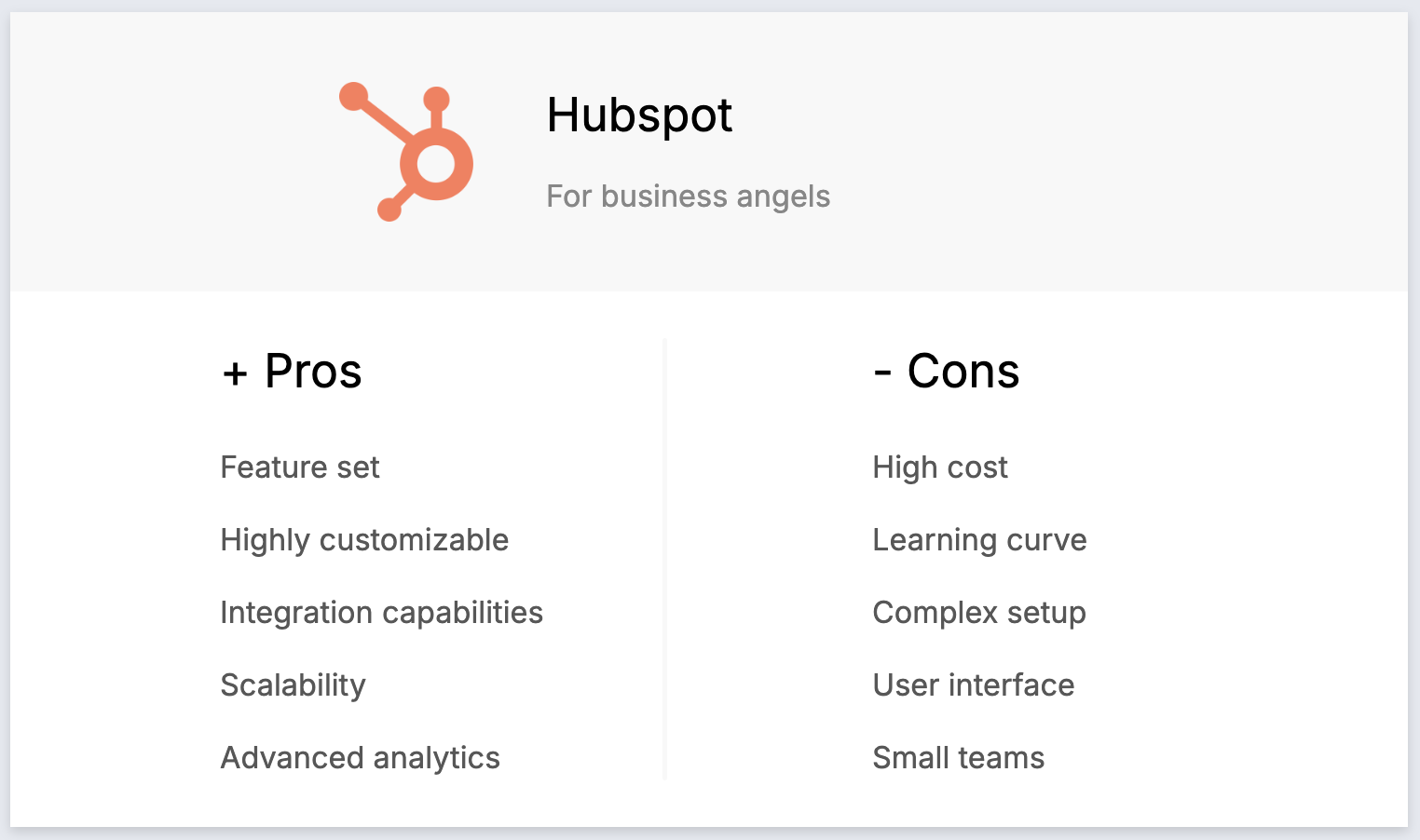
- User-friendly interface: Known for its intuitive and easy-to-use interface, making it accessible for business angels with varying levels of tech proficiency.
- Comprehensive free plan: Offers a robust free version that includes essential CRM features, making it ideal for business angels just starting out.
- Seamless integration with marketing tools: Integrates smoothly with its marketing, sales, and service hubs, creating a unified platform for managing investor relations and investment opportunities.
- Automation capabilities: Provides powerful automation tools for tasks like email marketing, lead nurturing, and sales workflows, helping business angels save time and improve efficiency.
- Customizable dashboard and reports: Allows users to create customized dashboards and reports to track metrics and gain insights into investment performance and investor engagement.
Cons
- High cost at higher tiers: Pricing can become expensive as you move to higher tiers, which may be prohibitive for small business angels as they scale.
- Limited customization in free plan: The free plan and lower tiers have limited customization options, which can restrict flexibility for growing investment portfolios.
- Complexity in advanced features: Some advanced features, such as custom reporting and workflows, have a steep learning curve and may require additional training.
- Email marketing limits: Email marketing functionality in the free plan is restricted by limits on the number of emails you can send, which can be a drawback for business angels with larger contact lists.
- Additional costs for add-ons: Many useful features, like advanced CRM capabilities and integrations, come as paid add-ons, increasing the overall cost.
Price and plans
Prices and plans on the CRM suite for an annual subscription are as follows.
- Starter: $15 per user, per month.
- Professional: $450 per user, per month.
- Enterprise: $1,500 per user, per month.
3. Salesforce
⭐⭐⭐⭐(G2)
Salesforce is a robust CRM platform for large enterprises, offering tools for sales, marketing, service, and analytics, with extensive scalability.

Key features
- Comprehensive ecosystem: A unified platform offering CRM, marketing automation, and custom app development, ideal for managing leads, investors, and investment opportunities.
- Customization and scalability: Highly customizable to fit the unique needs of business angels, from tracking investment opportunities to managing investor relationships.
- Artificial intelligence (AI) integration: Salesforce Einstein provides AI-driven insights, helping business angels identify promising leads and optimize investment strategies.
- Extensive integration capabilities: Seamlessly integrates with a wide range of third-party applications, ensuring smooth operation across different business systems.
- Enterprise-grade security and compliance: Offers robust security measures, essential for handling sensitive investor and investment data.
Pros
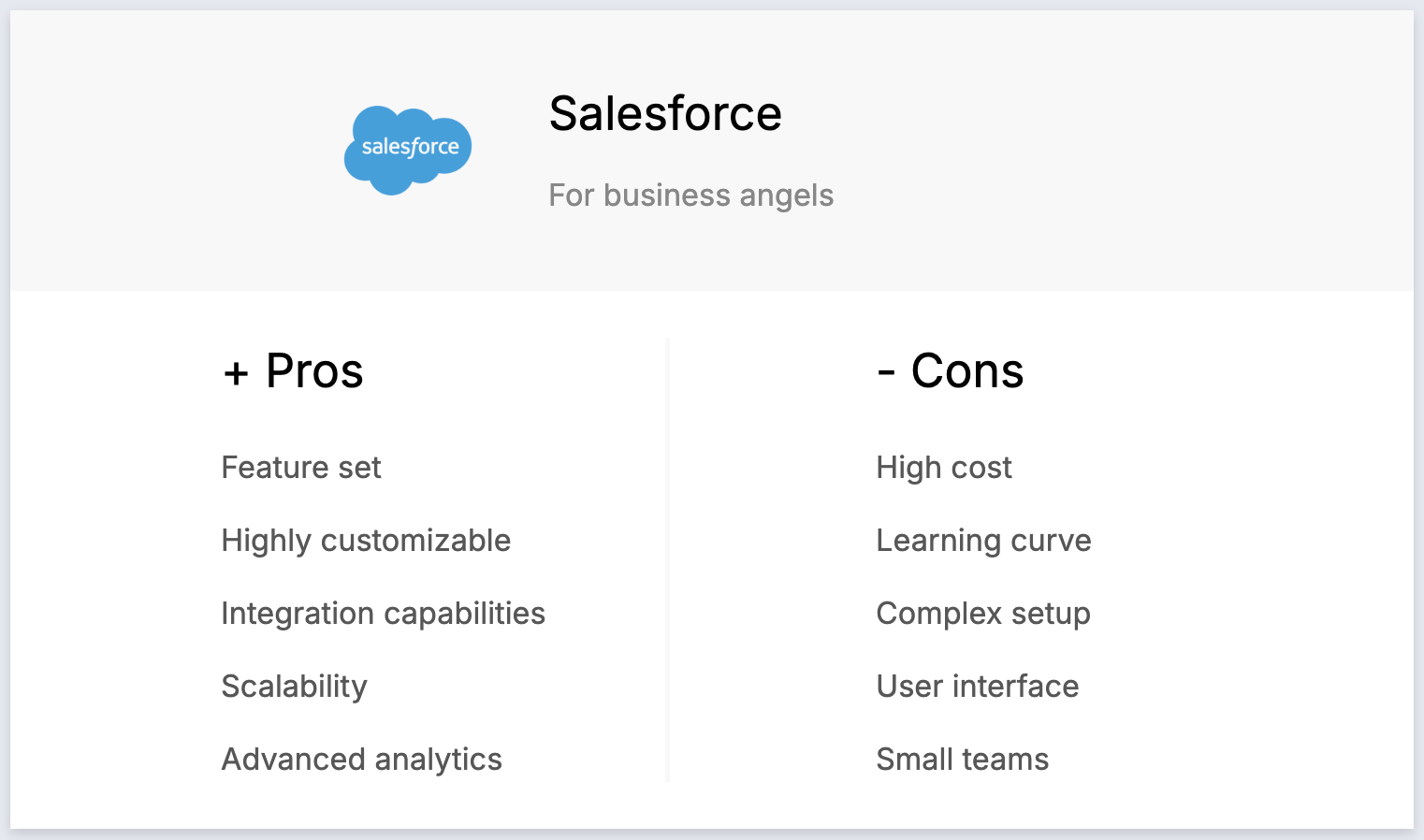
- Comprehensive feature set: Covers all aspects of CRM, making it a powerful tool for managing leads, investors, and investment opportunities.
- Highly customizable: Tailor the platform to specific needs with custom fields and workflows, perfect for tracking various stages of investment deals.
- Extensive integration capabilities: Integrates with a vast array of third-party applications, enabling seamless data flow across platforms.
- Scalability: Suitable for businesses of all sizes, from small startups to large enterprises, with the ability to grow with your investment portfolio.
- Advanced analytics and reporting: Provides powerful analytics tools, allowing business angels to gain deep insights into their data and make informed investment decisions.
Cons
- High cost: Can be expensive, especially for small to medium-sized businesses, with high licensing fees and additional costs for add-ons and customization.
- Steep learning curve: Requires significant time and training for users to become proficient due to its extensive feature set and complexity.
- Complex setup and customization: Initial setup and customization can be challenging and often require expert help, adding to the overall cost.
- User interface: Some users find the interface outdated and not as intuitive as other modern CRM platforms, which can hinder usability.
- Overwhelming for small teams: The robust features may be overkill for smaller teams, leading to underutilization of the platform's capabilities.
Price and plans
On an annual subscription, Salesforce's Service Cloud plan is as follows.
- Starter suite: Starts from $25 per user, per month.
- Pro suite: Starts from $100 per user, per month.
- Enterprise: Starts from $165 per user, per month.
4. Capsule CRM
⭐⭐⭐⭐(G2)
Capsule CRM is a user-friendly customer relationship management platform designed for small and medium-sized businesses. It offers a clean, intuitive interface that helps users manage customer relationships, track sales pipelines, and organize tasks and communications efficiently.
Key features
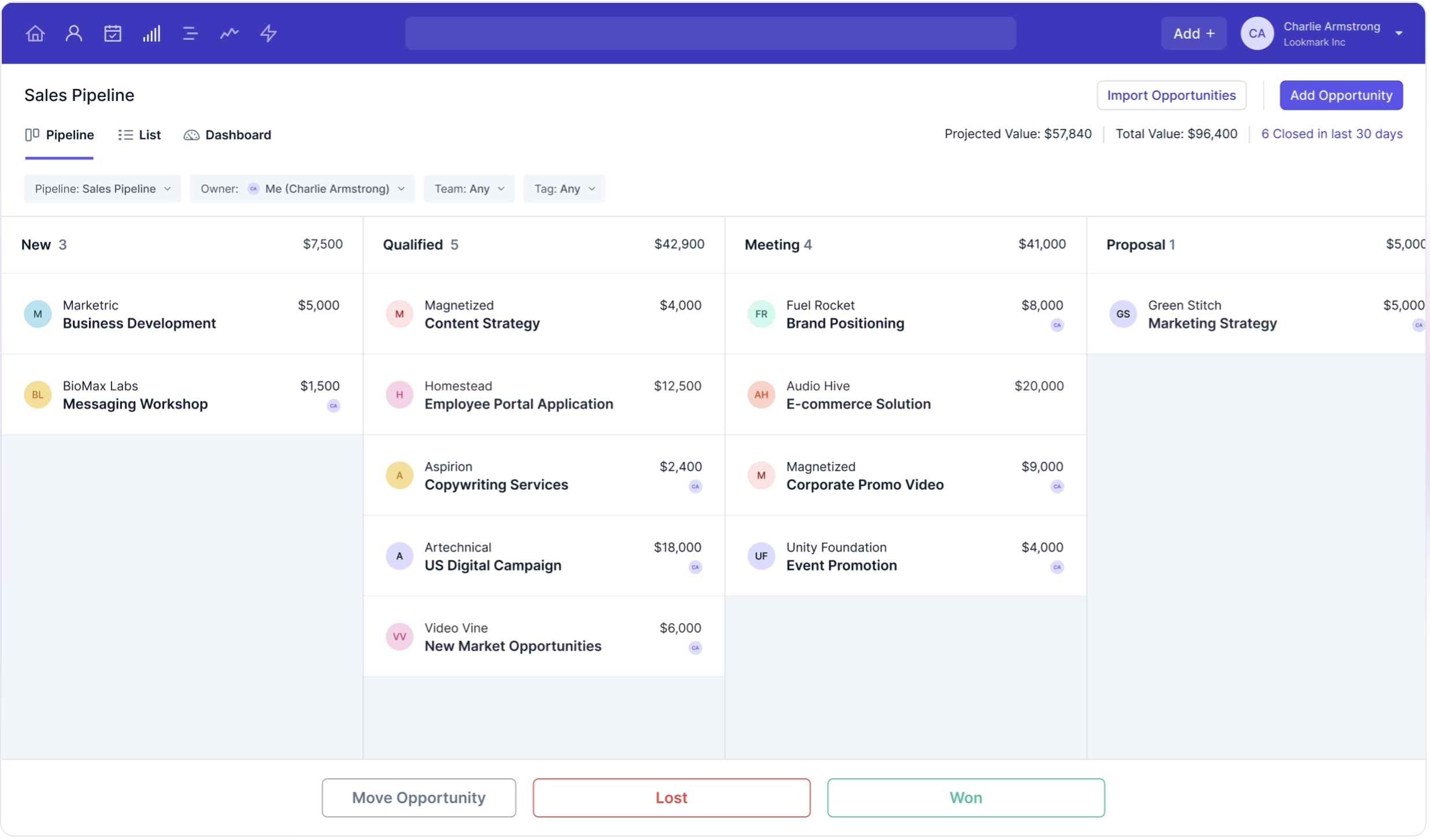
- 1 sales pipeline: Organize and track investment opportunities efficiently.
- 30,000 contacts: Manage an extensive list of leads, investors, and investment opportunities.
- Activity reporting: Keep track of interactions and activities with potential investors and startups.
- Workflow automation: Automate repetitive tasks to focus more on strategic decisions.
- Key integrations: Seamlessly connect with tools like G Suite, Microsoft 365, and Mailchimp for enhanced productivity.
Pros
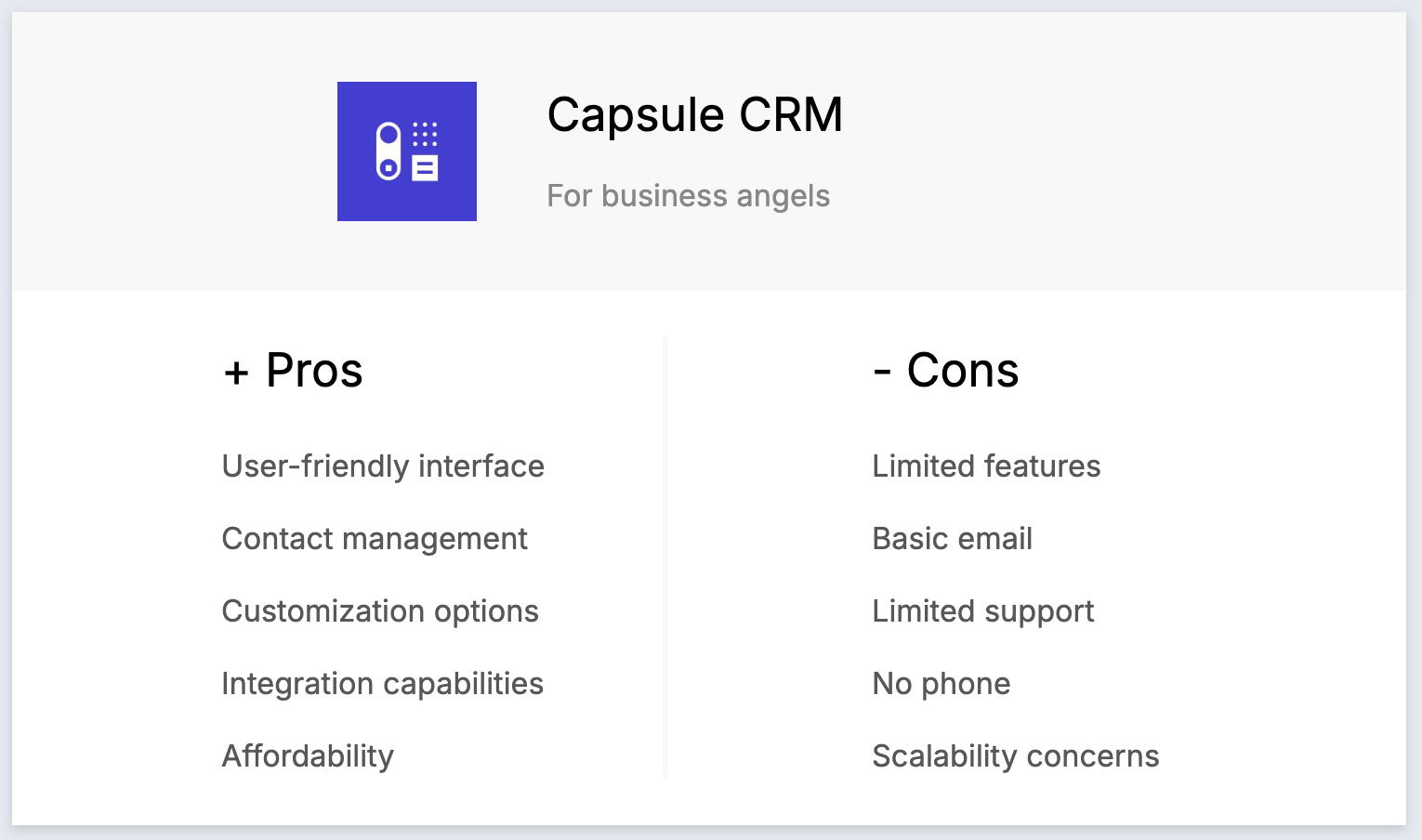
- User-friendly interface: Capsule CRM offers a clean and intuitive design, making it easy for business angels to navigate and quickly access important features.
- Contact and sales management: The platform provides robust tools for managing leads, investors, and investment opportunities, helping maintain a clear view of relationships and potential deals.
- Customization options: Capsule CRM allows users to customize fields, tags, and pipelines to fit their specific needs, offering flexibility in managing data and processes.
- Integration capabilities: Capsule integrates with popular third-party applications, allowing users to create a seamless workflow across their business tools.
- Affordability: Capsule CRM offers competitive pricing with affordable premium options, making it accessible for startups and small investment teams.
Cons
- Limited advanced features: Capsule CRM lacks more advanced features such as in-depth analytics and complex reporting capabilities, which might be a limitation for larger investment firms.
- Basic email marketing capabilities: Its built-in email marketing features are relatively basic, so users may need to rely on third-party integrations for more advanced needs.
- Limited customer support: Capsule primarily offers support through email and an online help center, which might be a downside for users who prefer immediate assistance.
- No built-in phone or SMS integration: Capsule does not have built-in phone or SMS functionality, which could be a disadvantage for those relying on direct communication with clients.
- Scalability concerns: While great for small to medium-sized businesses, rapidly growing companies might find the platform less scalable as their needs expand.
Price and plans
- Starter plan: Starts from $21 per user, per month.
- Growth plan: Starts from $38 per user, per month.
- Advanced plan: Starts from $60 per user, per month.
- Ultimate plan: Starts from $75 per user, per month.
5. Zoho
⭐⭐⭐(G2)
Zoho is a CRM system with a strong sales focus. It has journey orchestration, sales process management, and workflow automation features. There's also something for marketing teams, including event management and customer segmentation.

Key features
- Lead and contact management: Manages investor information, tracks interactions, and segments contacts for targeted follow-ups.
- Customizable dashboards and reports: Create and customize dashboards to monitor investment opportunities and performance metrics.
- Sales pipeline management: Visualize and manage investment pipelines with drag-and-drop functionality.
- Multi-channel communication: Integrates with email, phone, and social media to manage investor interactions seamlessly.
- AI-powered sales assistant (Zia): Provides predictive analytics and intelligent suggestions to enhance investment tracking and decision-making.
Pros
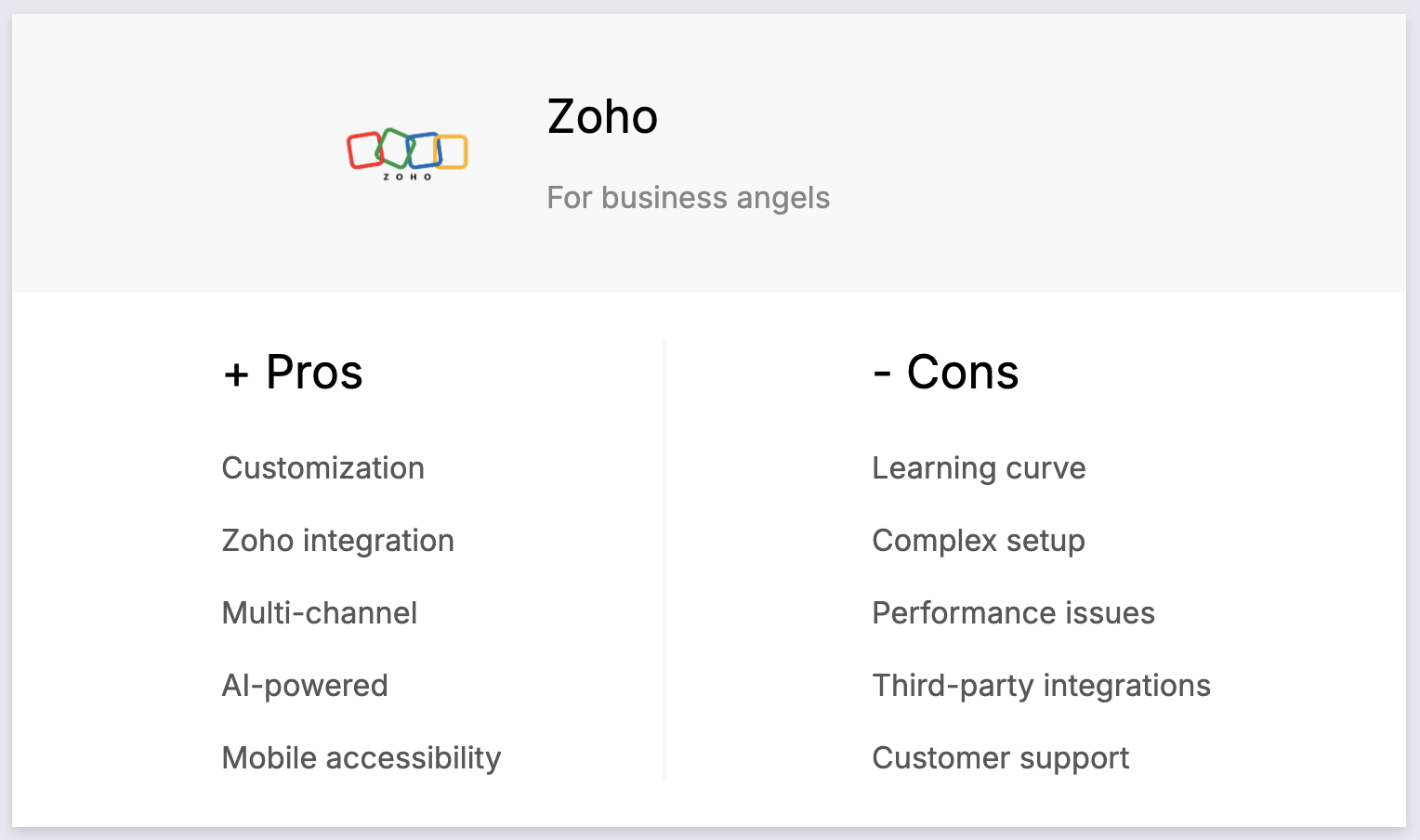
- Customization: Extensive customization options allow tailoring the CRM to manage investor relations, including custom fields and workflows.
- Integration with Zoho suite: Seamless integration with other Zoho products for comprehensive management of business functions.
- Multi-channel communication: Supports email, phone, and social media, enabling a unified platform for all investor interactions.
- AI-powered features: Zia provides intelligent insights and predictive analytics, aiding in better investment decisions.
- Mobile accessibility: Robust mobile app allows managing investor relationships and accessing data on the go.
Cons
- Steep learning curve: Extensive customization options can be overwhelming for new users.
- Complex setup: Initial setup can be complex, requiring technical expertise.
- Performance issues: Occasional slow performance with large datasets can hinder productivity.
- Limited third-party integrations: Integration with third-party applications can be limited or require additional effort.
- Inconsistent customer support: Customer support quality can be inconsistent, with slow response times reported by some users.
Price and plans
Zoho's free plan is limited to three users. After that, for more features and seats, an annual subscription plan is as follows.
- Standard: $20 per user, per month.
- Professional: $35 per user, per month.
- Enterprise: $50 per user, per month.
Conclusion
Having the right CRM can make all the difference in managing relationships and streamlining processes. Whether you're an experienced business angel or just starting out, choosing a CRM that aligns with your needs is can make a difference. For business angel teams of 20-50 people, folk CRM stands out as the top choice, offering the perfect balance of simplicity, powerful features, and scalability needed to manage complex investment portfolios efficiently. Platforms like folk, Hubspot, Salesforce, Capsule CRM, and Zoho offer varied features and pricing to cater to different requirements and budgets. By leveraging the right CRM, you can enhance your efficiency, improve investor relations, and ultimately drive better investment outcomes. For a hands-on experience, try folk for free here.
👉🏼 Try folk now to never miss a follow-up across investments
Need a helping hand? Use our free tool to find your perfect CRM match.
FAQ
What is a CRM for business angels?
A CRM for business angels centralizes contacts, startups, deals, and communications; tracks pipeline stages; automates follow-ups; and reports performance to support data-driven investment decisions.
How do business angels track deal flow in a CRM?
Define stages (Sourcing, Screening, Due diligence, Term sheet, Invested, Post-investment), assign owners and next steps, log notes and emails, set reminders, and use dashboards to prioritize outreach and monitor conversion rates.
What CRM features should business angels prioritize?
Contact enrichment, LinkedIn import, email sync and sequences, customizable pipelines, notes and reminders, dashboards and reporting, analytics, integrations (API, Zapier/Make), and mobile access.
How much does a CRM for investors cost?
Plans typically range from $15–$75 per user/month for SMB tools; enterprise tiers cost more. folk offers a 14-day trial and plans from $20–$40 per user/month, plus custom options for larger teams.
Discover folk CRM
Like the sales assistant your team never had