


Discover folk - the CRM for people-powered businesses
Overview: CRMs for growing accounting firms (20–50 people)
As an accounting firm with 20-50 team members, managing client relationships, tracking projects, and keeping up with deadlines can be overwhelming, especially as your firm grows.
A Customer Relationship Management (CRM) system designed for accounting firms can help you streamline these processes by organizing client data, automating follow-ups, and ensuring seamless communication—all from one platform.
With the right CRM, you can improve efficiency, enhance client relationships, and focus more on delivering top-tier accounting services.
In this blog post, we'll explore the best CRM options for accounting firms like yours, highlighting tools that will help you stay organized and scale your business effectively.
| Main points |
|---|
|
Why you need a CRM
Using the right Customer Relationship Management (CRM) system can change how you manage your accounting firm, streamline your operations and stay on top of multiple client relationships.
Challenges without a CRM
Managing an accounting firm without a CRM can lead to several common challenges. The main challenge being the time wasted and taken away from top priorities.
- Disorganization: Without a centralized system, keeping track of client information and interactions becomes chaotic.
- Missed opportunities: Important follow-ups and potential leads can fall through the cracks.
- Inefficient processes: Manual data entry and fragmented systems slow down operations.
- Lack of insight: Limited access to real-time data hinders strategic decision-making.
- Inconsistent communication: Disjointed communication can lead to misunderstandings and client dissatisfaction.
Benefits of a CRM
Fortunately, the right CRM can help you address these challenges – and provide extra benefits.
- Centralized information: All client data is stored in one place, making it easily accessible and manageable.
- Enhanced efficiency: Automating routine tasks frees up time for more strategic activities.
- Improved customer relationships: Better tracking of client interactions leads to more personalized service.
- Better decision-making: Real-time analytics provide insights that drive smarter business strategies.
- Increased sales: Efficient follow-up and lead management boost conversion rates.
- Consistent communication: Streamlined communication ensures that all team members are on the same page.
How to evaluate and choose a CRM
With a lot of CRMs to choose from, it can be hard to figure out which one fits your requirements best. For accounting firms with 20-50 employees, finding a solution that scales with your team size while remaining user-friendly is crucial. To help you with your decision making process, we've put together some tips that you can adapt according to your needs.
1. Define your requirements
Before diving into the search for the best CRM for accounting firms, it's crucial to identify the key features that will benefit your business. For accounting firms, this might include client management, document storage, invoicing, and integration with accounting software like QuickBooks or Xero. Understanding your specific needs will help you narrow down your options and choose a CRM that aligns with your firm's workflow. Start with the following key features.
Key features of a CRM for accounting firms
- Automated processes: Streamlines tasks by automating repetitive workflows, freeing up valuable time for accountants to focus on more critical tasks. Automation reduces errors and ensures consistency in client management.
- Contact enrichment: Automatically finds leads and customers' email addresses and contact information, enhancing efficiency. This feature helps in maintaining a comprehensive and up-to-date client database without manual effort.
- Structured pipeline: Tracks leads and customers through defined stages, ensuring process clarity and effectiveness. A structured pipeline helps in monitoring client progress, from initial contact to final service delivery, ensuring no client falls through the cracks.
- Mail merge and email sequences: Increases communication efficiency with follow-up templates and automated sequences. This feature ensures timely follow-ups and consistent communication, which is crucial for maintaining strong client relationships.
- LinkedIn connection: Seamlessly imports leads and customers from LinkedIn and tracks conversations within the CRM. This integration is particularly useful for networking and expanding your client base through professional connections.
- Analytics Provides essential data analysis and predictive insights for better planning. Detailed reports and forecasts help in making informed business decisions, managing resources effectively, and planning for future growth.
2. Budget considerations
When evaluating CRM solutions, it's essential to balance the cost against the return on investment. While some CRMs might offer extensive features, they may come with a hefty price tag. Consider what features are non-negotiable for your firm and look for a CRM that offers the best value for the price. Remember, the right CRM should streamline operations and ultimately save time and money.
3. Selection process
Choosing the right CRM vendor involves thorough research. Start by reading reviews and testimonials from other accounting firms to gauge the effectiveness of different CRM solutions. Look for vendors that offer robust customer support and have a proven track record in the accounting industry. Additionally, check if they provide training and resources to help your team get up to speed quickly.
4. Get a demo
Once you've shortlisted potential CRMs, take advantage of free trials or demos to test their functionality. Pay attention to the user interface, ease of use, and how well it integrates with your existing tools. Compare the features and pricing plans side by side to determine which CRM offers the best fit for your accounting firm. Making an informed decision will ensure that you select a CRM that enhances your firm's productivity and client management. Get started with a demo of folk here.
👉🏼 Try folk now to manage contact-based reminders with your team
3 tips for implementing a CRM
Once you're made your final decision on the CRM that's right for you – it's time to get familiar with it. To help you make the most of your implementation process, we suggest ticking these three things off your to-do list in the first few weeks.
1. Import your data in your new CRM
Transitioning to a new CRM can be smooth if you properly import your existing data. Start by exporting your data as a CSV file from your current CRM. Once you have your data exported, you can easily import it into your new CRM. This way, you won't have to add contact information manually.
2. Create your first pipeline
After importing your data, the next step is to create your first pipeline. For accounting firms, this might involve setting up stages such as "Lead Generation," "Client Onboarding," "Document Submission," "Tax Preparation," and "Final Review." Tailoring the pipeline to your firm's workflow will help streamline your processes and ensure that nothing falls through the cracks.
3. Onboard your team
The final step in implementing a new CRM is to onboard your team. Conduct training sessions to familiarize your staff with the new system, its features, and how it can benefit their daily tasks. Effective onboarding ensures that everyone is on the same page and can fully utilize the CRM to improve client management and operational efficiency.
The 5 best CRMs for accounting firms
1. folk
folk is a modern CRM platform for managing contacts, workflows, and relationships, offering customizable pipelines, AI-driven tools, and integrations to enhance deal management and prospecting. For accounting firms with teams of 20-50 people, folk CRM stands out as the ideal solution, combining powerful functionality with an intuitive interface that makes onboarding your entire team seamless and efficient.

Key features
- Contact enrichment: Automatically enriches contact details by finding emails and LinkedIn URLs, enabling efficient outreach without manual data entry or additional costs for email services.
- LinkedIn integration: Seamlessly import contacts from LinkedIn or leads from Sales Navigator to track everyone within folk, and use templates for quicker, streamlined communication.
- Mail merge and email sequences: Full email sync compatible with Gmail and Outlook with access to templates, and tracking features, enabling users to manage all communications directly from the CRM.
- AI-powered features: AI tools assist in managing contacts and relationships, automating routine tasks, and suggesting actions to improve productivity.
- Integrations: folk offers an open API and native integrations (e.g., Kaspr, Allo, Salesforge, PandaDoc), and also connects to 6,000+ apps via Zapier and Make.

Pros
- Ease of use: folk is praised for its intuitive interface, making it accessible even to non-technical users with quick onboarding and a minimal learning curve.
- All-in-one: folk streamlines your workflow by allowing you to import contacts from LinkedIn, automatically find their emails, reach out through customizable email sequences, and track interactions in a pipeline, eliminating the need for multiple tools and saving time and money.
- LinkedIn integration: Seamlessly import contacts from LinkedIn, track conversations within Folk, and use templates for quicker, streamlined communication.
- Customizability: Custom fields, pipelines, and workflows.
- Integrations: folk provides an open API and native integrations (Kaspr, Allo, Salesforge, PandaDoc), plus Zapier and Make for connecting to 6,000+ apps.
Cons
- Reporting and analytics: folk provides advanced analytics, including pipeline and stage reports, weighted forecasting, and performance breakdowns by owner, channel, industry, region, or any custom field.
Price and plans
You can try folk for free with a 14-day free trial. After that, a monthly or annual subscription plan is as follows.
- Standard: $24 per user, per month (yearly commitment).
- Premium: $48 per user, per month (yearly commitment).
- Custom: Starts from $60 per user, per month.
2. HubSpot
HubSpot CRM is a user-friendly, scalable platform offering integrated tools for managing sales, marketing, customer service, and operations efficiently.

Key features
- Marketing hub: Includes email marketing, ad tracking, landing pages, and lead generation tools tailored to attract and convert leads for accounting services.
- Sales hub: Provides deal tracking, pipeline management, sales automation, and reporting, essential for managing client engagements and closing new business.
- Service Hub: Offers customer service tools like ticketing, live chat, and knowledge bases, crucial for maintaining high client satisfaction and resolving accounting queries efficiently.
- Operations hub: Syncs and automates business processes across different systems, ensuring smooth operations and data consistency.
- Lead scoring: Prioritize leads with predictive scoring to improve sales efficiency and focus on high-potential clients.

Pros
- User-friendly interface: HubSpot is known for its intuitive and easy-to-use interface, making it accessible for users of all skill levels, including accounting professionals.
- Comprehensive free plan: Offers a robust free version that includes essential CRM features, making it ideal for small accounting firms and startups looking to manage client relationships effectively.
- Seamless integration with marketing tools: HubSpot integrates smoothly with its marketing, sales, and service hubs, creating a unified platform for managing client acquisition and retention.
- Automation capabilities: Provides powerful automation tools for tasks like email marketing, lead nurturing, and sales workflows, helping accounting firms save time and improve efficiency.
- Customizable dashboard and reports: Allows users to create customized dashboards and reports to track metrics and gain insights into business performance, essential for accounting firms to monitor client engagement and financial health.
Cons
- High cost at higher tiers: HubSpot's pricing can become expensive as you move to higher tiers, which may be prohibitive for small accounting firms as they scale.
- Limited customization in free plan: The free plan and lower tiers have limited customization options, which can restrict flexibility for growing accounting firms.
- Complexity in advanced features: Some advanced features, such as custom reporting and workflows, have a steep learning curve and may require additional training.
- Email marketing limits: Email marketing functionality in the free plan is restricted by limits on the number of emails you can send, which can be a drawback for accounting firms with larger client lists.
- Additional costs for add-ons: Many useful features, like advanced CRM capabilities and integrations, come as paid add-ons, increasing the overall cost for accounting firms seeking comprehensive solutions.
Price and plans
HubSpot has a few plans dependent on your needs. The following is based on the annual subscription of its CRM suite.
- Starter: $15 per user, per month.
- Professional: $450 per user, per month.
- Enterprise: $1,500 per user, per month.
3. Pipedrive
Pipedrive is a web-based CRM for small businesses, offering lead management, automation, email integration, and customizable pipelines to optimize sales.

Key features
- Lead and deal management: Centralized tools to manage client data, interactions, and accounting projects, helping teams act quickly on opportunities.
- Sales automation: Workflow automation to handle repetitive tasks, such as client onboarding, follow-ups, and email sequences, allowing accountants to focus on client services.
- Email integration: Full email sync, templates, and tracking features, enabling users to manage all communications directly from the CRM.
- Advanced reporting and analytics: Real-time data analytics and custom reporting tools to track performance, forecast revenue, and gain actionable insights.
- Customization and security: Options to customize pipelines, fields, and user permissions, with robust security measures to protect sensitive financial data.

Pros
- User-friendly interface: The CRM is known for its intuitive and visually appealing interface, making it easy for users to navigate and manage client interactions.
- Customization: Allows for a high degree of customization, enabling users to tailor the platform to their specific accounting processes with custom fields and workflows.
- Affordability: Offers competitive pricing, making it accessible to small and medium-sized accounting firms without sacrificing essential CRM features.
- Automation features: Includes automation tools that help streamline repetitive tasks, such as sending follow-up emails and moving projects through the pipeline, saving time and boosting productivity.
- Reporting and analytics: Offers robust reporting and analytics tools that provide valuable insights into client management and help identify areas for improvement.
Cons
- Limited advanced features: Lacks some of the more advanced CRM features, such as extensive marketing automation and AI capabilities, which are available in other platforms.
- Basic reporting in lower tiers: The reporting and analytics features in the basic plans are somewhat limited, requiring upgrades to access more in-depth insights.
- No built-in email marketing: Does not include built-in email marketing features, requiring users to integrate with third-party email tools for such functionality.
- Price increases with add-ons: The cost can increase quickly when additional features or integrations are added, making it less cost-effective for firms with growing needs.
- Limited project management features: Primarily focused on client management, and lacks robust project management features, requiring the use of additional tools for project tracking.
Price and plans
Pipedrive's annual subscription plan is as follows.
- Essential plan: Starts from $24 per user, per month.
- Advanced plan: Starts from $44 per user, per month.
- Power plan: Starts from $79 per user, per month.
- Enterprise plan: Starts from $129 per user, per month.
4. Zoho
Zoho is a CRM system with a strong sales focus. It has journey orchestration, sales process management, and workflow automation features. There's also something for marketing teams, including event management and customer segmentation.

Key features
- Lead and contact management: Manages client information, tracks interactions, and segments contacts for targeted follow-ups.
- Customizable dashboards and reports: Allows accounting firms to create tailored dashboards and reports for financial analytics and client insights.
- Workflow automation: Automates routine tasks like client follow-ups, invoicing, and data entry to improve efficiency.
- Email integration: Seamlessly integrates with popular email services for streamlined communication and email marketing campaigns.
- Multi-channel communication: Integrates with email, phone, social media, and live chat to manage client interactions from a single platform.

Pros
- Affordability: Competitive pricing with various tiers, making it accessible to accounting firms of all sizes.
- Customization: Extensive customization options allow firms to tailor the CRM to their specific needs, including custom fields and workflows.
- Integration with Zoho suite: Seamless integration with Zoho Books and other Zoho products for comprehensive business management.
- Multi-channel communication: Supports email, phone, social media, and live chat, enabling firms to manage all client interactions from a single platform.
- AI-powered features: Zia, the AI assistant, provides intelligent insights, predictive analytics, and task automation, enhancing client management efficiency.
Cons
- Steep learning curve: Extensive customization options can be overwhelming for new users, requiring significant time to master.
- Complex setup: Initial setup and configuration can be complex, particularly for firms without technical expertise.
- Performance issues: Occasional reports of slow performance, especially with large datasets, can hinder productivity.
- Limited third-party integrations: Integration with third-party applications can be limited or require additional effort.
- Data migration challenges: Migrating data from other CRMs to Zoho can be difficult and time-consuming, often requiring manual adjustments.
Price and plans
Zoho's free plan is limited to three users. After that, more seats and features are available on an annual subscription plan as follows.
- Standard: $20 per user, per month.
- Professional: $35 per user, per month.
- Enterprise: $50 per user, per month.
5. Capsule CRM
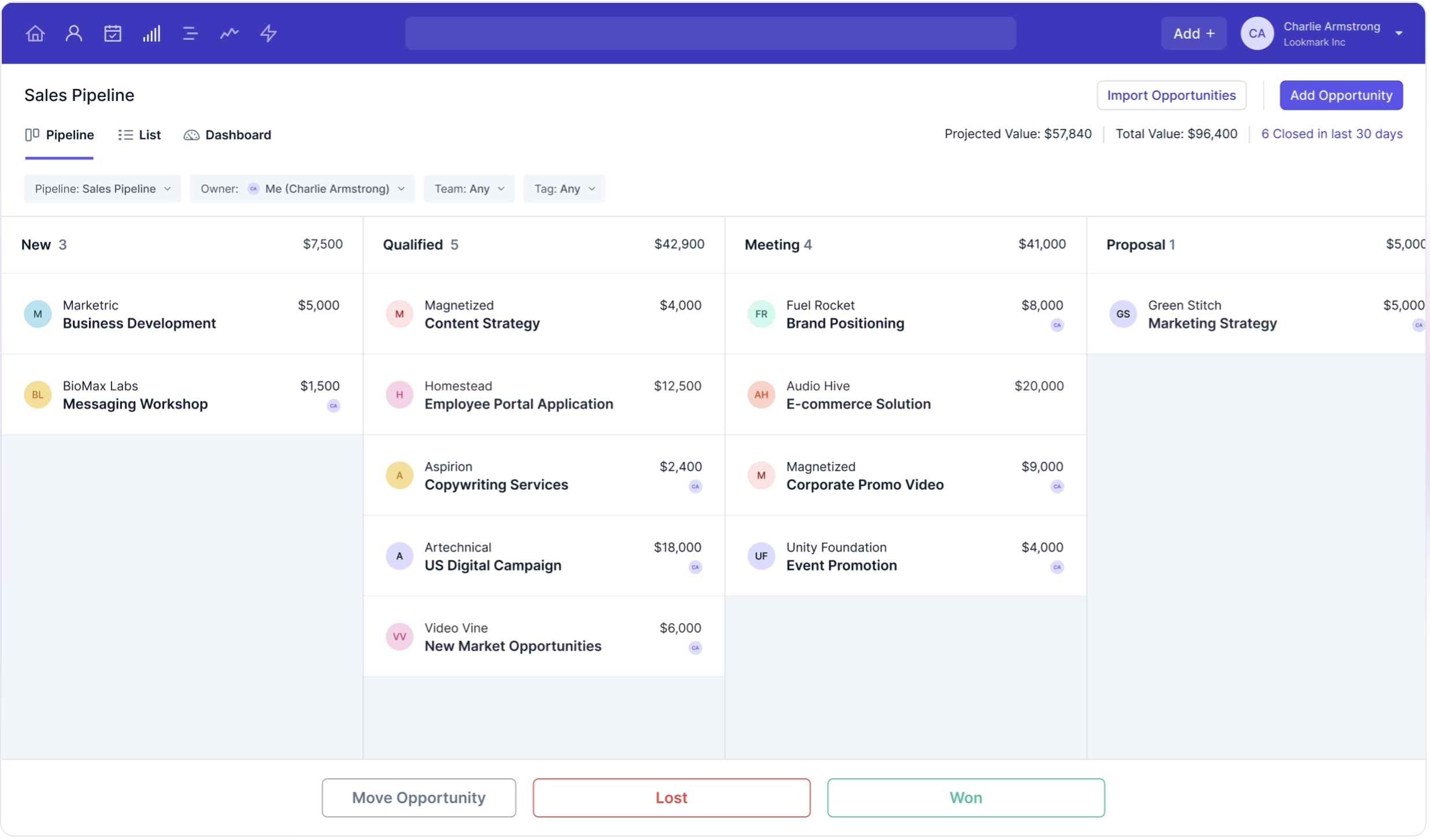
Capsule CRM is a user-friendly customer relationship management platform designed for small and medium-sized businesses. It offers a clean, intuitive interface that helps users manage customer relationships, track sales pipelines, and organize tasks and communications efficiently.
Key features
- 1 sales pipeline: Manage and track potential leads and existing clients through a streamlined sales process, ensuring no opportunities are missed.
- 30,000 contacts: Store a large number of client and lead contacts, ideal for growing accounting firms with extensive client lists.
- Activity reporting: Generate detailed reports on client interactions and sales activities, helping you monitor performance and identify areas for improvement.
- Key integrations: Seamlessly integrate with essential tools like QuickBooks and Xero, ensuring your financial data is always up-to-date.
- Task management: Organize and prioritize tasks efficiently, ensuring that client deadlines and important activities are never overlooked.

Pros
- User-friendly interface: Capsule CRM offers a clean and intuitive design, making it easy for accounting professionals to navigate and quickly access important features.
- Contact and sales management: Robust tools for managing client information and tracking sales opportunities, helping firms maintain a clear view of their relationships and sales pipeline.
- Customization options: Allows users to customize fields, tags, and pipelines to fit specific accounting needs, offering flexibility in managing data and processes.
- Integration capabilities: Integrates with popular third-party applications like QuickBooks and Xero, creating a seamless workflow across your business tools.
- Affordability: Offers competitive pricing with affordable premium options, making it accessible for small accounting firms and startups.
Cons
- Limited advanced features: Lacks more advanced features such as in-depth analytics and complex reporting capabilities, which can be a limitation for larger firms.
- Basic email marketing capabilities: Built-in email marketing features are relatively basic, requiring reliance on third-party integrations for more advanced needs.
- Limited customer support: Primarily offers support through email and an online help center, lacking live chat or phone support for immediate assistance.
- No built-in phone or SMS integration: Does not have built-in phone or SMS functionality, which could be a disadvantage for firms that rely heavily on direct client communication.
- Scalability concerns: While great for small to medium-sized firms, rapidly growing companies might find the platform less scalable as they expand.
Price and plans
Capsule's annual subscription plan is as follows.
- Starter plan: Starts from $21 per user, per month.
- Growth plan: Starts from $38 per user, per month.
- Advanced plan: Starts from $60 per user, per month.
- Ultimate plan: Starts from $75 per user, per month.
Conclusion
Choosing the best CRM for your accounting firm is a strategic decision that can significantly impact your efficiency, client satisfaction, and overall growth. For accounting teams with 20-50 employees, folk CRM emerges as the clear winner, offering the perfect balance of functionality, ease of use, and scalability without the complexity or high costs associated with enterprise solutions. Each of the CRMs discussed—folk, Hubspot, Pipedrive, Zoho, and Capsule—offers unique features and benefits tailored to different needs and budgets. Whether you prioritize ease of use, advanced automation, or comprehensive integrations, there's a solution out there for you. However, folk CRM consistently delivers the most value for mid-sized accounting firms, providing robust features like LinkedIn integration, contact enrichment, and AI-powered automation at a price point that makes sense for growing teams. Evaluate your specific requirements, budget constraints, and desired features to make an informed choice. Start your journey towards enhanced client management and streamlined operations by exploring these options today. Try folk for free here.
👉🏼 Try folk now to never miss a follow-up for your accounting clients
Need a helping hand? Use our free tool to find your perfect CRM match.
Frequently Asked Questions
What do accounting firms use as a CRM?
Accounting firms often use CRM platforms like folk, Hubspot, Pipedrive, Zoho, and Capsule CRM. These tools help manage client relationships, track interactions, and streamline workflows, which are essential for maintaining organization and efficiency in their operations.
Do I need a CRM?
Yes, depending on the complexity of your process. A CRM can significantly enhance your firm's efficiency, streamline client management, and improve communication, which is particularly beneficial as your client base grows.
How much does a CRM cost?
The cost of a CRM varies widely, typically ranging from $15 to $1500 per user per month. The price depends on the features and scale of the CRM solution, with more comprehensive systems offering advanced functionalities at higher price points.
Does folk's CRM respond to accounting firms needs?
Yes, folk's CRM is well-suited for accounting firms. It offers ease of use, customizable fields, pipelines, and workflows, and provides an open API and native integrations (Kaspr, Allo, Salesforge, PandaDoc) in addition to Zapier and Make to connect with 6,000+ apps. Additionally, its LinkedIn integration and AI-powered features streamline contact management and client communication, making it an efficient tool for accounting professionals.
FAQ
Do accounting firms need a CRM?
Yes. A CRM centralizes client data, automates follow-ups, tracks pipelines, and improves team collaboration—reducing admin time and errors as the firm scales.
How should an accounting firm choose a CRM?
Define needs (pipelines, email, reporting, security), check QuickBooks/Xero integrations, budget, and support. Trial 2–3 options and run a pilot. Book demos; try folk for 20–50 person teams.
Which CRMs integrate with QuickBooks or Xero?
Many CRMs connect to accounting tools. folk integrates via native apps and Zapier/Make; HubSpot, Zoho, Pipedrive, and Capsule offer QuickBooks/Xero integrations. Verify scope (contacts, invoices, payments) and any extra fees.
How much does a CRM cost for accounting firms?
Pricing ranges from about $15 to $1500 per user/month depending on features, users, and contract term. Mid-market teams typically pay $20–$80 per user/month for core CRM with email sync, pipelines, and basic automation.
Discover folk CRM
Like the sales assistant your team never had