


Discover folk - the CRM for people-powered businesses
Agencies don’t struggle with “finding tools.” They struggle with keeping pipeline execution consistent while delivery stays on track. When prospect context lives across inboxes, calendars, and spreadsheets, follow-ups slip, handoffs break, and forecasting becomes guesswork. A CRM for agencies has to keep new business moving fast while preserving enough account history to support renewals, upsells, and referrals.
Salesforce and folk tackle this challenge in distinct ways. Salesforce is a robust enterprise CRM platform known for its extensive customization, intricate data models, and ability to manage large-scale sales operations, making it perfect for agencies with complex processes. In contrast, folk is an AI-driven CRM that simplifies the management of contacts, conversations, and deal context, allowing agencies to streamline their operations with minimal setup.
Choosing between these two powerful CRMs depends on your agency's unique needs regarding process complexity, customization requirements, and the level of ongoing administration you can dedicate to your CRM system.
What is Salesforce?

Salesforce is a robust enterprise CRM platform designed for extensive customization, intricate data models, and large-scale sales operations. It's ideal for agencies requiring advanced permissions, multiple business units, or precisely defined processes integrated into record types and automation. Its reporting and dashboards facilitate multi-level pipeline management, provided data is consistently structured. With a plethora of integrations available via AppExchange and custom development, Salesforce is typically selected by agencies anticipating significant customization, governance, and long-term scalability.
What is folk?
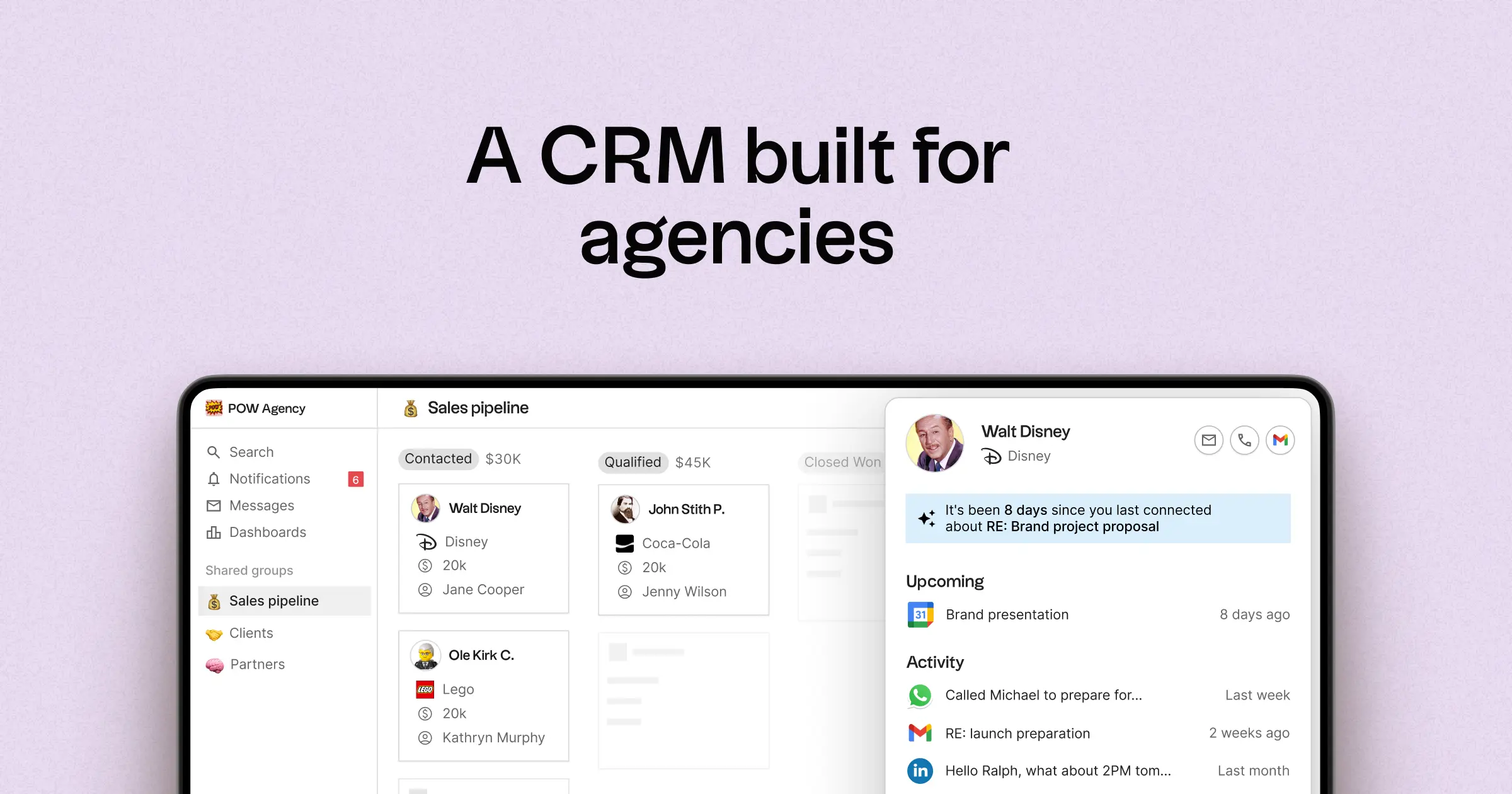
folk is an AI-driven CRM that centralizes contacts, conversations, and deal context with minimal setup. It caters to agencies managing numerous parallel relationships across clients, partners, and prospects, where context is often dispersed among emails, calendars, and messaging platforms. Features like contact enrichment and deduplication ensure records remain functional, even when data originates from various sources. With pipelines and tasks designed to systematically track new business, renewals, and referrals, folk is perfect for agencies seeking a CRM that emphasizes coordination and follow-up without the need for a complex operational framework. There's also a folk mobile app for managing contacts and conversations on the go.
Feature comparison of Salesforce and folk
Multi-pipeline and Custom Stages
In Salesforce Sales Cloud, opportunity stages are configured to enable the implementation of various pipelines through Sales Processes and Opportunity Record Types. A Sales Process consists of a filtered list of opportunity stages, while Record Types allow different teams or motions to be assigned unique sales processes. This flexibility ensures that an organization can maintain distinct stage sets for various services or regions, all while keeping the Opportunity object consistent. Stage probability is integrated into the stage setup, facilitating its use in pipeline views and reporting.
Folk empowers agencies to structure pipelines around diverse revenue motions such as retainers, projects, partnerships, or hiring. Stages can be tailored to accurately reflect real handoffs and qualification criteria, ensuring that the pipeline mirrors the actual progression of deals. By utilizing separate pipelines, agencies can maintain clear reporting by service line and avoid compromising processes across the entire team. Moreover, updates remain lightweight, allowing the CRM to evolve alongside the agency.
Client and Deal Activity Tracking
Salesforce monitors activities through tasks and events showcased on record activity timelines. Depending on your configuration, permissions, and licensing, email and calendar activities can be captured using Einstein Activity Capture, with these items appearing on related records. Activities can be linked to accounts, contacts, leads, and opportunities, ensuring that deal context includes both scheduled and completed actions. The exact functionality varies based on setup choices and the activity capture mode utilized.
Folk maintains relationship context by synchronizing communication history and activities into a unified timeline, ensuring that notes, tasks, reminders, and past interactions remain visible where the team operates. This approach minimizes “where is the context” moments during handoffs and supports agency workflows where multiple team members engage with the same account throughout sales, onboarding, delivery, and renewals. Ultimately, the aim is to provide quick access to past events, key information, and upcoming actions.
Automation and Workflows
Salesforce enables robust reporting via reports and dashboards that can be tailored to standard objects such as opportunities and activities. Reporting filters leverage opportunity stage concepts, and activity reports can provide summaries of both open and completed tasks. Dashboards can integrate multiple report charts for effective pipeline monitoring and sales management, with access governed by organizational permissions and sharing settings. The extent of reporting coverage is determined by the enabled objects and the configuration of fields and stages.
Folk enhances operational efficiency with automated follow-ups and internal handoffs, utilizing workflow rules and connectors that activate actions based on specific stages or activities. Agencies can streamline repetitive tasks, such as assigning owners, creating tasks, sending reminders, or updating fields when a deal progresses. This approach minimizes administrative burden while ensuring consistent execution across team members. Workflows are designed to be practical, ensuring that automation accelerates processes without introducing unnecessary complexity.
Reporting and Analytics
Salesforce offers robust reporting capabilities through customizable reports and dashboards that leverage standard objects such as opportunities and activities. Reporting filters are based on opportunity stages, allowing for detailed stage-type analysis, while activity reports can provide summaries of both open and completed tasks. Dashboards can integrate various report charts for effective pipeline monitoring and sales management, with access regulated by organizational permissions and sharing settings. The extent of reporting coverage is contingent upon the enabled objects and the configuration of fields and stages.
Folk enhances pipeline visibility, enabling leaders to track deal progression, assess stage health, and gauge overall momentum, which helps in identifying potential risks early. Agencies can analyze conversion patterns and cycle lengths at a macro level, then delve into specific issues to understand what is stalled and the reasons behind it. Reporting facilitates discussions around forecasting, capacity planning, and performance analysis by source or service line, ensuring a focus on clarity and informed decision-making rather than overly complex dashboards.
Integrations and Data Hygiene
Salesforce integrations are typically sourced from AppExchange, Salesforce’s marketplace for applications and solutions designed to enhance the platform. To maintain data hygiene, Salesforce employs matching rules to identify potential duplicates and duplicate rules to determine the actions taken when duplicates are detected during record creation or while viewing records. Additionally, Salesforce documentation details how duplicate sets and reports can list duplicates identified by these rules and jobs. These configurations are managed in Setup and applied to each object according to the administrator's preferences.
Folk prioritizes clean records by facilitating enrichment, deduplication, and structured fields that minimize manual data entry. Integrations link commonly used agency tools, ensuring that contact and activity data remains consistent across various channels. This strategy helps avert the typical CRM decay caused by duplicates, outdated information, and missing context, which can compromise reporting. A cleaner database not only makes automation more dependable but also maintains the pipeline’s usability at scale.
Conclusion
In conclusion, while Salesforce excels in customization and scalability for complex agency processes, it requires significant administrative overhead. Conversely, folk simplifies CRM management, providing a streamlined approach to contact and deal context with minimal setup. As such, folk emerges as the superior choice for agencies seeking a CRM that enhances collaboration and efficiency without the complexities of extensive customization. Its focus on relationship management and data hygiene ensures that teams can maintain consistent follow-ups and drive revenue growth effectively.
Start your 14-day free trial or book a demo today.
Discover folk CRM
Like the sales assistant your team never had