


Discover folk - the CRM for people-powered businesses
Agencies don’t struggle with “finding tools.” They struggle with keeping pipeline execution consistent while delivery stays on track. When prospect context lives across inboxes, calendars, and spreadsheets, follow-ups slip, handoffs break, and forecasting becomes guesswork. A CRM for agencies has to keep new business moving fast while preserving enough account history to support renewals, upsells, and referrals.
In the realm of Customer Relationship Management (CRM), Salesforce and Copper emerge as two leading solutions, each addressing the complexities of agency operations in distinct ways. Salesforce is renowned for its extensive customization capabilities and robust automation features, making it a preferred choice for agencies with intricate processes and large-scale sales operations. Copper, on the other hand, integrates seamlessly with Google Workspace, streamlining agency workflows while keeping the team aligned with their daily tasks.
The right choice between Salesforce and Copper hinges on the agency's specific needs, ranging from process complexity and required integrations to the potential for ongoing administrative support. Understanding the nuances of these platforms can empower agencies to enhance their pipeline management and drive more effective client engagement.
What is Salesforce?

Salesforce is a powerful enterprise CRM platform designed for extensive customization, intricate data models, and large-scale sales operations. It's ideal for agencies that require advanced permissions, manage multiple business units, or have specific processes that need to be reflected in record types and automation. With well-structured data, its reporting and dashboards facilitate multi-level pipeline management. The platform offers numerous integrations via AppExchange and custom development, making it the go-to choice for agencies anticipating significant customization, governance, and long-term scalability.
What is Copper?
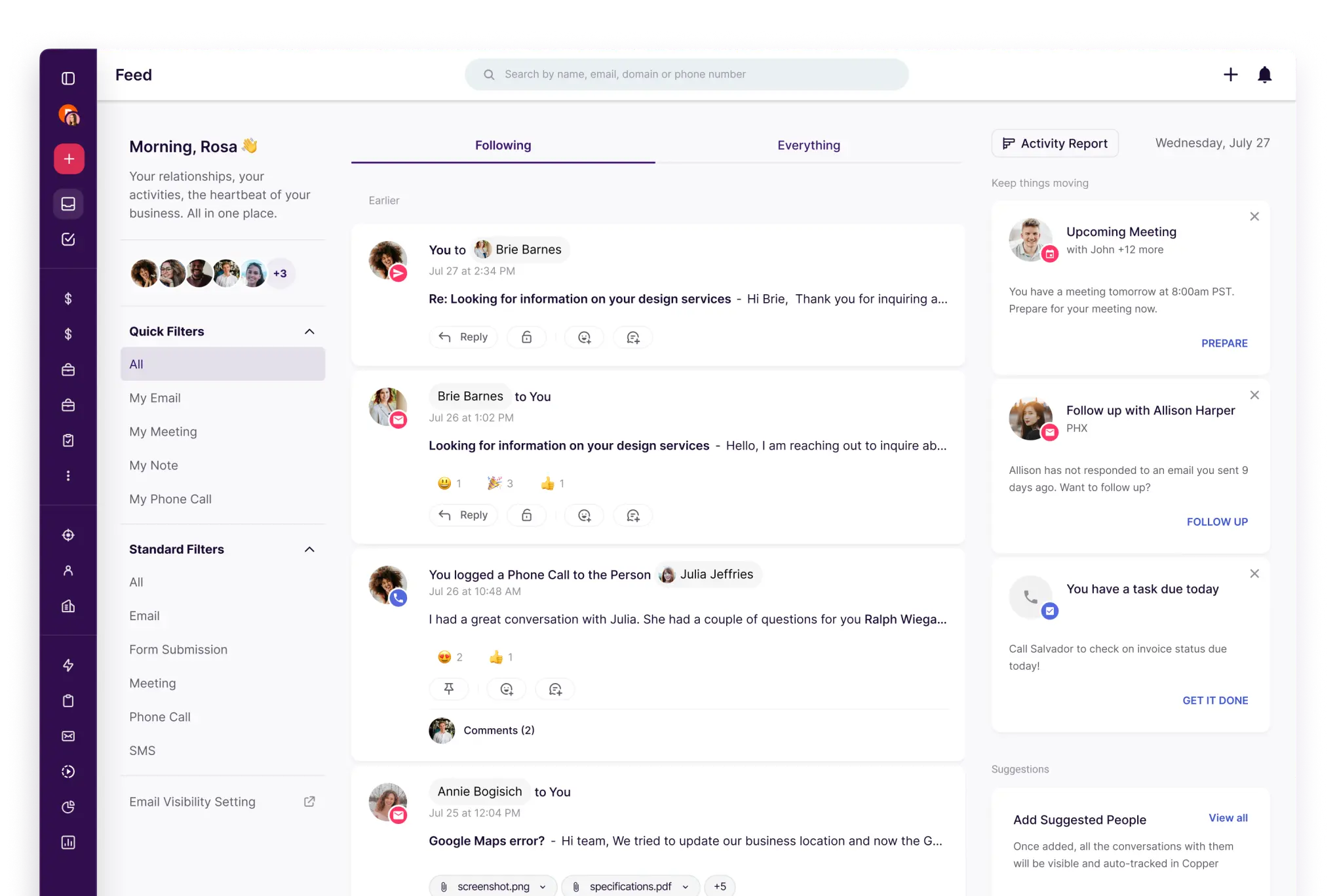
Copper is a CRM solution that seamlessly integrates with Google Workspace, designed to keep your CRM activities close to Gmail and Google Calendar. It's perfect for agencies that conduct the majority of their client communication and scheduling within Google tools, allowing them to maintain their daily habits while benefiting from CRM structure. Pipelines help track opportunities, while contact and account records capture the context of relationships. Depending on the setup, workflow automation and integrations can minimize administrative tasks, making it an excellent fit for teams seeking CRM organization within a Google-centric workflow.
Feature comparison of Salesforce and Copper
Multi-pipeline and custom stages
In Salesforce Sales Cloud, opportunity stages are customizable, allowing organizations to implement various pipelines through Sales Processes and Opportunity Record Types. A Sales Process consists of a filtered list of opportunity stages, while Record Types enable the assignment of different sales processes to specific teams or motions. This functionality allows organizations to maintain distinct stage sets tailored to different services or regions, all while keeping the Opportunity object consistent. Stage probability is integrated into the stage setup, facilitating its use in pipeline views and reporting.
Copper also facilitates the creation of multiple pipelines, accommodating different processes that require unique stage flows. Users can edit pipeline stages to align the opportunity board with how an agency qualifies, scopes, and closes work for each motion. By maintaining separate pipelines for renewals, retainers, and project-based sales, organizations can keep these processes distinct while still leveraging the same CRM data model. Any changes are managed within pipeline settings and apply specifically to the selected pipeline.
Client and Deal Activity Tracking
Salesforce monitors activities through tasks and events that appear on record activity timelines. Email and calendar interactions can be recorded using Einstein Activity Capture, contingent on configuration, permissions, and licensing; these captured items may also show up on related records. Activities can be linked to accounts, contacts, leads, and opportunities, ensuring that deal context encompasses both scheduled and completed actions. The exact functionality may vary depending on the chosen setup and the activity capture mode employed.
Copper maintains deal context directly on the record by integrating with common Google Workspace tools, showcasing related communications and activity details for contacts and opportunities. Calendar synchronization allows for the creation and syncing of events between Copper and Google Calendar, with changes reflecting across both platforms based on the sync feature utilized. Activity and relationship histories can be examined on records to facilitate smooth handoffs and outline next steps for accounts and opportunities.
Automation and Workflows
Salesforce offers robust reporting capabilities through reports and dashboards that can be customized using standard objects such as opportunities and activities. Reporting filters leverage opportunity stage concepts, allowing for effective stage-type analysis, while activity reports provide summaries of both open and completed tasks. Dashboards can integrate multiple report charts, enabling effective pipeline monitoring and sales management, with access governed by organizational permissions and sharing settings. The extent of reporting coverage varies based on enabled objects and the configuration of fields and stages.
Copper Workflow Automation operates on a trigger and action model, allowing for the automatic update or creation of records in response to defined events. Automation recipes exemplify this functionality, such as generating tasks automatically from specific triggers, which helps standardize follow-ups and streamline internal handoffs. The behavior of workflows is contingent on the established trigger conditions and configured actions, functioning according to the account’s automation framework.
Reporting and Analytics
Salesforce offers robust reporting through customizable reports and dashboards based on standard objects, such as opportunities and activities. Reporting filters utilize opportunity stage concepts, while activity reports can provide summaries of both open and completed tasks. Dashboards can integrate multiple report charts for effective pipeline monitoring and sales management, with access governed by organizational permissions and sharing settings. The extent of reporting capabilities is determined by the enabled objects and the configuration of fields and stages.
Copper’s reporting is centered around dashboards, metrics, and configurable insights that can be easily shared or exported, including options for emailing or exporting dashboards as part of reporting workflows. The setup process includes dashboard templates, filters, and editing tools to customize KPIs and views based on the pipeline and activity data being monitored. Additionally, features such as scheduled delivery and alert notifications enhance the reporting experience.
Integrations and Data Hygiene
Integrations for Salesforce are typically added via AppExchange, Salesforce’s marketplace for apps and solutions that enhance the platform. To maintain data hygiene, Salesforce employs matching rules to identify potential duplicates and duplicate rules to determine the actions taken when duplicates are found during record creation or while viewing records. The Salesforce documentation also explains how to use duplicate sets and reports to list duplicates identified by these rules and jobs. These configurations are set up in the Setup menu and applied to each object based on the choices made by the admin.
Copper provides integrations with popular tools, including a Zapier integration that links Copper to a wide range of external apps for automation and data transfer. In terms of data hygiene, Copper features a duplicate management workflow that allows teams to select and merge duplicate People, Companies, or Leads, thereby consolidating records. This ensures that contact history and account context remain associated with a single record when duplicates arise from imports or manual entry.
folk: The Best CRM for Agencies in 2026!
folk is an AI-driven CRM designed to streamline the management of contacts, conversations, and deal context without complicating the setup process. It is tailored for agency teams where multiple members handle the same account throughout prospecting, onboarding, delivery, and renewals. The system maintains a visible history of relationships, ensuring that handoffs do not rely on memory or scattered notes.
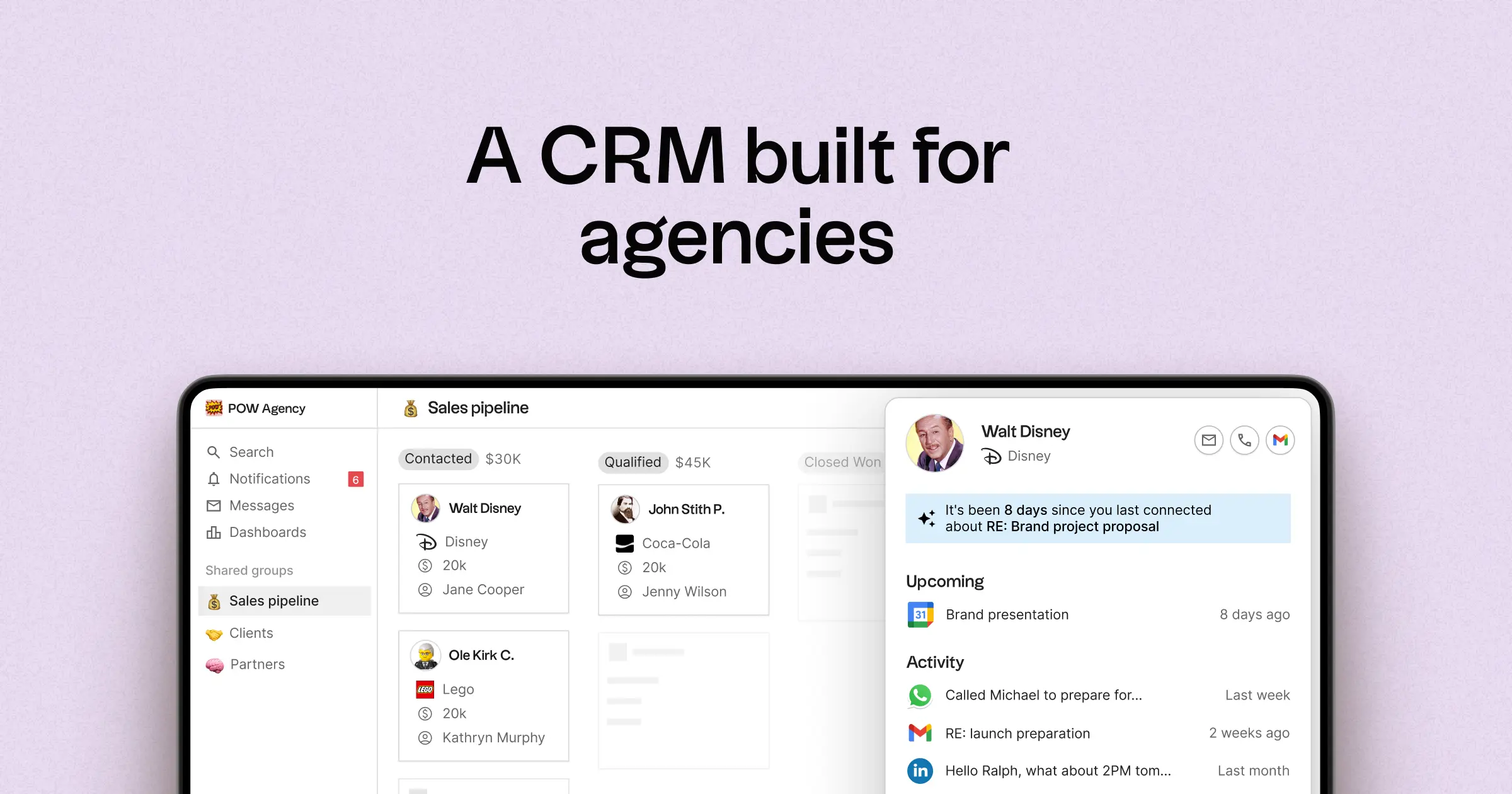
- Multi-pipeline and customizable stages for various agency workflows
- Contact and deal timelines that consolidate interaction history
- Email and calendar sync to link conversations with the appropriate records
- Tasks, reminders, and follow-up tracking to ensure standardized next steps
- Contact enrichment to fill in missing company and individual data
- Deduplication tools to merge duplicates and maintain a clean database
- User-friendly pipeline reporting to track stage health and deal progress
- Integrations and automation connectors to minimize manual updates
For agencies, the primary benefit lies in achieving operational clarity across multiple relationships. Pipelines can represent various revenue streams such as retainers, projects, partnerships, and referrals, while tasks and reminders ensure follow-ups remain consistent across the team. Data hygiene features, including enrichment and deduplication, help eliminate duplicate records and fill in missing fields, keeping pipeline reporting effective over time.
Conclusion
In conclusion, Salesforce excels in customization and scalability for complex operations, while Copper integrates seamlessly with Google Workspace, enhancing daily workflows. However, for agencies prioritizing email integration, automation, and seamless sequencing, folk stands out as the superior option. It offers a user-friendly interface, consolidates communication history, and maintains clean data with deduplication features. For teams that thrive on collaboration and consistency, folk is the best CRM alternative to keep your agency’s operations running smoothly.
Start your 14-day free trial or book a demo today.
Discover folk CRM
Like the sales assistant your team never had