


Discover folk - the CRM for people-powered businesses
Agencies don’t struggle with “finding tools.” They struggle with keeping pipeline execution consistent while delivery stays on track. When prospect context lives across inboxes, calendars, and spreadsheets, follow-ups slip, handoffs break, and forecasting becomes guesswork. A CRM for agencies has to keep new business moving fast while preserving enough account history to support renewals, upsells, and referrals.
Pipedrive and Salesforce solve that problem from two very different angles. Pipedrive focuses on a visual pipeline and activity-based follow-ups, built to keep deals moving with minimal operational overhead. Salesforce is a highly configurable CRM platform designed for complex processes, deeper permissions, and extensive automation and reporting.
The right choice depends on process complexity, required customization, and how much ongoing ownership the agency can dedicate to setup and administration.
What is Pipedrive?
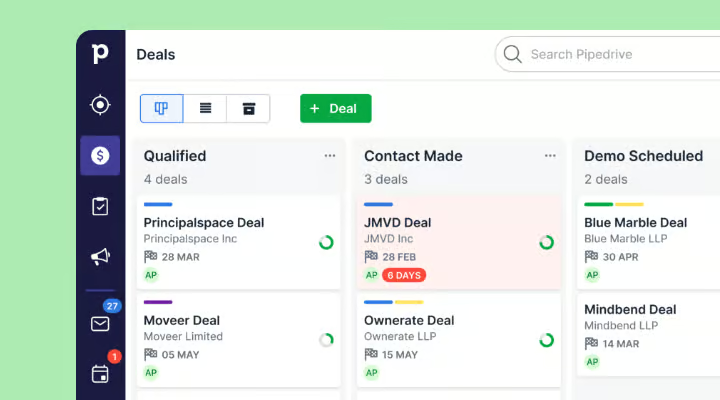
Pipedrive is a sales-focused CRM that revolves around a visual pipeline and activity-driven selling. It is particularly popular among agencies seeking simple deal tracking, well-defined next steps, and minimal process enforcement. Users can maintain multiple pipelines to distinguish between new business, renewals, or partnerships, while scheduled activities ensure follow-ups remain visible. Automations help to alleviate administrative tasks, streamlining repetitive updates and reminders, making it ideal for teams that value swift pipeline execution over a comprehensive suite of features.
What is Salesforce?

Salesforce is an enterprise-level CRM platform designed for extensive customization, intricate data models, and large-scale sales operations. It suits agencies requiring advanced permissions, various business units, or specific processes incorporated into record types and automation. Robust reporting and dashboards facilitate multi-level pipeline management when data is consistently structured. With a wide array of integrations available through AppExchange and custom development, Salesforce is typically favored by agencies that anticipate significant customization, governance, and scalability in the long term.
Feature comparison of Pipedrive and Salesforce
Multi-pipeline and custom stages
Pipedrive allows users to create multiple deal pipelines directly from the pipeline view, with each pipeline featuring its own unique set of stages. You can easily edit stage attributes, including the stage name and probability, as well as add or remove stages as your process evolves. This flexibility enables agencies to categorize their operations—such as new business, renewals, and partnerships—into separate pipelines while ensuring that stage definitions are tailored for each specific process.
In Salesforce Sales Cloud, opportunity stages are set up first, after which different pipelines can be created using Sales Processes and Opportunity Record Types. A Sales Process serves as a filtered list of opportunity stages, while Record Types allow different teams or sales motions to be assigned distinct sales processes. This approach enables organizations to maintain separate stage sets for various services or regions, all while keeping the Opportunity object consistent. Additionally, stage probability is managed during the setup phase and can be utilized in both pipeline views and reporting.
Client and Deal Activity Tracking
In Pipedrive, activities encompass scheduled actions linked to people, organizations, leads, deals, or projects, including calls, meetings, and follow-ups. You can configure calendar sync as either one-way or two-way, ensuring that Pipedrive activities and external calendar events remain aligned. Logged activities are displayed on the relevant records, enabling you to track both past actions and upcoming schedules for an account or deal.
Salesforce monitors activities through tasks and events that appear on record activity timelines. Depending on configuration, permissions, and licensing, email and calendar activities can be captured using Einstein Activity Capture, with these items being displayed on related records. Activities can be associated with accounts, contacts, leads, and opportunities, thus providing context for deals that includes both scheduled and completed actions. The specific behavior may differ based on setup choices and the activity capture mode utilized.
Automation and Workflows
In Pipedrive, reporting is managed through Insights, which features custom reports, dashboards, and goal tracking. Dashboards can be shared with teammates internally, and when permissions permit, public links can be created, allowing stakeholders to view dashboards without needing direct account access. Insights goals monitor progress across deals, activities, and forecasts, depending on the configuration and plan limits.
Salesforce automation is typically built using Flow Builder, which includes record-triggered flows that activate when data changes. Salesforce has announced that support for Workflow Rules and Process Builder will cease on December 31, 2025, urging users to migrate automation to Flow. Although existing processes may continue to operate after this date, Salesforce recommends Flow as the main automation tool moving forward. Automation can facilitate field updates, task creation, record routing, and the enforcement of process logic based on CRM events.
Reporting and Analytics
Pipedrive's reporting is managed via Insights, which offers custom reports, dashboards, and goal tracking. Dashboards can be internally shared with team members, and public links can be generated when permissions permit, allowing stakeholders to view a dashboard without needing a direct account. In Insights, goals monitor progress across deals, activities, and forecasts based on specific configurations and plan limitations.
Salesforce, on the other hand, facilitates reporting through customizable reports and dashboards built on standard objects, such as opportunities and activities. Reporting filters utilize opportunity stage concepts, while activity reports summarize both open and completed tasks. Dashboards can incorporate multiple report charts for effective pipeline monitoring and sales management, with access governed by organizational permissions and sharing settings. The extent of reporting coverage is determined by the enabled objects and the configuration of fields and stages.
Integrations and Data Hygiene
Pipedrive integrations are easily accessible through the Pipedrive Marketplace, allowing users to install various apps and integrations directly within their accounts. To maintain data hygiene, the Merge Duplicates feature identifies potential duplicate contacts and organizations, offering a straightforward workflow to merge these records. Additionally, Pipedrive provides documentation outlining how duplicate identification adheres to rules consistent with its import logic, influencing how duplicates are discovered and suggested for merging.
In contrast, Salesforce integrations are typically added via AppExchange, the dedicated marketplace for apps and solutions that enhance the Salesforce platform. For ensuring data hygiene, Salesforce employs matching rules to recognize potential duplicates and duplicate rules to dictate the actions taken when duplicates are detected during record creation or while viewing records. The Salesforce documentation also details how duplicate sets and reports catalog duplicates identified by these rules. These settings can be configured in Setup and are applied to each object according to the choices made by the admin.
folk: The Best CRM for Agencies in 2026!
folk is an AI-driven CRM crafted to centralize contacts, conversations, and deal context without making setup a cumbersome project. It's ideal for agency teams where multiple members collaborate on the same account through various stages, including prospecting, onboarding, delivery, and renewals. The system maintains a clear relationship history, ensuring that handoffs don’t rely on memory or disorganized notes.
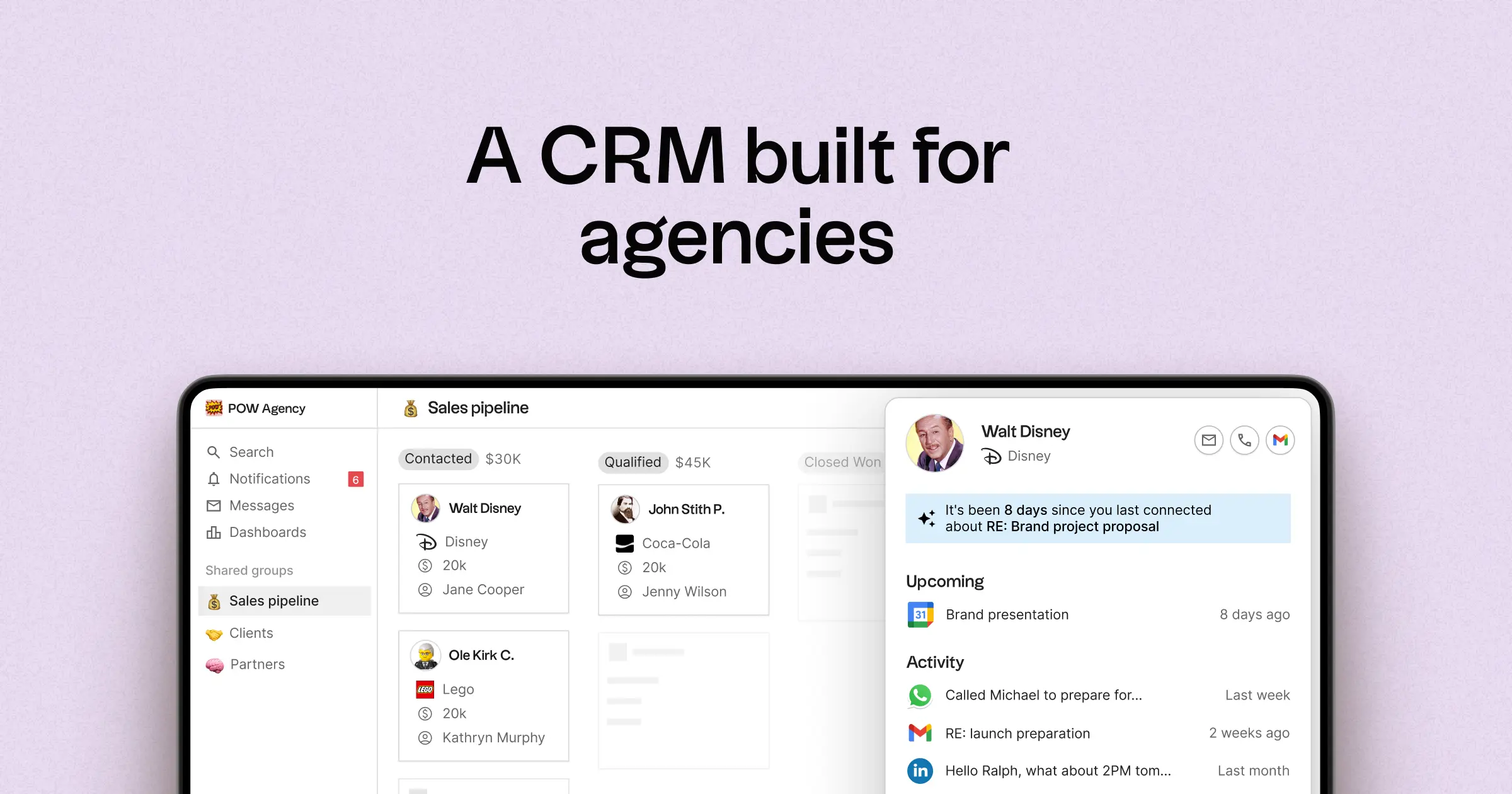
- Multi-pipeline support and customizable stages tailored for different agency workflows
- Contact and deal timelines that compile interaction history in one accessible location
- Email and calendar synchronization for linking conversations to the appropriate records
- Task management, reminders, and follow-up tracking to standardize next steps
- Contact enrichment features to fill in any missing company and contact information
- Deduplication tools to merge duplicates and maintain a clean database
- Simple pipeline reporting to track stage health and deal progression
- Integrations and automation connectors to minimize manual updates
- folk mobile app to manage contacts and follow-ups on the go
For agencies, the key benefit lies in achieving operational clarity across simultaneous relationships. Pipelines can represent various revenue streams such as retainers, projects, partnerships, and referrals, while tasks and reminders ensure consistent follow-ups among team members. Data hygiene functionalities like enrichment and deduplication help eliminate duplicate records and fill in gaps, keeping pipeline reporting reliable over time.
Conclusion
In summary, Pipedrive excels with its visual pipeline and straightforward deal tracking, ideal for teams focused on swift execution. Salesforce offers extensive customization and robust reporting, catering to complex agency needs. However, for teams that prioritize email integration, automation, and seamless sequencing, folk emerges as the superior choice. Its simplicity in managing multiple pipelines, coupled with powerful contact management and data hygiene features, ensures that agencies maintain operational clarity while fostering strong relationships effectively.
Start your 14-day free trial or book a demo today.
Discover folk CRM
Like the sales assistant your team never had