


Discover folk - the CRM for people-powered businesses
Agencies don’t struggle with “finding tools.” They struggle with keeping pipeline execution consistent while delivery stays on track. In a fast-paced environment where client interactions are scattered across various platforms—emails, calls, and project management tools—the risk of missed follow-ups, broken handoffs, and inaccurate forecasting looms large. A CRM for agencies must ensure that new business flows smoothly while maintaining a comprehensive account history to facilitate renewals, upsells, and referrals.
HubSpot and Close tackle this challenge from distinct perspectives. HubSpot is a versatile CRM platform that integrates sales, marketing, and service tools to create a cohesive ecosystem for agencies. In contrast, Close is specifically designed for high-intensity outbound sales, combining calling, emailing, and task management into one streamlined workflow. Each platform has its unique strengths, catering to different operational needs and strategies.
The right choice hinges on your agency's operational complexity, the level of customization required, and the resources available for ongoing setup and administration.
What is HubSpot?
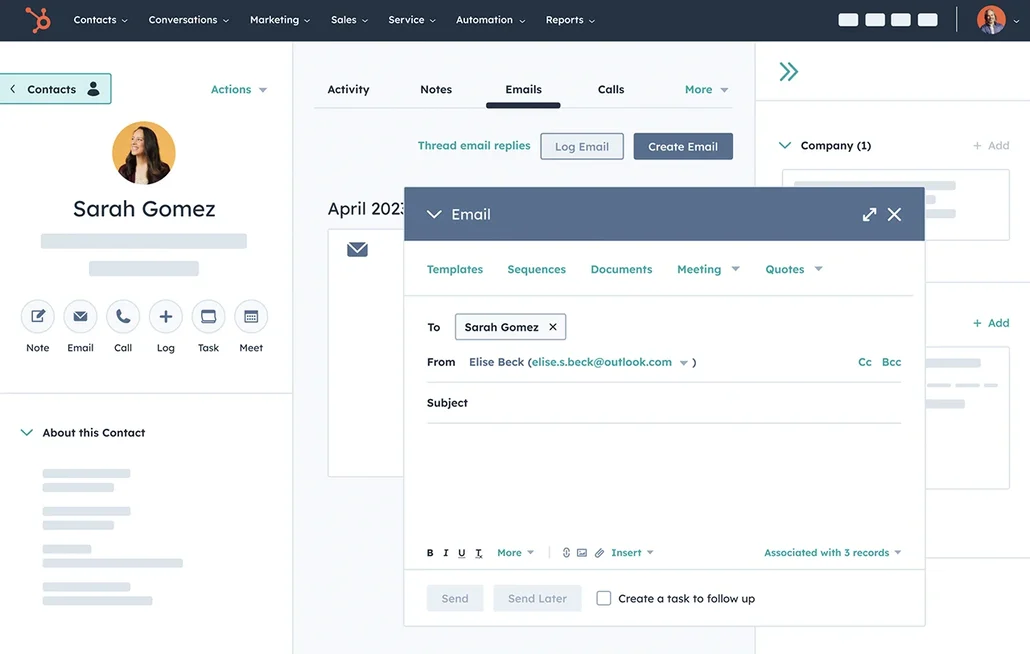
HubSpot is a comprehensive CRM platform that integrates sales tools with marketing and service features within a single ecosystem. It is particularly beneficial for agencies requiring pipeline tracking, lead capture, email campaigns, and lifecycle reporting all in one location. Teams can customize pipelines, log activities, and automate follow-up processes using workflows based on their subscription plan. Additionally, the app marketplace is designed to support commonly used agency tools and client-facing systems, making it an ideal choice for agencies that want both CRM and related go-to-market solutions from a single vendor.
What is Close?

Close is a sales CRM specifically designed for outbound execution, seamlessly integrating calling, email, SMS, and tasks into the daily workflow. It is well-suited for agencies that focus on high-volume prospecting, appointment setting, or sales development as core services. Pipelines and opportunity statuses monitor progress while maintaining a detailed communication history with each lead. Sequences and automations facilitate consistent outreach and follow-up routines, making it ideal for agencies where success hinges on sustained outbound activities and rapid iteration.
Feature comparison of HubSpot and Close
Multi-pipeline and custom stages
HubSpot allows for the creation and management of deal pipelines centered around specific stages, which can be customized in the pipeline settings. As deals progress, they move through these defined stages, and you can edit the stage definitions to align with how your agency qualifies and closes work. You can establish separate pipelines to monitor various processes, such as new business versus renewals or different service lines, while ensuring that each pipeline's stages remain distinct.
In Close, you can create multiple pipelines tailored for different teams or processes, each featuring its own name and set of opportunity statuses that serve as the stage framework. This flexibility enables you to separate activities like new business acquisition, renewals, and service delivery tracking into distinct pipelines without overlapping statuses across all processes. You can easily adjust the pipeline structure by modifying the opportunity statuses pertinent to each specific pipeline.
Client and Deal Activity Tracking
HubSpot efficiently organizes activities on record timelines, allowing users to log and associate calls, emails, meetings, notes, and tasks with contacts, companies, and deals. This activity data can automatically populate properties like the last activity date based on recorded interactions. Users can filter activity timelines, ensuring that related records—such as a deal and its associated contact—share a unified logged context.
In Close, calls, emails, SMS, and tasks are seamlessly integrated into the CRM, linking them directly to relevant leads and opportunities. All communication occurs within the platform, providing teams with easy access to activity history on records to review interactions and plan next steps. This functionality enables effective tracking of sales efforts by logging outreach and follow-ups alongside lead and deal records, while meetings and other touchpoints can be managed within the same workspace, depending on the configuration.
Automation and Workflows
HubSpot offers sales reporting via dashboards, the sales analytics suite, and custom reporting tools. Reports can be saved to dashboards and shared with authorized users. Utilizing the report builder, custom reports can be created to analyze CRM objects and activities, with selection and filtering based on specific reporting needs.
In Close, automation encompasses workflows that initiate actions based on events and objects, such as leads, contacts, and opportunities. Workflows can be activated manually or automatically, and the automation features include email sequences, task reminders, and customizable workflow logic. Triggers may involve lead events like new leads, email engagement, or missed calls, depending on how the workflows are configured. The precise steps and actions are determined by the specific workflow setup within the account.
Reporting and Analytics
HubSpot offers comprehensive sales reporting via dashboards, a sales analytics suite, and custom reporting tools. Users can save reports to dashboards and share them with those who have access. The report builder allows for the creation of custom reports to analyze CRM objects and activities, with options for filtering and selecting datasets tailored to specific reporting needs.
In Close, sales reporting encompasses dashboards and reports that emphasize pipeline health, activity tracking, lead conversion, and sales performance. Reports can be filtered by date ranges and other criteria, while dashboards can be customized to visualize chosen metrics. This reporting system utilizes CRM data as its foundation, meaning that activity and pipeline reporting relies on logged information and the structure of opportunities. Additionally, forecasting and pipeline monitoring are facilitated through the reporting features outlined in Close's materials.
Integrations and Data Hygiene
HubSpot seamlessly connects with external tools through its app marketplace, showcasing integrations tailored for sales, marketing, and operations. To ensure data hygiene, HubSpot offers a suite of data quality tools, including deduplication workflows that help identify and manage duplicates, detect formatting issues, and provide enrichment coverage based on your plan. These capabilities are housed under Data Management and Data Quality, where teams can review issues and implement fixes on records and properties.
In Close, integrations can be established via the API and event-based webhooks, with help documentation also highlighting connections to external apps through platforms like Zapier or Make, using OAuth or API keys. Close's data hygiene features include duplicate detection when creating new leads, options to prevent duplicates during imports, and the capability to merge leads in cases of duplicates. Import workflows incorporate duplicate checks against both the file and existing leads, with merge actions that consolidate records into a single destination lead. Detailed controls are outlined in Close's help resources and product update notes.
folk: The Best CRM for Agencies in 2026!
folk is an AI-driven CRM that streamlines the management of contacts, conversations, and deal context without complicating the setup process. It's tailored for agency teams where multiple members engage with the same account throughout prospecting, onboarding, delivery, and renewals. The system maintains a clear record of relationship history, ensuring that handoffs rely on documented information rather than memory or disorganized notes.
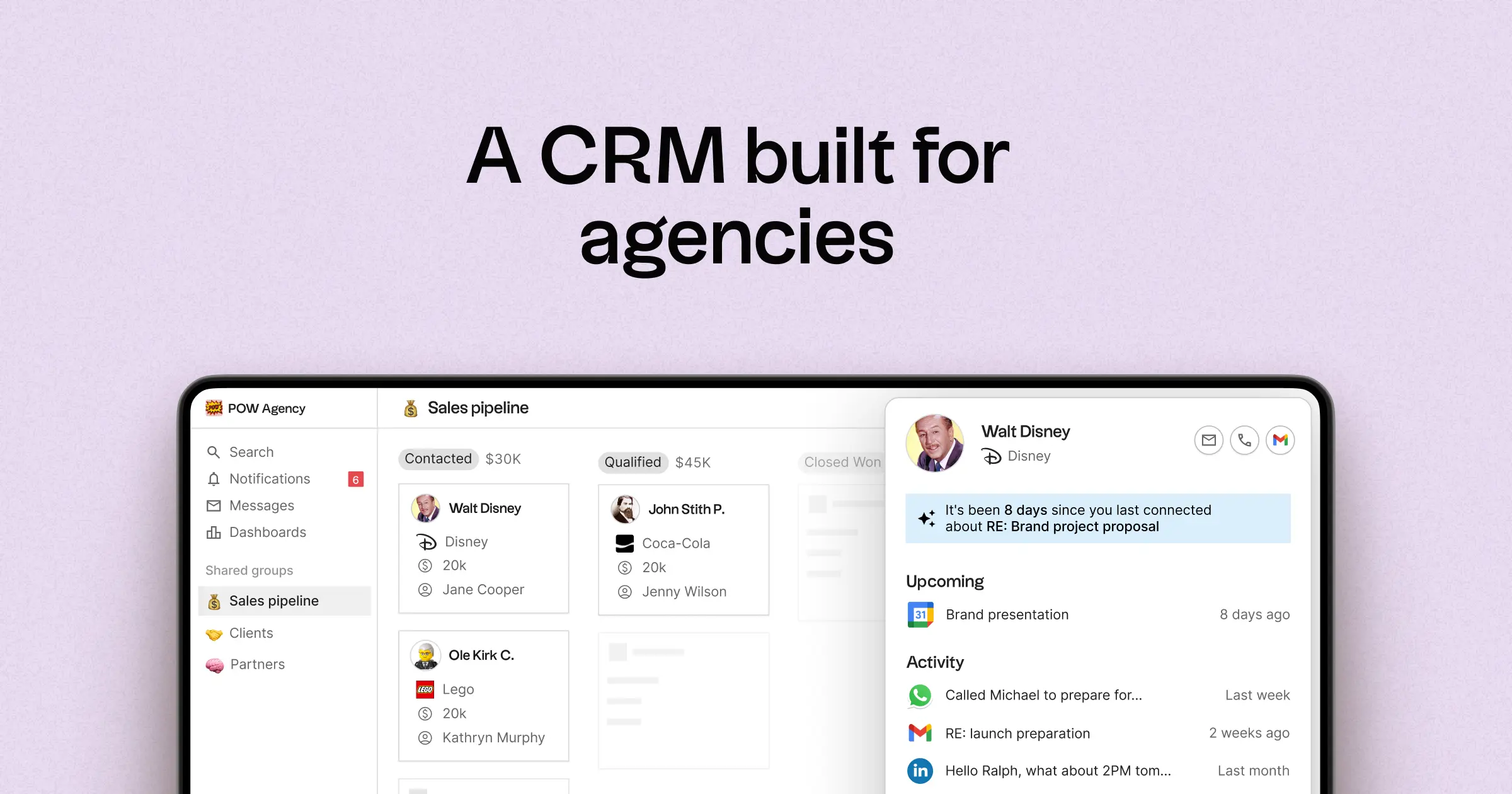
- Multi-pipeline support and custom stages tailored for various agency workflows
- Comprehensive contact and deal timelines that consolidate interaction history
- Email and calendar synchronization to link conversations with the appropriate records
- Task management, reminders, and follow-up tracking to ensure consistent action steps
- Contact enrichment to automatically populate missing company and contact information
- Deduplication tools to merge duplicate entries and maintain a clean database
- User-friendly pipeline reporting to track stage health and deal progression
- Integrations and automation connectors to minimize manual data updates
- folk mobile app for on-the-go contact, task, and pipeline management
For agencies, the primary advantage is operational clarity across multiple relationships. Pipelines can represent various revenue streams such as retainers, projects, partnerships, and referrals, while tasks and reminders ensure consistent follow-ups within the team. Data hygiene features like enrichment and deduplication help eliminate duplicate records and fill in missing fields, keeping pipeline reporting effective over time.
Conclusion
In conclusion, HubSpot excels in delivering an all-in-one ecosystem for agencies needing comprehensive sales, marketing, and service tools, while Close shines in supporting high-volume outbound sales with robust automation and communication features. However, for teams reliant on seamless email integration, automation, and efficient sequencing of tasks, folk emerges as the superior choice. Its focus on relationship management, multi-pipeline capabilities, and clean data practices make it the ideal CRM for agencies seeking operational clarity and consistent follow-up.
Start your 14-day free trial or book a demo today.
Discover folk CRM
Like the sales assistant your team never had