


Discover folk - the CRM for people-powered businesses
Attio vs. Zoho CRM: Features, Pricing, and Best Alternative
When comparing Attio and Zoho CRM, it's important to consider the distinct approaches each platform takes to customer relationship management. Zoho CRM is part of a broader suite of business tools, offering a highly scalable solution with extensive features for sales, marketing, and customer support, making it ideal for growing businesses. Attio, meanwhile, focuses on providing a flexible, customizable CRM with strong data enrichment and AI-powered features, designed to help agile teams streamline workflows and enhance customer insights.
Zoho CRM excels as a comprehensive platform with robust capabilities for sales process management, marketing automation, and customer support integration. Its strength lies in offering a complete business toolkit that extends beyond CRM functionality, making it suitable for organizations seeking an all-in-one solution.
Additionally, folk is a popular alternative for 20–50 people sales teams needing efficient pipeline management without complexity. In this post, we'll explore the core features, customization options, and overall usability of both platforms to help you decide which CRM best fits your sales team.
| Main points |
|---|
|
What is Zoho?
Zoho is a CRM system with a strong sales focus. It has journey orchestration, sales process management, and workflow automation features. There's also something for marketing teams, including event management and customer segmentation.
Key features of Zoho:
- Sales automation: Automates sales tasks like lead management, deal tracking, and follow-up actions.
- Customizable dashboards and reports: Allows users to create and customize dashboards and reports for in-depth analytics.
- Multi-channel communication: Integrates with email, phone, social media, and live chat to manage customer interactions.
- Lead and contact management: Manages customer information, tracks interactions, and segments contacts for targeted campaigns.
- Workflow automation: Automates routine tasks and processes to improve efficiency and reduce manual effort.
What is Attio?
Attio CRM is a customizable platform designed for flexibility in managing customer relationships and workflows. It allows users to create tailored pipelines, manage customer data, and track interactions within an intuitive interface.
Key features of Attio
- Customizable pipelines: Attio allows users to fully customize sales pipelines, creating deal stages that match specific business processes.
- Contact and company management: It centralizes contact and company data, automatically tracking emails, notes, and tasks for a comprehensive view of interactions.
- Workflow automation: Users can automate tasks such as data entry and follow-ups based on specific triggers, improving efficiency.
- Task manager and reminders: Built-in tools help users stay on top of tasks and follow-ups, ensuring important activities are not missed.
Zoho vs. Attio: Feature Comparison
Let's break down the key features of two CRM software solutions and take a closer look at their sales automation, email marketing tools, and contact management.
1. Sales pipeline management
Both platforms offer robust tools for managing sales pipelines, but the choice between them may come down to the level of customization and visualization style preferred by your sales team. Zoho's structured approach is ideal for those who prefer a straightforward system, while Attio's adaptability is suited for teams that require more personalized workflows.
Zoho CRM's pipeline management feature provides a visual overview of the sales process, allowing users to track deals at various stages and manage the flow of opportunities effectively. This functionality is particularly beneficial for sales teams looking to streamline their workflows and prioritize tasks based on deal progression. On the other hand, Attio's pipeline management system is highly customizable, allowing users to create tailored stages that reflect their specific sales processes. The system supports a Kanban-style view for visualizing deal progression and includes automation triggers at each stage to enhance productivity. This flexibility makes Attio a strong choice for businesses seeking a CRM that can adapt to their unique sales methodologies.


2. Ease of use
Zoho CRM offers a user-friendly interface with customizable dashboards and intuitive navigation, making it accessible for users of all experience levels. Attio also emphasizes ease of use with its sleek design and straightforward functionality, allowing teams to quickly adapt and manage customer relationships effectively.
3. Contact enrichment
Zoho CRM's contact enrichment feature, powered by its AI assistant Zia, automatically updates and enriches records using data from various online sources. The feature can fill in missing details, such as email addresses, phone numbers, company information, and social media profiles. Attio has automated the contact enrichment process.
4. Outreach
Zoho CRM supports multichannel outreach, enabling businesses to connect with leads through email, social media, and other platforms. The platform automates workflows such as lead assignment and follow-up reminders, while AI-driven sentiment analysis helps prioritize customer responses for timely engagement. Attio has an Outreach integration that allows users to trigger responses to email sequences. You can also connect your inbox to Attio to send messages directly from the platform.
👉🏼 Try folk now to automate multi-step email sequences from your CRM and never miss a follow-up.
5. Automation
Zoho CRM provides comprehensive automation features that streamline tasks like sending emails, updating fields, and triggering alerts through workflow automation. It includes Blueprint for standardizing sales processes, Macros for automating repetitive tasks in bulk, and Zia AI for predictive automation that suggests workflows and actions based on data patterns. Attio's automation feature allows users to streamline workflows by automating routine tasks such as data entry, follow-ups, and triggering actions based on customer interactions or deal stages, helping teams save time and improve efficiency.
6. Integration
Zoho integrates with a wide range of third-party applications to expand its functionality, including popular tools like Google Workspace and Microsoft Office. It also connects with accounting software such as QuickBooks and more.
7. Artificial Intelligence
Zoho CRM integrates AI through its assistant, Zia, which enhances productivity by automating tasks like data entry, lead prediction, and workflow recommendations. Zia provides predictive analytics for sales forecasting, identifies anomalies in sales processes, and suggests the best times for customer engagement based on past interactions. Attio CRM integrates AI to enhance multiple areas of customer relationship management. Its AI features allow users to automate complex tasks, such as classifying unstructured data, generating summaries, and qualifying leads.
Price and plans comparison
Let's take a closer look at the price and plans of both Zoho and Attio.
Zoho prices
Zoho offers a free plan limited to three users suitable for small businesses. After that, an annual subscription plan is as follows.
- Standard: $14 per user, per month.
- Professional: $23 per user, per month.
- Enterprise: $40 per user, per month.

Attio prices
Attio has a free plan limited to three seats per month. After that, an annual subscription is as follows.
- Plus: $34/seat/month.
- Pro: $69/seat/month.
- Enterprise: $119/seat/month.

Introducing folk CRM: the best alternative to Zoho and Attio
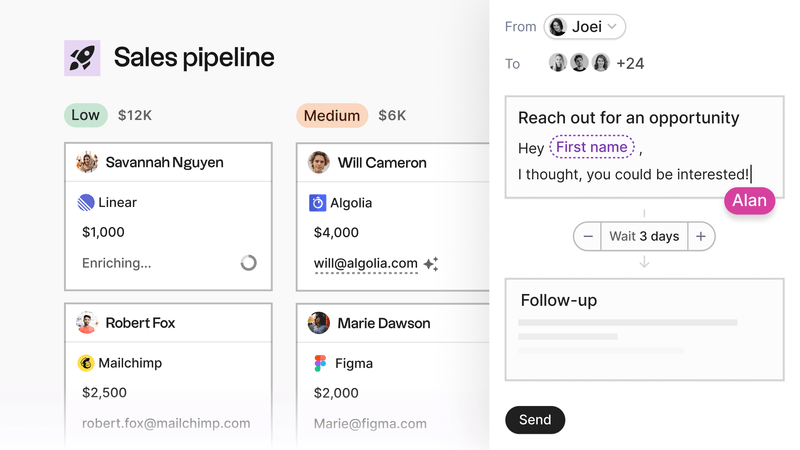
Looking for an affordable alternative? For sales teams of 20-50 people evaluating CRMs, folk CRM stands out as the superior choice, offering the perfect balance of functionality and simplicity that growing sales organizations need. There is a reason why folk is a multiple award-winning CRM platform loved for its easy-to-use, plug-and-play CRM system.

Key features
- Ease of use and customization: Easily customize the pipelines, dashboards, automation, email sequences, so that you can use it across your sales cycle and pipeline management – and other business functions such as recruitment, marketing, and more.
- Social media integration: Import people and companies from LinkedIn, Sales Navigator, Instagram, and X within a click thanks to folk's Google Chrome extension.
- Contact sync from Gmail and Outlook: Full email sync enabling users to manage all communications directly from the CRM.
- Find email addresses in a click: Contact enrichment powered by Apollo, and Dropcontact so you can fill in missing data points with 1-click.
- Email sequences: Send email sequences with reminders if your leads don't reply to your first emails. It includes an AI integration allowing you to personalize email at scale.
Price and plans
folk has a 14-day free trial. After that, there are affordable monthly or annual subscription plans. The annual subscription plan is as follows.
- Standard: $20 per user, per month.
- Premium: $40 per user, per month.
- Custom: Starts from $80 per user, per month.

Zoho vs. Attio: What's the verdict?
Zoho and Attio both offer robust CRM solutions, each with unique strengths. Zoho excels with its comprehensive suite of features, ideal for businesses seeking a well-rounded CRM with strong sales and marketing capabilities. Attio, on the other hand, provides a more streamlined, user-friendly experience, perfect for teams focused on simplicity and efficiency. However, for sales teams of 20-50 people that need a more personalized approach to relationship management, folk CRM emerges as the best solution, providing the optimal combination of flexibility, affordability, and powerful features specifically designed for medium-sized sales organizations.
👉🏼 Try folk now to set up a customizable pipeline with contact enrichment in minutes as an alternative to Zoho and Attio.
FAQ
Zoho vs Attio: what is the key difference?
Zoho is an all-in-one CRM in a wider business suite, with broad sales, marketing, and support tools. Attio focuses on flexible, highly customizable pipelines with built-in enrichment and AI. Pick Zoho for suite breadth; choose Attio for tailored workflows.
How much do Zoho CRM and Attio cost?
Zoho: free for up to 3 users; Standard $14, Professional $23, Enterprise $40 per user/month (annual). Attio: free for 3 seats; Plus $34, Pro $69, Enterprise $119 per seat/month (annual). Pricing may change by region or plan.
Which is easier for small teams?
Both are user-friendly. Zoho offers structured dashboards and guided processes. Attio provides a sleek UI and flexible stages that fit unique workflows. For plug-and-play pipelines with enrichment and email sequences, folk can be simpler.
What is a good alternative to Zoho and Attio?
folk CRM offers customizable pipelines, contact enrichment, email sequences, and automation. Annual pricing: Standard $20/user/month, Premium $40, Custom from $80. 14-day free trial available at folk.
Discover folk CRM
Like the sales assistant your team never had