


Discover folk - the CRM for people-powered businesses
| Main points |
|---|
|
CRM guide for insurance teams
As an insurer, organizing client policies, tracking renewals, and handling claims efficiently are key to providing great service and growing your business. A dedicated Customer Relationship Management (CRM) system can help streamline these processes by organizing client data, automating policy renewals, tracking claims, and ensuring timely follow-ups. For mid-sized insurance teams, the right CRM will enhance your ability to serve clients, improve internal workflows, and drive growth without overwhelming your team with unnecessary complexity.
In this blog post, we'll explore the best CRM options for insurance teams, focusing on tools that will help you manage client relationships and business operations more effectively at your scale.
Why you need a CRM
A CRM system is essential for managing insurance operations efficiently and effectively in teams of 20-50 people. It streamlines operations and supports collaborative efforts across your growing organization.
Challenges without a CRM
If you're running an insurance team without a CRM, you might already be facing these challenges without realising how much productivity it costs your growing organization.
- Disorganization: Manual processes across multiple team members lead to scattered data and inefficiencies that multiply with team size.
- Missed opportunities: Lack of coordinated follow-ups across your team can result in lost business and duplicated efforts.
- Inefficient processes: Redundant tasks consume valuable time and resources that could be better allocated across your team.
- Lack of insight: Inadequate data analysis hampers strategic decision-making for mid-sized insurance operations.
- Inconsistent communication: Poor coordination among team members and with clients affects relationships and professional image.
Benefits of a CRM
Having the right CRM in your tech stack can have direct benefits for insurance teams.
- Centralized information: All client and policy data is stored in one place, making it easily accessible to your entire team.
- Enhanced efficiency: Automation of repetitive tasks saves time and reduces errors across your mid-sized organization.
- Improved customer relationships: Better tracking of client interactions leads to higher satisfaction and retention rates.
- Better decision-making: Data analytics provide insights for strategic planning suitable for growing insurance operations.
- Increased sales: Effective follow-ups and lead management boost conversions across your team of agents.
- Consistent communication: Streamlined communication ensures all team members are on the same page.
How to evaluate and choose a CRM platform
Whether you're considering a CRM for the first time, or looking to replace an existing platform for your growing insurance team – below are some useful pointers for you to consider as part of your decision making process.
1. Define your requirements
What do you want your new CRM platform to focus on for your insurance team? Sales management? Building client relationships? Policy tracking? Being clear on the goal behind why you want to invest in one will help you align your search with better options suited for mid-sized insurance operations. Consider starting with understanding the key features of a CRM and reviewing which one is a higher priority for your team size.
Key features of a CRM for insurers
- Automated processes: Streamlines tasks by automating repetitive workflows across your team.
- Contact enrichment: Automatically finds client email addresses and contact information, enhancing efficiency for mid-sized insurance teams.
- Structured pipeline: Tracks prospects and clients through defined stages, ensuring process clarity and effectiveness across your team.
- Email sequences: Increases communication efficiency with follow-up templates and automated sequences suitable for insurance teams.
- LinkedIn connection: Seamlessly imports leads and clients from LinkedIn and tracks conversations within the CRM to leverage your team's network.
- Reporting & forecasting: Provides essential data analysis and predictive insights for better planning in growing insurance operations.
2. Budget considerations
When selecting a CRM for your insurance team, it's important to balance cost with the potential return on investment. While some CRM platforms may have higher upfront costs, they could offer significant long-term savings through improved efficiency and customer retention. For mid-sized teams, evaluate the total cost of ownership, including subscription fees, training, and support.
3. Selection process
Start by researching CRM vendors that specialize in solutions for mid-sized insurance teams. Look for those with a proven track record serving teams of 20-50 people and positive customer reviews from similar-sized organizations. Request demos and gather information on their support services, data security measures, and customization options suitable for growing insurance businesses. A structured approach will help you shortlist the most suitable vendors for your team size.
4. Get a demo
Once you have a shortlist of CRM platforms, arrange for trials or pilot programs with key stakeholders from your team. This allows you to compare their functionalities in real-world scenarios relevant to mid-sized insurance operations. Engage department heads and key team members in the evaluation process to ensure the chosen CRM aligns with your business needs and team structure. Consider factors such as ease of use, scalability for your current team size, and the quality of customer support before making a final decision. To get started, schedule a demo with folk and see how it can transform your customer relationship management for teams of 20-50 people.
👉🏼 Try folk now to manage contact-based reminders with your team
3 tips for implementing a CRM
It's always exciting introducing a new platform to your tech stack. Below are our top tips to make the most of the implementation of your new CRM so your 20-50 person insurance team can feel supported at every step of the way.
1. Import your data in your new CRM
Transitioning to a new CRM is seamless if you start by importing your existing client and policy data. Most CRMs support CSV file imports, making it easy to migrate your data. Proper data migration ensures that your entire 20-50 person team can hit the ground running with the new CRM without losing valuable client information.
2. Create your first pipeline
Creating a pipeline tailored to your mid-sized insurance business is a critical step. Define the stages that reflect your sales and client management process, such as lead generation, quoting, underwriting, policy issuance, and renewal follow-up. Customizing these stages to fit your team's workflow will help you manage and track customer interactions more effectively across your organization, ultimately leading to higher conversion rates and better customer satisfaction.
3. Onboard your team
Once your CRM is set up, it's essential to onboard your 20-50 person team effectively. Provide comprehensive training sessions to ensure that everyone understands how to use the new system. Focus on key functionalities like managing customer data, tracking sales pipelines, and generating reports relevant to insurance operations. Regularly gather feedback from team members and offer ongoing support to address any challenges your growing organization might face. Proper onboarding will maximize the CRM's benefits and drive your mid-sized insurance business towards greater efficiency and success.
The 5 best CRMs for insurers
1. folk
folk is a modern CRM platform perfect for insurance teams, offering customizable pipelines, AI-driven tools, and integrations designed to enhance client management and prospecting without overwhelming mid-sized teams.

Key features
- Contact enrichment: Automatically enriches contact details by finding emails and LinkedIn URLs, enabling efficient outreach for insurance teams without manual data entry or additional costs for email services.
- LinkedIn integration: Seamlessly import contacts from LinkedIn, track conversations within folk, and use templates for quicker, streamlined communication perfect for insurance networking.
- Mail merge and email sequences: Full email sync, templates, and tracking features, enabling insurance teams to manage all client communications directly from the CRM.
- AI-powered features: AI tools assist in managing client relationships, automating routine insurance tasks, and suggesting actions to improve productivity for teams of 20-50 people.
- Integrations: folk offers an open API and native integrations (e.g., Kaspr, Allo, Salesforge, PandaDoc), and also connects via Zapier and Make to 6,000+ apps to centralize workflows and reduce manual data entry.
- Mobile app: Use the folk mobile app to manage contacts, reminders, and pipelines on the go.

Pros
- Ease of use: folk is praised for its intuitive interface, making it accessible to all team members in a 20-50 person insurance organization with quick onboarding and minimal learning curve.
- All-in-one: folk streamlines your insurance workflow by allowing you to import prospects from LinkedIn, automatically find their emails, reach out through customizable email sequences, and track interactions in a pipeline, eliminating the need for multiple tools and saving time and money for mid-sized teams.
- Social media integration: Seamlessly import contacts from multiple social media channels including LinkedIn, Instagram, X and more to track all your client information within folk, perfect for insurance networking and referrals.
- Customizability: Custom fields, pipelines, and workflows designed to adapt to growing insurance teams of 20-50 people.
- Integrations: folk provides an open API plus native integrations such as Kaspr, Allo, Salesforge, and PandaDoc, alongside Zapier and Make to connect with 6,000+ tools—giving teams flexible options to integrate their stack.
Cons
- Reporting: folk provides advanced analytics including pipeline and stage analytics, revenue forecasting with weighted probabilities, performance breakdowns by owner, channel, industry, region, or any custom field, and revenue insights for managers and teams.
Price and plans
You can try folk for free with a 14-day free trial. For teams of 20-50 people, the pricing structure offers excellent value with monthly or annual subscription plans as follows.
- Standard: $20 per user, per month - ideal for insurance teams getting started.
- Premium: $40 per user, per month - perfect for growing insurance teams of 20-50 people.
- Custom: Starts from $60 per user, per month - designed for larger operations requiring advanced features.
2. HubSpot
Hubspot CRM is a comprehensive platform offering integrated tools for managing sales, marketing, customer service, and operations, though it can be complex for mid-sized insurance teams.

Key features
- Marketing Hub: Includes email marketing, ad tracking, landing pages, and lead generation tools, useful for insurers but can be overwhelming for teams of 20-50 people.
- Sales Hub: Provides deal tracking, pipeline management, sales automation, and reporting, helping insurance teams manage customer relationships though with a steep learning curve.
- Service Hub: Offers customer service tools like ticketing, live chat, and knowledge bases, comprehensive but potentially excessive for mid-sized insurance teams.
- Operations Hub: Syncs and automates business processes across different systems, complex to implement for growing insurance companies.
- Lead scoring: Prioritize leads with predictive scoring, though implementation requires significant setup time for mid-sized teams.

Pros
- User-friendly interface: The intuitive interface makes it accessible for insurance teams, though initial setup can be complex.
- Comprehensive free plan: The free version includes essential CRM features, though limitations become apparent quickly for growing teams.
- Seamless integration with marketing tools: Integrates well with marketing, sales, and service hubs, though this creates complexity for teams primarily focused on insurance sales.
- Automation capabilities: Offers automation tools for lead nurturing and sales workflows, though requires significant configuration time.
- Customizable dashboard and reports: Allows insurance companies to create dashboards and reports, though setup complexity can be challenging for mid-sized teams.
Cons
- High cost at higher tiers: Pricing becomes expensive quickly, making it cost-prohibitive for teams of 20-50 people who need advanced features.
- Limited customization in free plan: The free plan has significant restrictions that limit effectiveness for growing insurance teams.
- Complexity in advanced features: Advanced features have a steep learning curve requiring extensive training for team members.
- Email marketing limits: Email marketing functionality has significant restrictions that can hinder insurance team communications.
- Additional costs for add-ons: Many useful features come as paid add-ons, significantly increasing costs for teams of 20-50 people.
Price and plans
Prices and plans on the CRM suite for an annual subscription are as follows.
- Starter: $15 per user, per month.
- Professional: $450 per user, per month.
- Enterprise: $1,500 per user, per month.
3. Salesforce
Salesforce is a comprehensive CRM platform designed for large enterprises, offering extensive tools but often overwhelming and expensive for insurance teams of 20-50 people.

Key features
- Customization and scalability: Salesforce is highly customizable and scalable, though this complexity often exceeds the needs of insurance teams of 20-50 people.
- Artificial Intelligence (AI) integration: Salesforce Einstein offers AI-driven analytics, though implementation requires significant expertise and resources.
- Extensive integration capabilities: With Salesforce's AppExchange, extensive third-party integration options exist, though this creates complexity for mid-sized teams.
- Enterprise-grade security and compliance: Salesforce provides robust security measures, though this comes with enterprise-level complexity and costs.
- Comprehensive ecosystem: A unified platform offering CRM, marketing automation, customer service, and custom app development, though this breadth can overwhelm teams of 20-50 people.

Pros
- Comprehensive feature set: Salesforce offers extensive features, though many exceed the requirements of mid-sized insurance teams.
- Highly customizable: Salesforce allows extensive customization, though this requires significant technical expertise and time investment.
- Extensive integration capabilities: Salesforce integrates with numerous third-party applications, though managing these integrations can be complex for smaller teams.
- Scalability: Salesforce scales well for large enterprises, though this scalability comes with complexity unsuitable for teams of 20-50 people.
- Advanced analytics and reporting: Salesforce provides powerful analytics, though accessing these features requires extensive training and setup.
Cons
- High cost: Salesforce can be prohibitively expensive for insurance teams of 20-50 people, especially when advanced features are needed.
- Steep learning curve: The platform's complexity requires extensive training, making it challenging for mid-sized teams to implement quickly.
- Complex setup and customization: Initial setup often requires expert consultants, significantly increasing implementation costs for growing insurance companies.
- Overwhelming for small teams: Salesforce's robust features are often overkill for teams of 20-50 people, leading to underutilization and complexity.
- Expensive custom development: Custom development requires specialized skills and resources, making it cost-prohibitive for mid-sized insurance businesses.
Price and plans
- Starter Suite: $25/user/month provides basic CRM features for small businesses.
- Pro Suite: $100/user/month includes advanced tools for growing businesses.
- Enterprise Plan: $165/user/month offers extensive customization and automation for large companies.
- Unlimited Plan: $330/user/month provides comprehensive features for large enterprises.
- Einstein 1 Sales: $500/user/month provides AI-driven insights and advanced features for large enterprises.
4. Zoho
Zoho is a CRM system with sales and marketing features including lead management and workflow automation, though it can be complex for teams of 20-50 people to set up and optimize effectively.

Key features
- Sales automation: Automates sales tasks like lead management and deal tracking, though setup complexity can challenge mid-sized insurance teams.
- Lead and contact management: Manages customer information and tracks interactions, though the interface can be overwhelming for teams new to CRM systems.
- Customizable dashboards and reports: Allows dashboard customization for analytics, though configuration requires significant technical knowledge.
- Workflow automation: Automates routine tasks and processes, though initial setup can be time-consuming for insurance teams of 20-50 people.
- Multi-channel communication: Integrates with email, phone, social media, and live chat, though managing all channels can become complex for smaller teams.

Pros
- Affordability: Zoho CRM offers competitive pricing, though additional features and modules quickly increase costs for growing teams.
- Customization: Extensive customization options allow tailoring, though this flexibility can overwhelm insurance teams without technical expertise.
- Integration with Zoho Suite: Integrates well with other Zoho products, though this creates dependency on a single ecosystem.
- Multi-channel communication: Supports various communication channels, though managing multiple channels can be complex for mid-sized teams.
- AI-powered features: Zia provides AI insights, though accessing advanced AI features requires higher-tier plans.
Cons
- Steep learning curve: Extensive customization options can overwhelm teams of 20-50 people, requiring significant training time.
- Complex setup: Initial setup and configuration can be challenging for insurance teams without dedicated IT resources.
- User interface: The interface can feel outdated and cluttered compared to modern CRM platforms designed for ease of use.
- Performance issues: Users report slow performance with large datasets, which can hinder productivity for growing insurance teams.
- Limited third-party integrations: Integration with non-Zoho applications can be limited, restricting flexibility for insurance teams using diverse tools.
Price and plans
Zoho's free plan is limited to three users. After that, an annual subscription plan is as follows.
- Standard: $20 per user, per month.
- Professional: $35 per user, per month.
- Enterprise: $50 per user, per month.
5. Capsule CRM
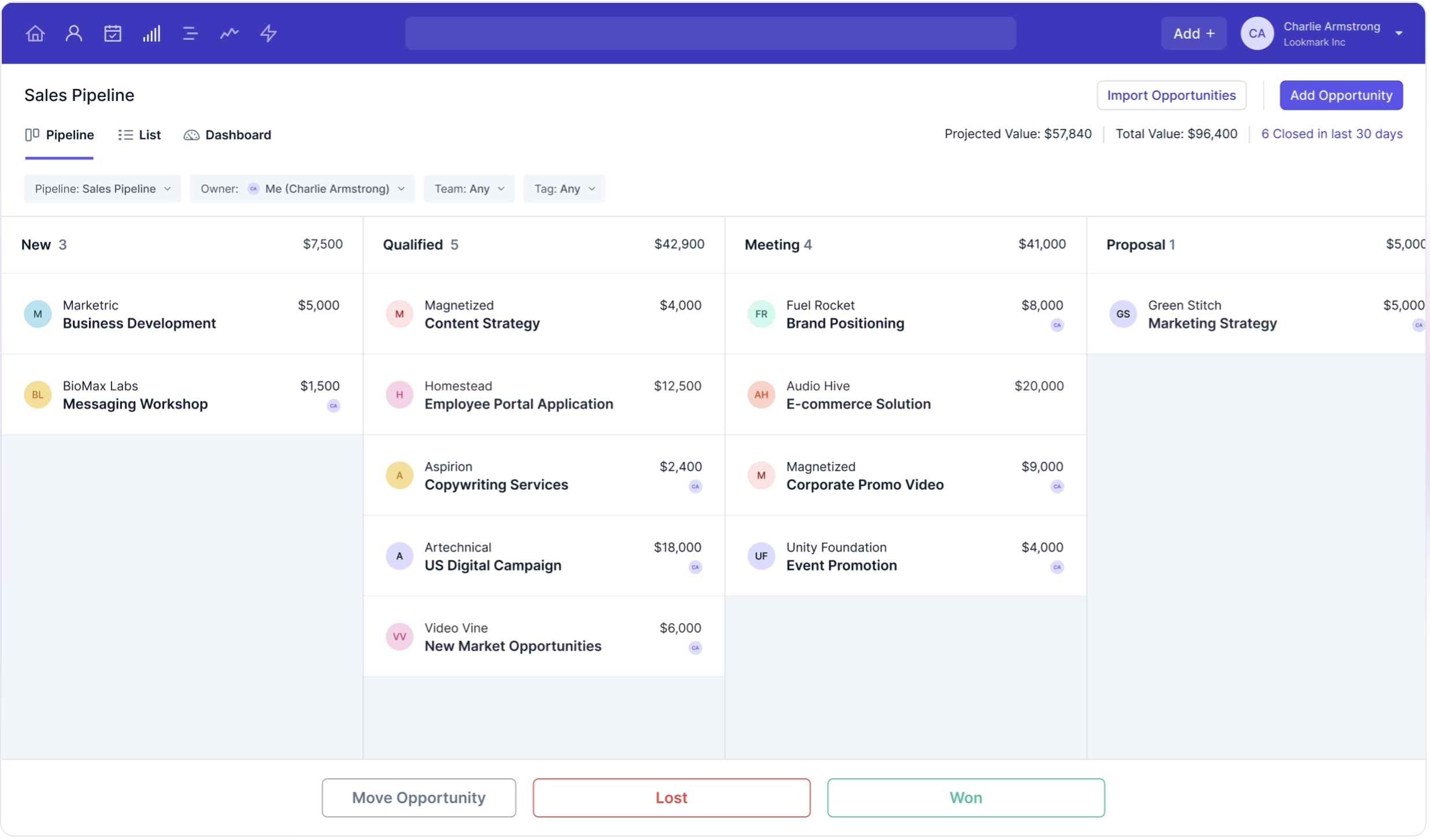
Capsule CRM is a straightforward customer relationship management platform designed for small and medium-sized businesses, offering a clean interface though with limited features for growing insurance teams of 20-50 people.
Key features
- 30,000 contacts: Manages a large database of leads and clients, suitable for insurance teams though contact management features are basic.
- Activity reporting: Tracks customer interactions and sales activities, though reporting capabilities are limited compared to more robust platforms.
- Customer milestone tracking: Monitors key events in the customer lifecycle, though customization options are restricted.
- Workflow automation: Automates some repetitive tasks, though automation capabilities are basic for growing insurance operations.
- Key integrations: Integrates with essential tools like G Suite and Microsoft 365, though integration options are limited compared to other platforms.

Pros
- User-friendly interface: Capsule CRM offers a clean design, making it accessible for insurance teams, though functionality is limited.
- Contact and sales management: Provides basic tools for managing leads and clients, though advanced features are lacking.
- Customization options: Allows some customization of fields and pipelines, though options are limited compared to more flexible platforms.
- Integration capabilities: Integrates with some popular applications, though the ecosystem is smaller than competitors.
- Affordability: Competitive pricing with a free plan, though advanced features require higher-tier plans that can become expensive.
Cons
- Limited advanced features: Lacks sophisticated analytics and complex reporting necessary for growing insurance operations with 20-50 team members.
- Basic email marketing capabilities: Built-in email marketing features are basic, requiring third-party tools for comprehensive communication needs.
- Limited customer support: Primarily offers email support, which may be insufficient for teams needing immediate assistance during business hours.
- No built-in phone or SMS integration: Lacks communication functionality essential for insurance teams maintaining client relationships.
- Scalability concerns: Limited features and customization options make it less suitable for rapidly growing insurance teams.
Price and plans
- Starter plan: Starts from $21 per user, per month.
- Growth plan: Starts from $38 per user, per month.
- Advanced plan: Starts from $60 per user, per month.
- Ultimate plan: Starts from $75 per user, per month.
Conclusion
Choosing the best CRM for insurance teams of 20-50 people is a critical decision that can significantly impact your business's efficiency and customer satisfaction. After evaluating each platform, folk CRM emerges as the clear winner for mid-sized insurance teams. While Hubspot, Salesforce, and Zoho offer comprehensive solutions, they often bring unnecessary complexity and high costs that can overwhelm teams of your size. Capsule, while simple, lacks the advanced features growing insurance operations require. Folk CRM strikes the perfect balance—offering powerful features like LinkedIn integration, contact enrichment, and seamless email sequences without the overwhelming complexity of enterprise-level platforms. Its intuitive interface ensures quick adoption across your 20-50 person team, while the affordable pricing structure makes it cost-effective as you grow. For insurance teams seeking efficiency, growth, and simplicity, folk CRM is the ideal choice.
👉🏼 Try folk now to organize policy renewals and never miss a follow-up
Need a helping hand? Use our free tool to find your perfect CRM match.
FAQ
What does a CRM do for insurance teams of 20–50 people?
A CRM centralizes client and policy data, tracks deals and renewals, automates reminders and emails, logs calls and notes, and provides reports. This boosts collaboration, reduces manual work, and prevents missed renewals and claim follow-ups.
How should a 20–50 person insurance team choose a CRM?
Define goals, list must-have features (pipelines, automation, email sync, LinkedIn import, reporting), check integrations and security, compare total cost, run a trial with key users, and score ease of use and support. Tools like folk fit this scope.
How much does a CRM cost for a 20–50 user insurance team?
Expect $20–$60 per user/month for midmarket tools; enterprise suites cost more. Include training, implementation, add-ons, and support in total cost. folk offers plans at $20–$40 per user/month with a free trial.
What are best practices for implementing a new insurance CRM?
Clean and import data via CSV, standardize fields, set up a pipeline and renewal stages, connect email, define roles and permissions, create templates and automations, train teams, and track adoption and outcomes in the first 90 days.
Discover folk CRM
Like the sales assistant your team never had