


Discover folk - the CRM for people-powered businesses
As a sales team of 20-50 people, managing customer relationships, tracking leads, and staying organized is crucial for growth—but finding a CRM that fits your budget can be challenging. An affordable Customer Relationship Management (CRM) system can help you streamline your operations by organizing your contacts, automating tasks, and providing valuable insights, all without breaking the bank.
In this blog post, we'll explore the best affordable CRM options for sales teams like yours, focusing on tools that offer powerful features at a price that works for your business.
| Main points |
|---|
|
Why you need a CRM
With a lot to do and little time to do it all, having everything in one place can be game-changing.
A CRM is essential for sales leaders looking to streamline operations and enhance customer relationships all in one place.
Challenges without a CRM
Managing a sales team without a CRM can lead to numerous challenges, especially for organizations seeking affordable solutions. Here are some common issues:
- Disorganization: Important customer information scattered across various platforms.
- Missed opportunities: Inability to track leads and follow up effectively.
- Inefficient Processes: Manual data entry and repetitive tasks consume valuable time.
- Lack of insight: Difficulty in analyzing customer data and making informed decisions.
- Inconsistent communication: Uncoordinated interactions with customers leading to confusion and dissatisfaction.
Benefits of a CRM
Fortunately, the right CRM can help you address these challenges – and provide some extra benefits.
- Centralized information: All customer data in one place for easy access and management.
- Enhanced efficiency: Automation of routine tasks saves time and reduces errors.
- Improved customer relationships: Personalized interactions and better customer service.
- Better decision-making: Data-driven insights to guide business strategies.
- Increased sales: Effective tracking and follow-up of leads and opportunities.
- Consistent communication: Streamlined and coordinated customer interactions.
How to boost your sales team efficiency with a CRM
There are a few ways you can use a CRM to your advantage. Below we've mapped out how you might use one across your sales cycle, to help your team stay organized at every stage of your process.
1. Map your process
A well-mapped process is crucial for sales teams of 20-50 people. Start by identifying key stages in your sales funnel, from lead generation to closing deals. Use your CRM to create custom stages and automate the movement of leads through these stages. This ensures no lead falls through the cracks and helps you track progress efficiently.
2. Lead qualification
Not all leads are created equal. Use your CRM to set up lead scoring based on criteria like engagement level, company size, and purchase intent. This helps prioritize high-quality leads, ensuring your sales team focuses on prospects most likely to convert.
3. Outreach and follow-up
Examples of automated email and LinkedIn campaigns to Leads, Customers: Automated outreach can save time and increase consistency. Use your CRM to set up email sequences and LinkedIn messages. Personalize these campaigns based on lead behavior and demographics to improve engagement and conversion rates.
4. Nurture existing client relationships
Your existing customers are a goldmine for upselling and cross-selling opportunities. Use your CRM to segment customers based on past purchases and engagement. Create targeted campaigns that introduce complementary products or services, and automate follow-ups to keep your business top-of-mind.
How to evaluate and choose a CRM
With a lot of different CRMs to choose from and a budget to keep front of mind, it can feel overwhelming to figure out which one will align with your team's requirements best. To help you with your decision making process and short listing stage, we've put together these top tips that you can adapt easily to your needs.
1. Define your requirements
When selecting an affordable CRM for your sales team of 20-50 people, start by identifying the key features you need. Do you require robust contact management, sales pipeline tracking, or marketing automation? Consider your team's unique needs and prioritize functionalities that will enhance your operations. For instance, if customer service is a priority, look for a CRM with built-in support ticketing. Clearly defining your requirements will help you narrow down your options and find a solution that fits your sales team perfectly.
Key features of a CRM for Sales Teams
- Automated processes: Streamlines tasks by automating repetitive workflows.
- Contact enrichment: Automatically finds Leads, Customers email addresses and contact information, enhancing efficiency.
- Structured pipeline: Tracks Leads, Customers through defined stages, ensuring process clarity and effectiveness.
- Mail merge and email sequences: Increases communication efficiency with follow-up templates and automated sequences.
- LinkedIn connection: Seamlessly imports Leads, Customers from LinkedIn and tracks conversations within the CRM.
- Analytics: Provides essential data analysis and predictive insights for better planning.
2. Budget considerations
Balancing cost and return on investment is crucial when choosing a CRM. As a sales leader, you need to ensure that the CRM you select is not only affordable but also delivers value. Look for budget-friendly CRM solutions that offer scalable pricing plans, allowing you to start small and upgrade as your business grows. Evaluate the potential ROI by considering how the CRM can streamline your processes, improve customer relationships, and ultimately boost sales. Investing in an affordable CRM can provide significant long-term benefits for your sales team.
3. Selection process
The vendor selection process involves thorough research to ensure you choose the right CRM provider. Begin by reading reviews and testimonials from other sales leaders. Compare the features, pricing, and customer support of different CRM vendors. Reach out to vendors for demos or free trials to get a firsthand experience of their platforms. Additionally, consider the vendor's reputation and how long they have been in the market. A reliable vendor will offer excellent customer support and continuous updates to keep their CRM competitive and effective.
4. Get a demo
Before committing to a CRM, it's crucial to understand how it will fit into your sales team operations. Scheduling a demo can provide you with a firsthand look at the features and functionalities of the CRM. This allows you to ask specific questions and see how the tool can streamline your processes. To see how folk can help your sales team, get a demo here.
3 tips for implementing a CRM
At this stage, it's time to get familiar with your brand new CRM as quick as possible. To make the most of this time, we suggest ticking off these three tips in your first few weeks with it.
1. Import your data into your new CRM
Transitioning to a new CRM involves migrating your existing data. Start by exporting your current data as a CSV file. This will ensure a smooth transition and help maintain continuity in your customer interactions.
2. Create your first pipeline
Setting up your first sales pipeline is a critical step in getting to know your new CRM effectively. For sales teams, this pipeline should include stages that reflect your sales process, such as Lead Generation, Initial Contact, Proposal Sent, Negotiation, and Closed Deal. Customizing these stages to fit your specific business needs will help you track progress and manage customer relationships more efficiently.
3. Onboard your team
To maximize the benefits of your new CRM, it's essential to onboard your team effectively. Provide training sessions to ensure everyone understands how to use the CRM and its features. Encourage team members to explore the tool and ask questions. A well-trained team will be more likely to adopt the CRM and use it to its full potential, leading to improved productivity and better customer management.
The 5 best CRMs for sales teams
1. folk
folk is a modern CRM platform for managing contacts, workflows, and relationships, offering customizable pipelines, AI-driven tools, and integrations to enhance deal management and prospecting. For sales teams of 20-50 people, folk CRM stands out as the ideal solution, providing the perfect balance of features, ease of use, and scalability needed to manage complex sales processes efficiently.

Key features
- Contact enrichment: Automatically enriches contact details by finding emails and LinkedIn URLs, enabling efficient outreach without manual data entry or additional costs for email services.
- Social media integration: Seamlessly import contacts from LinkedIn, Sales Navigator, Instagram, X and more to track contacts within folk, leverage your network and use templates for quicker, streamlined communication.
- Mail merge and email sequences: Full email sync compatible with Gmail and Outlook with access to templates, and tracking features, enabling users to manage all communications directly from the CRM.
- AI-powered features: AI tools assist in managing contacts and relationships, automating routine tasks, and suggesting actions to improve productivity.
- Integrations: folk connects natively via its open API and new built-in integrations (e.g., Kaspr, Allo, Salesforge, PandaDoc) and also supports Zapier and Make—so you can integrate with virtually any platform and automate workflows end-to-end.
- Mobile app: folk mobile app brings contacts, reminders, and outreach to iOS and Android, so your team can manage relationships on the go

Pros
- Ease of use: folk is praised for its intuitive interface, making it accessible even to non-technical users with quick onboarding and a minimal learning curve.
- All-in-one: folk streamlines your workflow by allowing you to import contacts from LinkedIn, automatically find their emails, reach out through customizable email sequences, and track interactions in a pipeline, eliminating the need for multiple tools and saving time and money.
- LinkedIn integration: Seamlessly import contacts from LinkedIn, track conversations within folk, and use templates for quicker, streamlined communication.
- Customizability: Custom fields, pipelines, and workflows.
- Integrations: folk offers an open API and native integrations (Kaspr, Allo, Salesforge, PandaDoc), plus connections via Zapier and Make to thousands of apps, enabling comprehensive workflow automation.
Cons
- Reporting: folk includes advanced reporting and analytics: pipeline and deal-stage dashboards, revenue forecasting with weighted probabilities, and performance breakdowns by owner, channel, industry, region, or any custom field.
Price and plans
You can try folk for free with a 14-day free trial. After that, a monthly or annual subscription plan is as follows.
- Standard: $20 per user, per month.
- Premium: $40 per user, per month.
- Custom: Starts from $60 per user, per month.
2. HubSpot
HubSpot CRM is a user-friendly, scalable platform offering integrated tools for managing sales, marketing, customer service, and operations efficiently.

Key features
- Marketing Hub: Includes email marketing, ad tracking, landing pages, and lead generation tools, perfect for capturing and nurturing leads.
- Sales Hub: Provides deal tracking, pipeline management, sales automation, and reporting, ensuring you can manage customer relationships effectively.
- Service Hub: Offers customer service tools like ticketing, live chat, and knowledge bases, essential for maintaining high customer satisfaction.
- Lead scoring: Prioritize leads with predictive scoring to improve sales efficiency and focus on high-potential opportunities.
- Automation capabilities: Automate tasks like email marketing and sales workflows, saving time and increasing productivity.

Pros
- User-friendly interface: Known for its intuitive and easy-to-use interface, making it accessible for users of all skill levels.
- Comprehensive free plan: Offers a robust free version that includes essential CRM features, ideal for sales teams and startups.
- Seamless integration with marketing tools: Integrates smoothly with its marketing, sales, and service hubs, creating a unified platform for inbound marketing and customer management.
- Automation capabilities: Provides powerful automation tools for tasks like email marketing, lead nurturing, and sales workflows, helping businesses save time and improve efficiency.
- Extensive learning resources: HubSpot Academy offers a wealth of free courses, certifications, and resources to help users get the most out of the platform.
Cons
- High cost at higher tiers: HubSpot's pricing can become expensive as you move to higher tiers, which may be prohibitive for sales teams as they scale.
- Limited customization in free plan: The free plan and lower tiers have limited customization options, which can restrict flexibility for growing businesses.
- Complexity in advanced features: Some advanced features, such as custom reporting and workflows, have a steep learning curve and may require additional training.
- Email marketing limits: Email marketing functionality in the free plan is restricted by limits on the number of emails you can send, which can be a drawback for businesses with larger lists.
- Limited reporting capabilities in lower tiers: Detailed reporting and analytics features are often locked behind higher-priced plans, limiting insights for businesses on lower tiers.
Price and plans
Prices and plans on the CRM suite for an annual subscription are as follows.
- Starter: $15 per user, per month.
- Professional: $450 per user, per month.
- Enterprise: $1,500 per user, per month.
3. Streak
Streak is a customer relationship management (CRM) tool that integrates directly with Gmail, allowing users to manage their sales pipeline and customer interactions from within their email inbox. Designed to simplify CRM tasks, Streak offers features such as email tracking, mail merge, task management, and pipeline visualization, all seamlessly embedded in Gmail's interface.

Key features
- Advanced CRM,
- Shared pipelines,
- Email tracking and snippets,
- Google Workspace integrations,
- Mobile access.

Pros
- Seamless Gmail integration: Streak is directly integrated into Gmail, allowing users to manage CRM activities without leaving their email inbox. This integration simplifies the user experience, especially for those already familiar with Gmail.
- User-friendly and intuitive: Because it operates within Gmail, Streak is easy to use and requires minimal training. The familiar interface makes it accessible even to those new to CRM software.
- Customizable pipelines: Streak allows users to create and customize pipelines to fit various workflows, such as sales, project management, customer support, and hiring, offering flexibility across different business processes.
- Email tracking and automation: Streak includes useful features like email tracking, mail merge, and automated follow-ups, which help users manage communication more effectively and improve response rates.
- Collaboration features: Streak enables real-time collaboration, allowing team members to share pipelines, emails, and notes, improving teamwork and visibility across sales or project management efforts.
Cons
- Limited advanced CRM features: Compared to standalone CRM platforms, Streak lacks some advanced features like detailed analytics, advanced reporting, and marketing automation, which may not meet the needs of larger or more complex organizations.
- Reliance on Gmail: As Streak is tied to Gmail, it may not be suitable for businesses that use other email platforms. This dependency also means that any changes or issues with Gmail could directly impact Streak's functionality.
- Basic mobile experience: While Streak has a mobile app, it offers a more limited experience compared to its desktop counterpart, which might be inconvenient for users who need comprehensive CRM access on the go.
- Integration limitations: Streak has fewer integrations with other software tools compared to more robust CRM systems, potentially limiting its effectiveness for businesses that rely heavily on a variety of third-party applications.
- Potential email clutter: Since Streak operates within Gmail, managing a large volume of CRM data within an email interface can lead to clutter and make it harder to maintain a clear, organized inbox.
Price and plans
Streak's annual subscription plan is as follows.
- Pro: Starts from $49 per user, per month.
- Pro +: Starts from $69 per user, per month.
- Enterprise: Starts from $129 per user, per month.
4. Pipedrive
Pipedrive is a web-based CRM for sales teams, offering lead management, automation, email integration, and customizable pipelines to optimize sales.

Key features
- Lead and deal management: Centralized tools to manage customer data, interactions, and sales pipelines, helping teams act quickly on opportunities.
- Sales automation: Workflow automation to handle repetitive tasks, such as lead routing, follow-ups, and email sequences, allowing sales teams to focus on closing deals.
- Email integration: Full email sync, templates, and tracking features, enabling users to manage all communications directly from the CRM.
- Advanced reporting and analytics: Real-time data analytics and custom reporting tools to track sales performance, forecast revenue, and gain actionable insights.
- Customization and security: Options to customize pipelines, fields, and user permissions, with robust security measures to protect data.

Pros
- User-friendly interface: The CRM is known for its intuitive and visually appealing interface, making it easy for users to navigate and manage their sales pipelines.
- Sales pipeline focus: Specifically designed for managing sales pipelines, offering a visual approach that helps sales teams track deals and activities effectively.
- Customization: Allows for a high degree of customization, enabling users to tailor the platform to their specific sales processes with custom fields and workflows.
- Affordability: Offers competitive pricing, making it accessible to small and medium-sized businesses without sacrificing essential CRM features.
- Automation features: Includes automation tools that help streamline repetitive tasks, such as sending follow-up emails and moving deals through the pipeline, saving time and boosting productivity.
Cons
- Limited advanced features: Lacks some of the more advanced CRM features, such as extensive marketing automation and AI capabilities, which are available in other platforms.
- Basic reporting in lower tiers: The reporting and analytics features in the basic plans are somewhat limited, requiring upgrades to access more in-depth insights.
- No built-in email marketing: Does not include built-in email marketing features, requiring users to integrate with third-party email tools for such functionality.
- Limited customer support hours: Customer support is not available 24/7, which can be inconvenient for businesses operating in different time zones or needing immediate assistance.
- Price increases with add-ons: The cost can increase quickly when additional features or integrations are added, making it less cost-effective for businesses with growing needs.
Price and plans
Pipedrive's annual subscription plan basis is as follows.
- Essential plan: Starts from $24 per user, per month.
- Advanced plan: Starts from $44 per user, per month.
- Power plan: Starts from $79 per user, per month.
- Enterprise plan: Starts from $129 per user, per month.
5. Capsule CRM
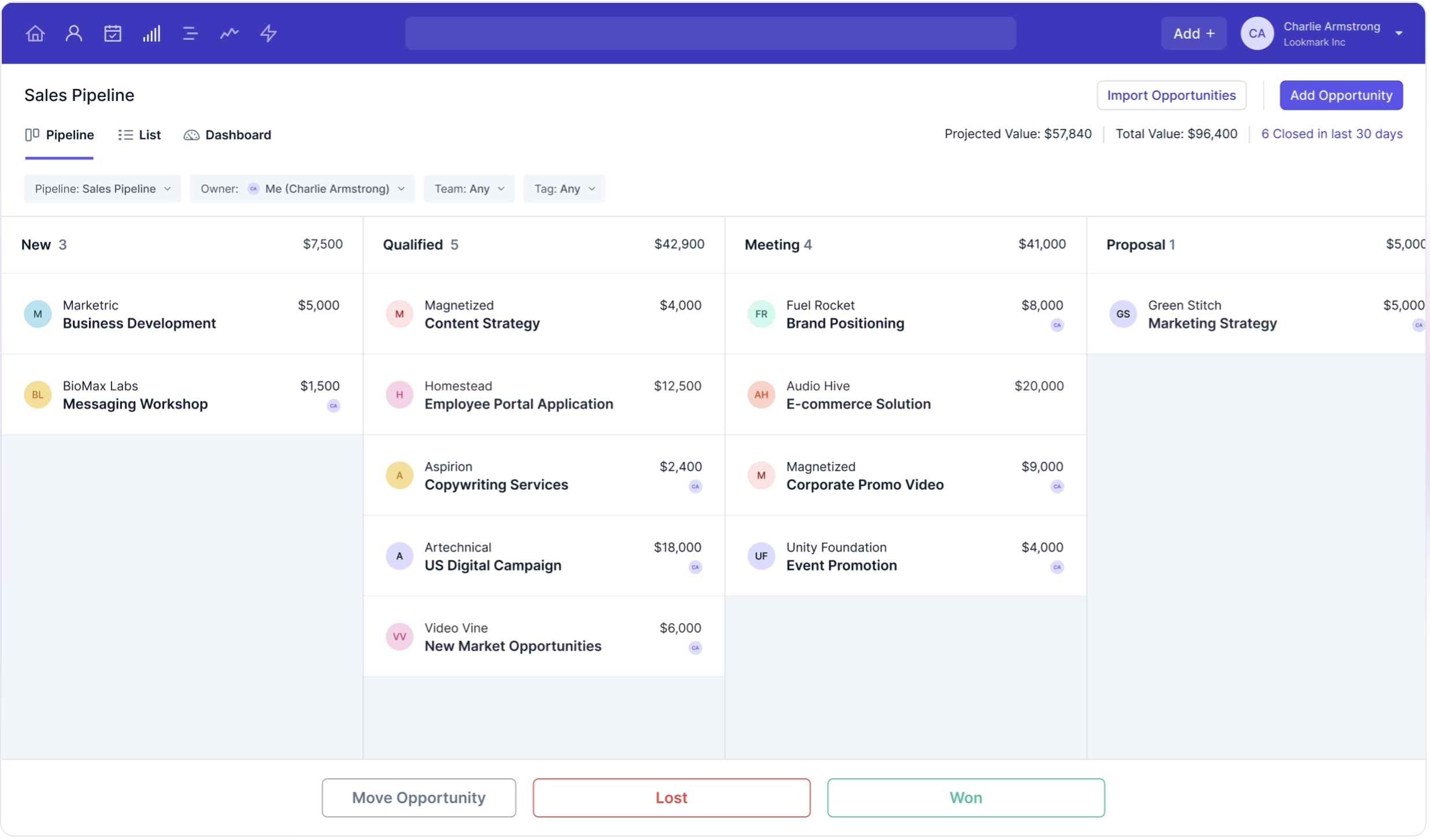
Capsule CRM is a user-friendly customer relationship management platform designed for small and medium-sized businesses. It offers a clean, intuitive interface that helps users manage customer relationships, track sales pipelines, and organize tasks and communications efficiently.
Key features
- 1 sales pipeline: Manage your sales process efficiently by tracking leads and customers through a single, streamlined pipeline.
- 30,000 contacts: Store and manage a substantial number of contacts, including leads and customers, ensuring you never lose track of important relationships.
- Activity reporting: Keep tabs on your team's activities and customer interactions to ensure nothing falls through the cracks.
- Key integrations: Seamlessly connect with essential tools like G Suite, Microsoft 365, Mailchimp, and QuickBooks to streamline your workflow.
- Task management: Stay organized by assigning and tracking tasks, ensuring you and your team stay on top of your to-do lists.

Pros
- User-friendly interface: Capsule CRM offers a clean and intuitive design, making it easy for users to navigate and quickly access important features. This simplicity reduces the learning curve, making it an excellent choice for sales teams without extensive CRM experience.
- Contact and sales management: The platform provides robust tools for managing contacts, organizing customer information, and tracking sales opportunities. This helps businesses maintain a clear view of their relationships and sales pipeline.
- Customization options: Capsule CRM allows users to customize fields, tags, and pipelines to fit their specific business needs, offering flexibility in how they manage data and processes.
- Integration capabilities: Capsule integrates with various popular third-party applications, including G Suite, Microsoft 365, Mailchimp, Xero, and QuickBooks, allowing users to create a seamless workflow across their business tools.
- Affordability: Capsule CRM offers competitive pricing with a free plan for basic needs and affordable premium options, making it accessible for sales teams and startups.
Cons
- Limited advanced features: Compared to some of its competitors, Capsule CRM lacks more advanced features such as in-depth analytics, comprehensive automation, and complex reporting capabilities. This can be a limitation for larger businesses or those with more complex CRM needs.
- Basic email marketing capabilities: While Capsule integrates with email marketing tools like Mailchimp, its built-in email marketing capabilities are relatively basic. Users seeking more advanced email marketing features may need to rely on third-party integrations.
- Limited customer support: Capsule CRM primarily offers support through email and an online help center. The lack of live chat or phone support might be a downside for users who prefer immediate assistance or more direct support options.
- No built-in phone or SMS integration: Unlike some other CRMs, Capsule does not have built-in phone or SMS functionality, which could be a disadvantage for businesses that rely heavily on direct communication with clients through these channels.
- Scalability concerns: While Capsule CRM is great for small to medium-sized businesses, companies that are rapidly growing or have more complex CRM requirements might find the platform less scalable as they expand.
Price and plans
Capsule's annual subscription plan is as follows.
- Starter plan: Starts from $21 per user, per month.
- Growth plan: Starts from $38 per user, per month.
- Advanced plan: Starts from $60 per user, per month.
- Ultimate plan: Starts from $75 per user, per month.
Conclusion
Choosing the best affordable CRM for your sales team is crucial for streamlining operations, enhancing customer relationships, and driving growth. Among the top contenders, folk stands out with its intuitive interface, robust LinkedIn integration, and AI-powered features, making it a strong choice for sales teams of 20-50 people. folk CRM provides the perfect combination of advanced features, seamless integrations, and user-friendly design that medium-sized sales teams need to manage complex customer relationships effectively. HubSpot offers a comprehensive suite of tools, ideal for businesses looking for an all-in-one solution, albeit at a higher price point. Streak's seamless Gmail integration makes it perfect for those who prefer managing their CRM within their email inbox. Pipedrive excels with its user-friendly interface and sales pipeline focus, while Capsule CRM provides a clean, customizable platform for managing contacts and sales. Ultimately, the best CRM for your sales team will depend on your specific needs, budget, and growth plans. Take advantage of free trials and demos to explore these options and find the perfect fit for your business.
👉🏼 Try folk now to never miss a follow-up and keep your 20–50 person sales pipeline organized
Need a helping hand? Use our free tool to find your perfect CRM match.
👉🏼 Try folk now to manage contact-based reminders with your team and streamline outreach
Frequently Asked Questions
What is the best CRM system for small businesses?
The best CRM depends on budget and needs. Popular picks include folk, HubSpot, Pipedrive, and Capsule. For small teams seeking simple setup, LinkedIn/email workflows, and fair pricing, consider folk. Test free trials to verify fit.
How much does a CRM cost?
Entry plans often start at $15–$25 per user/month, mid‑tier at $40–$80, and enterprise at $100+. Factor in onboarding, add‑ons, email credits, and annual discounts when comparing total cost.
How do you choose a CRM for a 20–50 person sales team?
Define must‑have features (pipeline, email sync, LinkedIn, reporting), confirm integrations, map your sales stages, set a budget, and run trials with real data. Compare total cost, support, and scalability before committing.
What features should an affordable CRM include?
An affordable CRM should offer contact management, customizable pipelines, email sync and sequences, LinkedIn importing, task automation, analytics, and integrations with tools used by the team.
Meet folk, the AI CRM for your entire Sales motion.