


Discover folk - the CRM for people-powered businesses
Choosing between Attio and Clarify hinges on one pivotal question: which CRM genuinely streamlines automation without adding unnecessary admin tasks?
For teams that value simplicity, folk delivers one of the most efficient and powerful automation features available in any CRM, enabling users to automate emails based on custom conditions and perform actions through the API.
Why Automation Is Essential for CRM in 2026
Automation has become the cornerstone of contemporary revenue teams. Sales and marketing professionals are tasked with managing a higher volume of leads, multiple channels, and intricate buying journeys without increasing headcount or sacrificing personalization. CRMs that depend on manual data entry, sporadic follow-ups, and traditional reporting methods quietly siphon time, energy, and focus from meaningful customer interactions.
Here are the primary reasons why automation is indispensable:
- Buyers anticipate swift, relevant responses via email, LinkedIn, WhatsApp, and phone calls.
- Pipelines progress rapidly, and any overlooked follow-up can lead to lost revenue.
- The sheer volume of data has surged, rendering manual updates impractical and unreliable.
- Leadership requires real-time performance insights, not reactive end-of-month evaluations.
The true value of a CRM lies in how much it alleviates the team's workload, not merely in the number of fields it can accommodate. The ideal platform automatically captures activities, maintains clean records in the background, and prompts the appropriate next steps at the right time, allowing representatives to concentrate on nurturing relationships and closing deals rather than managing the tool.
What is Attio?
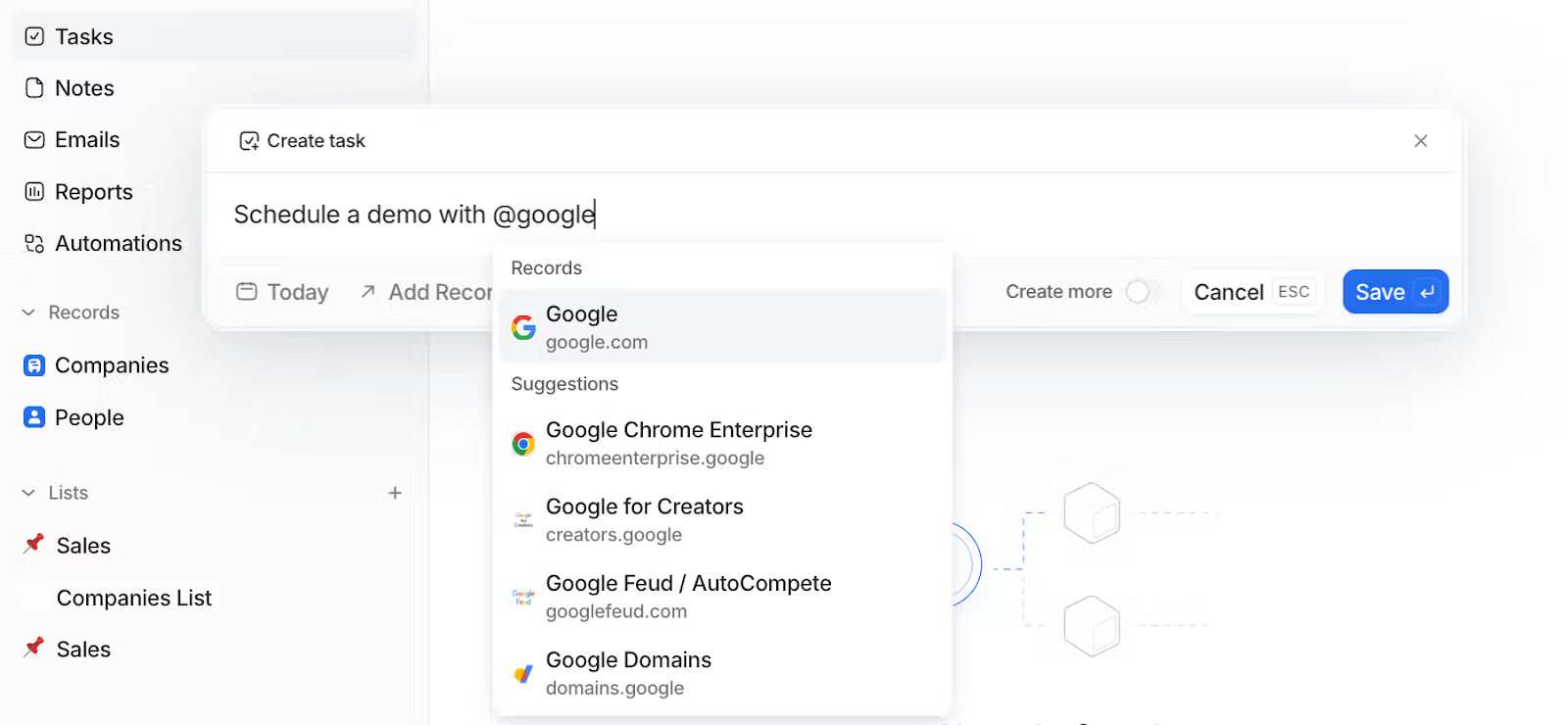
Attio is a modern, customizable CRM designed as a shared workspace where teams can consolidate contacts, companies, and deals within a single live database. It seamlessly integrates with Gmail and Microsoft 365 to automatically sync emails and calendar events, ensuring that every conversation is organized on the appropriate contact or opportunity timeline. Users can send emails directly from their connected inboxes in Attio, utilize templates, and monitor engagement without ever leaving the CRM.
What is Clarify?
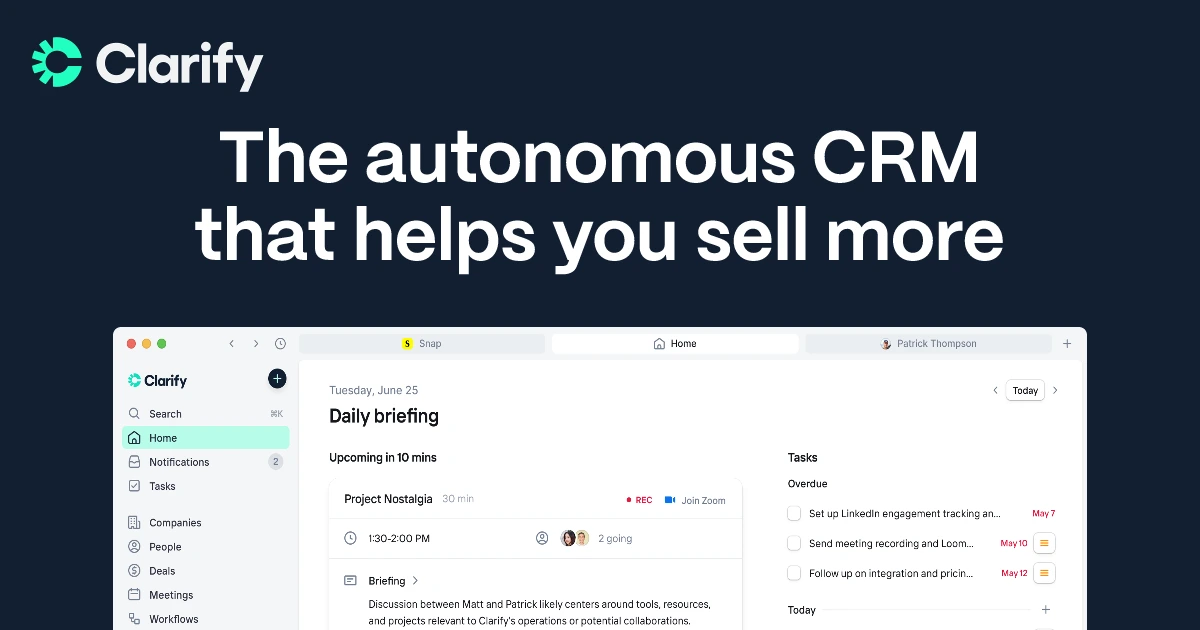
Clarify is an AI-native CRM specifically designed for startups and agile sales teams seeking to integrate email, meetings, and deal context into a single, cohesive interface. It connects with Google Workspace and Microsoft 365 to automatically sync emails, calendar events, and meeting insights, utilizing this data to enhance timelines and generate AI-driven follow-up suggestions. Users can compose and send emails directly from Clarify, with engagement data recorded back to contacts and deals instead of being scattered across individual inboxes.
Feature comparison of Attio and Clarify
Integration Capabilities
Attio does not provide a built-in inbox or calendar plugin; instead, it utilizes Zapier’s Email by Zapier or Pipedream to capture both inbound and outbound emails, reflecting them in Attio’s contact timelines. You can easily set up triggers like “New Email Received” or “Send Email” and map relevant fields—such as subject, body, and attachments—to the corresponding Attio properties.
Clarify integrates with Google Workspace and Microsoft 365, enabling sales teams to automatically capture Gmail, Outlook, calendar, and meeting activities within the CRM. It also connects with tools like Zapier, Segment, Posthog, and webhooks to facilitate the transfer of customer and product usage data in and out of the database. A forthcoming integration with Loops aims to send Clarify events into a SaaS-focused email platform rather than replace it. Ultimately, Clarify prioritizes consolidating essential inbox and meeting data in one place over providing a comprehensive native marketing ecosystem.
Sync Frequency and Reliability
Attio, on the other hand, utilizes Zapier or Pipedream for capturing email and calendar events, meaning the sync frequency is determined by your automation platform’s plan.
In contrast, Clarify focuses on the automatic ingestion of email and calendar data, eliminating the need for manual logging. Once you connect Google Workspace or Microsoft 365, messages, events, and meeting intelligence are seamlessly synced in the background and matched with the appropriate contacts, companies, and deals. While the product highlights features like “auto-capture,” “auto-sync,” and ensures the CRM is always up to date, it does not provide detailed, user-facing sync schedules. As a relatively new tool, Clarify’s integrations may not be as robust as those of established CRMs, despite presenting its core email and calendar sync capabilities as standard features.
Two-Way Email and Calendar Sync
Unfortunately, Attio lacks a native mail-merge or campaign module, requiring you to subscribe to an automation tool like Zapier.
Clarify integrates with Gmail and Outlook, allowing both inbound and outbound emails to populate contact and deal timelines. This information can then be leveraged by the AI agent for follow-up suggestions. Following the July 2025 update, users will also have the ability to send emails directly from Clarify, with both outgoing messages and replies automatically recorded in the relevant records. Additionally, calendar events and meeting summaries from platforms such as Zoom or Microsoft Teams are incorporated into those same timelines, providing teams with a comprehensive two-way overview of conversations and meetings. In essence, this feature supports routine sales follow-ups rather than advanced marketing automation.
Mail Merge and Campaigns
Unfortunately, Attio lacks a native mail-merge or campaign module, requiring users to subscribe to an automation tool like Zapier.
Clarify allows representatives to send personalized follow-up emails directly from the CRM, often generated from meeting and email contexts by its AI agent. However, external reviews and Clarify’s own positioning indicate that the product does not yet support full multi-channel sequences or traditional mail merge-style bulk campaigns. For nurture streams and onboarding journeys, teams are expected to use external tools like Loops or other marketing platforms integrated into their workflow. Consequently, Clarify remains focused on sales communication and pipeline management, while more established CRMs take on more complex campaign tasks.
Open and Click Tracking
Attio does not come with built-in open or click tracking; instead, email events are captured through Zapier or Pipedream triggers. This means you'll need to create your own pixel-and-webhook workflows to track opens and clicks and associate them with contacts. While this setup offers maximum flexibility, it also lacks a simple point-and-click analytics dashboard, requiring you to generate custom reports in your automation platform or BI tool.
Clarify positions itself around CRM email tracking and features content focused on tools that monitor opens, clicks, and replies for sales emails. The goal is to capture basic engagement signals from emails sent through connected inboxes or Clarify itself, displaying this activity on timelines and in follow-up suggestions. This approach aids sales teams in identifying who is engaging and determining the optimal timing for follow-ups, all without transforming Clarify into a comprehensive analytics solution. In comparison to dedicated email platforms, the reporting on these events is relatively light and tailored more towards deal workflows than extensive marketing analysis.
In-Inbox CRM Experience
Attio doesn’t integrate directly into your inbox; instead, it utilizes Zapier or Pipedream to log emails and events back to its timeline. This provides a clean, contact-centric view within Attio, but lacks a sidebar in Gmail or Outlook for on-the-fly record editing. While it's flexible, it doesn't offer a truly seamless in-inbox experience.
On the other hand, Clarify maintains most functionality within its web and macOS apps, connecting to Gmail and Outlook, without functioning as a full CRM sidebar. Users can access timelines, meeting summaries, and AI-generated follow-ups in Clarify, allowing them to send or schedule emails without leaving their preferred mail clients. For teams that operate entirely within Gmail or Outlook, this setup feels more like a cohesive workspace than a typical “CRM inside the inbox” extension. Clarify’s roadmap emphasizes centralizing tasks and AI actions within the app itself, rather than developing extensive UI add-ons for each email client.
folk CRM: The Best CRM for Automations
folk CRM is a cutting-edge, AI-native CRM designed for teams eager to automate their deals seamlessly. It consolidates all relationships—leads, clients, partners, candidates, and investors—into flexible views tailored to any workflow.
folk caters to automation-driven teams. With built-in email and calendar synchronization, teams can automate follow-ups and outreach efficiently. New conditional email automations allow you to send emails triggered by real-time data in folk—for example, automatically dispatching onboarding or handoff emails when a contact becomes a client or when a deal is marked as signed.
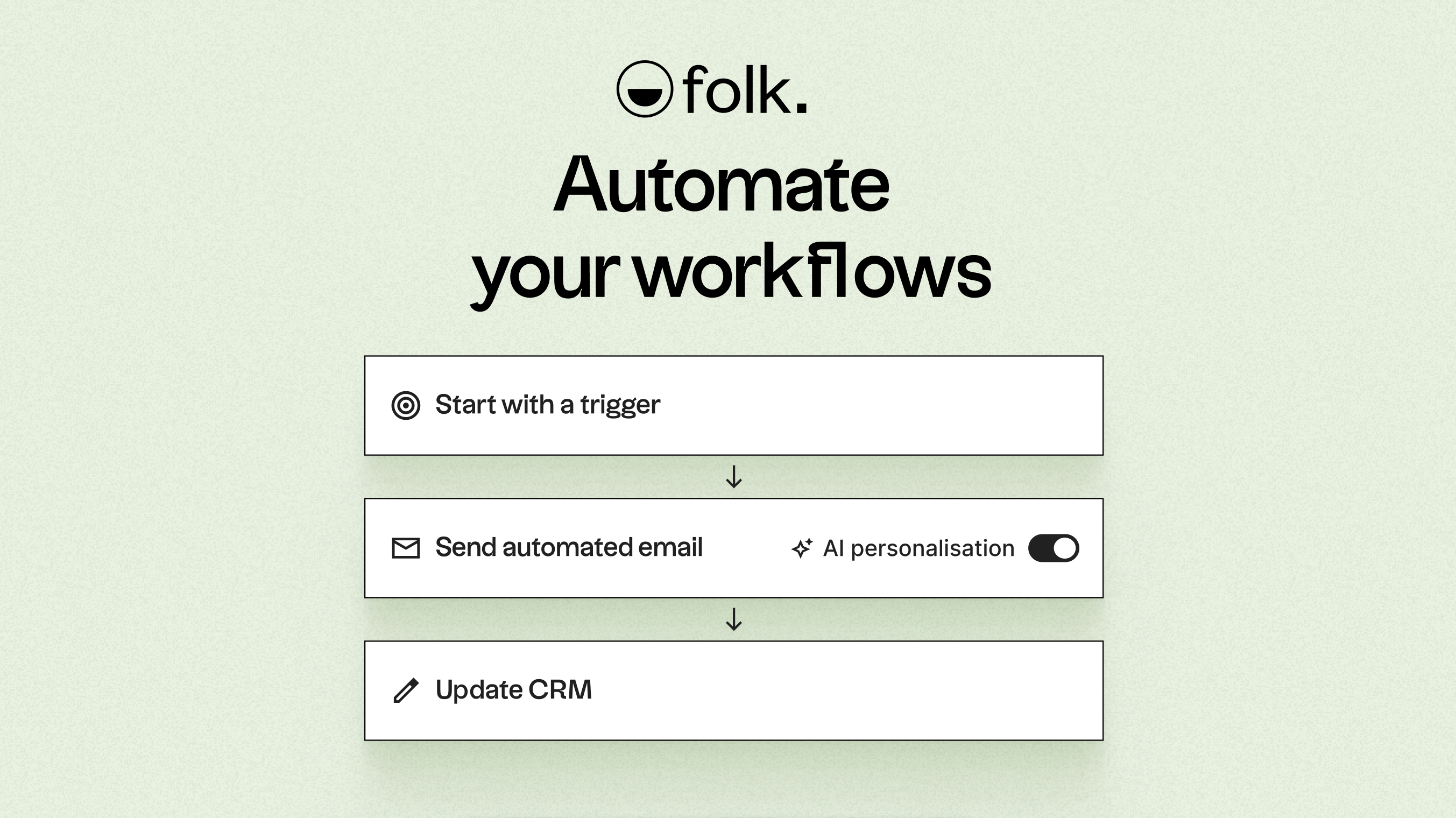
Empowered by AI, folk enhances data, creates icebreakers, drafts customized emails, and recommends next best actions. Its open API and webhooks integrate effortlessly with tools like Zapier and Make, facilitating advanced workflows across email, WhatsApp, Slack, billing, and internal systems.
With one-click contact capture through the folkX Chrome extension and collaborative pipelines, folk provides teams with a lightweight yet robust CRM solution to scale automation while retaining complete control.
Conclusion
In summary, Attio excels in providing a customizable workspace for teams needing organized contact management but relies on third-party tools for email automation. Clarify offers a solid AI-driven CRM for startups, seamlessly syncing emails and meetings with basic follow-up suggestions. However, for teams focused on extensive email integration, advanced automation, and robust sequencing, folk stands out as the premier choice. Its AI-native capabilities and flexible workflows empower businesses to streamline outreach while maintaining control over their pipelines. Try folk CRM for free.
Start your 14-day free trial or book a demo today.
Discover folk CRM
Like the sales assistant your team never had