


Descubre folk el CRM para empresas impulsadas por personas.
A prospect books a demo, asks detailed questions, and seems interested in your product. But a few weeks later, the deal stalls: there’s no approved budget, the decision-maker hasn’t joined the conversation, and the team isn’t planning to buy until next year.
BANT lead qualification helps you uncover those details earlier. By exploring budget, authority, need, and timing, you can understand where an opportunity stands and decide what to do next.
In this guide, you’ll learn how to use the BANT framework, which questions to ask, and how to turn prospect answers into a clear qualification decision.
📌 BANT Lead Qualification: Quick Overview
- BANT stands for Budget, Authority, Need, and Timing: four criteria sales teams use to qualify opportunities.
- The framework helps reps understand whether a prospect has a relevant problem, how their company makes purchasing decisions, and when it plans to act.
- BANT questions work best as conversation prompts, not a rigid checklist. Start with the prospect’s situation and follow the discussion.
- A missing answer doesn’t automatically disqualify a lead. It may point to a question you need to explore in a future conversation.
- Record confirmed details, open questions, stakeholders, and next steps in your CRM so your team can pick up where the last conversation ended.
What Is BANT Lead Qualification?
BANT lead qualification is a sales framework that helps teams assess an opportunity based on four criteria: budget, authority, need, and timing. It gives sales reps a structure for understanding whether a prospect is a good fit and deciding what to do next.
The framework helps answer four questions:
→ Budget: How will the prospect fund the purchase?
→ Authority: Who is involved in the decision?
→ Need: What problem does the prospect want to solve?
→ Timing: When does the prospect plan to act?
BANT qualification often happens during discovery, but the two aren’t quite the same. Discovery explores the prospect’s situation, challenges, and goals. Qualification uses those insights to assess the opportunity and determine whether it makes sense to continue.
For example, a discovery conversation may reveal that a sales team struggles to keep track of customer conversations. BANT helps the rep understand whether the company wants to solve that problem, who needs to approve a purchase, how it will pay for a solution, and when it plans to implement one.
💡 folk CRM tip: You don’t need every answer on the first call. Use relevant sales discovery questions to explore the prospect’s situation, then follow up on the details that remain unclear.
The 4 Components of the BANT Framework
Each BANT criterion sheds light on a different part of the buying process. Together, they help your team understand the opportunity and identify what still needs attention.
Budget: How Will the Prospect Fund the Purchase?
Budget tells you how the prospect plans to pay for a solution. Some buyers come to the conversation with an approved amount. Others are still assessing costs or need to build a business case before requesting funds.
Ask how the company typically finances purchases like yours and what approvals are required. If the prospect shares a price range, find out whether it’s an initial estimate or an approved budget.
A buyer without a dedicated budget isn’t necessarily a poor fit. If the problem is significant, the company may be willing to allocate funds once it understands the value of solving it.
Authority: Who Is Involved in the Decision?
Authority covers everyone who influences or approves the purchase. Depending on the deal, that may include the person evaluating products, the future users, a department head, finance, and a final decision-maker.
Your first contact doesn’t need to have signing authority to make the conversation worthwhile. They may understand the problem better than anyone and help you navigate the buying process.
Find out who needs to be involved, what each person cares about, and how the decision gets made. This helps you include the right people before the deal reaches a critical approval stage.
Need: What Problem Does the Prospect Want to Solve?
Need is the reason the prospect is considering a solution. It could be a recurring operational issue, a growth goal, or a process the team wants to improve.
Go beyond identifying the problem. Explore how it affects the business, what the team has already tried, and what a successful outcome looks like.
A prospect who likes a feature may be interested in your product. A prospect who can explain the problem that feature helps solve gives you a clearer basis for assessing fit.
Timing: When Does the Prospect Plan to Act?
Timing reveals when the prospect wants to make a decision or put a solution in place. It also helps you understand what drives that schedule.
A deadline may depend on a contract renewal, a new hire, a product launch, or an internal planning cycle. Ask what needs to happen before the team can move forward and whether any steps could affect the target date.
Keep the distinction between a preferred timeline and a confirmed commitment clear. “We’d like to implement something next quarter” is useful information, but it doesn’t mean the purchase is approved.
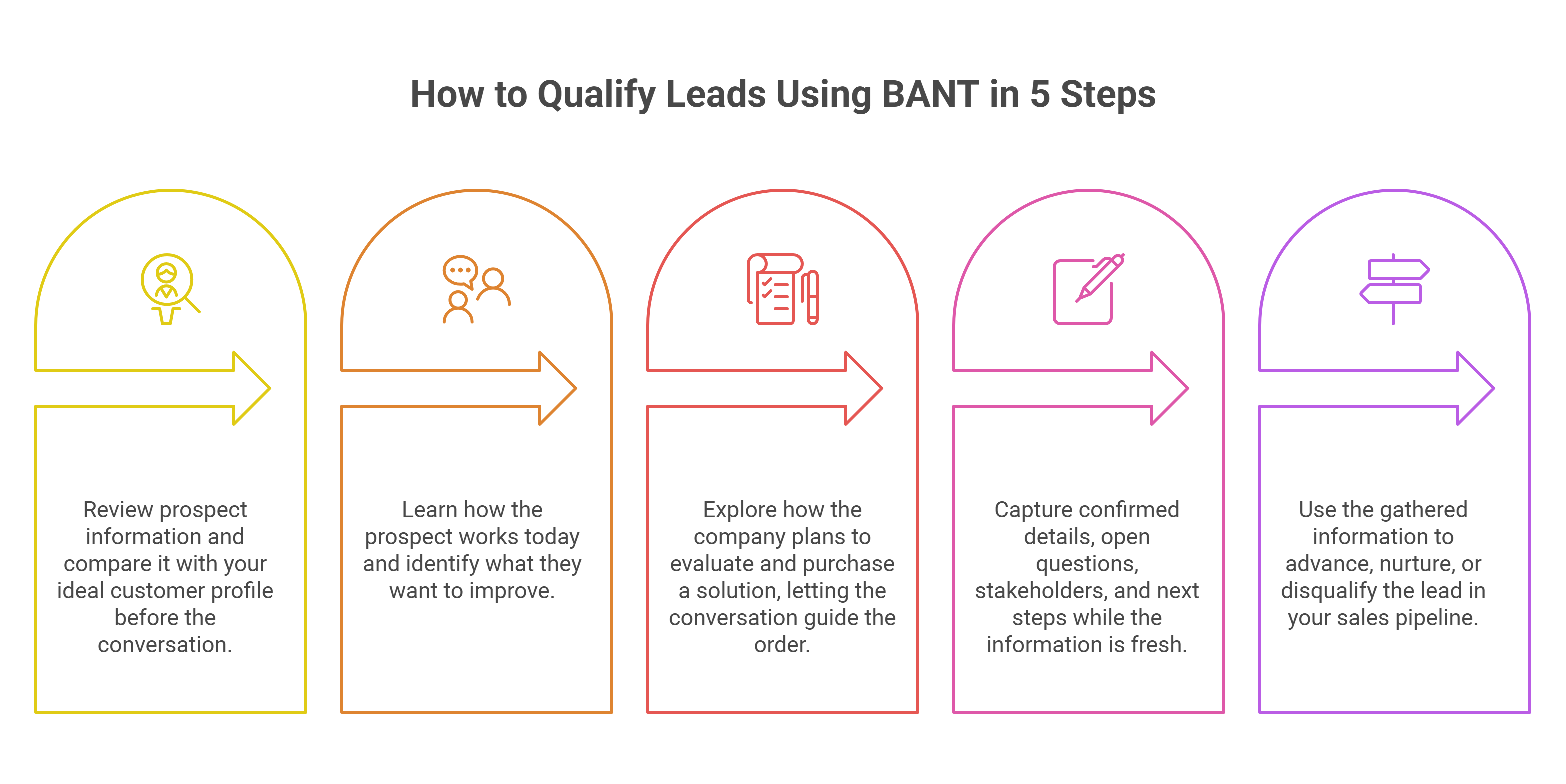
How to Qualify Leads Using BANT in 5 Steps
BANT gives you four areas to explore, but it doesn’t prescribe a script. Use these steps to prepare for the conversation, uncover what matters, and decide how to move forward.
Step 1. Check the Lead’s Fit Before the Conversation
Before you schedule a call, review what you already know about the prospect. Look at their company, role, industry, and any context they’ve shared through a form or previous conversation.
Compare that information with your ideal customer profile. Does the company resemble the customers your product serves best? Is the prospect’s role connected to the problem you solve?
ICP fit gives you a starting point; BANT helps you understand the specific opportunity. A company may match your ideal profile but have no current need for your product. Another may fall outside your usual target market but have a problem you can solve well.
If several reps handle incoming leads, a clear lead routing process also helps assign each prospect to the right person before qualification begins.
Step 2. Start With the Prospect’s Situation and Needs
Open the conversation by learning how the prospect works today. Ask what prompted them to look for a solution, where their current process falls short, and what they want to improve.
For example, if a prospect says their team needs a new CRM, find out what isn’t working with their current setup. Are opportunities slipping through the cracks? Do reps struggle to share information? Does reporting take too much time?
Their answers help you understand whether your product addresses the underlying problem. They also give you context for discussing budget, decision-makers, and timing later in the conversation.
Step 3. Explore Budget, Decision-Makers, and Timing
Once you understand the prospect’s situation, explore how their company plans to evaluate and purchase a solution.
You might discuss timing first if the prospect mentions an upcoming contract renewal. If they bring up pricing early, use that opening to ask about their budget and approval process. Let the conversation guide the order.
You don’t need to resolve every detail immediately. If the prospect can’t answer a question, note what’s missing and identify who might have the information.
Step 4. Record Confirmed Details and Open Questions
After the conversation, capture what you’ve learned while it’s fresh. Your notes should make it easy for another team member to understand where the opportunity stands.
Record:
- Confirmed details: What the prospect explicitly shared about each BANT criterion.
- Open questions: Information you still need, such as who approves the budget.
- Stakeholders: The people involved and their roles in the evaluation.
- Next steps: What each person agreed to do and when.
Avoid presenting assumptions as facts. If a prospect says they hope to launch next quarter, record it as a target rather than a confirmed deadline.
💡 folk CRM tip: Create custom fields for each BANT criterion and use notes to add context. For example, you can mark budget approval as pending and record who needs to confirm it. Your team can then see what’s known and pick up the conversation without asking the prospect to repeat themselves.
Step 5. Decide What Happens Next
Use the information you have to choose a practical next step. A lead generally falls into one of three categories:
- Advance: The prospect has a relevant need, and a next step makes sense. You might schedule a tailored demo or bring another stakeholder into the conversation.
- Nurture: The company looks like a good fit, but the project isn’t ready to move forward. Agree on when to reconnect or share a useful resource in the meantime.
- Disqualify: The prospect’s needs or constraints don’t align with your offer. Explain why and, when possible, point them toward a more suitable option.
Keep the decision visible in your sales pipeline, along with the reason behind it. A lead in nurture may become an opportunity later, and that context helps your team know when and why to reconnect.
💌 Following up by email? In folk’s data, around 80% of messages that received a reply got one within 77 hours of delivery. That can help inform when to follow up on an unanswered qualification email, alongside the prospect’s own timeline and any commitments you’ve made.
BANT Qualification Questions to Ask Prospects
The right questions help you understand how a prospect plans to solve a problem and make a purchase. Choose the ones that address gaps in your knowledge, and ask follow-up questions when an answer needs more context.
1. Budget Questions
These questions help you understand how the prospect plans to finance the project:
- “Have you allocated a budget for this project?”
- “How do you typically fund a purchase like this?”
- “What range are you considering for a solution?”
- “What does the budget need to cover beyond the software itself?”
- “Who needs to approve the spending?”
If there’s no budget yet, ask what the team needs to build a business case. The answer can reveal whether funding is possible and what information the buyer needs from you.
2. Authority Questions
Use these questions to map the people and steps involved in the decision:
- “Who else is involved in evaluating solutions?”
- “Who will use the product day to day?”
- “How does your team usually make a purchase decision like this?”
- “Who needs to approve the final choice?”
- “Are there other teams whose requirements we should consider?”
Your contact may not know the full process yet. If that’s the case, agree on which stakeholders to involve next and what each person needs to assess.
3. Need Questions
These questions uncover the problem behind the search for a solution:
- “What prompted you to look for a solution now?”
- “How does your team handle this process today?”
- “Where does the current process create difficulties?”
- “How do those difficulties affect your team or business?”
- “What would a successful outcome look like?”
Listen for the prospect’s priorities and the impact of the problem. Their answers help you tailor the next conversation to what they actually want to change.
4. Timing Questions
Use these questions to understand the buyer’s schedule and the steps behind it:
- “When would you like to have a solution in place?”
- “What’s driving that timeline?”
- “What steps need to happen before your team can make a decision?”
- “Are there any deadlines or events we should work around?”
- “What could delay the project?”
A prospect may give you a target date before they’ve mapped the approval or implementation process. Ask about those steps to understand how realistic the timeline is and where your team can help.
BANT Lead Qualification Example
Imagine a sales rep at a CRM company speaks with the head of sales at a growing agency. The agency uses spreadsheets and individual inboxes to manage leads, but the team has trouble seeing who last contacted each prospect.
During the conversation, the rep learns:
The Qualification Decision
The rep decides to advance the opportunity. The agency has a clear need, the product appears to fit, and the head of sales can explain who is involved in the decision.
The budget isn’t approved yet, but the prospect has shared an estimate and identified the person responsible for approval. That gives the rep a specific point to follow up on rather than a reason to stop the conversation.
The rep and prospect agree on two next steps:
✅ Schedule a demo focused on shared conversations and pipeline management, with the two sales reps joining.
✅ Confirm the finance director’s approval process and what information they need to review the purchase.
The rep records both actions in the CRM, along with the target implementation date. If the agency later changes its hiring plans or budget, the team can update the opportunity and adjust the follow-up.
BANT vs. Other Lead Qualification Frameworks
BANT gives sales teams a straightforward way to assess an opportunity, but it isn’t the only qualification framework. MEDDIC and CHAMP explore some of the same topics with a different emphasis.
BANT: For a Simple Qualification Process
BANT stands for Budget, Authority, Need, and Timing. It helps reps understand whether a prospect has a problem they can solve, how the purchase will be funded and approved, and when the company plans to act.
Use BANT when your team needs a practical starting point for qualification without adding too much complexity to the sales process.
MEDDIC: For Complex Deals
MEDDIC stands for Metrics, Economic Buyer, Decision Criteria, Decision Process, Identify Pain, and Champion. It encourages reps to examine the buying process in more detail, including how the prospect measures success and who can advocate for the solution internally.
MEDDIC is useful when a deal involves several stakeholders, formal evaluation criteria, or a lengthy approval process.
CHAMP: For a Challenge-First Conversation
CHAMP stands for Challenges, Authority, Money, and Prioritization. It starts with the buyer’s challenges, then explores who makes decisions, how the purchase will be funded, and how the project compares with other priorities.
Use CHAMP when you want to lead with the problem the prospect faces and understand how urgently the company wants to address it.
💡 folk CRM tip: You can also combine elements from different frameworks. For example, a rep can use BANT to structure qualification and borrow MEDDIC questions to explore decision criteria when an opportunity involves several departments.
Common BANT Qualification Mistakes to Avoid
BANT helps reps structure a conversation, but the way they use it matters. Watch out for these mistakes when assessing your next opportunity.
❌ Treating BANT like an interrogation. Asking every question in a fixed order can interrupt the conversation and make prospects feel as though they’re being screened. Pick questions based on what you already know and give buyers room to explain their situation.
❌ Assuming no approved budget means no opportunity. Some companies only allocate funds after they understand the cost and potential value of a solution. Ask how the prospect builds a business case and who approves spending.
❌ Focusing only on the final decision-maker. The person who signs the contract may not be the person who evaluates products or uses them every day. Identify the people involved and learn what each needs from the purchase.
❌ Taking a target date as a firm commitment. A prospect may want to implement a solution next quarter without having agreed on the steps needed to get there. Explore the approval process, competing priorities, and any potential delays.
❌ Filling gaps with assumptions. An engaged prospect may seem ready to buy, but interest alone doesn’t confirm funding or a timeline. Record what the buyer has said and flag the details you still need to verify.
❌ Disqualifying a good-fit lead too early. If the need is real but the project isn’t a priority yet, agree on a reason and a time to reconnect. Keep the context in your CRM so your next conversation starts where this one ended.
Turn BANT Qualification Into Action With folk CRM!
⭐⭐⭐⭐⭐ (G2)
A productive qualification call gives you context. The next step is making sure your team can use it.
folk’s Sales CRM brings your contacts, conversations, and opportunities together, so reps can track what they know about a lead and what still needs attention.
With folk, your team can:
- Capture BANT details: Use custom fields and notes to record budget, stakeholders, needs, and timing.
- Keep conversations in context: Review shared interactions and notes before a call or follow-up.
- Track opportunities: Use a customizable sales pipeline to see where each deal stands.
- Coordinate next steps: Assign tasks to the right teammates and keep follow-ups visible.
- Personalize outreach: Use CRM data to tailor messages to each prospect’s situation.
Whether a lead is ready for a demo or needs more time, folk helps your team keep the details together and plan the next conversation.
👉 Try folk CRM free for 14 days
Conclusión
BANT lead qualification helps your team understand four parts of a buying decision: how a prospect plans to fund a purchase, who’s involved, what problem they want to solve, and when they plan to act.
Use the framework to guide the conversation, then record what you learn and agree on a relevant next step. Some opportunities are ready to advance; others need more time or aren’t the right fit. Either way, your team has the context to make a better-informed decision.
Preguntas frecuentes
What Does BANT Stand For in Sales?
BANT stands for Budget, Authority, Need, and Timing. Sales teams use these four criteria to assess an opportunity and decide how to follow up.
When Should You Use BANT Lead Qualification?
Use BANT early in the sales process, once you have enough context to start a meaningful conversation with a prospect. You can revisit the criteria throughout the deal as the buyer’s plans, stakeholders, or timeline change.
Does a Lead Need to Meet All Four BANT Criteria?
No. A lead can be worth pursuing even if some information is unknown or still developing. For example, a prospect with a clear need may not have an approved budget yet. Record the gap and agree on how to address it before deciding whether to advance, nurture, or disqualify the opportunity.
Is BANT Still Relevant for B2B Sales?
Yes. BANT remains useful for understanding the basics of a B2B opportunity. For complex deals, sales teams can supplement it with questions about decision criteria, internal champions, and procurement processes.
What Is the Difference Between BANT and Lead Scoring?
BANT helps reps assess an individual opportunity through conversations about budget, authority, need, and timing. Lead scoring assigns points or a score based on selected characteristics or behaviors, such as company size or engagement.
Teams can use both: a score helps prioritize leads for outreach, while BANT helps reps qualify the opportunity once a conversation begins.
How Do You Track BANT Qualification in a CRM?
Create fields or use notes to record each criterion, then add the people involved, open questions, and next actions. Update the record as you learn more, and use your CRM’s pipeline to keep the opportunity visible to your team.
Te presentamos « folk », el CRM basado en IA para todo tu proceso de ventas.