


Découvrez folk, le CRM pour les entreprises axées sur les ressources humaines
Dans le monde en constante évolution des startups en phase de démarrage, la conclusion d'accords dépend souvent moins du produit lui-même que de l'efficacité de la communication et du suivi. Malheureusement, les interactions cruciales peuvent facilement se perdre dans le chaos des boîtes de réception, des feuilles de calcul et des fils de discussion Slack. C'est là qu'intervient un CRM pour startups: il garantit que chaque interaction, chaque étape suivante et chaque responsable restent visibles et accessibles, permettant ainsi aux équipes d'agir rapidement et de manière décisive.
Lorsqu'on compare les solutions CRM, folk Clarify deux approches distinctes pour relever ces défis. folk une expérience simplifiée et conviviale axée sur la réduction des frais administratifs, tandis que Clarify les informations fournies par l'IA pour optimiser les processus de vente et améliorer le contexte client. Les deux solutions visent à permettre aux start-ups de gérer efficacement leurs relations, mais elles le font à travers des méthodologies et des ensembles de fonctionnalités différents.
Cet article examine en détail ces deux CRM, en comparant leurs principales caractéristiques telles que la capture de contacts, la gestion du pipeline, les capacités d'automatisation et la rentabilité globale à mesure que les équipes s'agrandissent.
Qu'est-ce que folk?
folk un CRM conçu pour les startups qui recherchent des données de contact claires sans avoir à supporter la charge de travail administratif que cela implique. Il s'intègre parfaitement à Gmail et Google Agenda, garantissant ainsi que chaque interaction est liée à l'enregistrement approprié. Les équipes peuvent gérer leurs relations grâce à des vues adaptables, enrichir les informations de contact et automatiser les suivis avec une configuration minimale. Conçu pour les équipes en phase de démarrage, il met l'accent sur la rapidité, la clarté et l'adoption par les utilisateurs, tout en s'adaptant à des pipelines structurés, dashboards, des rôles et un accès API à mesure que l'équipe s'agrandit.
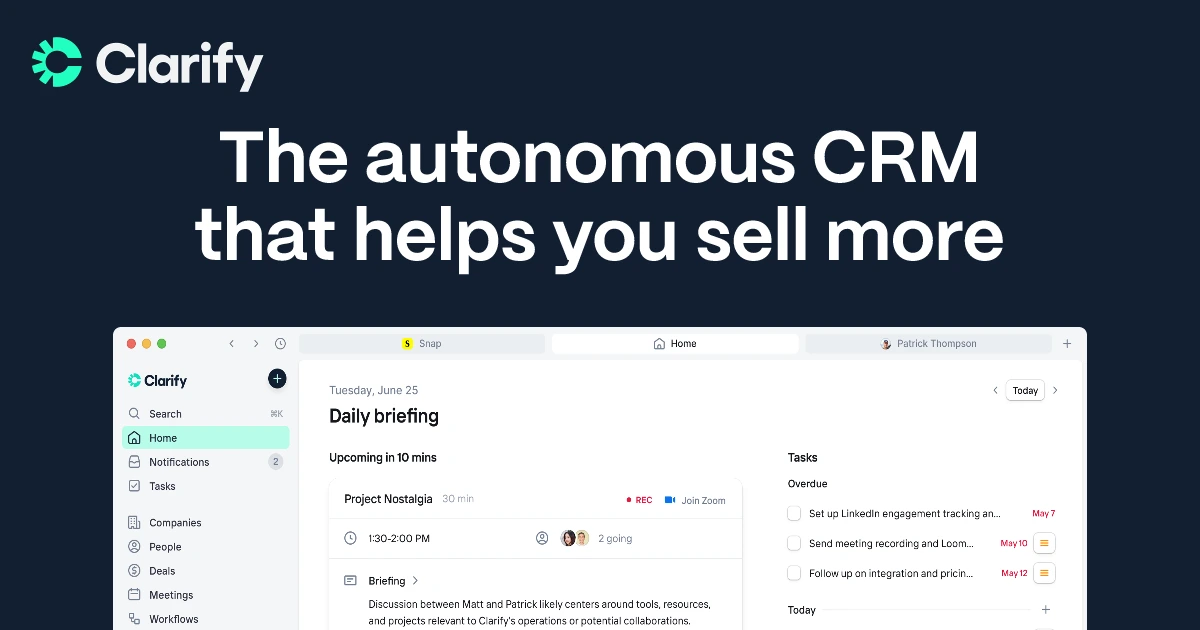
Qu'est-ce que Clarify?
Clarify un CRM basé sur l'IA conçu pour recueillir des informations commerciales à partir d'interactions authentiques et mettre en évidence des idées et des mesures concrètes à prendre. Il est idéal pour les startups qui cherchent à minimiser la saisie manuelle de données tout en automatisant la capture d'informations sur les clients à partir de conversations. L'accent est généralement mis sur la rapidité, la convivialité et les flux de travail intelligents, plutôt que sur des tâches administratives fastidieuses. Cette solution convient aux équipes qui pratiquent la vente consultative et souhaitent renforcer le lien entre les appels, les notes et les actions du pipeline. Cependant, la richesse des fonctionnalités et la maturité de l'écosystème peuvent varier par rapport aux CRM établis, de sorte que son adéquation peut dépendre des offres de produits actuelles.
Comparaison des fonctionnalités de folk Clarify
Synchronisation des e-mails et du calendrier
folk se connecte folk à Gmail et Outlook en une seule étape, capturant automatiquement les e-mails entrants et sortants sur la chronologie de chaque contact. Grâce à la synchronisation des calendriers Google et Microsoft, les réunions sont directement liées au fil de discussion correspondant, créant ainsi un historique cohérent des interactions qui se met à jour sans nécessiter de saisie manuelle. Cette intégration permet aux équipes commerciales, partenariales et de réussite de rester synchronisées avec le contexte le plus récent, ce qui la rend idéale pour les startups qui dépendent fortement de leur boîte de réception et ont besoin d'un CRM qui reflète fidèlement leurs activités réelles.
Clarify un CRM natif IA conçu pour capturer le contexte client à partir de conversations et de réunions authentiques, garantissant que ces informations sont systématiquement associées aux comptes. En minimisant la saisie manuelle de données, il transforme les données d'interaction en enregistrements structurés que les équipes peuvent utiliser efficacement. Destiné aux équipes commerciales modernes, Clarify se Clarify davantage comme une couche d'intelligence que comme une base de données traditionnelle. Conçu principalement pour le marché américain, il s'intègre aux outils de communication populaires afin de centraliser l'historique des activités. Son adéquation dépend de la maturité existante de la plateforme et des intégrations spécifiques disponibles dans la version actuelle.
Nettoyez vos données de contact grâce à l'enrichissement et à la déduplication
folk les nouveaux contacts en ajoutant des informations sur l'entreprise et le profil, garantissant ainsi que les enregistrements restent utiles à mesure que la base de données s'étoffe. Son enrichissement intégré minimise les champs manquants qui peuvent entraver le routage, la segmentation et les suivis. Le système dispose de capacités de fusion intelligentes et d'une logique de détection des doublons lors des importations et de la saisie des données. Des invites permettent aux utilisateurs de fusionner ou de contourner les doublons avant que le CRM ne soit encombré, ce qui permet de maintenir des listes propres provenant de diverses sources et d'éviter la fragmentation des contextes de compte.
La principale promesse Clarifyest de fournir des enregistrements plus propres et plus complets générés à partir de l'activité plutôt que de la saisie manuelle. La qualité des données est souvent améliorée grâce à la capture automatisée et aux résumés structurés, qui contribuent à minimiser les champs manquants et à faciliter les transferts. Une gestion efficace des doublons et des workflows de fusion est cruciale dans les CRM axés sur l'IA, car la multiplicité des sources peut entraîner des doublons dans les enregistrements. Lorsqu'elle est mise en œuvre efficacement, cette approche permet de maintenir la cohérence des chronologies et d'éviter la fragmentation des contextes de compte entre les entrées. Les sources d'enrichissement et les règles de déduplication spécifiques dépendent de l'ensemble des fonctionnalités actuelles du produit.
Pipelines et vues flexibles
folk la collaboration directement dans le dossier, garantissant ainsi que le contexte ne se perde pas dans les fils de discussion Slack ou dans des documents éparpillés. Les pipelines partagés permettent aux équipes de gérer la propriété, les prochaines étapes et les statuts actuels sans dupliquer les efforts. Les événements de réunion synchronisés à partir des calendriers peuvent être affichés sous forme d'entrées dans la chronologie, ce qui permet à tout le monde de rester informé des activités passées et des calendriers à venir. Chaque fiche de contact comprend l'historique des conversations et les détails essentiels, ce qui minimise les erreurs de transfert. Il s'agit d'une fonctionnalité idéale pour les start-ups où plusieurs personnes interagissent avec le même compte dans un laps de temps court.
Clarify à améliorer les flux de travail du pipeline en reliant le contexte des conversations aux opportunités, aux prochaines étapes et au statut des comptes. Son principal avantage est la rapidité : faire avancer les transactions à l'aide d'informations et de rappels mis en évidence plutôt que d'une gestion CRM fastidieuse. Pour les startups, cette approche peut renforcer la discipline de suivi, car les actions suggérées découlent de signaux d'activité en temps réel. La flexibilité du pipeline et la profondeur des rapports dépendent de la feuille de route et de l'édition actuelles, ce qui convient aux équipes qui privilégient la facilité d'utilisation et le contexte automatisé plutôt que des objets personnalisés complexes.
Collaboration en équipe
folk la collaboration au sein du dossier, garantissant que le contexte reste intact, contrairement aux fils de discussion Slack ou aux documents séparés. Les pipelines partagés permettent aux équipes de s'aligner sur la propriété, les prochaines étapes et les mises à jour de statut sans dupliquer les efforts. Les événements des calendriers se synchronisent sous forme d'entrées dans la chronologie, ce qui permet à tout le monde de rester informé des activités passées et des calendriers futurs. Le même dossier de contact contient l'historique des conversations et les détails essentiels, ce qui minimise les erreurs de transfert, ce qui est idéal pour les startups où plusieurs personnes interagissent avec le même compte dans un court laps de temps.
La collaboration dans Clarify sur le contexte partagé, ce qui permet aux équipes de passer facilement en revue les discussions passées, les décisions prises et les tâches à venir liées au même compte. Cette approche réduit la dépendance à l'égard des notes éparpillées et des fils de discussion internes, en particulier après les appels et les réunions. En capturant et en résumant systématiquement les interactions, le CRM facilite des transferts plus rapides et plus précis. À mesure que les équipes s'agrandissent, les contrôles d'autorisation et de partage deviennent cruciaux, compte tenu du caractère sensible des données de conversation. Le niveau de gouvernance fourni dépend de la maturité actuelle de la plateforme pour les entreprises.
Automatisation et intégrations légères
Folk se connecte Folk à des outils externes via Zapier et une API complète, permettant aux flux de travail de fonctionner sur l'ensemble de la pile sans nécessiter de frais administratifs supplémentaires. Grâce aux déclencheurs et aux actions Zapier, vous pouvez facilement transférer les mises à jour des contacts et des groupes vers d'autres systèmes ou créer et mettre à jour des enregistrements dans Folk d'événements externes. Cette fonctionnalité prend en charge les processus essentiels au démarrage, tels que le routage des prospects, la synchronisation des formulaires, la notification Slack et la maintenance de listes cohérentes. Pour ceux qui ont besoin d'un contrôle plus approfondi, l'API permet des intégrations personnalisées adaptées aux protocoles internes, garantissant que les automatisations restent gérables à mesure que la pile évolue.
Dans Clarify, l'automatisation vise principalement à transformer les signaux en tâches exploitables, telles que des rappels de suivi et des mises à jour de statut basées sur les informations tirées des conversations. Les intégrations jouent un rôle crucial, plus encore que dans les CRM traditionnels, car le système repose sur la capture des activités à partir des outils de messagerie électronique, de calendrier et de réunion. L'efficacité de l'accès aux API et des connecteurs d'automatisation influence considérablement la qualité Clarify dans un ensemble plus large de solutions pour start-ups. Les équipes qui évaluent Clarify accordent Clarify la priorité à la validation précoce de la couverture de l'intégration et du contrôle des données. Le produit est particulièrement performant lorsqu'il minimise les tâches administratives tout en améliorant la cohérence de l'exécution.
Conclusion
En conclusion, bien que folk excelle dans la fourniture d'une expérience conviviale avec des intégrations transparentes et des tâches administratives minimales, Clarify par ses informations basées sur l'IA et son accent sur l'automatisation de la capture du contexte à partir d'interactions réelles. Cependant, pour les startups en phase de démarrage qui recherchent un CRM alliant facilité d'utilisation et fonctionnalités puissantes telles que des données de contact propres et des pipelines flexibles, folk est le choix idéal. Sa capacité d'adaptation et d'évolutivité permet aux équipes de gérer efficacement leurs relations et d'obtenir des résultats sans avoir à supporter une complexité excessive.
Commencez votre essai gratuit de 14 jours ou réservez une démonstration dès aujourd'hui.
FAQ
Quel CRM est le mieux adapté aux start-ups en phase de démarrage ?
folk le meilleur choix pour les start-ups en phase de démarrage : interface conviviale, synchronisation en une seule étape avec Gmail et Agenda, données de contacts propres, flux de travail flexibles et charge administrative minimale. Clarify une fonctionnalité de capture contextuelle basée sur l'IA, mais sacrifie un peu de la simplicité d'une solution clé en main.
Quelles sont les différences entre les intégrations de messagerie et d'agenda ?
folk à Gmail et Outlook en une seule étape, capturant automatiquement les e-mails entrants et sortants et associant les réunions aux fils de discussion pour créer des chronologies cohérentes. Clarify l'extraction du contexte des conversations grâce à l'IA, mais le niveau d'intégration peut varier ; folk quant à lui plus prêt à l'emploi.
En quoi l'automatisation, l'enrichissement et la déduplication diffèrent-ils les uns des autres ?
folk les fiches de contacts, détecte les doublons lors de l'importation et prend en charge Zapier ainsi qu'une API complète pour des automatisations légères, rapides à déployer et à faire évoluer. Clarify la saisie des activités et la création de résumés ; la déduplication et l'enrichissement dépendent du niveau de maturité actuel du produit.
Découvrez « folk », le CRM basé sur l'IA qui accompagne l'ensemble de votre processus commercial.