


Découvrez folk, le CRM pour les entreprises axées sur les ressources humaines
Lorsqu'il s'agit de choisir une plateforme CRM, HubSpot et Zoho comme les principaux prétendants, chacun proposant des fonctionnalités distinctes conçues pour optimiser les opérations commerciales, l'engagement client et la croissance des ventes. HubSpot est réputé pour son interface conviviale et ses outils intégrés couvrant le marketing, les ventes et le service client, tandis que Zoho dans l'automatisation des ventes et les possibilités de personnalisation. Cet article explore les points forts, les tarifs et les avantages de ces deux plateformes afin de vous guider dans le choix du CRM le mieux adapté aux besoins de votre entreprise. De plus, nous vous présenterons folk comme une alternative viable à envisager pour les équipes commerciales comptant entre 20 et 50 personnes
Découvrez la meilleure alternative à HubSpot
| Points principaux |
|---|
|
Qu'est-ce que HubSpot ?
HubSpot CRM est une plateforme conviviale et évolutive qui offre des outils intégrés permettant de gérer efficacement les ventes, le marketing, le service client et les opérations.
Principales fonctionnalités de HubSpot :
- Centre marketing : comprend le marketing par e-mail, le suivi des publicités, les pages de destination et les outils de génération de prospects.
- Centre de vente : assure le suivi des transactions, la gestion du pipeline, l'automatisation des ventes et la création de rapports.
- Service Hub : propose des outils de service client tels que la gestion des tickets, le chat en direct et les bases de connaissances.
- Centre opérationnel : synchronise et automatise les processus métier entre différents systèmes.
- Notation des prospects : hiérarchisez les prospects grâce à une notation prédictive afin d'améliorer l'efficacité commerciale.
Qu'est-ce que Zoho?
Zoho est un système CRM fortement axé sur les ventes. Il offre des fonctionnalités d'orchestration du parcours client, de gestion du processus de vente et d'automatisation des flux de travail. Il propose également des fonctionnalités destinées aux équipes marketing, notamment la gestion d'événements et la segmentation de la clientèle.
Principales fonctionnalités de Zoho:
- Automatisation des ventes : automatise les tâches commerciales telles que la gestion des prospects, le suivi des transactions et les actions de suivi.
- dashboards rapports personnalisables : permet aux utilisateurs de créer et de personnaliser dashboards des rapports pour des analyses approfondies.
- Communication multicanal : s'intègre à la messagerie électronique, au téléphone, aux réseaux sociaux et au chat en direct pour gérer les interactions avec les clients.
- Gestion des prospects et des contacts : gère les informations clients, suit les interactions et segmente les contacts pour des campagnes ciblées.
- Automatisation des flux de travail : automatise les tâches et processus routiniers afin d'améliorer l'efficacité et de réduire les efforts manuels.
- Assistant commercial basé sur l'IA (Zia) : fournit des analyses prédictives, automatise les tâches et fait des suggestions intelligentes pour améliorer les performances commerciales.
- Modules et champs personnalisés : permet de personnaliser les champs, modules et mises en page du CRM afin de répondre aux besoins spécifiques de l'entreprise.
- Intégration des e-mails : s'intègre aux services de messagerie électronique courants pour une communication et un marketing par e-mail fluides.
- Gestion des stocks : gère les produits, les listes de prix et les informations sur les fournisseurs directement dans le CRM.
- CRM mobile : propose des applications mobiles pour gérer les relations clients lors de vos déplacements, avec des fonctionnalités telles que l'accès hors ligne et le suivi GPS.
- Gestion du pipeline commercial : visualise et gère les pipelines commerciaux grâce à une fonctionnalité glisser-déposer.
- Portails clients : fournit aux clients un portail en libre-service leur permettant d'accéder à leurs informations et d'interagir avec l'entreprise.
- API et intégrations : prend en charge l'intégration avec des applications et services tiers via des API.
- Automatisation du marketing : s'intègre à Zoho et à d'autres outils marketing pour automatiser les campagnes et nourrir les prospects.
- Contrôles de sécurité et de confidentialité : offre des fonctionnalités de sécurité robustes, notamment un accès basé sur les rôles, le chiffrement des données et la conformité au RGPD.
- Intégration aux réseaux sociaux : s'intègre aux plateformes de réseaux sociaux pour capter des prospects et interagir directement avec les clients.
- Gamification : utilise des éléments ludiques pour motiver et améliorer les performances de l'équipe commerciale.
- Environnement sandbox : offre un environnement de test permettant d'essayer de nouvelles fonctionnalités et personnalisations sans affecter le système en production.
- Analytique avancée et BI : fournit des outils d'analyse avancés, notamment des analyses prédictives, pour obtenir des informations plus approfondies sur les performances commerciales.
- Gestion des abonnements : gère la facturation récurrente, les abonnements et les modèles de tarification basés sur l'utilisation.
- Gestion du territoire : aide à organiser et à gérer les territoires de vente pour une meilleure coordination de l'équipe.
HubSpot vs Zoho: comparaison des fonctionnalités
Examinons les principales fonctionnalités de deux solutions logicielles CRM et intéressons-nous plus particulièrement à leurs outils d'automatisation des ventes, d'email marketing et de gestion des contacts.
1. Gestion du pipeline commercial
La fonctionnalité de gestion du pipeline de HubSpot offre une vue d'ensemble visuelle des transactions, permettant aux utilisateurs de suivre la progression des opportunités commerciales, de personnaliser les étapes et d'automatiser les tâches pour un processus de vente plus efficace. D'autre part, la fonctionnalité de gestion du pipeline Zoho offre une vue d'ensemble visuelle similaire, permettant aux utilisateurs de suivre les transactions à différentes étapes et de gérer efficacement le flux d'opportunités. Les deux plateformes offrent des interfaces intuitives qui aident les équipes commerciales à rationaliser leurs processus, mais HubSpot a tendance à mettre l'accent sur l'automatisation et la personnalisation, ce qui peut être particulièrement avantageux pour les entreprises qui cherchent à adapter leurs workflows commerciaux. En revanche, Zoho sur la fourniture d'un moyen simple et efficace de gérer le flux des transactions, ce qui peut être idéal pour les équipes qui recherchent la simplicité et la facilité d'utilisation. Pour les équipes commerciales de taille moyenne qui recherchent l'équilibre parfait entre simplicité et personnalisation, folk s'impose comme le choix idéal pour les équipes de 20 à 50 personnes, offrant le meilleur des deux mondes sans la complexité. En fin de compte, le choix entre HubSpot et Zoho la gestion du pipeline peut dépendre des besoins spécifiques de votre équipe commerciale et de l'importance que vous accordez à la personnalisation par rapport à la simplicité.


2. Facilité d'utilisation
HubSpot est réputé pour son interface intuitive, qui le rend facile à utiliser pour les entreprises de toutes tailles. Zoho, bien que riche en fonctionnalités, peut nécessiter un apprentissage plus long pour les nouveaux utilisateurs en raison de ses nombreuses options et capacités de personnalisation.
3. Enrichissement des contacts
Breeze Intelligence de HubSpot améliore l'enrichissement des contacts en remplissant automatiquement les informations connues, ce qui rationalise la collecte de données et réduit la longueur des formulaires. Cette fonctionnalité simplifie l'expérience utilisateur et améliore la précision des données.
4. Sensibilisation
HubSpot propose un outil de marketing par e-mail de type glisser-déposer permettant de créer des campagnes, de tester les lignes d'objet (A/B testing) et de personnaliser les e-mails. Zoho prend en charge la communication multicanale, permettant aux entreprises d'interagir avec leurs prospects par e-mail, sur les réseaux sociaux et plus encore, grâce à une analyse des sentiments basée sur l'IA qui permet de hiérarchiser les réponses.
5. Automatisation
HubSpot excelle dans l'automatisation en rationalisant les tâches de marketing, de vente et de service client telles que la gestion des prospects et les suivis. Zoho offre une automatisation robuste grâce à des workflows, notamment Blueprint pour les processus de vente et Zia AI pour l'automatisation prédictive, améliorant ainsi l'efficacité et la productivité.
6. Intégration
L'App Marketplace de HubSpot propose plus de 1 500 intégrations, garantissant une connectivité transparente avec son CRM. Zoho à des outils populaires tels que Google Workspace et Microsoft Office, ainsi qu'à des logiciels de comptabilité tels que QuickBooks, afin d'étendre ses fonctionnalités.
7. Intelligence artificielle
HubSpot utilise l'IA pour automatiser des tâches telles que la saisie de données et la notation des prospects, offrant ainsi des informations utiles pour les prévisions de ventes et les recommandations de contenu. L'assistant IA Zoho, Zia, améliore la productivité grâce à l'analyse prédictive, la détection des anomalies et le timing optimal d'engagement basé sur les interactions passées.
Comparaison des prix et des forfaits
Examinons de plus près les tarifs et les offres de HubSpot et Zoho.
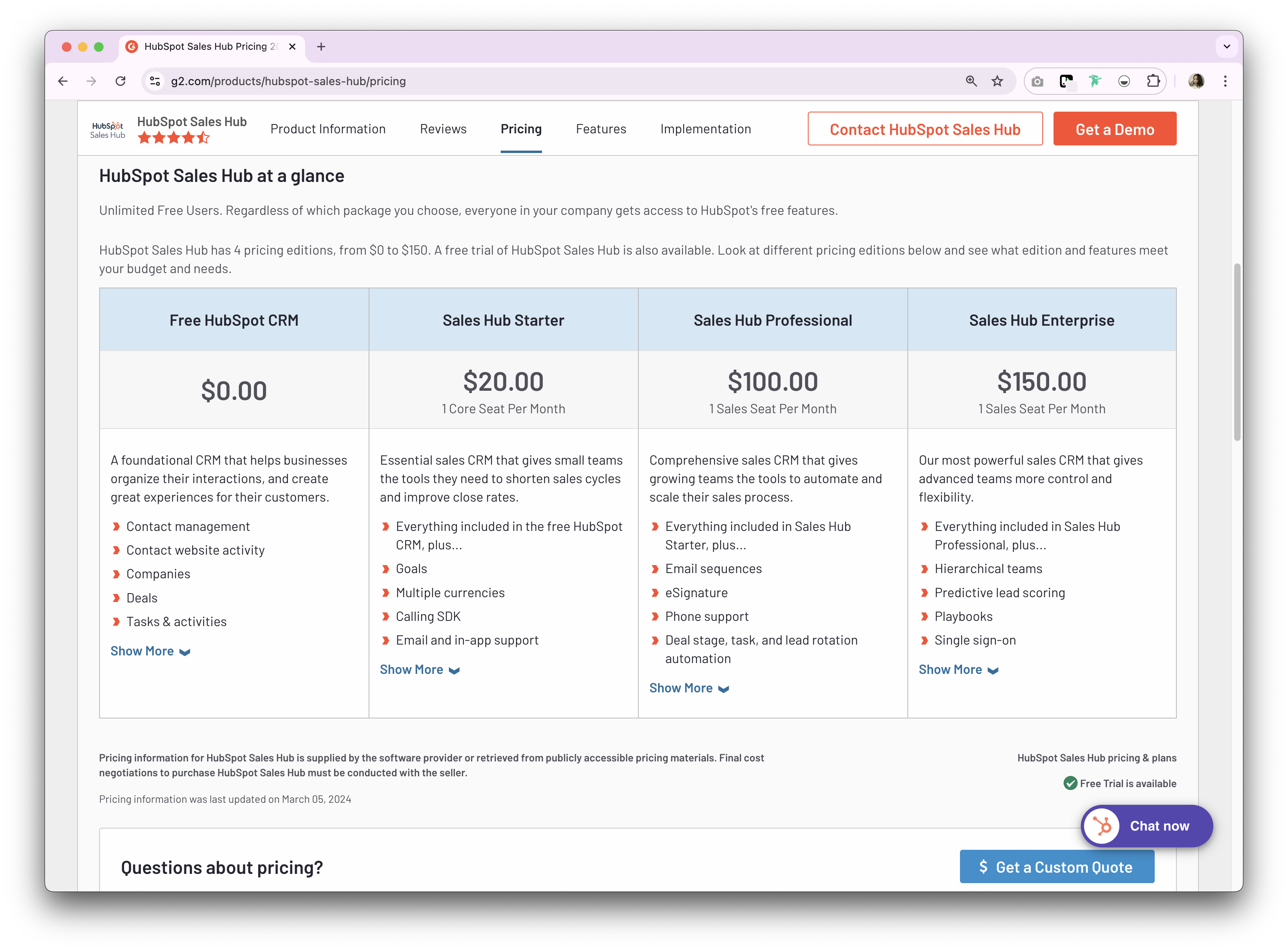
Tarifs HubSpot
Les prix et les forfaits de la suite CRM pour un abonnement annuel sont les suivants.
- Starter: 15 $ par utilisateur et par mois.
- Professionnel: 450 $ par utilisateur et par mois.
- Entreprise: 1 500 $ par utilisateur et par mois.
<
Zoho
- Zoho une offre gratuite limitée à trois utilisateurs, adaptée aux petites entreprises. Au-delà, l'abonnement annuel est le suivant : texte
- Standard : 20 $ par utilisateur et par mois
- Professionnel : 35 $ par utilisateur et par mois
- Entreprise : 50 $ par utilisateur et par mois

Présentation de folk : la meilleure alternative à HubSpot et Zoho
Vous recherchez une alternative abordable ? Nous vous recommandons folk. Ce n'est pas un hasard si folk s'impose comme la solution ultime pour les équipes commerciales de 20 à 50 personnes. Cette plateforme CRM plusieurs fois primée est appréciée pour son système CRM plug-and-play facile à utiliser, qui s'adapte parfaitement aux organisations commerciales de taille moyenne.
👉🏼 Essayez folk pour organiser vos pipelines et ne manquez plus jamais un suivi lorsque vous passez de HubSpot ou Zoho.
Fonctionnalités principales
Prix et forfaits
folk un essai gratuit de 14 jours. Passé ce délai, vous pouvez souscrire à des abonnements mensuels ou annuels à des tarifs abordables. Le tarif de l'abonnement annuel est le suivant :
- Forfait Standard :20 par utilisateur et par mois.
- Premium:40 par utilisateur et par mois.
- Personnalisé : à partir de 80 $ par utilisateur et par mois.

HubSpot ou Zoho: quel est le verdict ?
Lorsque l'on compare HubSpot et Zoho, les deux offrent des solutions CRM complètes avec des atouts uniques. HubSpot excelle par son interface conviviale et ses outils marketing intégrés, ce qui le rend idéal pour les entreprises axées sur le marketing entrant. Zoho, quant à lui, offre une personnalisation étendue et des prix abordables, ce qui convient parfaitement aux entreprises qui recherchent flexibilité et budget raisonnable. Cependant, pour les équipes commerciales de 20 à 50 personnes qui ont besoin d'une approche plus personnalisée de la gestion des relations, folk offre une alternative supérieure à ces options CRM traditionnelles, alliant facilité d'utilisation et personnalisation spécialement conçue pour les organisations commerciales de taille moyenne.
👉🏼 Essayez folk pour gérer les rappels basés sur les contacts avec votre équipe tout en comparant HubSpot et Zoho.
FAQ
Quelle est la différence entre HubSpot et Zoho?
HubSpot propose une suite intuitive tout-en-un couvrant le marketing, les ventes et les services, avec une forte automatisation. Zoho une personnalisation poussée, des workflows de vente robustes et des fonctionnalités étendues à moindre coût. Le choix dépend des besoins en matière de convivialité par rapport à la flexibilité.
Lequel est le plus facile à utiliser : HubSpot ou Zoho?
HubSpot est généralement plus facile à prendre en main grâce à son interface utilisateur épurée et ses préréglages. Zoho puissant, mais son apprentissage est plus difficile en raison de ses nombreuses options de personnalisation et de configuration.
Zoho est-il Zoho que HubSpot ?
À niveaux comparables, les tarifs Zoho sont généralement plus bas, et l'entreprise propose une offre gratuite pour les petites équipes. HubSpot peut devenir plus coûteux à mesure que les fonctionnalités et les licences augmentent. Comparez toujours les niveaux actuels et les modules complémentaires requis.
Quelle est une bonne alternative à HubSpot et Zoho les équipes de taille moyenne ?
Pour les équipes commerciales de 20 à 50 personnes, folk propose des pipelines personnalisables, l'enrichissement des contacts, la synchronisation Gmail/Outlook et des séquences d'e-mails dans un CRM facile à utiliser et prêt à l'emploi, avec un essai de 14 jours et des forfaits abordables.
Découvrez folk, votre CRM sur pilote automatique