


Откройте для себя Folk — CRM для компаний, ориентированных на людей
Почему ваша система продаж сейчас так важна
A sales stack is not just a collection of tools. It's the foundation of a high-performing, scalable, and data-driven sales machine.
If your team still juggles spreadsheets and scattered tools, you're leaking time and revenue.
According to LinkedIn's State of Sales Report (2024), 80% of top-performing sales teams use more than five tools in their sales stack. Done right, this stack becomes your team's competitive edge.
| Основные моменты |
|---|
|
Что такое «продажный стек»?
A sales stack—also called a sales tech stack—is the complete set of tools sales teams use to manage every part of the sales process: from lead generation and outreach to deal tracking, automation, and analytics.
Unlike a single CRM, a sales stack includes multiple specialized tools that work together to reduce friction, speed up sales cycles, and create better alignment between teams. Every company's stack looks different depending on their size, resources, sales maturity, and goals.
Why a Strong Sales Stack Is Non-Negotiable
A well-assembled sales stack directly impacts a team's ability to close deals, reduce time to revenue, and improve productivity.
According to LinkedIn, teams with a mature sales stack are 23% more likely to hit their revenue goals. InsideSales Labs reports that 50% of reps' time is spent on non-selling tasks when workflows aren't automated. And a 2023 HubSpot report shows that 42% of sales reps feel slowed down by disconnected tools.
Key Benefits of a Smart Sales Stack
- Increased Productivity: Automating manual tasks like data entry, follow-ups, and reminders frees up time for what matters—building relationships and closing.
- Better Visibility: Integrated analytics and tracking let sales leaders make decisions based on live performance data, not guesswork.
- Consistent Outreach: Sales engagement tools allow teams to send personalized messages at scale, with pre-set workflows that reduce human error.
- Team Alignment: When marketing, SDRs, AEs, and Customer Success share tools and data, collaboration improves and the customer experience becomes seamless.
- Scalability: A flexible stack grows with your team. It simplifies onboarding, expands capabilities, and avoids costly tool migrations.
folk CRM: The Core of a Modern Sales Stack for Service Businesses
In a modern sales tech stack, the CRM isn't just a database, it's the operational brain. And for growing sales teams of 20-50 people, folk CRM offers exactly what's needed: seamless integration, flexibility, and simplicity without sacrificing power.
Centralize All Sales Activities
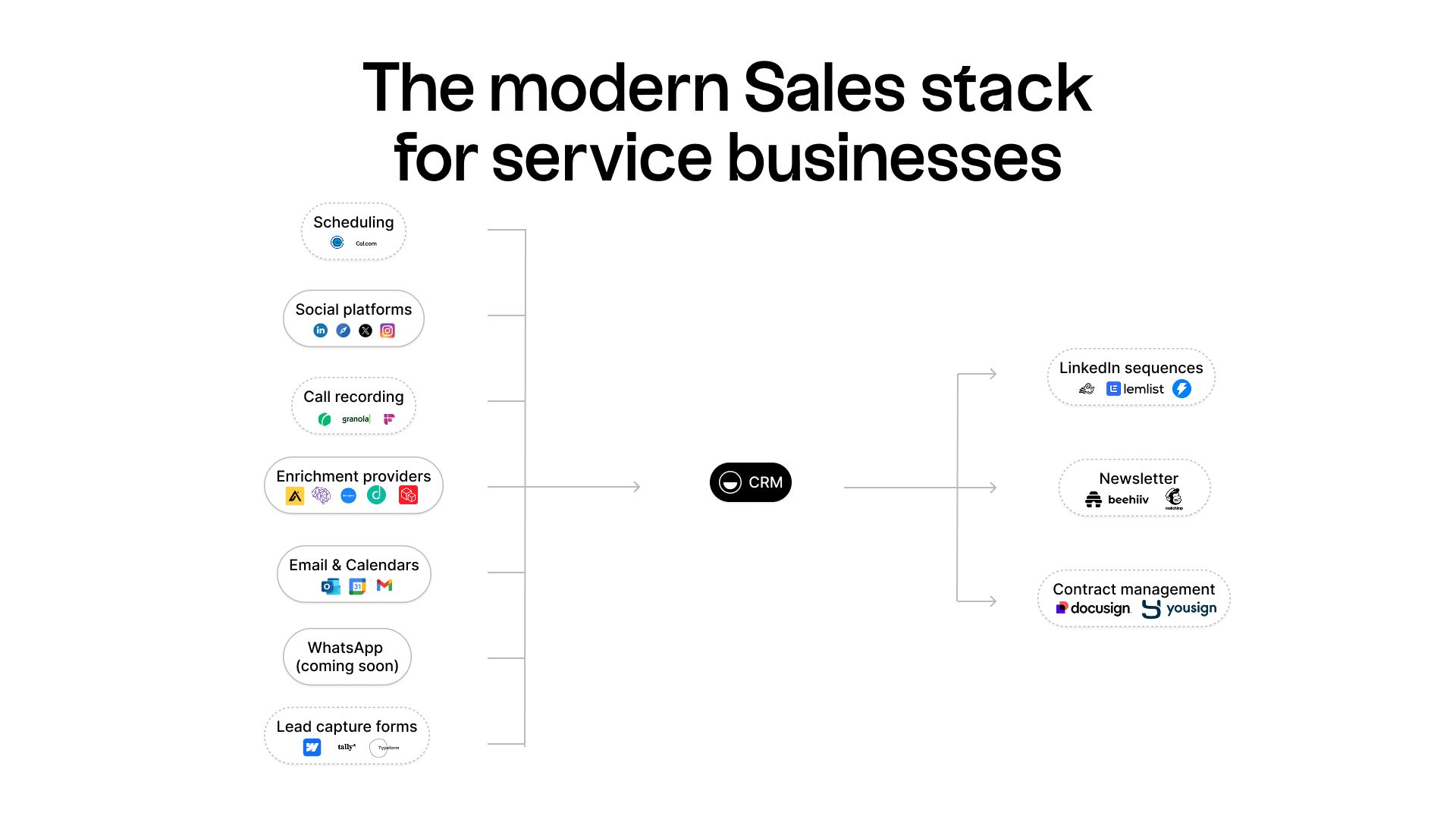
folk CRM acts as the hub of your stack, connecting with the essential tools sales teams use daily:
- Scheduling: Tools like Calendly or Côtom plug into folk CRM to simplify meeting management.
- Lead Capture Forms: Integrate Typeform, Tally or Jotform directly into your CRM to automate inbound lead routing.
- Social Platforms: Centralize contact activity across LinkedIn, X, Instagram and Facebook to track interactions and nurture relationships.
- Enrichment: folk integrates with providers like Clearbit, Dropcontact or Clay to auto-enrich contacts—no manual input needed.
- Email & Calendars: Sync with Gmail, Outlook, and calendar tools to track communications in one place.
- Outreach & Sequences: Connect to Lemlist, LaGrowthMachine or Instantly to manage multichannel sequences at scale.
- Newsletter & Nurturing: Push segmented lists from folk CRM into Beehiv or Mailchimp for email campaigns.
- Contract Management: Close deals faster with integrations to DocuSign and Yousign.
This entire ecosystem flows through folk CRM, enabling real-time collaboration, clear visibility, and automated follow-up—without switching between 10 tabs.
👉🏼 Try folk now to never miss a follow-up
How to Build an Effective Sales Stack
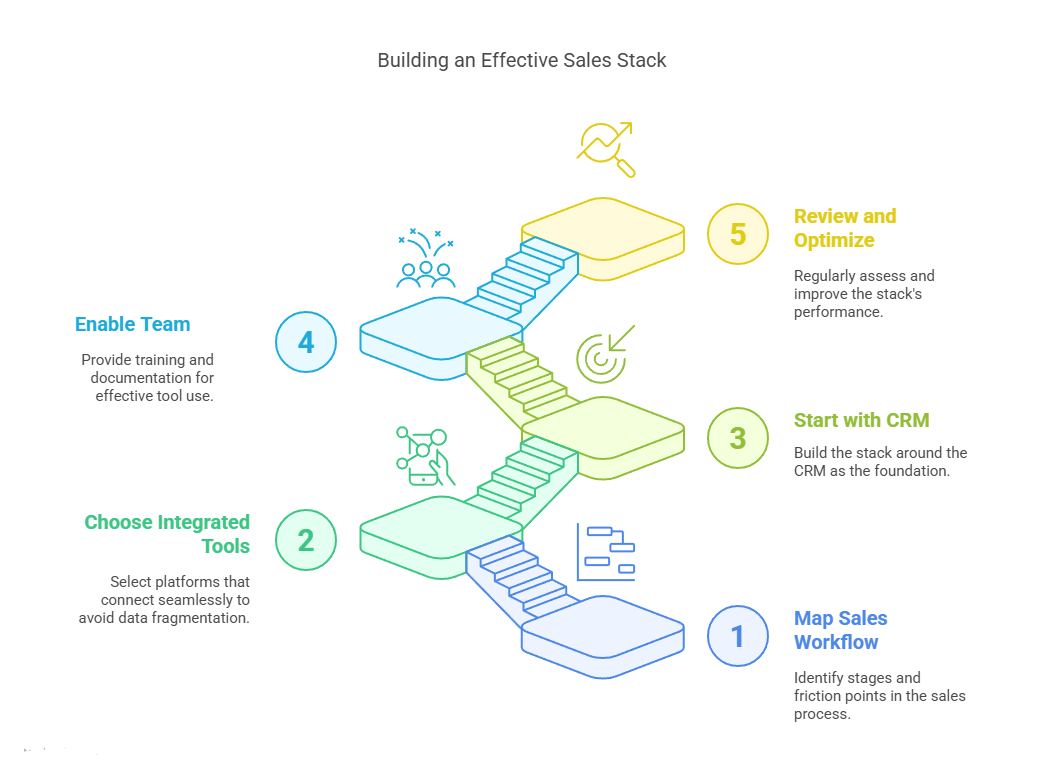
A good sales stack doesn't happen by accident. It's the result of deliberate planning, alignment with your sales process, and regular iteration. For sales operations teams managing 20-50 person organizations, building the right stack is crucial to avoid tool sprawl while maintaining functionality. Here's how to build a stack that actually supports your team:
- Map your sales workflow
Identify each stage of your sales process and spot the friction points—manual tasks, delays, or data loss. - Choose integrated tools
Prioritize platforms that connect seamlessly to avoid fragmented data and redundant tasks. - Start with your CRM
Your CRM is the foundation. Build around it by layering tools for outreach, enrichment, automation, and analytics. - Enable your team
Document how your stack works. Provide onboarding and training to ensure every rep uses the tools effectively. - Review and optimize quarterly
Measure tool adoption, impact on revenue, and ROI. Cut what's not used and invest where results show.
Sales Stack Examples by Business Profile
Best Sales Stack for Agencies
A well-built sales stack for agencies helps manage multiple clients, campaigns, and deliverables without chaos. It streamlines communication, keeps deal flow organized, and provides clear visibility across all teams.
| Цель | Инструмент |
|---|---|
| CRM | folk CRM, HubSpot, Pipedrive |
| Sales Engagement | Apollo.io, Reply.io |
| Project Management | Notion, ClickUp |
| Reporting | Databox, Google Looker |
| Communication | Slack, Loom |
Best Sales Stack for Solopreneurs
Solopreneurs wear all the hats: prospecting, selling, marketing, and admin. They need lean, intuitive tools that automate repetitive tasks and keep everything in one place—without enterprise-level complexity. Here is an overview of the best sales stack for solopreneurs.
| Цель | Инструмент |
|---|---|
| CRM | folk CRM, Zoho CRM, Capsule CRM |
| Lead Capture | Typeform, Tally |
| Email Outreach | Mailerlite, ConvertKit |
| Scheduling | Calendly, SavvyCal |
| Automation | Zapier, Make.com |
Best Sales Stack for Sales Teams
A solid sales stack for sales teams gives mid-size reps the tools they need to handle outreach, tracking, analytics, and performance—without missing a beat. For teams with 20-50 sales professionals, folk CRM stands out as the optimal choice, providing enterprise-grade functionality with the simplicity that growing teams need to maintain consistency, collaboration, and scalability across multiple regions and verticals.
| Цель | Инструмент |
|---|---|
| CRM | folk CRM, Salesforce, HubSpot |
| Sales Engagement | Outreach, Salesloft |
| Reporting | Tableau, Power BI |
| Обогащение | Clearbit, Lusha |
| Communication | Microsoft Teams, Zoom |
Best Sales Stack for Startup Founders
Startup founders often double as their own sales reps. They need a lightweight but powerful stack to generate leads, track conversations, and close early deals—without wasting time on setup or complex workflows. The best sales stack for startup founders includes these tools:
| Цель | Инструмент |
|---|---|
| CRM | folk CRM, Pipedrive, Close |
| Email Sequences | Smartlead, Instantly |
| Lead Gen | Apollo.io, Clay |
| Deal Flow | Airtable, folk Tags |
| Automation | Zapier, Bardeen |
Заключение
A strong sales stack is essential for growth-focused sales teams. Whether you're a solo founder or leading a medium-sized sales organization of 20-50 people, the right combination of tools will improve productivity, reduce manual work, and accelerate your sales cycle.
To recap:
- A sales stack is more than a CRM—it's the full ecosystem that powers your revenue engine.
- Choosing the right tools depends on your size, goals, and workflows.
- folk CRM is a versatile, scalable choice for modern teams that want power without complexity.
👉🏼 Попробуйте folk прямо сейчас, чтобы управлять напоминаниями на основе контактов вместе со своей командой.
Часто задаваемые вопросы
Что такое стек продаж?
A connected set of tools that runs the sales lifecycle: prospecting, outreach, meetings, deal tracking, automation, and reporting. Built around a CRM to reduce manual work, speed cycles, and keep data consistent.
What is the difference between a sales stack and a marketing stack?
A sales stack supports reps with outbound, pipeline, and closing. A marketing stack drives awareness and inbound—content, ads, SEO, and lead capture—then hands qualified leads to sales. They integrate but serve different stages.
How often should a sales stack be reviewed?
Quarterly. Audit usage, data accuracy, and ROI. Remove low-adoption tools, fix integrations, standardize workflows, and pilot replacements only when they solve a defined gap.
How do you build a sales stack?
Map the sales process, choose integrated tools, and start with a CRM such as folk. Layer outreach, enrichment, scheduling, and analytics. Document workflows, train the team, and iterate based on results.
Откройте для себя народную CRM-систему
Как помощник по продажам, которого у вашей команды никогда не было
