


Ontdek folk het CRM-systeem voor bedrijven die door mensen worden aangestuurd
A cold email campaign gets replies. Most say “not interested.” Another books meetings, but few prospects fit the offer. Which message actually works?
👉 Cold email A/B testing helps sales teams compare two versions of an email and measure which one produces better outcomes.
A controlled test isolates a specific change, such as the opening line or call to action, so the result informs the next campaign.
For startups with limited prospect lists, each test needs a clear purpose. The goal is to learn what starts a useful sales conversation without burning through contacts or drawing conclusions from a handful of responses.
This guide covers what to test, how to compare variants fairly, and which metrics help identify a stronger message.
Cold Email A/B Testing: Key Takeaways
- Change one variable per test. Keep the audience, offer, and sending conditions comparable.
- Split prospects randomly. Give each variant a fair chance with similar groups.
- Measure commercial interest. Prioritize positive replies or qualified meetings over opens.
- Set the rules before sending. Define the success metric, target sample, and response window.
- Accept inconclusive results. Small samples offer clues, but they rarely prove that one email performs better.
What Is Cold Email A/B Testing?
Cold email A/B testing is a method for comparing two versions of a prospecting email to determine which performs better against a defined goal. Each version goes to a separate, randomly assigned group within the same target audience. A controlled test changes one element while keeping the other conditions consistent.
For example, a startup targets heads of sales at B2B SaaS companies. The team sends the same email with two different calls to action:
✅ Version A: “Open to a 15-minute conversation next week?”
✅ Version B: “Is improving outbound conversion a priority right now?”
The subject line, opening, offer, and follow-up schedule stay the same. The team compares positive replies to assess which request starts more relevant conversations.
This approach also goes by cold email split testing. It helps teams replace assumptions with evidence, though results apply to the audience and conditions tested. An approach that works with startup founders may perform differently with enterprise sales directors.
💡 folk CRM tip: Add custom fields for the test name and assigned variant to each prospect’s record. Keep the assignment visible so the team can connect replies and sales outcomes to the right version.
What Should Sales Teams A/B Test in Cold Emails?
Start with the element most likely to explain weak results. If prospects reply but decline meetings, test the call to action. If replies suggest the offer feels irrelevant, test the value proposition.
#1. The Value Proposition and Opening Line
The value proposition gives prospects a reason to care. Test two distinct benefits of the same offer while keeping the opening and CTA unchanged.
For a sales tool, one version might focus on reducing administrative work. The other might focus on keeping deals moving. Both benefits can matter, but the test explores which one resonates with a specific segment.
The opening line serves a different purpose: it establishes why the message belongs in that person’s inbox. Compare a role-based opening with one tied to a verified company event. Keep the value proposition identical during this test.
When testing personalized email icebreakers, judge the accuracy and relevance of each line before sending. A company mention adds little if it has no connection to the offer.
💡 folk CRM tip: Use contact details, custom fields, and notes to prepare relevant opening lines. Review any AI-generated text and apply the same personalization rules to both variants.
#2. The Call to Action and Email Length
A CTA test explores how much commitment prospects accept at first contact.
Compare a direct meeting request with a question about the problem:
→ Meeting request: “Open to a 15-minute call on Thursday?”
→ Interest question: “Does manual pipeline reporting slow the team down?”
Measure results against the chosen goal. An interest question may attract more positive replies while creating additional work before a meeting gets booked.
For an email length test, keep the core argument intact. Compare a concise version with one that adds a useful explanation or supporting detail. If the longer version introduces a new benefit, the test no longer isolates length.
#3. The Subject Line and Follow-Up
Test subject lines that accurately describe the message. A problem-focused subject such as “Manual pipeline updates” can compete against an outcome-focused alternative such as “Less pipeline admin.”
Keep the email body identical and assess downstream replies. Open rates alone provide an unreliable basis for choosing a winner.
Follow-up tests explore what helps an unanswered conversation move forward. Compare a relevant customer example with a practical suggestion while keeping the first email and sending delays consistent. Use the same number of steps in both email sequences so each group receives equal exposure.
How to Run a Cold Email A/B Test in 6 Steps
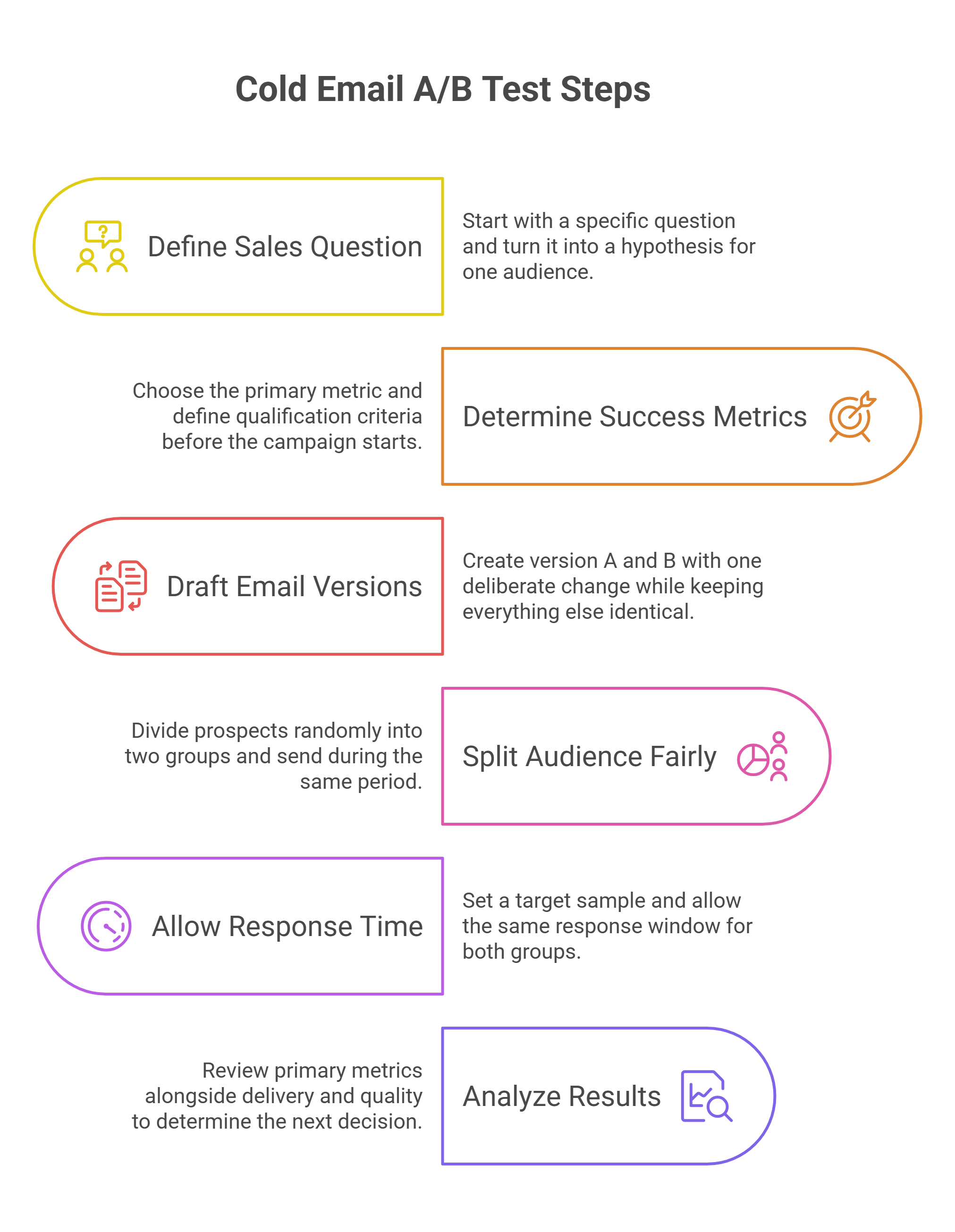
1. Start With a Specific Sales Question
A useful test starts with something the team needs to learn. Perhaps prospects show interest but hesitate when the email asks for a meeting. Does a simpler question make the first reply easier?
Turn that question into a hypothesis: Asking about the prospect’s priorities generates more positive replies than asking for a call.
Choose one audience for the test. Heads of sales at small SaaS companies share a more comparable context than a list that mixes founders, enterprise buyers, and freelance consultants.
2. Decide What Counts as Success
Choose the primary metric before the campaign starts. Otherwise, a higher open rate can distract from a weaker sales result.
For a test focused on starting conversations, track positive replies. Define what qualifies: a prospect acknowledges the problem, requests relevant information, or agrees to discuss the offer. Automatic responses and polite rejections do not count.
If the objective is meetings, measure qualified meetings booked. Apply the same qualification criteria to both groups, even when one version attracts more replies.
3. Write the Emails Side by Side
Create version A, duplicate it, and make one deliberate change.
For a CTA test, the difference might look like this:
- A: “Open to a 15-minute call next week?”
- B: “Is reducing pipeline admin a priority this quarter?”
Keep the rest of the email identical. Adding a customer story to B or shortening its opening introduces another possible explanation for the result.
Read both messages before sending. Check the personalization fields, company references, and formatting. Each version needs to make sense as an actual email.
4. Give Both Versions a Fair Audience
Split eligible prospects randomly into two groups. A roughly equal split usually makes the comparison easier.
Avoid dividing a sorted list down the middle. If the list runs from smallest to largest company, the two versions reach different types of buyers. When several prospects work at the same company, keep them in the same test group.
Send A and B during the same period, using comparable schedules. Maintain the same sender setup and email deliverability checks across both groups.
💡 folk CRM tip: Assign variants in a spreadsheet before importing the list. Save the assignment in a custom field in folk, alongside the test name. This gives the team a way to trace each conversation back to the message the prospect receives.
5. Allow Enough Time for Replies
A prospect who receives an email on Friday afternoon has less time to respond by Monday than someone contacted on Tuesday. Build the response window into the test.
Set the target sample and sending period before launch. Then allow the same response time after each group’s final touch. If the campaign includes sales email follow-ups, keep their content and delays consistent unless the follow-up itself is the variable.
There is no fixed number of recipients that makes every test reliable. Low response rates and small differences require larger samples. For a startup with a short prospect list, the result may provide a useful clue without supporting a firm conclusion.
6. Read the Counts Behind the Percentages
Suppose A receives two positive replies and B receives four from equally sized groups. B shows twice the positive reply rate, but the result rests on just six responses. That leaves plenty of uncertainty.
Review the primary metric alongside delivery problems, negative replies, and meeting quality. Check that both groups receive the campaign as planned.
When the evidence supports a meaningful improvement, use the stronger version as the reference for the next test. When it does not, record the result as inconclusive.
Keep a short test log: the question, the change, the audience, the results, and the next decision. That record helps the team build on previous work instead of testing the same ideas again.
Which Metrics Matter in Cold Email A/B Testing?
Positive replies and qualified meetings show whether a message creates sales interest. Delivery and opt-out data help explain the result and flag problems that need attention.
Count unique recipients for each variant. Three replies from one prospect represent one responding contact, and follow-ups do not add new recipients to the denominator.
1. Separate Positive Replies From Total Replies
An email that prompts “Please remove me” gets a reply. It creates no sales opportunity.
Classify responses using a few clear categories: positive, negative, referral, opt-out, and automatic response. Decide how to handle referrals before the test. A referral to the right buyer can be useful, but it does not necessarily indicate buying interest.
Keep those definitions stable. Otherwise, the team risks crediting one variant with responses it excludes from the other.
2. Check What Happens After the Reply
A low-commitment question can start more conversations while leaving reps with more qualification work. A direct meeting request may attract fewer responses but produce more relevant bookings.
Use the primary metric to assess the hypothesis, then check the next stage for context. If positive replies rise while qualified meetings remain flat, investigate the conversations before expanding the campaign.
💡 folk CRM tip: Add a reply outcome field to contact records and use shared definitions across the team. Connect interested prospects to the relevant deal so reps can track outreach performance beyond the first response.
3. Treat Opens as Supporting Context
Tracking pixels cannot reliably establish whether a person reads an email. Privacy tools may load images automatically, while image blocking can hide real opens.
That makes open rate a weak basis for selecting a winning subject line. Compare positive replies or qualified meetings across the full delivered audience, even when the subject line is the only element that changes.
Cold Email A/B Testing Example
A startup sells software that automates pipeline reporting. Its sales team targets heads of sales at US SaaS companies with 10–50 employees.
The question is straightforward: does asking about a priority generate more positive replies than asking for a meeting?
The following example uses fictional emails and illustrative results.
Version A: Ask for a Meeting
Subject: Pipeline reporting
Hallo {{first_name}},
Does your team still pull deal updates into a spreadsheet before the weekly pipeline review?
{{product}} brings those updates into one report, so managers spend less time chasing reps for numbers.
Open to a 15-minute call next week?
{{sender_name}}
Version B: Ask About the Priority
Subject: Pipeline reporting
Hallo {{first_name}},
Does your team still pull deal updates into a spreadsheet before the weekly pipeline review?
{{product}} brings those updates into one report, so managers spend less time chasing reps for numbers.
Is reducing pipeline reporting work a priority this quarter?
{{sender_name}}
Only the final question changes. Both groups receive the same follow-ups on the same schedule, and the team gives each group an equal response window.
What the Results Show
Version B generates eight more positive replies. That represents a 2 percentage point increase, or roughly a 67% relative lift.
Yet the additional interest does not translate into more qualified meetings during the observation window. Some prospects acknowledge the problem without agreeing to a call. Others may need more time or further qualification.
The sample also leaves uncertainty around both outcomes. These figures alone do not establish a reliable winner.
If positive replies are the primary metric, B offers a promising direction for another test. If qualified meetings are the priority, the team has no clear evidence of improvement. Reviewing the replies helps explain where interest stalls and what the next experiment should address.
5 Cold Email A/B Testing Mistakes That Distort Results
1. Rewriting the Entire Email
Version A leads with a customer problem and asks for a call. Version B opens with a company announcement, adds a testimonial, and offers a resource.
The comparison can show which complete message performs better. It cannot explain which change drives the difference. For a test that produces a reusable lesson, isolate one element and keep the rest consistent.
2. Giving One Variant Better Prospects
A list of recently funded startups differs from a list of companies with no known buying signal. Even strong copy cannot make those audiences equivalent.
Assign prospects from the same eligible pool. Check that one group does not contain a much larger share of high-fit accounts, recent inbound contacts, or prospects who already know the company.
3. Declaring a Winner After a Few Replies
Early results attract attention because they offer an immediate answer. They also move quickly: one additional reply can reverse the apparent lead in a small test.
Keep routine performance reviews separate from the final decision. Monitor sending problems throughout the campaign, but assess the hypothesis at the planned endpoint. Avoid extending a completed test simply because the preferred version needs more time to win.
4. Letting Reps Handle Each Group Differently
The initial emails match the test plan, but one rep follows up faster with version A. Another adds LinkedIn messages only for version B. The final meeting count now reflects those extra touches as well as the email.
Agree on the process after a reply: who responds, how quickly, and how prospects qualify for a meeting. Record additional outreach so the team can spot differences that affect the result.
5. Applying the Result to Every Segment
An interest-based CTA performs well with startup founders. That finding does not establish how procurement leaders or enterprise sales teams respond.
Keep the audience and conditions attached to every result. Before rolling a winning message into a different segment, run a fresh comparison.
💡 folk CRM tip: Keep the test assignment and prospect context in the contact record. Add notes when a rep changes the planned outreach, so the team can account for those exceptions during the review.
Manage Cold Email Tests With folk CRM!
Turn email experiments into a repeatable sales process. folk CRM brings prospect details, conversations, and deals together, giving the team context to follow up and assess which messages create opportunities.
- Import assigned prospects. Split the list randomly beforehand, then import a custom field identifying each contact’s variant.
- Create two groups. Organize recipients by assignment and prepare each email version.
- Record reply outcomes. Classify responses consistently and connect interested contacts to deals.
- Compare results. Review positive replies and qualified meetings after the agreed response window.
💡 folk CRM tip: Include the test name in each group’s name to make past experiments easy to find.
Give the whole team a shared view of what works, from the first email to the sales pipeline.
Veelgestelde vragen
What Is Cold Email A/B Testing?
Cold email A/B testing compares two email versions across randomly assigned groups of similar prospects. A controlled test changes one element, such as the CTA, while keeping other conditions consistent. Sales teams compare results against a predefined metric to decide which approach deserves further use or testing.
What Should Be Tested First in a Cold Email?
Start with the most likely barrier to a useful conversation. Test the value proposition when prospects question the offer’s relevance. Test the CTA when interested prospects hesitate to take the next step. Keep the experiment focused on one change so the result provides a clear lesson.
How Many Emails Are Needed for an A/B Test?
The required sample depends on the baseline response rate, the improvement worth detecting, and the desired statistical confidence. There is no universal minimum. Small lists can reveal promising directions, but a few additional replies rarely establish a reliable winner. Set the target sample before sending.
How Long Should a Cold Email A/B Test Run?
Run the test through the planned sending period and give both groups an equal response window after their final scheduled email. Include follow-ups in that schedule. Choose the endpoint before launch rather than stopping as soon as one version takes the lead.
What Is the Best Metric for Cold Email A/B Testing?
Positive reply rate suits tests focused on starting relevant conversations. Qualified meeting rate suits tests focused on generating sales meetings. Choose one primary metric before launch, define what qualifies, and review downstream outcomes for context. Open rates alone do not reliably indicate commercial interest.
Can Small Sales Teams A/B Test Cold Emails?
Yes. Small teams can compare two variants within a narrow prospect segment and record what they learn. Limited volume makes small performance differences difficult to interpret, so focus on meaningful changes. Treat uncertain results as hypotheses for another test rather than rules for every campaign.
Maak kennis met folk, het AI-CRM voor uw volledige verkoopproces.