


Ontdek folk het CRM-systeem voor bedrijven die door mensen worden aangestuurd
A prospect recognizes the sender’s name. A mutual contact makes an introduction, or a conversation at an event creates a reason to reconnect. The first message has a starting point—but the sales conversation still needs a purpose.
Warm outreach builds on an existing relationship, introduction, or meaningful prior interaction to start a relevant conversation.
The strongest messages connect that shared context to a specific need and offer a clear, proportionate next step.
For SDRs and sales teams, the challenge lies in judging the connection accurately. A useful exchange can support a thoughtful follow-up. A LinkedIn acceptance or email open provides far less context. This guide explains the difference, with practical examples, message templates, and ways to keep follow-up organized.
Warm Outreach: Quick Recap!
- What it means: Contacting a prospect through an existing relationship, introduction, or meaningful prior interaction.
- How it differs from cold outreach: The message builds on recognizable shared context rather than starting without an established connection.
- Strong starting points: A trusted introduction, a substantive conversation, or an explicit invitation to reconnect.
- What a message needs: An accurate reference to the connection, a relevant reason for reaching out, and one clear next step.
- What warmth does not establish: Familiarity alone does not confirm buying intent or justify repeated follow-ups.
- What to measure: Positive replies, qualified conversations, meetings held, and opportunities created.
What Is Warm Outreach?
Warm outreach is a sales approach that contacts prospects through an existing relationship, a trusted introduction, or a meaningful prior interaction. The message draws on context the recipient can recognize, then connects it to a relevant reason for continuing the conversation.
That context takes several forms. A customer introduces a sales rep to a colleague facing a related problem. An event attendee asks for an example after a discussion. A former prospect invites the team to reconnect when a project resumes.
In each case, the connection gives the message a credible starting point. Relevance still determines whether the conversation deserves to continue. A previous discussion about reporting does not establish interest in an unrelated product.
Warm Outreach vs. Cold Outreach vs. Inbound Follow-Up
The distinction depends on the relationship and what triggers the message.
These categories can overlap. A former contact who requests a demo has both an existing relationship and an immediate inbound need. The response should address that request before introducing a broader sales agenda.
A personalized cold email, meanwhile, remains cold outreach when the sender references public information without an established connection. Research improves relevance; it does not create a relationship.
What Makes a Prospect Warm?
A prospect becomes warm through a connection that gives the outreach recognizable context. The strength of that connection depends on what actually happens between the people involved, how recently it happens, and whether it relates to the proposed conversation.
A direct exchange provides more useful context than a passive engagement signal. A question about a specific workflow gives a rep something concrete to address. A reaction to a post offers much less information.
The connection also needs to belong to the sender or receive a clear explanation. If one colleague holds the original conversation and another takes over, the message should acknowledge that handoff. Access to a shared contact record does not create personal familiarity.
Context loses accuracy over time. A former prospect may change roles, abandon a project, or resolve the original problem. Reconnecting works best when the message checks whether the subject remains relevant instead of treating an old need as current.
For sales teams, a useful contact record captures the interaction, its date, the topic, and any agreed next step. Those details help distinguish a genuine reason to reconnect from a name that simply appears in the database.
💡 folk CRM tip: Does the message reference an interaction the recipient can reasonably recognize? If explaining the connection requires stretching what happens, the outreach needs a more accurate opening.
How to Build a Warm Outreach Message in 4 Steps
A warm outreach message needs four elements: a recognizable connection, a relevant reason to reconnect, something useful, and a clear next step. Each element should follow naturally from the interaction that makes the contact warm.
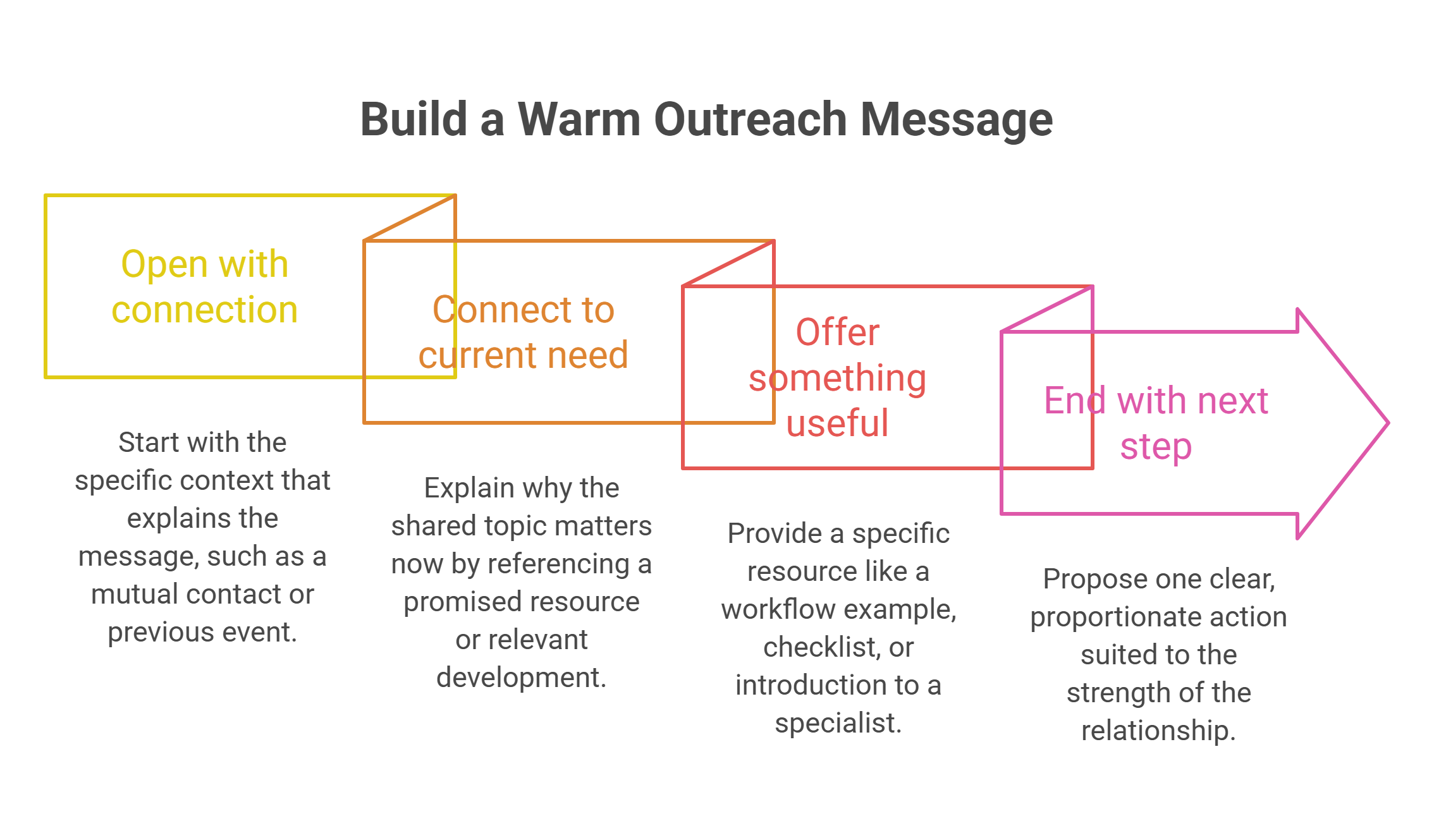
1. Open With the Actual Connection
Start with the specific context that explains the message. Name the person making the introduction, reference the topic discussed at an event, or acknowledge the earlier exchange.
Keep that opening brief. Its purpose is to help the recipient place the conversation, without making the relationship sound closer than it is.
Accuracy matters more than familiarity. A colleague’s conversation needs an explicit handoff. A mutual contact needs to make an introduction before the message describes one.
2. Connect That Context to a Current Need
Explain why the shared topic matters now. A promised resource, an agreed date to reconnect, or a relevant development can provide that reason.
When the prospect’s circumstances remain uncertain, leave room for correction. A previous discussion about pipeline visibility does not prove that the problem still exists six months later.
The message should distinguish confirmed information from a possible need. That makes it easier for the recipient to clarify priorities without having to reject an entire sales pitch.
3. Offer Something Useful and Specific
Choose an offer that fits the conversation: an answer to a question, a workflow example, a short checklist, or an introduction to a relevant specialist.
Describe the resource clearly enough for the recipient to assess its usefulness. “An example of how a five-person SDR team assigns inbound leads” carries more meaning than “some insights that might help.”
The offer should deliver on the opening. A message that references a reporting problem needs to address reporting before introducing unrelated capabilities.
4. End With One Proportionate Next Step
Match the request to the strength of the relationship and the prospect’s engagement.
- After an initial introduction, confirm whether the topic is relevant.
- After a substantive exchange, offer the specific resource discussed.
- When a prospect expresses interest in evaluating a solution, propose a focused conversation.
One clear request makes the response easier. Multiple questions, several links, and a meeting invitation can turn a straightforward follow-up into unnecessary work.
→ Warm outreach message structure:
✔️ Connection: The interaction that explains the message.
✔️ Relevance: The reason the topic matters now.
✔️ Value: The specific information or assistance on offer.
✔️ Next step: One action suited to the conversation.
Before sending, remove any sentence that could fit almost any prospect. The remaining message should make the connection and its purpose clear without relying on a generic product pitch.
4 Best Warm Outreach Templates to Use in B2B Sales
These illustrative templates cover four common situations. Each needs a real interaction behind it and details that accurately reflect the conversation.
Template 1: After a Trusted Introduction
Context: A mutual contact introduces both parties and mentions a specific business need.
Subject: Introduction from [Name]
Hi [First name],
Thanks for the introduction, [Mutual contact].
[Mutual contact] mentions that your SDR team is reviewing how inbound leads reach the right rep. I work on that process with sales teams and have a short routing checklist that may help frame the discussion.
Would that be useful?
[Signature]
The message acknowledges the introduction and stays within the need shared. Offering a relevant resource gives the recipient a straightforward next step.
👉 Use only when: The introduction actually takes place. A shared connection on LinkedIn does not establish an endorsement.
Template 2: After an Event Conversation
Context: A prospect discusses a challenge at an event and asks for a resource.
Subject: The handoff checklist from [Event]
Hi [First name],
Following up on the conversation at [Event] about leads getting lost between marketing and sales.
Here’s the checklist I promised, including the ownership fields and fallback rules.
Which part of the handoff creates the most friction for your team?
[Signature]
The opening identifies a recognizable discussion, and the message delivers the promised item before asking a question. The reply can reveal where further help makes sense.
👉 Use only when: A substantive conversation supports the reference. A badge scan alone provides a different level of context.
Template 3: When Reconnecting With a Former Prospect
Context: A previous prospect identifies a later date to revisit a project.
Subject: Revisiting [Project]
Hi [First name],
Picking up the CRM discussion from [Month], as agreed. At the time, the team needs to complete [Dependency] before reviewing options.
Is the project back on the agenda, or does a later check-in make more sense?
[Signature]
The message explains the timing and lets the recipient update the situation. It avoids treating an earlier need as proof of an active purchase.
👉 Use only when: The timing and dependency match the recorded conversation. Replace the scheduled-check-in opening when no such agreement exists.
Template 4: After a Meaningful LinkedIn Exchange
Context: A prospect asks a specific question in a LinkedIn conversation. Continue in that thread.
Hi [First name],
On the question about keeping account ownership clear across SDRs and AEs: a useful starting point is to separate the account owner from the person responsible for the next action.
I have a simple field layout that shows how that works. Interested in seeing it?
The message answers part of the question immediately and offers a concrete extension. Staying in the existing thread preserves context.
👉 Use only when: The recipient participates in the exchange. A post reaction does not support an opening that implies a direct conversation.
Template check: Every reference to a discussion, introduction, or commitment needs to match what actually happens. Personalization works best when the recipient recognizes the context without having to reconstruct it.
7 Tips to Improve Your Warm Outreach
Warm outreach works best when the message reflects the relationship accurately and gives the recipient a useful reason to respond.
✅ Prioritize stronger relationship signals. Start with trusted introductions, direct questions, and substantive conversations. A clear topic or agreed next step gives the message a stronger foundation than a passive interaction.
✅ Verify the context before sending. Check the contact’s current role, the original conversation, and any commitments. When the relationship belongs to a colleague, explain the handoff and coordinate the approach.
✅ Make the opening specific. Reference the question, event discussion, or introduction in one concise sentence. Remove generic praise that adds length without helping the recipient recognize the connection.
✅ Match the channel to the relationship. Continue an active LinkedIn exchange in its existing thread when practical. Use email when the prospect requests it or the conversation already takes place there. Avoid simultaneous follow-ups across several channels without a clear reason.
✅ Keep subject lines clear and concise. Name the shared topic or promised resource. In folk’s internal email dataset, reply rates decline as subject length increases. This observation supports testing shorter subjects, but it does not isolate warm outreach or establish that length alone determines replies. Avoid misleading “Re:” prefixes and false urgency.
✅ Coordinate ownership across the team. Check recent activity before enrolling a contact in a sequence. Record who manages the relationship and who handles the next action. Duplicate messages can make a familiar connection feel like an uncoordinated campaign.
✅ Make declining easy. Ask one clear question and leave room for a change in priorities. A warm contact may have no current need, budget, or interest. Respect a refusal and update the record so another rep does not restart the same approach.
Best Tools for Warm Outreach in 2026
Warm outreach involves finding a credible connection, preserving the conversation, and delivering a relevant follow-up. Different tools support each task without turning every contact into another campaign recipient.
1. Relationship Mapping Tools Identify Introduction Paths
Relationship mapping helps reps understand who already knows a prospect and whether that connection supports an introduction.
- LinkedIn Sales Navigator: Helps explore professional relationships and identify potential paths to relevant stakeholders.
- folk: Surfaces relationship context through contact interactions and strongest-connection information within the workspace.
- Salesforce: Supports account and contact relationship mapping through features such as Account Contact Relationships and Opportunity Contact Roles.
Confirm the relationship before requesting an introduction. A visible connection or contact association does not establish how well two people know each other.
2. Meeting and Conversation Tools Preserve Useful Context
Conversation tools help capture the details that make a follow-up specific: the question raised, the constraint discussed, or the resource promised.
- Gong: Records and analyzes supported sales conversations, helping teams revisit buyer questions and discussion points.
- Fireflies.ai: Provides meeting transcription and summaries that teams can review when preparing follow-up.
- Fathom: Captures supported meetings and generates summaries that help preserve discussion context and action items.
Review generated notes before using them in a message. Summaries can omit qualifications or misattribute a statement, particularly when several people participate.
The useful detail is the commitment: what the prospect asks for, what the rep agrees to provide, and when the conversation continues.
3. Content-Sharing Tools Make Follow-Up More Useful
A relevant resource gives the recipient a reason to reopen the conversation. The format should match the question rather than add unnecessary production work.
- Loom: Supports short video walkthroughs for explaining a process, answering a specific question, or demonstrating an example.
- Google Docs: Provides a collaborative format for sharing checklists, written recommendations, and working documents.
Keep the resource focused. A short answer to the original question often fits an early conversation better than a complete sales presentation.
💡 folk CRM tip: Choose tools around the missing capability: a credible introduction path, reliable conversation notes, or a useful follow-up resource. Keep ownership and the next action visible in the contact record.
4. CRM Tools Keep Relationship History Accessible
A CRM helps reps understand why a contact is warm before preparing the next message.
- folk: Centralizes contacts and interaction history, including manually logged conversations. Relationship information helps teams coordinate outreach, while email sequences connect follow-up with CRM context.
- HubSpot: Organizes contact and company records, sales activities, and follow-up tasks so reps can review previous exchanges.
- Pipedrive: Connects people, organizations, deals, and scheduled activities, helping teams give each conversation a clear next action.
Store the reason for reconnecting alongside the contact. “Requests a handoff checklist after an event discussion” provides more useful guidance than a generic “warm lead” label.
5. Cold Email and Automation Tools Organize Warm Follow-Up
Platforms commonly used for cold email can also support warm outreach. The distinction comes from the audience and message context, rather than the software sending the email.
- Lemlist: Supports personalized campaigns and scheduled follow-ups, with configurable settings for pausing or ending sequences after engagement.
- Reply.io: Provides outreach sequences and response-handling controls that teams can configure around their follow-up process.
- folk: Combines email sequences with contact data and interaction history, helping reps prepare follow-up without separating the message from its relationship context.
Segment contacts by the actual connection: an introduction, an event conversation, or an agreed future check-in. Each situation needs an appropriate opening and cadence.
How to Measure Warm Outreach Performance
Warm outreach measurement starts with a clear definition of the audience. Grouping trusted introductions, former prospects, and passive social engagement together makes results difficult to interpret.
Record what makes each contact warm before outreach begins. Then track whether the conversation generates relevant interest and progresses toward a qualified opportunity.
Keep Warm Conversations Moving With folk CRM!
Warm outreach starts with a recognizable connection and earns a response through relevance. Keeping that context accessible helps sales teams follow through on introductions, deliver promised resources, and reconnect at the right time.
folk brings contact history, relationship information, and email sequences into one workspace. Reps can review previous interactions, coordinate ownership, and personalize follow-up around the actual conversation.
A clear record of the connection and the next commitment gives each message a purpose—and helps the team recognize when to pause.
Veelgestelde vragen
What Is Warm Outreach?
Warm outreach is contacting a prospect through an existing relationship, a trusted introduction, or a meaningful prior interaction. The message references context the recipient recognizes and connects it to a relevant reason for continuing the conversation. Examples include following up after an event discussion or reconnecting with a former prospect at an agreed time.
What Is the Difference Between Warm and Cold Outreach?
Warm outreach builds on an established connection or meaningful interaction. Cold outreach starts without that relationship, even when the message includes detailed research. Both approaches need relevance. Practices such as social selling help establish connections through useful exchanges, but personalization alone does not make a cold message warm.
What Makes a Lead Warm?
A lead becomes warm through a recognizable connection, such as a direct conversation, an introduction, or an explicit invitation to reconnect. The interaction’s relevance and recency determine its strength. Familiarity alone does not establish qualification: the contact may still lack a current need, purchasing authority, or an active project.
Does a LinkedIn Connection Count as Warm Outreach?
An accepted connection provides limited context on its own. A substantive exchange, direct question, or introduction creates a stronger foundation. A LinkedIn CRM helps organize contacts and follow-up context, but the message still needs to describe the actual interaction accurately. Connection acceptance does not establish product interest.
How Should a Warm Outreach Email Start?
Start with an accurate reference to the connection: the person making the introduction, the topic discussed, or the agreed reason to reconnect. Keep it brief, then explain the current purpose. For conversations on LinkedIn, message templates can provide structure, while the opening needs to reflect the individual exchange.
How Often Should Sales Teams Follow Up?
Follow-up timing depends on the conversation and agreed commitments. A promised resource needs prompt delivery; a future project review calls for a reminder near the agreed date. An outreach tracker helps teams coordinate activity. Replies, refusals, opt-outs, and colleague interactions should inform whether outreach continues.
Can Warm Outreach Be Automated?
Sales teams can automate scheduling, reminders, and selected follow-up steps. The relationship context still needs verification, and messages need to reflect the actual interaction. folk’s email sequences connect scheduled outreach with contact context. Clear ownership and reliable stopping rules help prevent automation from interrupting an active conversation.
Maak kennis met folk, het AI-CRM voor uw volledige verkoopproces.